Do you keep writing or saying “sorry” in every apology, email, conversation, caption, or professional message? The word is useful, but repeating it can make your communication sound less precise.
The best alternative depends on what you actually mean. You might need a formal apology, genuine regret, sympathy for someone else, or a word describing something unfortunate.
This guide explains synonyms for sorry by meaning, tone, intensity, and situation. You will learn which alternatives work in school, work, personal conversations, creative writing, social media, and everyday American English.
What Does Sorry Mean?
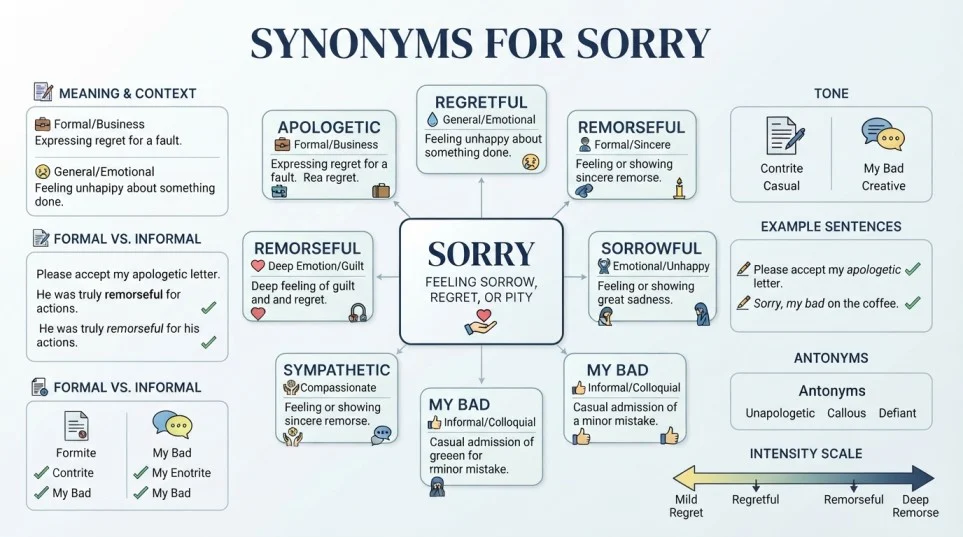
“Sorry” usually expresses regret, an apology, sympathy, or disappointment. Formal choices include apologetic and regretful, casual choices include my bad, while emotional choices include remorseful, contrite, or sorrowful.
Meaning, Tone and Context
Simple Definition
The word sorry commonly expresses regret about something you did, said, or caused. It can also show sympathy when someone experiences difficulty or loss.
In another meaning, sorry can describe something disappointing, unfortunate, inadequate, or of poor quality.
For example:
“I am sorry for being late.”
Here, sorry expresses an apology.
“I am sorry to hear about your loss.”
Here, sorry expresses sympathy.
“That was a sorry excuse.”
Here, sorry describes something inadequate or unconvincing.
Part of Speech
Sorry is primarily an adjective.
It can describe a person’s feeling of regret or sympathy, as in “I am sorry.”
It can also describe something unfortunate or disappointing, as in “That is a sorry situation.”
Tone
The tone of sorry depends heavily on context.
It can sound:
- Polite
- Sincere
- Emotional
- Sympathetic
- Casual
- Regretful
- Sarcastic in some situations
- Critical when describing something poor or inadequate
Formality Level
Sorry is flexible and works in casual conversation as well as professional communication.
However, formal writing may benefit from more precise words such as apologetic, regretful, or remorseful.
Common Use Cases
People commonly use sorry when:
- Apologizing for a mistake
- Expressing regret
- Showing sympathy
- Responding to bad news
- Acknowledging inconvenience
- Describing an unfortunate situation
- Describing something disappointing or inadequate
- Politely interrupting or asking someone to repeat something
Related Forms
Related words include:
Apologize: the verb for expressing regret.
Apology: a statement expressing regret.
Apologetic: describing someone who expresses regret.
Remorse: deep regret about wrongdoing.
Regretful: feeling or expressing regret.
Sympathy: concern for another person’s difficulty or suffering.
When and How to Use Sorry
The word sorry is appropriate when you want to acknowledge a mistake, show regret, express sympathy, or politely respond to an unfortunate situation.
Professional Example
“I am sorry for the delay in responding to your email.”
This is polite and appropriate for many workplace situations.
Personal Example
“I am sorry I forgot your birthday.”
The word communicates personal regret without sounding excessively formal.
Academic Example
“I am sorry, but I will not be able to attend today’s study session.”
This is conversational rather than academic in tone, but it can work in communication with classmates or instructors.
Emotional Example
“I am truly sorry for what you are going through.”
Here, sorry expresses sympathy rather than an admission of personal fault.
Another Word for Sorry
The best single replacement depends on the intended meaning.
| Situation | Useful Alternative |
|---|---|
| Professional writing | Apologetic |
| Academic writing | Regretful |
| Casual conversation | My bad |
| Emotional writing | Remorseful |
| Creative writing | Sorrowful |
| Resume or workplace use | Regretful |
| Social media captions | My apologies |
| Stronger meaning | Remorseful |
| Softer meaning | Regretful |
For a simple apology, apologetic is useful when describing a person’s attitude.
For deeper regret, remorseful or contrite communicates greater emotional weight.
For sympathy, sorrowful or a phrase such as “I am saddened to hear that” may be more appropriate.
When Not to Use Sorry
Sorry is sometimes too vague because it does not explain exactly what you regret.
Instead of:
“Sorry for the inconvenience.”
A more specific professional sentence might be:
“I apologize for the scheduling error.”
Sorry can also sound too casual when the situation requires a more formal expression.
For example, “I am sorry about the issue” is less precise than “I regret the error and appreciate your patience.”
You should also avoid using extremely emotional alternatives when the situation is minor. Saying “I am deeply remorseful” after accidentally interrupting someone can sound unnatural.
Words Commonly Confused With Sorry
Sorry vs. Apologetic
Sorry is the common expression. Apologetic describes someone who shows or feels regret.
“I am sorry for the mistake.”
“She sounded apologetic after the meeting.”
Sorry vs. Regretful
Sorry can express several emotions, while regretful specifically emphasizes regret.
“I am sorry I missed the event.”
“I am regretful that I could not attend.”
Sorry vs. Remorseful
Remorseful is much stronger. It usually involves deep regret about wrongdoing.
“I am sorry for being late.”
“He was remorseful after realizing the harm he had caused.”
Sorry vs. Sympathetic
Sympathetic means showing concern for another person’s suffering. It does not necessarily mean you caused the problem.
“I am sorry to hear about your loss.”
“She was sympathetic toward her friend.”
Sorry vs. Sorrowful
Sorrowful describes deep sadness or grief. It is more literary and emotional than everyday sorry.
“He looked sorrowful after hearing the news.”
Sorry vs. Contrite
Contrite describes sincere regret and humility after doing something wrong.
“She gave a contrite apology after admitting her mistake.”
Best Synonym by Context for Sorry
| Context | Best Synonym | Why It Works | Example |
|---|---|---|---|
| Formal writing | Apologetic | Sounds respectful and polished | His response was apologetic. |
| Academic writing | Regretful | Clearly communicates regret | The researcher was regretful about the omission. |
| Professional or business use | Regretful | Appropriate for acknowledging an issue | We are regretful about the scheduling error. |
| Resume use | Apologetic | Useful when describing communication style | Maintained an apologetic and respectful tone. |
| Casual conversation | My bad | Natural and informal | My bad, I sent the wrong file. |
| Creative writing | Sorrowful | Adds emotional depth | She gave him a sorrowful look. |
| Emotional tone | Remorseful | Communicates deep regret | He was remorseful after the argument. |
| Strong intensity | Contrite | Shows sincere and serious regret | She offered a contrite apology. |
| Soft or moderate tone | Regretful | Less intense than remorseful | I am regretful that things worked out this way. |
| Social media captions | My apologies | Short and polite | My apologies for the late post. |
| US usage | Sorry | Extremely common and natural | Sorry, I did not hear you. |
| UK usage | Sorry | Also very common in everyday English | Sorry, could you repeat that? |
Which Synonym Should You Choose?
Start by asking what you actually want to communicate.
If you simply made a mistake, apologetic or regretful can work well.
If you feel deep guilt about serious wrongdoing, remorseful, contrite, or penitent may be more appropriate.
If another person is suffering and you want to show concern, sympathetic or sorrowful may communicate the intended feeling better.
If you are speaking casually with friends, a phrase such as my bad can sound natural.
Always consider the relationship, seriousness of the situation, formality of the setting, and emotional intensity before choosing an alternative.
Real Life Examples of Sorry in Sentences
School
“I am sorry I forgot to bring my assignment.”
Workplace
“I am sorry for the delay in sending the report.”
Writing
“The character felt genuinely remorseful after discovering the consequences of his decision.”
Conversation
“Sorry, could you say that again?”
Social Media
“My apologies for disappearing for a few days.”
Resume
“Handled customer concerns with a respectful and apologetic communication style.”
“I regret the confusion caused by the incorrect attachment.”
Storytelling
“She lowered her eyes and offered a quiet, contrite apology.”
18 Synonyms for Sorry
| Synonym | Simple Meaning | Best Used For | Example Sentence |
|---|---|---|---|
| Apologetic | Showing regret | Professional and personal apologies | He sounded apologetic during the conversation. |
| Regretful | Feeling regret | Formal and everyday situations | She was regretful about missing the meeting. |
| Remorseful | Feeling deep regret | Serious mistakes or wrongdoing | He became remorseful after recognizing the consequences. |
| Contrite | Deeply sorry and humble | Serious apologies | She gave a sincere and contrite response. |
| Penitent | Showing regret for wrongdoing | Formal or religious contexts | The penitent speaker openly admitted his mistake. |
| Repentant | Regretting wrongdoing and wanting to change | Serious moral situations | The repentant employee promised to correct his behavior. |
| Regret | A feeling of sadness about something done or missed | Formal writing and reflection | She expressed regret about the decision. |
| Apology | A statement expressing regret | Formal and professional communication | Please accept my apology for the confusion. |
| Remorse | Deep regret for wrongdoing | Serious emotional situations | He felt genuine remorse after hurting his friend. |
| Sorrowful | Experiencing deep sadness | Emotional and creative writing | Her sorrowful expression revealed how much she cared. |
| Saddened | Made unhappy by something | Sympathy and emotional communication | I was saddened to hear the news. |
| Sympathetic | Showing concern for another person’s difficulty | Personal and supportive communication | She was sympathetic toward her coworker. |
| Compassionate | Showing care for someone suffering | Emotional and professional contexts | His compassionate response helped calm the situation. |
| Unfortunate | Happening with an undesirable result | Situations rather than personal apologies | It was an unfortunate misunderstanding. |
| Regrettable | Deserving regret | Formal writing | The incident was regrettable but preventable. |
| Lamentable | Deserving sadness or regret | Formal and literary writing | The loss was a lamentable event for the community. |
| Pitiful | Deserving pity or describing something inadequate | Critical or descriptive contexts | The excuse was pitiful and unconvincing. |
| Poor | Inferior or inadequate | Describing quality rather than an apology | The company delivered a poor response to the complaint. |
Synonym Groups and Usage Differences
Professional vs. Personal Synonyms
Professional communication usually benefits from precise and restrained language.
Words such as regretful, apologetic, regrettable, and apology can work well in emails, customer communication, workplace messages, and formal notices.
Personal conversations allow more emotional flexibility. Words such as remorseful, contrite, sorrowful, and sad can communicate deeper feelings.
Formal vs. Conversational Synonyms
For formal writing, choose words that clearly identify the type of regret.
“Regrettable” works when describing an unfortunate event.
“Apologetic” works when describing a person’s attitude.
In casual conversation, sorry, my bad, and my apologies are generally more natural.
Academic Synonyms
Academic writing usually benefits from precision rather than emotional language.
Words such as regret, regrettable, and apology can be appropriate when discussing documented actions or responses.
Highly emotional words such as sorrowful may sound out of place unless the subject specifically concerns emotion, literature, history, or personal experience.
Professional and Business Synonyms
Business communication should acknowledge problems without exaggerating emotion.
Instead of repeating “sorry,” consider:
“I apologize for the delay.”
“We regret the inconvenience.”
“We acknowledge the error.”
“Please accept our apology.”
These expressions can sound more precise and professional.
Creative or Literary Synonyms
Creative writing gives you more freedom to express emotional intensity.
Sorrowful, lamentable, contrite, remorseful, and penitent can create different emotional shades.
The right word depends on whether the character feels sadness, guilt, shame, regret, or responsibility.
Slang or Modern Synonyms
My bad is a common casual expression of responsibility.
It works in relaxed conversations, texts, and informal online communication.
It is usually inappropriate for formal academic writing, official business correspondence, or serious professional apologies.
Strongest vs. Weaker Synonyms
A simple intensity scale can help:
Regretful: mild to moderate regret.
Apologetic: moderate expression of apology.
Remorseful: strong personal regret.
Contrite: strong regret combined with humility.
Penitent: strong regret connected with wrongdoing and a desire to make amends.
The strongest word is not always the best word. Choose the level that matches the actual situation.
Emotional vs. Neutral Synonyms
Regrettable, unfortunate, and regret can remain relatively neutral.
Sorrowful, remorseful, contrite, and penitent carry more emotional weight.
Use emotional vocabulary when the feeling itself matters. Use neutral vocabulary when clarity and professionalism are more important.
Antonyms of Sorry
Because sorry has several meanings, its opposites also depend on context.
| Antonym | Meaning | Example Sentence |
|---|---|---|
| Unapologetic | Not expressing regret | He remained unapologetic about the decision. |
| Unrepentant | Not sorry for wrongdoing | The unrepentant offender refused to admit fault. |
| Unremorseful | Showing no remorse | She appeared unremorseful after the incident. |
| Indifferent | Not concerned | He seemed indifferent to the criticism. |
| Unconcerned | Not worried or bothered | She was unconcerned about the minor mistake. |
| Carefree | Free from worry | He felt carefree after finishing the project. |
| Happy | Feeling pleasure or satisfaction | She was happy with the outcome. |
| Glad | Feeling pleased | I am glad you arrived safely. |
| Pleased | Feeling satisfaction | The manager was pleased with the results. |
| Fortunate | Experiencing good circumstances | We were fortunate to find a solution quickly. |
| Lucky | Benefiting from good fortune | They were lucky to avoid the delay. |
| Excellent | Extremely good in quality | The team delivered excellent work. |
| Admirable | Deserving approval or respect | Her response was admirable. |
| Impressive | Producing admiration | The final presentation was impressive. |
| Respectable | Good enough to deserve respect | The company achieved a respectable result. |
Comparison: Sorry vs. Similar Words
Sorry vs. Apologetic
The main difference is grammatical use and emphasis. Sorry is commonly used as the direct expression of an apology, while apologetic describes someone who shows regret.
Apologetic is more formal than everyday sorry.
Example:
“I am sorry for the mistake.”
“She was apologetic about the mistake.”
Sorry vs. Regretful
Both can communicate regret, but regretful focuses more specifically on feeling regret.
Regretful is generally more formal.
Example:
“I am sorry I missed the meeting.”
“I am regretful that I could not attend.”
Sorry vs. Remorseful
Remorseful is considerably stronger because it suggests deep regret over wrongdoing.
Sorry is more flexible and can describe minor mistakes.
Example:
“I am sorry for being late.”
“He was remorseful after causing serious harm.”
Sorry vs. Contrite
Contrite suggests sincere regret combined with humility.
It is more formal and emotionally serious than ordinary sorry.
Example:
“She said she was sorry.”
“She gave a contrite apology.”
Sorry vs. Sympathetic
Sorry can express sympathy, while sympathetic specifically describes concern for another person’s hardship.
Sympathetic is more precise when you did not cause the problem.
Example:
“I am sorry to hear that.”
“She was sympathetic toward her friend.”
Sorry vs. Sorrowful
Sorrowful means deeply sad. It does not normally function as a direct everyday replacement for an apology.
It is more emotional and literary.
Example:
“I am sorry about the loss.”
“The character gave a sorrowful smile.”
Common Phrases and Expressions with Sorry
1. I am sorry.
Meaning:
A simple expression of regret or apology.
Example sentence:
“I am sorry for forgetting your message.”
2. I am sorry to hear that.
Meaning:
A polite way to express sympathy about someone’s difficult experience.
Example sentence:
“I am sorry to hear that your trip was canceled.”
3. Sorry about that.
Meaning:
A casual acknowledgment of a minor mistake or inconvenience.
Example sentence:
“Sorry about that, I sent the wrong document.”
4. Sorry for the inconvenience.
Meaning:
An apology for causing difficulty, delay, or disruption.
Example sentence:
“We are sorry for the inconvenience caused by the temporary closure.”
5. I am sorry for your loss.
Meaning:
A respectful expression of sympathy after someone’s death.
Example sentence:
“I am sorry for your loss, and I hope you have support during this difficult time.”
6. Sorry to bother you.
Meaning:
A polite way to acknowledge that you are interrupting someone.
Example sentence:
“Sorry to bother you, but could you help me with this question?”
7. Sorry, could you repeat that?
Meaning:
A polite request for someone to say something again.
Example sentence:
“Sorry, could you repeat that? I could not hear you.”
8. My apologies.
Meaning:
A polite or moderately formal way to apologize.
Example sentence:
“My apologies for the delayed response.”
Common Mistakes to Avoid
1. Using Sorry When a More Precise Word Is Better
Sorry can cover many meanings, so it can become vague.
Instead of repeatedly saying sorry, identify whether you mean regret, apology, sympathy, or disappointment.
2. Confusing Sorry With Remorse
Remorse suggests much deeper regret.
Do not use remorseful for every small mistake. It can make a minor situation sound unnecessarily serious.
3. Using Casual Language in Formal Writing
“My bad” may sound natural with friends, but it is usually too casual for academic or professional communication.
Use “I apologize” or “I regret” when the setting requires a formal tone.
4. Using an Overly Dramatic Synonym
Words such as contrite, penitent, and remorseful carry significant emotional weight.
They may sound excessive when you simply forgot to reply to a text.
5. Repeating Sorry Too Often
Repeating the same word can weaken your writing.
Vary the wording only when the meaning actually changes. Do not replace sorry with a random synonym just for variety.
6. Choosing the Wrong Emotional Tone
Sympathetic means concerned about another person’s difficulty.
Remorseful means deeply sorry about your own wrongdoing.
Using one in place of the other can change the meaning.
FAQs
What is the best synonym for “sorry”?
The best synonym depends on context. Apologetic works for formal descriptions, regretful for regret, and remorseful for deep personal guilt.
What is a formal synonym for “sorry”?
Apologetic, regretful, regrettable, and apology are useful formal alternatives. The best choice depends on whether you describe a person, feeling, event, or statement.
What is an informal synonym for “sorry”?
“My bad” is a common informal expression of apology in American English. It works well in relaxed conversations but is unsuitable for formal writing.
What is another word for “sorry” in professional writing?
Professional alternatives include apologetic, regretful, apology, and regrettable. Choose based on whether you are apologizing directly or describing an unfortunate situation.
What is the difference between “sorry” and “remorseful”?
Sorry can express simple regret, apology, or sympathy. Remorseful is stronger and usually indicates deep regret about a person’s own wrongdoing.
What is the opposite of “sorry”?
The opposite depends on the meaning. Unapologetic contrasts with sorry as an apology, while happy, fortunate, or excellent can contrast with other meanings of sorry.
Conclusion
The word sorry is useful because it can express apology, regret, sympathy, sadness, or disappointment. However, its broad meaning means that a more precise synonym can sometimes communicate your intention more clearly.
Use apologetic for a formal description of someone’s regret, regretful for a clear expression of regret, and remorseful or contrite when the situation involves deeper guilt.
For sympathy, consider sorrowful, sympathetic, or saddened, depending on the sentence. For casual conversations, simple sorry or my bad may sound most natural.
The practical vocabulary tip is simple: do not choose a synonym merely because it sounds sophisticated. First identify the exact feeling or meaning you want to express, then choose the word that matches the situation.
Discover More Post:
- 25+ Synonyms for Frustrated | Meanings, Examples, and Best …
- 25+ Synonyms for Kids | Meanings, Examples, and Best …
- 25+ Synonyms for Framework | Meanings, Examples, and Best …