Sometimes “mean” or “rude” feels too general. You may be describing someone who is impolite in an email, hurtful in conversation, disrespectful at work, or unnecessarily harsh in a personal situation.
Choosing a more precise word helps readers understand exactly what happened. A word such as “discourteous” focuses on manners, while “unkind” focuses more on hurtful behavior.
This guide to synonyms for mean and rude explains the differences between these words and shows which alternatives work best in professional writing, school assignments, conversations, social media, emails, and creative writing.
What Does Mean and Rude Mean?
“Mean and rude” generally describes behavior that is unkind, unpleasant, disrespectful, or lacking in good manners. Formal choices include discourteous and disrespectful, while casual choices include nasty, harsh, or obnoxious.
Meaning, Tone and Context
Simple Definition
“Mean” can describe behavior that is unkind, hurtful, spiteful, or intentionally unpleasant. “Rude” usually describes behavior that lacks politeness, respect, or consideration for others.
The two words overlap, but they are not identical.
Someone can be rude without deliberately trying to hurt someone. For example, interrupting a speaker may be rude. Someone can also be mean by deliberately making a hurtful comment.
Part of Speech
“Mean” can function as an adjective or verb depending on its use.
For example:
“She was mean to her classmate.”
Here, “mean” is an adjective describing behavior.
“I mean that sincerely.”
Here, “mean” is a verb expressing intention or meaning.
“Rude” is primarily an adjective.
For example:
“His comment was rude.”
Tone
Words describing mean or rude behavior usually have a negative tone. However, the emotional intensity varies considerably.
“Discourteous” sounds relatively formal and factual. “Cruel” is much stronger because it suggests serious emotional harm or deliberate harshness.
Formality Level
The best alternative depends on the situation.
For formal writing, consider “discourteous,” “disrespectful,” “inconsiderate,” or “impolite.”
For everyday conversation, “unkind,” “nasty,” “harsh,” or “rude” may sound more natural.
For creative writing, words such as “spiteful,” “venomous,” or “biting” can create stronger emotional imagery when the context supports them.
Common Use Cases
These words can describe:
- Comments
- Conversations
- Emails
- Workplace behavior
- Social interactions
- Arguments
- Online comments
- Personal relationships
- Customer service interactions
- Fictional characters
- School situations
- Public behavior
When and How to Use Mean and Rude
Use “mean” when the main idea is unkindness, hurtful behavior, or deliberate unpleasantness.
Use “rude” when the main issue is poor manners, disrespect, or inappropriate social behavior.
Personal Context
“Her response was mean and made him feel embarrassed.”
Here, “mean” emphasizes the emotional effect of the response.
Professional Context
“The employee apologized for making a rude comment during the meeting.”
Here, “rude” focuses on inappropriate workplace behavior.
Academic Context
“The character’s behavior becomes increasingly hostile toward the other students.”
“Hostile” gives a more specific description than simply calling the character mean.
Social Media Context
“That comment was unnecessarily harsh.”
“Harsh” works well when someone says something unpleasant without necessarily being openly insulting.
Another Word for Mean and Rude
There is no single perfect replacement for every situation. The best word depends on what kind of negative behavior you want to describe.
Professional Writing
Use “discourteous,” “disrespectful,” or “inconsiderate.”
Academic Writing
Use “disrespectful,” “discourteous,” “hostile,” or “insensitive,” depending on the evidence.
Casual Conversation
Use “unkind,” “nasty,” “harsh,” or simply “rude.”
Emotional Writing
Use “hurtful,” “cruel,” “spiteful,” or “insensitive” when the emotional effect matters.
Creative Writing
Use “biting,” “venomous,” “scornful,” or “spiteful” when the character or scene requires stronger imagery.
Resume or Workplace Use
Avoid casually labeling someone as “mean.” Describe the behavior instead.
For example:
“She used disrespectful language during customer interactions.”
This sounds more objective than:
“She was mean to customers.”
Social Media Captions
“Unkind,” “harsh,” “disrespectful,” and “nasty” can work depending on the intended tone.
Stronger Meaning
Use “cruel,” “vicious,” “malicious,” or “hostile” only when the behavior genuinely supports the stronger description.
Softer Meaning
Use “blunt,” “insensitive,” “unfriendly,” or “discourteous” when the behavior is unpleasant but does not justify a severe description.
When Not to Use Mean and Rude
Avoid using “mean” when you can identify the exact behavior.
Instead of:
“He was mean in the meeting.”
Consider:
“He interrupted several colleagues during the meeting.”
The second sentence gives readers evidence instead of a broad judgment.
Avoid using “rude” when the problem is actually dishonesty, cruelty, aggression, or hostility. A more precise word can communicate the situation better.
For example:
“She gave a rude answer.”
If the answer deliberately intended to hurt someone, “hurtful” or “spiteful” may communicate the situation more accurately.
Similarly, if someone repeatedly attacks another person, “hostile” may be more informative than “rude.”
Words Commonly Confused With Mean and Rude
Unkind
“Unkind” focuses primarily on a lack of kindness. It can describe words or actions that hurt someone.
Impolite
“Impolite” focuses mainly on poor manners or failure to follow expected social conventions.
Disrespectful
“Disrespectful” suggests that someone is treating another person, group, role, or expectation without appropriate respect.
Insensitive
“Insensitive” describes behavior that fails to consider another person’s feelings or circumstances.
Harsh
“Harsh” describes language, criticism, treatment, or behavior that feels excessively severe or unpleasant.
Cruel
“Cruel” is considerably stronger. It suggests causing pain or suffering, especially without sufficient concern for the other person.
Best Synonym by Context for Mean and Rude
| Context | Best Synonym | Why It Works | Example |
|---|---|---|---|
| Formal writing | Discourteous | Clearly describes poor manners | The customer’s response was discourteous. |
| Academic writing | Disrespectful | Works well for analyzing behavior | The student’s remarks were disrespectful. |
| Professional or business use | Inconsiderate | Focuses on behavior affecting others | The decision was inconsiderate of the team’s workload. |
| Resume | Disrespectful | More objective than calling someone mean | The employee addressed concerns without using disrespectful language. |
| Casual conversation | Unkind | Natural and easy to understand | That was an unkind thing to say. |
| Creative writing | Spiteful | Adds emotional and intentional meaning | Her spiteful remark silenced the room. |
| Emotional tone | Hurtful | Highlights emotional impact | His words were deeply hurtful. |
| Strong intensity | Cruel | Signals serious unkindness | The character made a cruel remark. |
| Soft or moderate tone | Unfriendly | Describes unpleasant behavior without extreme judgment | The receptionist seemed unfriendly. |
| Social media captions | Harsh | Common and natural online | That criticism was unnecessarily harsh. |
| Workplace communication | Discourteous | Professional and relatively neutral | The email sounded discourteous. |
| Personal relationships | Insensitive | Highlights lack of emotional awareness | Her comment was insensitive. |
| Customer service | Impolite | Directly addresses manners | The caller became increasingly impolite. |
| Arguments | Hostile | Appropriate when behavior is openly aggressive | His tone became hostile. |
| Literary description | Biting | Suggests sharp and cutting language | She answered with a biting comment. |
| Everyday criticism | Nasty | Strong but common in informal speech | He made a nasty remark. |
| Public behavior | Disrespectful | Emphasizes violation of respect | The behavior was disrespectful to the audience. |
| Mild disagreement | Blunt | Useful when someone is direct rather than intentionally cruel | Her feedback was blunt but useful. |
Which Synonym Should You Choose?
Start by asking what makes the behavior negative.
If the problem is poor manners, choose impolite or discourteous.
If someone shows little respect, choose disrespectful.
If someone fails to consider another person’s feelings, choose inconsiderate or insensitive.
If words cause emotional pain, choose hurtful.
If the behavior is deliberately nasty, consider spiteful or malicious, but only when the context supports that meaning.
If the behavior is extremely harmful or intentionally cruel, “cruel” may be appropriate.
The goal is not to choose the strongest word. The goal is to choose the most accurate word.
Real Life Examples of Mean and Rude in Sentences
School
“The student apologized after making a disrespectful comment about his classmate.”
Workplace
“The manager asked everyone to keep the discussion professional and avoid discourteous language.”
Writing
“The author portrays the character as insensitive rather than openly cruel.”
Conversation
“That was an unkind thing to say.”
Social Media
“Your response sounds unnecessarily harsh.”
Resume
“Handled difficult customer interactions calmly and professionally without responding to disrespectful behavior.”
“Thank you for your feedback. I would appreciate keeping future communication respectful and constructive.”
Storytelling
“His biting words changed the mood of the room almost instantly.”
18 Synonyms for Mean and Rude
| Synonym | Simple Meaning | Best Used For | Example Sentence |
|---|---|---|---|
| Unkind | Not kind or considerate | General personal situations | Her unkind comment hurt his feelings. |
| Impolite | Lacking good manners | Everyday and formal situations | It is impolite to interrupt someone repeatedly. |
| Discourteous | Not showing proper courtesy | Professional and formal writing | The response was discourteous and unnecessary. |
| Disrespectful | Showing insufficient respect | Workplace, school, and social situations | His disrespectful tone upset the team. |
| Inconsiderate | Failing to think about others | Personal and professional behavior | Leaving without telling anyone was inconsiderate. |
| Insensitive | Not considering another person’s feelings | Emotional and social situations | Her insensitive remark made the situation worse. |
| Harsh | Excessively severe or unpleasant | Criticism, comments, and language | The review was harsher than expected. |
| Hurtful | Causing emotional pain | Personal and emotional writing | His words were more hurtful than he realized. |
| Nasty | Very unpleasant or unkind | Informal conversation | She received a nasty comment online. |
| Hostile | Openly unfriendly or aggressive | Conflict and workplace situations | The conversation became hostile after the accusation. |
| Spiteful | Intended to hurt or annoy someone | Deliberately unkind behavior | He made a spiteful remark after the argument. |
| Cruel | Deliberately causing pain or suffering | Strong emotional situations | The character made a cruel decision. |
| Insulting | Expressing disrespect or contempt | Comments and remarks | His insulting comment ended the conversation. |
| Offensive | Likely to upset or insult | Public, social, and professional contexts | The joke was offensive to several people. |
| Abrasive | Rough or unpleasant in manner | Workplace communication | His abrasive communication style frustrated colleagues. |
| Boorish | Lacking social manners | Formal or literary descriptions | His boorish behavior embarrassed his friends. |
| Obnoxious | Extremely unpleasant or annoying | Informal descriptions | The obnoxious behavior continued throughout dinner. |
| Scornful | Showing contempt or strong disrespect | Literary and emotional writing | She gave him a scornful look. |
Synonym Groups and Usage Differences
Professional vs. Personal Synonyms
Professional communication usually benefits from objective vocabulary.
“Discourteous,” “disrespectful,” and “inconsiderate” can describe behavior without sounding overly emotional.
Personal communication allows more emotional words such as “hurtful,” “unkind,” or “nasty.”
For example:
Professional:
“The comment was disrespectful.”
Personal:
“That comment was really hurtful.”
Formal vs. Conversational Synonyms
Formal writing often favors “discourteous,” “impolite,” and “disrespectful.”
Conversational English commonly uses “unkind,” “nasty,” “harsh,” and “rude.”
A sentence such as “His behavior was discourteous” sounds more formal than “He was being rude.”
Academic Synonyms
Academic writing should favor precise descriptions rather than emotional labels.
Useful choices include:
- Disrespectful
- Discourteous
- Insensitive
- Hostile
- Inconsiderate
- Offensive
When writing an essay, explain what the person actually did whenever possible.
Instead of writing:
“The character was mean.”
Write:
“The character repeatedly used insulting language toward people with less social power.”
The second version gives readers more useful information.
Professional and Business Synonyms
In workplace writing, avoid unnecessarily emotional descriptions.
Instead of:
“My manager was mean.”
Consider:
“My manager used a consistently dismissive tone during team discussions.”
This wording identifies the behavior more specifically.
“Discourteous,” “disrespectful,” “abrasive,” and “inconsiderate” can be useful when the context supports them.
Creative or Literary Synonyms
Creative writing allows more expressive vocabulary.
“Biting,” “spiteful,” “scornful,” “venomous,” and “vicious” can create stronger characterization when appropriate.
However, stronger words should match the character’s actions.
A mildly sarcastic comment does not automatically justify describing someone as cruel.
Slang or Modern Synonyms
Informal English includes expressions such as “nasty,” “jerky,” and “a jerk.”
These are conversational rather than formal.
They can work in dialogue, social media, texting, and casual speech, but they are generally unsuitable for academic essays, resumes, and professional reports.
Strongest vs. Weaker Synonyms
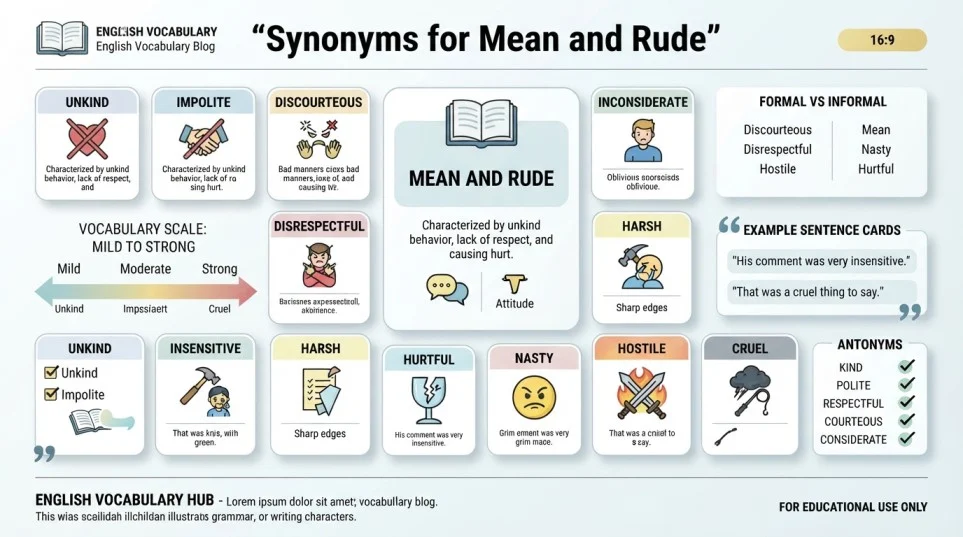
A useful intensity scale is:
Mild: blunt, unfriendly, impolite
Moderate: unkind, discourteous, inconsiderate, disrespectful
Strong: insulting, hostile, spiteful, nasty
Very strong: cruel, vicious, malicious
The exact strength depends on context. “Nasty” can sometimes be casual and mild, while “cruel” usually carries a much heavier emotional meaning.
Emotional vs. Neutral Synonyms
More neutral choices include:
- Impolite
- Discourteous
- Disrespectful
- Inconsiderate
More emotional choices include:
- Hurtful
- Cruel
- Spiteful
- Nasty
- Vicious
Choose neutral vocabulary when you are reporting behavior objectively. Choose emotional vocabulary when the emotional impact is an important part of the message.
Antonyms of Mean and Rude
Because “mean” and “rude” can describe several kinds of behavior, their opposites also vary by context.
| Antonym | Meaning | Example Sentence |
|---|---|---|
| Kind | Caring and considerate | She was kind to the new student. |
| Polite | Showing good manners | He was polite throughout the interview. |
| Courteous | Showing respect and good manners | The staff remained courteous. |
| Respectful | Showing proper respect | The students were respectful during the discussion. |
| Considerate | Thinking about other people’s needs | She was considerate of everyone’s schedule. |
| Thoughtful | Showing care and attention | His thoughtful message made her feel appreciated. |
| Friendly | Pleasant and welcoming | The receptionist was friendly and helpful. |
| Compassionate | Showing concern for others’ suffering | The nurse was compassionate with the family. |
| Gentle | Mild and careful in manner | She gave him a gentle response. |
| Gracious | Pleasant and courteous | He remained gracious after losing the competition. |
| Tactful | Careful not to offend | She gave tactful feedback. |
| Patient | Calm when dealing with difficulty | The teacher was patient with the student. |
| Warm | Friendly and affectionate | Her warm welcome made everyone comfortable. |
| Supportive | Providing encouragement or help | His supportive response gave her confidence. |
| Civil | Polite and reasonably respectful | Both sides remained civil during the debate. |
Comparison: Mean and Rude vs. Similar Words
Mean and Rude vs. Unkind
The main difference is focus.
“Mean and rude” can refer to several kinds of unpleasant behavior. “Unkind” focuses specifically on a lack of kindness.
“Mean and rude” is broader.
“She was mean and rude to the guests.”
“Unkind” is more focused on emotional or interpersonal harm.
“Her unkind comment upset the guests.”
Mean and Rude vs. Impolite
“Impolite” specifically emphasizes poor manners.
“Mean and rude” can suggest emotional hostility or deliberate unkindness.
“Rude” is generally more conversational.
“Impolite” often sounds slightly more formal.
“He was rude during dinner.”
“He was impolite during the formal reception.”
Mean and Rude vs. Disrespectful
“Disrespectful” emphasizes a failure to show respect.
It is often more useful than “rude” in professional, academic, or institutional contexts.
“Rude” is broader and more conversational.
“His comment was rude.”
“His comment was disrespectful toward the speaker.”
Mean and Rude vs. Insensitive
“Insensitive” means failing to consider another person’s feelings or circumstances.
It does not necessarily mean intentionally cruel.
“Her comment was insensitive.”
“She deliberately made a mean comment.”
The first emphasizes a lack of awareness. The second can suggest intentional unkindness.
Mean and Rude vs. Harsh
“Harsh” describes severity.
It can describe criticism, words, treatment, weather, sounds, or conditions.
“Mean and rude” usually describes social behavior.
“His criticism was harsh.”
“His response was rude.”
Mean and Rude vs. Cruel
“Cruel” is stronger than “mean” or “rude.”
It suggests serious suffering, deliberate harm, or a severe lack of compassion.
“Her response was rude.”
“His treatment of the animal was cruel.”
The second sentence describes a much more serious situation.
Common Phrases and Expressions with Mean and Rude
1. A Mean Comment
Meaning:
A statement that is unkind or hurtful.
Example sentence:
“Someone left a mean comment under her video.”
2. A Rude Remark
Meaning:
A comment that is impolite, disrespectful, or inappropriate.
Example sentence:
“His rude remark changed the mood of the conversation.”
3. Being Rude
Meaning:
Behaving without appropriate manners or respect.
Example sentence:
“There is no reason for being rude to the staff.”
4. Mean to Someone
Meaning:
To behave toward someone in an unkind way.
Example sentence:
“She apologized for being mean to her brother.”
5. A Little Harsh
Meaning:
Somewhat severe, blunt, or unpleasant.
Example sentence:
“Your feedback is useful, but that last sentence sounds a little harsh.”
6. Unnecessarily Rude
Meaning:
More impolite or disrespectful than the situation requires.
Example sentence:
“The reply was unnecessarily rude.”
7. Mean Spirited
Meaning:
Showing an unkind or malicious attitude.
Example sentence:
“The joke sounded mean spirited rather than funny.”
8. Speak Harshly
Meaning:
To use severe or unpleasant language.
Example sentence:
“He spoke harshly during the argument.”
Common Mistakes to Avoid
1. Using “Mean” When a More Precise Word Is Better
“Mean” is broad.
If the person ignored someone’s feelings, “insensitive” may be more accurate. If the person broke social rules, “impolite” may work better.
2. Confusing Rudeness With Cruelty
Not every rude action is cruel.
Interrupting someone can be rude, while deliberately causing serious emotional pain may be cruel.
3. Using Casual Vocabulary in Formal Writing
Words such as “nasty,” “jerky,” or “a jerk” can sound too informal for professional or academic writing.
Use “discourteous,” “disrespectful,” or “inconsiderate” when appropriate.
4. Choosing an Overly Dramatic Synonym
Do not use “vicious” or “cruel” simply because you want stronger vocabulary.
The synonym should match the actual behavior.
5. Repeating “Mean” Too Often
If the same word appears repeatedly, replace some instances with precise alternatives such as “unkind,” “harsh,” “disrespectful,” or “insensitive.”
6. Choosing the Wrong Emotional Tone
“Discourteous” sounds relatively objective.
“Cruel” sounds strongly judgmental.
Choose based on how much emotion the sentence should communicate.
FAQs
What is the best synonym for “mean and rude”?
“Disrespectful” is a useful general choice because it can describe behavior, comments, and communication while fitting both personal and professional contexts.
What is a formal synonym for “mean and rude”?
“Discourteous” is a formal alternative that emphasizes poor manners. “Disrespectful” is another strong choice when lack of respect is the main issue.
What is an informal synonym for “mean and rude”?
“Unkind,” “nasty,” and “harsh” are natural conversational alternatives. “Nasty” is stronger and more informal than “unkind.”
What is another word for “mean and rude” in professional writing?
“Discourteous,” “disrespectful,” or “inconsiderate” can work well in professional writing because they describe behavior without sounding unnecessarily emotional.
What is the difference between “mean and rude” and “impolite”?
“Impolite” focuses mainly on poor manners. “Mean” can suggest deliberate unkindness, while “rude” can describe broader disrespectful behavior.
What is the opposite of “mean and rude”?
Common opposites include “kind,” “polite,” “courteous,” “respectful,” “considerate,” “friendly,” and “gracious,” depending on the intended meaning.
Conclusion
The best synonym for mean and rude depends on what you want to communicate. Use “impolite” for poor manners, “disrespectful” for a lack of respect, “insensitive” for a failure to consider feelings, and “hurtful” when emotional impact matters.
For formal writing, “discourteous” can sound more polished, while “unkind,” “harsh,” and “nasty” are more natural in everyday conversation. Stronger choices such as “cruel” and “spiteful” should be reserved for situations that genuinely justify them.
The most useful vocabulary tip is simple: do not automatically choose the strongest synonym. Choose the word that explains the behavior most accurately.
Discover More Post:
- 25+ Synonyms for Frustrated | Meanings, Examples, and Best …
- 25+ Synonyms for Kids | Meanings, Examples, and Best …
- 25+ Synonyms for Framework | Meanings, Examples, and Best …