Do you keep using the word “resistance” in essays, emails, reports, captions, or everyday conversations? The word is useful, but repeating it can make your writing feel predictable.
The best synonym depends on what kind of resistance you mean. You might need a formal term such as opposition, a professional term such as reluctance, or a stronger word such as defiance.
This guide explains the meaning, tone, intensity, and context of resistance so you can choose words that sound natural and precise.
What Does Resistance Mean?
Resistance means refusing, opposing, or pushing back against something. Depending on context, useful alternatives include opposition in formal writing, reluctance in personal situations, defiance for strong refusal, and friction or impediment for physical or technical contexts.
Meaning, Tone and Context
Simple Definition
Resistance means an act, attitude, or force that prevents something from happening easily. It can involve disagreement, refusal, physical force, political opposition, or difficulty in making progress.
For example:
“Employees showed resistance to the new policy.”
Here, resistance means that employees were unwilling to accept or support the change.
In physics and engineering, resistance can describe a force that opposes movement or the flow of electricity.
Part of Speech
Resistance is primarily a noun.
Its related forms include:
Resist: to oppose, refuse, or withstand something.
Resistant: unwilling to accept something or able to withstand a particular force or effect.
Resister: a person or group that actively opposes something.
Resistive: relating to resistance, especially in technical or scientific contexts.
Tone
Resistance is usually neutral. Its emotional effect depends on the situation.
- In a workplace report, resistance can sound factual.
- In a political or social discussion, opposition or defiance may sound stronger.
- In a personal situation, reluctance can sound softer and less confrontational.
Formality Level
Resistance works in casual conversation, academic writing, business communication, technical writing, and creative writing.
It is especially useful when you want a broad word that does not automatically imply anger or hostility.
Common Use Cases
Resistance commonly appears when discussing:
- Opposition to change
- Refusal to cooperate
- Political disagreement
- Social movements
- Military conflict
- Physical forces
- Electrical circuits
- Emotional reluctance
- Organizational change
- Scientific or medical contexts
When and How to Use Resistance
Use resistance when you want to describe pushback, opposition, or a force that prevents progress.
Professional
“The management team encountered resistance when introducing the new workflow.”
Personal
“Her resistance to asking for help made the situation more difficult.”
Academic
“The study examines public resistance to changes in environmental policy.”
Emotional
“He felt an internal resistance to accepting the decision.”
Creative
“The old house seemed to offer silent resistance against the storm.”
Social Media
“Sometimes resistance to change is really fear of the unknown.”
“We have noticed some resistance to the proposed schedule and would like to understand the concerns.”
Resume
“Reduced resistance to process improvements by addressing employee concerns.”
Another Word for Resistance
There is no single perfect replacement for resistance because the meaning changes with context.
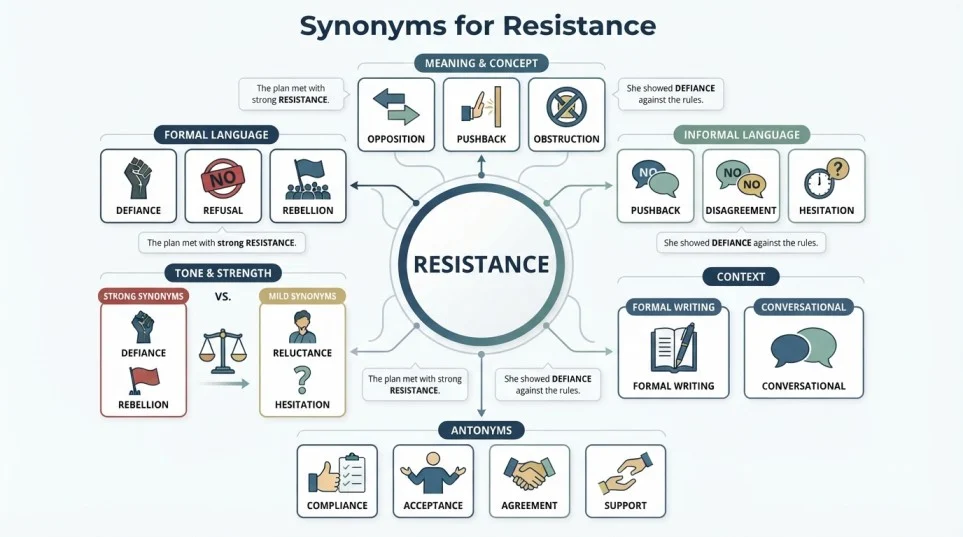
- For professional writing, opposition, reluctance, or pushback can work well.
- For academic writing, opposition, rejection, obstruction, or noncompliance may be appropriate depending on the subject.
- For casual conversation, pushback or refusal often sounds more natural.
- For emotional writing, reluctance, hesitation, or defiance can express different shades of feeling.
- For creative writing, defiance, struggle, friction, or obstruction can create stronger imagery.
- For resumes and workplace writing, pushback, opposition, and reluctance are useful when they accurately describe the situation.
- For social media captions, defiance, pushback, refusal, and standing firm can create a stronger message.
- For a stronger meaning, choose defiance, rebellion, obstruction, or hostility, depending on what you actually mean.
- For a softer meaning, choose hesitation, reluctance, reservation, or disagreement.
When Not to Use “Resistance”
Avoid resistance when you need to identify the exact type of opposition.
For example, “There was resistance to the proposal” is understandable, but it does not explain whether people disagreed, refused, delayed action, or actively blocked the proposal.
A more precise sentence might be:
“There was strong opposition to the proposal.”
- If someone simply feels uncertain, hesitation may be better.
- If someone refuses to cooperate, noncompliance may be more accurate.
- If someone actively tries to stop a process, obstruction may communicate the situation more clearly.
Words Commonly Confused With “Resistance”
Resistance vs. Opposition
Resistance is a broad term for pushback or an opposing force.
Opposition specifically emphasizes disagreement or being against something.
Resistance vs. Reluctance
Resistance often suggests active pushback.
Reluctance usually suggests hesitation or unwillingness without strong confrontation.
Resistance vs. Defiance
Resistance can be mild or strong.
Defiance usually suggests deliberate refusal to obey or accept authority.
Resistance vs. Obstruction
Resistance describes pushback in general.
Obstruction specifically involves creating barriers or preventing progress.
Resistance vs. Rebellion
Resistance can involve disagreement or refusal.
Rebellion usually suggests organized or deliberate opposition against authority or established control.
Resistance vs. Refusal
Resistance can be gradual or indirect.
Refusal is clearer and more direct because it means saying no or declining to do something.
Best Synonym by Context for “Resistance”
| Context | Best Synonym | Why It Works | Example |
|---|---|---|---|
| Formal writing | Opposition | Clearly communicates disagreement | The proposal faced opposition from several groups. |
| Academic writing | Opposition | Works well in analytical discussions | Researchers examined opposition to the policy. |
| Professional use | Pushback | Describes workplace disagreement naturally | The team received pushback from employees. |
| Resume | Obstacle | Focuses on something that had to be overcome | Addressed obstacles during the implementation process. |
| Casual conversation | Pushback | Natural in everyday American English | We got some pushback from customers. |
| Creative writing | Defiance | Adds emotional strength | Her defiance surprised everyone in the room. |
| Emotional writing | Reluctance | Expresses hesitation without extreme conflict | His reluctance was easy to understand. |
| Strong intensity | Defiance | Suggests deliberate and firm refusal | Her defiance challenged the decision. |
| Mild intensity | Hesitation | Suggests uncertainty or caution | His hesitation lasted only a few seconds. |
| Moderate intensity | Resistance | Provides a balanced description | The plan met some resistance. |
| Social media | Pushback | Sounds conversational and modern | Expect some pushback when you challenge old habits. |
| Technical use | Impedance | Describes opposition to alternating electrical current | The circuit has high impedance. |
| Physical context | Friction | Describes force opposing movement | Friction creates resistance between the surfaces. |
| Political context | Opposition | Clearly indicates disagreement | The bill faced opposition in the legislature. |
| Personal context | Reluctance | Communicates unwillingness softly | She showed reluctance to leave. |
| Workplace change | Noncompliance | Useful when required rules are not followed | Continued noncompliance required further review. |
| Conflict | Defiance | Communicates strong refusal | His defiance escalated the conflict. |
| Storytelling | Struggle | Adds emotional and narrative depth | The character faced a long struggle. |
| US usage | Pushback | Common in modern American professional speech | The proposal received considerable pushback. |
| UK usage | Opposition | Widely understood and neutral | The proposal encountered strong opposition. |
Which Synonym Should You Choose?
First, identify what kind of resistance you are describing.
- If someone disagrees with an idea, choose opposition.
- If someone hesitates, choose reluctance or hesitation.
- If someone strongly refuses to obey, choose defiance.
- If someone actively blocks progress, choose obstruction.
- If employees or customers disagree with a workplace decision, pushback is often natural in American English.
- If you are discussing physical movement, friction may be more accurate.
- If you are discussing an electrical circuit, use the technical term appropriate to the type of current and system.
The best synonym is not necessarily the strongest word. It is the word that communicates your intended meaning most precisely.
Real Life Examples of “Resistance” in Sentences
School
“The students initially showed resistance to the new classroom routine.”
Workplace
“The manager expected some resistance after announcing the policy change.”
Writing
“Her resistance to the idea became a central theme of the essay.”
Conversation
“I understand your resistance, but the change could make things easier.”
Social Media
“Resistance to change is sometimes a sign that people need more information.”
Resume
“Reduced resistance to organizational change through clear employee communication.”
“We understand the resistance to the proposed schedule and are open to discussing alternatives.”
Storytelling
“Despite his resistance, he eventually opened the letter.”
18 Synonyms for “Resistance”
| Synonym | Simple Meaning | Best Used For | Example Sentence |
|---|---|---|---|
| Opposition | Being against something | Formal and academic writing | The plan faced opposition from local residents. |
| Pushback | Negative response or disagreement | Business and casual communication | The company received pushback after changing its policy. |
| Reluctance | Unwillingness to act | Personal and professional situations | Her reluctance to speak was understandable. |
| Refusal | A clear decision to say no | Direct situations | His refusal ended the discussion. |
| Defiance | Strong refusal to obey or accept | Conflict and emotional writing | Her defiance impressed everyone around her. |
| Rebellion | Organized or serious opposition | Political and historical contexts | The rebellion challenged the established authority. |
| Obstruction | Action that prevents progress | Legal, professional, and formal contexts | The investigation was delayed by deliberate obstruction. |
| Hindrance | Something that makes progress harder | General and professional writing | Poor communication became a major hindrance. |
| Barrier | Something that blocks progress | Business, education, and social contexts | Cost remains a barrier to wider access. |
| Reluctancy | A state of being reluctant | Formal descriptive contexts | His reluctancy to participate was noticeable. |
| Disagreement | A difference of opinion | Neutral conversation and writing | The meeting revealed a disagreement about priorities. |
| Noncompliance | Failure or refusal to follow a requirement | Workplace, legal, and regulatory contexts | Continued noncompliance may result in further action. |
| Friction | Force or conflict that slows movement or cooperation | Physical and interpersonal contexts | Friction developed between the two departments. |
| Struggle | Difficulty or effort against something | Personal and creative writing | She described her struggle to adapt. |
| Rejection | Refusing to accept something | Ideas, offers, applications, and proposals | The proposal received repeated rejection. |
| Contestation | Formal challenge or dispute | Academic and formal writing | The decision became the subject of public contestation. |
| Hesitation | A pause caused by uncertainty | Personal and conversational contexts | After a moment of hesitation, he agreed. |
| Resistance to change | Unwillingness to accept something new | Organizational and social contexts | Resistance to change can slow implementation. |
Synonym Groups and Usage Differences
Professional vs. Personal Synonyms
Professional writing often benefits from precise and neutral words.
Opposition, pushback, reluctance, obstruction, and noncompliance can work in workplace situations when their meanings match the facts.
Personal writing often sounds more natural with hesitation, reluctance, refusal, or struggle.
For example:
Professional: “The proposal encountered opposition from several departments.”
Personal: “I felt some reluctance about making the decision.”
Formal vs. Conversational Synonyms
Formal writing often favors opposition, obstruction, noncompliance, and contestation.
Conversational American English commonly uses pushback, refusal, hesitation, and disagreement.
Compare:
Formal: “The proposal encountered significant opposition.”
Conversational: “The proposal got a lot of pushback.”
Both sentences are correct, but their tone is different.
Academic Synonyms
Academic writing requires precision.
Opposition, resistance, rejection, contestation, and noncompliance can be useful when the research context supports them.
Avoid choosing a complicated word simply because it sounds academic.
For example, opposition is usually clearer than contestation for a straightforward difference of opinion.
Professional and Business Synonyms
In business communication, pushback is common when describing concerns about a new idea or decision.
For formal reports, opposition, reluctance, obstruction, or noncompliance may be more suitable.
Choose noncompliance only when a person or organization fails to follow a stated rule, requirement, or standard.
Creative or Literary Synonyms
Creative writing gives you more freedom to emphasize emotion and imagery.
Words such as defiance, struggle, friction, rebellion, and barrier can create a stronger atmosphere.
For example:
“The wind met the mountain with relentless defiance.”
This creates a more dramatic image than simply saying:
“The wind faced resistance from the mountain.”
Slang or Modern Synonyms
There is no perfect slang replacement for resistance in every context.
Pushback is the most useful modern conversational alternative in American English.
It is appropriate for many workplace conversations, social posts, interviews, and informal discussions.
Avoid using very casual expressions in academic papers, formal reports, or professional documents when a precise formal term is available.
Strongest vs. Weaker Synonyms
A useful intensity scale is:
Hesitation → Reluctance → Disagreement → Resistance → Opposition → Refusal → Defiance → Rebellion
This is not an absolute ranking because context can change the strength of each word.
For example, opposition can be organized and serious, while resistance can sometimes be mild.
Emotional vs. Neutral Synonyms
Neutral terms include resistance, opposition, disagreement, and reluctance.
More emotional terms include defiance, rebellion, and struggle.
Choose neutral vocabulary when your goal is objective reporting.
Choose emotional vocabulary when you intentionally want to communicate attitude, conflict, or intensity.
Antonyms of “Resistance”
| Antonym | Meaning | Example Sentence |
|---|---|---|
| Acceptance | Willingness to accept something | Her acceptance made the transition easier. |
| Agreement | Sharing the same opinion | The teams reached an agreement. |
| Cooperation | Working together willingly | Cooperation improved the project. |
| Compliance | Following a rule or request | The organization demonstrated compliance. |
| Support | Approval or assistance | The proposal received strong support. |
| Approval | Positive acceptance | The plan received official approval. |
| Consent | Permission or agreement | The project proceeded with consent. |
| Assistance | Help given to someone | The team offered assistance. |
| Collaboration | Working together toward a goal | Collaboration produced better results. |
| Willingness | Readiness to do something | Her willingness to help was appreciated. |
| Submission | Acceptance of authority or control | The process required formal submission. |
| Concession | Something given up to reach agreement | The negotiation ended with a concession. |
| Harmony | A state of agreement | The group worked in harmony. |
| Receptiveness | Openness to ideas or suggestions | His receptiveness encouraged discussion. |
| Endorsement | Public or formal support | The proposal gained endorsement from the committee. |
Comparison: “Resistance” vs. Similar Words
Resistance vs. Opposition
Main difference: Resistance is broader and can describe refusal, force, or pushback. Opposition specifically emphasizes being against something.
Stronger: Opposition can sound stronger when organized disagreement is involved.
More formal: Opposition is often preferred in formal writing.
Resistance: “The plan encountered resistance from employees.”
Opposition: “The proposal faced opposition from community groups.”
Resistance vs. Reluctance
Main difference: Resistance suggests pushback, while reluctance usually suggests hesitation or unwillingness.
Stronger: Resistance is generally stronger.
More formal: Both are suitable for formal writing.
Resistance: “There was resistance to the new procedure.”
Reluctance: “There was reluctance to adopt the new procedure.”
Resistance vs. Defiance
Main difference: Defiance implies a strong and deliberate refusal to obey or submit.
Stronger: Defiance is usually stronger.
More formal: Both can appear in formal writing, but defiance has more emotional force.
Resistance: “The workers showed resistance to the change.”
Defiance: “The worker openly displayed defiance toward the order.”
Resistance vs. Obstruction
Main difference: Resistance means pushback. Obstruction means actively creating a barrier to progress.
Stronger: Obstruction can imply more deliberate interference.
More formal: Obstruction is common in formal and legal contexts.
Resistance: “The proposal met resistance.”
Obstruction: “The project faced obstruction from several parties.”
Resistance vs. Refusal
Main difference: Resistance can be indirect or gradual. Refusal is a clear decision not to accept or do something.
Stronger: Refusal is more direct.
More formal: Both can be formal depending on context.
Resistance: “She showed resistance to the suggestion.”
Refusal: “She gave a clear refusal.”
Resistance vs. Rebellion
Main difference: Resistance can be individual or general. Rebellion usually involves stronger, organized opposition to authority.
Stronger: Rebellion usually communicates greater intensity.
More formal: Both are suitable in historical, political, and academic contexts.
Resistance: “The movement faced resistance from authorities.”
Rebellion: “The rebellion challenged the existing government.”
Common Phrases and Expressions with “Resistance”
1. Resistance to Change
Meaning:
An unwillingness to accept or adapt to something new.
Example sentence:
“Resistance to change can make organizational transitions more difficult.”
2. Resistance to Authority
Meaning:
Opposition to rules, commands, or people with authority.
Example sentence:
“The character’s resistance to authority shapes the story.”
3. Resistance Movement
Meaning:
An organized effort to oppose an occupying power, government, or established system.
Example sentence:
“The historical novel follows members of a resistance movement.”
4. Air Resistance
Meaning:
A force created when an object moves through air.
Example sentence:
“Air resistance slows the falling object.”
5. Electrical Resistance
Meaning:
The opposition to the flow of electric current.
Example sentence:
“The resistor provides electrical resistance within the circuit.”
6. Resistance Training
Meaning:
Physical exercise involving force against weights, bands, or other forms of resistance.
Example sentence:
“She added resistance training to her weekly exercise routine.”
7. Build Resistance
Meaning:
To develop the ability to withstand something.
Example sentence:
“Some organisms can build resistance to certain treatments.”
8. Overcome Resistance
Meaning:
To successfully deal with opposition or difficulty.
Example sentence:
“The team worked patiently to overcome resistance to the new process.”
Common Mistakes to Avoid
1. Using Resistance When You Mean Hesitation
If someone is uncertain rather than actively opposed, hesitation or reluctance may be more accurate.
2. Confusing Resistance With Opposition
These words overlap, but opposition specifically emphasizes disagreement or being against something.
3. Using Pushback in Very Formal Writing
Pushback is natural in modern American English, but opposition may sound more appropriate in a formal report or academic paper.
4. Using Defiance for a Mild Situation
Defiance suggests strong refusal or challenge.
Do not use it when someone simply has a minor concern or moment of hesitation.
5. Repeating Resistance Too Often
If the same word appears several times in a paragraph, consider whether opposition, reluctance, pushback, or another precise term better communicates the intended meaning.
6. Choosing a Synonym With the Wrong Emotional Tone
A neutral disagreement should not automatically become rebellion or defiance.
Choose vocabulary that matches the actual intensity of the situation.
7. Using Casual Language in Academic Writing
Words such as pushback can work in conversation, but formal academic writing often benefits from more precise terms such as opposition or resistance.
FAQs
What is the best synonym for resistance?
The best synonym depends on context. Opposition works well for disagreement, while reluctance, pushback, and defiance express different types of resistance.
What is a formal synonym for resistance?
Opposition is one of the most useful formal synonyms for resistance. Obstruction, noncompliance, and contestation can also work in specific contexts.
What is an informal synonym for resistance?
Pushback is a natural informal and professional conversational alternative in American English. It commonly describes disagreement with a proposal or decision.
What is another word for resistance in professional writing?
Opposition, pushback, reluctance, obstruction, or noncompliance may work, depending on whether you mean disagreement, hesitation, interference, or failure to follow rules.
What is the difference between resistance and opposition?
Resistance is a broad term for pushback or an opposing force. Opposition specifically describes disagreement or being against an idea, proposal, person, or policy.
What is the opposite of resistance?
Common opposites include acceptance, cooperation, agreement, support, compliance, consent, and receptiveness, depending on the situation.
Conclusion
Resistance describes pushback, opposition, refusal, or a force that prevents something from moving forward. Its meaning can change considerably depending on whether you are discussing people, ideas, organizations, physical forces, or technical systems.
The best synonym depends on the situation. Use opposition for disagreement, reluctance for hesitation, pushback for conversational workplace language, defiance for strong refusal, and obstruction when someone actively prevents progress.
When choosing among synonyms for resistance, focus on meaning first and tone second. A precise word is more effective than a complicated word that only sounds impressive.
Before publishing an educational vocabulary article, verify formal definitions and specialized meanings with trusted dictionaries such as Cambridge, Oxford, Merriam Webster, Collins, or Britannica.
The practical rule is simple: choose the word that tells your reader exactly what kind of resistance you mean.
Discover More Post:
- 25+ Synonyms for Access | Meanings, Examples, and Best …
- 25+ Synonyms for Acknowledge | Meanings, Examples, and …
- 25+ Synonyms for Attention | Meanings, Examples, and Best …