The word move appears everywhere. You move to a new home, move a meeting, move forward with a plan, move someone emotionally, or move an object across a room. Because the word has so many meanings, choosing a more precise alternative can make your writing much clearer.
Whether you are writing an essay, resume, email, social media caption, story, or workplace message, the right synonym depends on what kind of movement you mean. This guide explains the best alternatives with practical examples so you can choose naturally and confidently.
What Does “Move” Mean?
Move means to change position, location, direction, condition, or situation, or to take action. Formal alternatives include relocate and transfer, while casual choices include go and shift. Academic and professional writing often favors proceed, transition, reposition, or advance.
Meaning, Tone and Context
Simple Definition
Move generally means to change from one position, place, condition, or situation to another.
For example, you can move a chair, move to another city, move toward a goal, or move ahead with a project.
The exact meaning changes according to the sentence.
Part of Speech
Move can function as both a verb and a noun.
As a verb:
She decided to move to Chicago.
As a noun:
His next move surprised everyone.
Tone
Move is usually neutral. It is common in everyday conversation, professional communication, academic writing, journalism, and creative writing.
Its broad meaning makes it useful, but it can sometimes be less precise than a stronger alternative.
Formality Level
Move is suitable for almost every level of communication.
For formal writing, words such as relocate, transfer, proceed, advance, transition, reposition, or transport may communicate the intended meaning more precisely.
For casual conversation, go, shift, get going, or budge may sound more natural.
Common Uses
Move can describe:
- Changing physical position
- Changing residence
- Changing direction
- Progressing toward a goal
- Taking action
- Moving an object
- Changing a schedule
- Making a strategic decision
- Affecting someone emotionally
- Transferring something from one place to another
Important Word Forms
| Form | Word | Example |
|---|---|---|
| Verb | move | We need to move the table. |
| Noun | move | That was a smart move. |
| Present participle | moving | The train is moving slowly. |
| Past tense | moved | She moved last year. |
| Past participle | moved | They have moved the meeting. |
| Adjective | moving | It was a moving speech. |
When and How to Use “Move”
Move works well when the meaning is clear from the surrounding sentence.
Professional
We plan to move the project into its next phase next month.
In a more precise business context, transition or proceed may be preferable.
Personal
My sister is moving to Denver this summer.
Here, move naturally means changing residence.
Academic
The argument moves from a general observation to a specific conclusion.
In academic writing, progresses or transitions may sometimes provide greater precision.
Emotional
Her story moved everyone in the room.
Here, move means to create a strong emotional response.
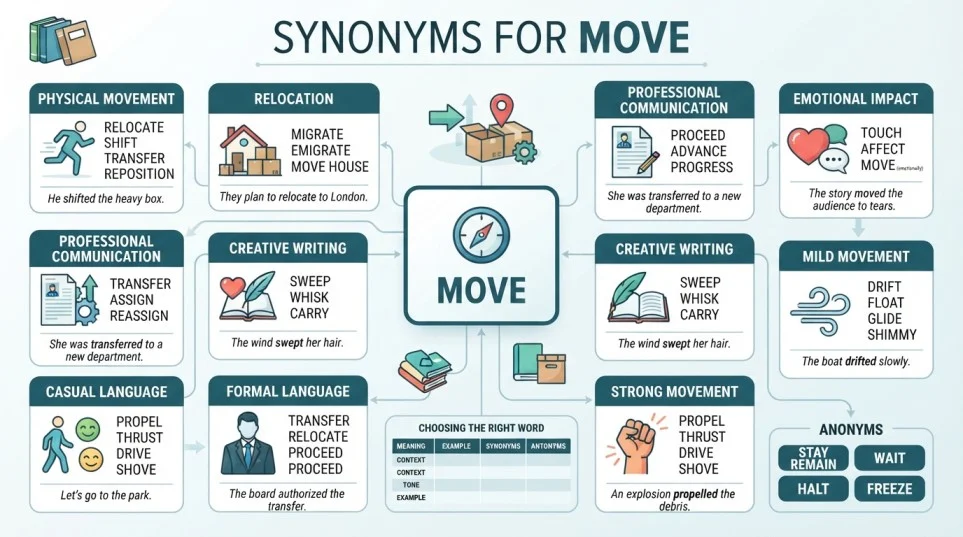
Another Word for “Move”
There is no single replacement that works in every sentence because move has several meanings.
| Context | Recommended Alternative |
|---|---|
| Professional writing | proceed |
| Academic writing | progress |
| Casual conversation | go |
| Emotional writing | touch |
| Creative writing | drift |
| Resume or workplace use | advance |
| Social media captions | go |
| Physical movement | shift |
| Relocation | relocate |
| Strong movement | propel |
| Gentle movement | drift |
The best synonym depends on the exact meaning you want to communicate.
When Not to Use “Move”
Move can sound too vague when your sentence requires a specific type of action.
Instead of:
We moved the project forward.
A more precise professional sentence could be:
We advanced the project into the implementation stage.
Instead of:
She moved to another department.
You could write:
She transferred to another department.
Instead of:
The company moved its headquarters.
You could write:
The company relocated its headquarters.
The original word is not incorrect. The alternative simply gives the reader more information.
Words Commonly Confused With “Move”
Move vs. Shift
Move is broad and can describe many types of change. Shift often suggests changing position, direction, attention, responsibility, or emphasis.
Please move the chair.
The discussion shifted toward costs.
Move vs. Relocate
Move is general. Relocate specifically emphasizes changing where a person, organization, or thing is based.
We moved to Texas.
The company relocated its headquarters to Texas.
Move vs. Transfer
Transfer usually means moving something or someone from one place, person, department, or system to another.
She transferred to the marketing department.
Move vs. Proceed
Proceed usually means continuing or moving forward with an action, plan, or process.
We can proceed with the proposal.
Move vs. Advance
Advance suggests progress toward a goal, position, stage, or desired result.
The team advanced to the next round.
Move vs. Migrate
Migrate describes movement from one region, system, environment, or platform to another. It often suggests a broader or more organized transition.
The company migrated its data to a new platform.
Best Synonym by Context for “Move”
| Context | Best Synonym | Why It Works | Example |
|---|---|---|---|
| Formal writing | Relocate | Precise for changing residence or location | The company relocated its office. |
| Academic writing | Progress | Shows development or forward movement | The argument progresses logically. |
| Professional use | Proceed | Clearly indicates continuing with an action | We can proceed with the plan. |
| Resume | Advance | Highlights professional progress | Advanced the project into testing. |
| Casual conversation | Go | Natural and simple | I need to go home. |
| Creative writing | Drift | Creates a gentle visual impression | Clouds drifted across the sky. |
| Emotional writing | Touch | Shows emotional effect | Her words touched me deeply. |
| Strong movement | Propel | Suggests powerful forward force | The engine propelled the vehicle forward. |
| Mild movement | Shift | Suggests a small change in position | He shifted in his chair. |
| Social media caption | Go | Short, natural, and energetic | Time to go somewhere new. |
| Physical movement | Shift | Useful for changing position | Shift the box to the left. |
| Relocation | Relocate | Specifically describes changing residence or base | They relocated to Seattle. |
| Organizational change | Transfer | Useful for people, roles, and resources | She transferred to another team. |
| Direction | Turn | Specifies a change in direction | Turn toward the entrance. |
| Progress | Advance | Emphasizes forward development | The project advanced quickly. |
| US usage | Move | Very common for general movement and relocation | We are moving next month. |
| UK usage | Move | Also common and natural | They are moving to a new flat. |
Which Synonym Should You Choose?
Start by identifying what move means in your sentence.
- If you mean changing a home or business location, choose relocate.
- If you mean continuing with an action, choose proceed.
- If you mean making progress, choose advance or progress.
- If you mean changing position slightly, choose shift.
- If you mean transferring a person, responsibility, or resource, choose transfer.
- If you mean causing an emotional reaction, choose touch or affect.
- If you mean strong physical forward movement, choose propel.
The best synonym is the one that preserves your intended meaning while giving the reader more useful information.
Real Life Examples of “Move” in Sentences
School
The teacher asked the students to move into smaller groups.
A more precise alternative could be reorganize when the focus is on changing group structure.
Workplace
We need to move the meeting to Friday.
Here, reschedule is more precise.
Writing
The author moves from personal experience to broader social commentary.
Transitions may be a stronger academic choice.
Conversation
Can you move your car?
This everyday use is completely natural.
Social Media
Sometimes you just have to move forward.
The word works well because the statement can have both literal and emotional meaning.
Resume
Moved the team toward a more efficient reporting process.
For a resume, advanced, led, or implemented may communicate achievement more clearly.
Could we move our meeting to Thursday?
This is natural and professional. Reschedule is another precise option.
Storytelling
She moved quietly through the empty hallway.
Here, walked, crept, strolled, or slipped could create a more specific image.
18 Synonyms for “Move”
| Synonym | Simple Meaning | Best Used For | Example Sentence |
|---|---|---|---|
| Shift | Change position or focus | Physical or abstract changes | She shifted the chair closer to the window. |
| Relocate | Move to a new place | Homes, offices, companies | The company relocated its main office. |
| Transfer | Move from one place or role to another | People, resources, responsibilities | He transferred to the finance department. |
| Proceed | Continue with an action | Business and formal communication | We can proceed with the next stage. |
| Advance | Move forward or make progress | Goals, projects, careers | The team advanced the project significantly. |
| Progress | Develop or move forward | Academic and professional contexts | The research progressed steadily. |
| Go | Move from one place to another | Casual conversation | We should go before traffic gets worse. |
| Travel | Move between places | Journeys and transportation | They traveled across the country. |
| Walk | Move on foot | Physical movement | She walked toward the entrance. |
| Drift | Move slowly without a clear direction | Creative and descriptive writing | The boat drifted toward the shore. |
| Propel | Push or drive forward | Strong physical movement | The motor propelled the boat forward. |
| Maneuver | Move carefully or skillfully | Vehicles, objects, strategy | He maneuvered the car into the narrow space. |
| Reposition | Put something in a new position | Professional and physical contexts | The designer repositioned the logo. |
| Migrate | Move from one system or region to another | Technology, populations, systems | The company migrated its files to a new platform. |
| Mobilize | Prepare or organize for movement or action | Organizations and groups | Volunteers mobilized quickly after the announcement. |
| Stir | Make a small movement | Slight physical movement | She stirred in her seat. |
| Budge | Move slightly | Informal conversation | The heavy cabinet would not budge. |
| Touch | Affect emotionally | Emotional writing | Her story touched everyone in the audience. |
Synonym Groups and Usage Differences
Professional vs. Personal Synonyms
Personal communication usually favors simple words such as move, go, shift, and travel.
Professional writing often benefits from more specific choices such as relocate, transfer, reposition, proceed, advance, and transition.
For example:
We moved the meeting.
is natural, while:
We rescheduled the meeting.
is more precise.
Formal vs. Conversational Synonyms
Formal writing may use proceed, relocate, transfer, advance, progress, and reposition.
Conversation often favors go, move, shift, walk, and budge.
The simpler word is not necessarily less correct. It simply creates a different level of precision and formality.
Academic Synonyms
Academic writing benefits from precise verbs.
Depending on the context, consider progress, advance, transition, proceed, shift, or develop.
For example:
The discussion moves from theory to application.
can become:
The discussion transitions from theory to application.
The second version makes the relationship between the two stages more explicit.
Professional and Business Synonyms
Business writing often requires clarity about what actually changed.
Use relocate for offices, transfer for people or responsibilities, reschedule for meetings, advance for projects, and proceed for planned actions.
This precision makes workplace communication easier to understand.
Creative or Literary Synonyms
Creative writing benefits from verbs that create a stronger image.
Words such as drift, wander, glide, creep, stroll, and rush can communicate not only movement but also speed, mood, and atmosphere.
The character moved through the forest.
is general.
The character wandered through the forest.
creates a more specific impression.
Slang or Modern Synonyms
Casual expressions such as get going or head out can replace move in informal speech.
We should head out soon.
These expressions work well in conversation and casual messages but may be unsuitable for academic papers or formal business documents.
Strongest vs. Weaker Synonyms
A useful intensity scale is:
Shift → move → walk → travel → advance → propel
These words are not perfect replacements in every sentence, but the scale illustrates how movement can become more specific or forceful.
Shift often suggests a small change.
Propel suggests forceful movement toward something.
Emotional vs. Neutral Synonyms
Move can be emotionally neutral when it describes physical movement.
She moved the chair.
It can also have an emotional meaning.
His speech moved the audience.
For emotional writing, touch, inspire, affect, or stir may communicate the emotional effect more clearly.
Antonyms of “Move”
Because move has several meanings, its opposite changes according to context. The following words and expressions apply mainly to the physical or positional sense of move.
| Antonym | Meaning | Example Sentence |
|---|---|---|
| Stay | Remain in the same place | Please stay here for a moment. |
| Remain | Continue in the same position or condition | The documents remained on the desk. |
| Stop | Cease movement | The vehicle stopped at the light. |
| Halt | Stop movement or activity | The train halted suddenly. |
| Pause | Temporarily stop | She paused before entering. |
| Freeze | Stop moving | Everyone froze when they heard the noise. |
| Rest | Remain still instead of moving | Let your arm rest for a few minutes. |
| Linger | Stay longer than expected | He lingered near the doorway. |
| Settle | Come to rest in a place | The dust settled on the table. |
| Stay put | Remain in the same location | Stay put until I return. |
| Keep still | Avoid movement | Please keep still during the examination. |
| Stand still | Remain without moving | The children stood still for the photo. |
| Be stationary | Remain in one position | The vehicle was stationary. |
| Wait | Remain until something happens | Wait here until the bus arrives. |
| Anchor | Keep something firmly in place | The heavy base anchored the structure. |
Comparison: Move vs. Similar Words
Move vs. Shift
Main difference: Move is general, while shift often suggests a change in position, emphasis, responsibility, or direction.
Stronger: Move is broader. Shift is more specific in many abstract contexts.
More formal: Neither is inherently formal, although shift can sound more precise in professional writing.
Move the table closer.
Shift the discussion toward customer needs.
Move vs. Relocate
Main difference: Relocate specifically describes changing a home, office, business, or established location.
Stronger: Relocate is more specific.
More formal: Relocate is more formal.
We moved to Austin.
The company relocated to Austin.
Move vs. Transfer
Main difference: Transfer emphasizes movement between people, departments, locations, systems, or responsibilities.
Stronger: Transfer is more precise for organizational changes.
More formal: Transfer is generally more formal.
She moved to another department.
She transferred to another department.
Move vs. Proceed
Main difference: Proceed means continuing with an action or process.
Stronger: Proceed is more specific when the subject is a plan or action.
More formal: Proceed is more formal.
We moved with the plan.
We proceeded with the plan.
Move vs. Advance
Main difference: Advance emphasizes forward progress toward a goal, stage, or position.
Stronger: Advance usually gives a clearer sense of progress.
More formal: Advance works well in professional and academic contexts.
The project moved forward.
The project advanced to the testing stage.
Move vs. Progress
Main difference: Progress emphasizes development or improvement rather than physical movement.
Stronger: Progress is more precise for development.
More formal: Progress is highly suitable for academic and professional writing.
The research moved slowly.
The research progressed slowly.
Common Phrases and Expressions with “Move”
1. Move forward
Meaning:
Continue toward a goal, decision, or future stage.
Example sentence:
We are ready to move forward with the proposal.
2. Move on
Meaning:
Leave one situation, topic, or stage and continue to something else.
Example sentence:
After discussing the issue, the team moved on to the next topic.
3. Move out
Meaning:
Leave a home or residence.
Example sentence:
They plan to move out at the end of the month.
4. Move in
Meaning:
Begin living in a new home.
Example sentence:
We moved in last weekend.
5. Move ahead
Meaning:
Continue or make progress.
Example sentence:
The organization decided to move ahead with the project.
6. Move up
Meaning:
Advance to a higher position, level, or place.
Example sentence:
She moved up quickly within the company.
7. Move toward
Meaning:
Travel or progress in the direction of something.
Example sentence:
The company is moving toward a more sustainable model.
8. Make a move
Meaning:
Take action or make a decision.
Example sentence:
The team made a move to strengthen its position.
Common Mistakes to Avoid
1. Using “Move” When a More Precise Word Is Better
Move is correct but sometimes vague.
Instead of:
We moved the meeting.
write:
We rescheduled the meeting.
2. Confusing Move With Relocate
Relocate specifically emphasizes changing a place of residence or organizational location.
Do not use relocate for every small physical movement.
3. Using Casual Language in Formal Writing
Words such as go, budge, or head out can sound too conversational in formal reports.
Choose a more precise professional verb when appropriate.
4. Using an Overly Dramatic Synonym
Do not replace every use of move with propel or another intense word.
A simple action often needs a simple verb.
5. Repeating Move Too Often
If several sentences contain move, look for opportunities to use shift, advance, relocate, transfer, proceed, or progress.
Only make the change when the meaning remains accurate.
6. Choosing the Wrong Emotional Tone
The word touch suggests emotional impact, while shift is usually neutral.
Make sure your synonym communicates the intended feeling.
7. Using Slang in Academic or Professional Writing
Expressions such as head out may be natural in conversation but are usually unsuitable for formal essays and professional reports.
FAQs
What is the best synonym for “move”?
The best synonym depends on meaning. Use relocate for changing locations, shift for position, advance for progress, and proceed for continuing an action.
What is a formal synonym for “move”?
Formal alternatives include relocate, transfer, proceed, advance, progress, reposition, and migrate, depending on the intended meaning.
What is an informal synonym for “move”?
Common informal alternatives include go, shift, budge, head, and get going. The right choice depends on what kind of movement you mean.
What is another word for “move” in professional writing?
Professional alternatives include proceed, advance, transfer, relocate, reposition, and progress. Choose the word that precisely describes the business action.
What is the difference between “move” and “shift”?
Move is a broad term for changing position or location. Shift usually suggests a change in position, focus, direction, emphasis, or responsibility.
What is the opposite of “move”?
Depending on the context, opposites include stay, remain, stop, halt, pause, freeze, and stand still. The correct opposite depends on the meaning of move.
Conclusion
The word move is flexible because it can describe physical movement, relocation, progress, changing direction, taking action, or emotional impact. That flexibility makes it useful, but it can also make your writing less precise.
For formal writing, consider relocate, transfer, proceed, advance, or progress when they accurately express your meaning. For casual conversation, simple words such as go and shift often sound more natural.
The most useful vocabulary habit is to ask what kind of movement you actually mean. Then choose the synonym that communicates that exact idea, tone, and level of intensity.
Discover More Post:
- 25+ Synonyms for Access | Meanings, Examples, and Best …
- 25+ Synonyms for Acknowledge | Meanings, Examples, and …
- 25+ Synonyms for Attention | Meanings, Examples, and Best …