Have you ever described a place, sound, photo, or story as eerie, only to realize you have used the same word several times? Finding the right alternative can make your writing more vivid and precise.
The word eerie is especially useful when something feels strangely unsettling, mysterious, or frightening without being openly terrifying. The best synonym depends on whether you want a mild sense of unease, a strong sense of fear, or a more literary effect.
This guide explains the meaning of eerie, shows how its alternatives differ, and helps you choose the right word for essays, stories, conversations, captions, emails, and everyday writing.
What Does “Eerie” Mean?
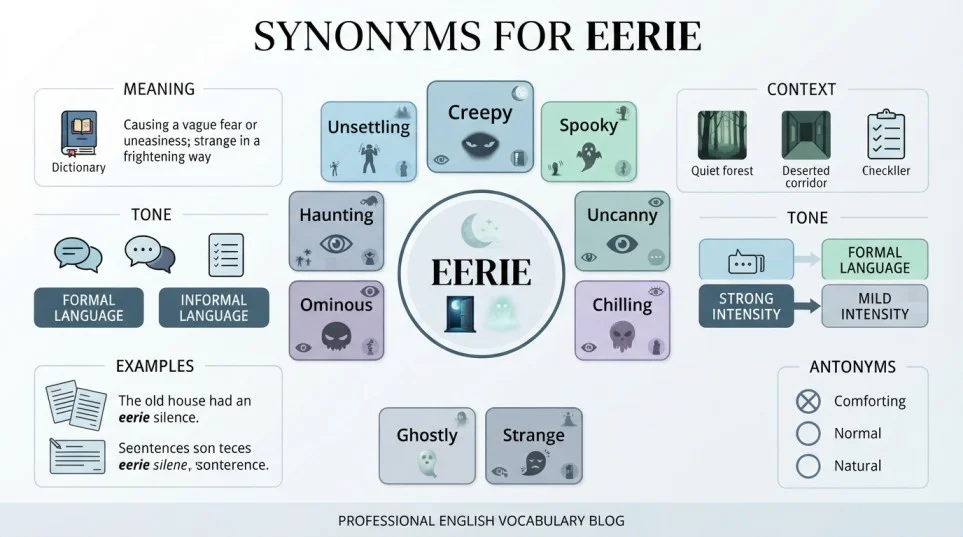
Eerie describes something strange, mysterious, or unsettling that creates a feeling of unease or fear. Depending on context, alternatives include strange, spooky, unsettling, uncanny, haunting, ominous, creepy, chilling, sinister, and ghostly.
Meaning, Tone and Context
Simple Definition
Eerie means strange, mysterious, or unsettling in a way that makes you feel nervous, uncomfortable, or slightly afraid.
An eerie situation does not always involve obvious danger. Sometimes an empty hallway, unusual silence, distant sound, or unfamiliar atmosphere can feel eerie.
Part of Speech
Eerie is an adjective.
You can use it before a noun or after a linking verb.
Examples:
The forest was eerie at night.
We heard an eerie sound from upstairs.
She noticed an eerie silence in the room.
Tone
Eerie usually has a negative or unsettling tone. However, it can sometimes describe something mysterious without suggesting serious danger.
For example, an eerie photograph may simply feel unusual and mysterious.
Formality Level
Eerie is a common and natural English word. It works in casual conversation, creative writing, journalism, reviews, essays, and descriptive writing.
For highly formal writing, a more precise word such as unsettling, ominous, or unusual may sometimes communicate the intended meaning more clearly.
Common Use Cases
Eerie is commonly used to describe:
- Places
- Sounds
- Silence
- Weather
- Stories
- Photographs
- Movies
- Buildings
- Experiences
- Atmospheres
- Expressions
- Events that feel strangely unusual
Related Forms
Eerie is primarily used as an adjective.
The noun eeriness describes the quality of being eerie.
Example:
The eeriness of the abandoned house made everyone uncomfortable.
When and How to Use “Eerie”
Use eerie when something creates an unusual feeling of discomfort, mystery, or quiet fear.
Creative Writing
The eerie forest seemed completely silent after sunset.
Personal Experience
There was something eerie about the empty street after midnight.
Social Media
This abandoned building has such an eerie atmosphere.
Storytelling
An eerie sound came from the hallway, but nobody was there.
Another Word for “Eerie”
There is no single replacement that works perfectly in every sentence. The best alternative depends on the exact feeling you want to express.
| Context | Recommended Word | Why It Works |
|---|---|---|
| Professional writing | Unsettling | Clear and relatively neutral |
| Academic writing | Uncanny | Useful for unusual or strangely familiar experiences |
| Casual conversation | Creepy | Natural and conversational |
| Emotional writing | Haunting | Suggests a lasting emotional effect |
| Creative writing | Ghostly | Creates supernatural imagery |
| Resume or workplace use | Unusual | More neutral and professional |
| Social media captions | Spooky | Casual and familiar |
| Stronger meaning | Chilling | Suggests a powerful feeling of fear |
| Softer meaning | Strange | Describes unusualness without strong fear |
When Not to Use “Eerie”
Do not use eerie simply because something is unusual.
For example:
The office has an eerie new software interface.
This may sound unnecessarily dramatic if the interface is merely unfamiliar.
A better choice could be:
The office has an unusual new software interface.
Likewise, if something creates genuine fear, eerie may be too mild.
Instead of:
The threatening message was eerie.
You could write:
The threatening message was sinister.
Choose eerie when the atmosphere feels strange and unsettling rather than simply unusual or openly dangerous.
Words Commonly Confused With “Eerie”
Eerie vs. Strange
Strange means unusual or unfamiliar. Eerie adds a feeling of discomfort or fear.
The building looked strange.
The empty building looked eerie at night.
Eerie vs. Creepy
Creepy usually describes something that makes you uncomfortable or nervous. It is more conversational than eerie.
That abandoned house is creepy.
The silent house had an eerie atmosphere.
Eerie vs. Scary
Scary directly means frightening. Eerie often describes a quieter and more mysterious kind of fear.
The horror movie was scary.
The silent hallway felt eerie.
Eerie vs. Uncanny
Uncanny describes something strangely unfamiliar or strangely familiar in a way that feels unsettling.
The robot had an uncanny resemblance to a human.
The empty room felt eerie.
Eerie vs. Haunting
Haunting describes something that creates a powerful and lasting emotional or mysterious impression.
The photograph was eerie.
The photograph had a haunting quality that stayed with me.
Eerie vs. Ominous
Ominous suggests that something bad may happen.
The silence was eerie.
The dark clouds looked ominous.
Best Synonym by Context for “Eerie”
| Context | Best Synonym | Why It Works | Example |
|---|---|---|---|
| Formal writing | Unsettling | Clear and restrained | The incident created an unsettling atmosphere. |
| Academic writing | Uncanny | Precise for unusual experiences | The study describes an uncanny sense of familiarity. |
| Professional or business use | Unusual | Neutral and appropriate | The situation was unusual but manageable. |
| Resume | Unusual | Avoids dramatic language | She remained calm during unusual circumstances. |
| Casual conversation | Creepy | Natural in everyday speech | That place looks creepy at night. |
| Creative writing | Haunting | Adds emotional depth | A haunting melody filled the room. |
| Emotional tone | Haunting | Suggests lasting feelings | His words left a haunting impression. |
| Strong intensity | Chilling | Creates stronger fear | We heard a chilling scream outside. |
| Mild intensity | Strange | Less dramatic | There was a strange feeling in the room. |
| Social media captions | Spooky | Familiar and casual | A spooky night in the old town. |
| US usage | Eerie | Common and natural | The road looked eerie after dark. |
| UK usage | Eerie | Also standard and widely understood | The quiet village seemed eerie at night. |
Which Synonym Should You Choose?
Start by asking what you actually mean.
If something is simply unusual, choose strange or unusual.
If it creates discomfort, choose unsettling or creepy.
If it suggests supernatural imagery, choose ghostly or spooky.
If it produces strong fear, choose chilling or terrifying.
If it suggests possible danger, choose ominous or sinister.
If it creates a lasting emotional impression, choose haunting.
For professional and academic writing, avoid dramatic alternatives unless the context genuinely supports them.
For creative writing, stronger descriptive words can create a more vivid atmosphere.
Real Life Examples of “Eerie” in Sentences
School
The student described the eerie setting of the novel in her literature essay.
Workplace
The empty office felt eerie after everyone had gone home.
Writing
The author created an eerie atmosphere through silence and dim lighting.
Conversation
That old house looks eerie from the road.
Social Media
An eerie sunset made the abandoned pier look completely different.
Resume
For a resume, eerie is generally too subjective. A more precise word such as unusual may work better when describing an unusual situation.
The office was unusually quiet this morning.
This is generally more appropriate than calling the office eerie in a professional email.
Storytelling
An eerie whisper drifted through the room as the lights began to flicker.
18 Synonyms for “Eerie”
| Synonym | Simple Meaning | Best Used For | Example Sentence |
|---|---|---|---|
| Unsettling | Causing discomfort or nervousness | Formal and general writing | The empty building created an unsettling feeling. |
| Creepy | Making you feel uncomfortable or afraid | Casual conversation | That old basement is really creepy. |
| Spooky | Suggesting ghosts or playful fear | Casual writing and captions | The town looked spooky after sunset. |
| Haunting | Creating a strong and lasting impression | Emotional and literary writing | The singer delivered a haunting performance. |
| Uncanny | Strangely unfamiliar or strangely familiar | Academic and descriptive writing | The painting had an uncanny resemblance to her face. |
| Chilling | Producing a strong feeling of fear | Dramatic writing | A chilling scream echoed through the house. |
| Ominous | Suggesting that something bad may happen | Serious descriptive writing | The ominous clouds covered the entire sky. |
| Sinister | Suggesting evil or harmful intentions | Strong descriptive writing | The stranger gave him a sinister smile. |
| Ghostly | Resembling or suggesting a ghost | Supernatural descriptions | A ghostly figure appeared near the window. |
| Strange | Unusual or unfamiliar | General conversation | There was a strange silence in the room. |
| Mysterious | Difficult to explain or understand | Neutral and creative writing | A mysterious light appeared in the distance. |
| Frightening | Causing fear | Direct descriptions | The frightening noise woke everyone. |
| Disturbing | Causing emotional discomfort | Serious situations | The documentary contained several disturbing images. |
| Spine chilling | Extremely frightening | Dramatic storytelling | The story ended with a spine chilling discovery. |
| Sinister looking | Appearing threatening or harmful | Visual descriptions | The abandoned building had a sinister looking entrance. |
| Foreboding | Creating a sense that something bad may happen | Literary writing | A feeling of foreboding filled the village. |
| Otherworldly | Seeming beyond ordinary human experience | Fantasy and creative writing | The cave had an otherworldly beauty. |
| Spectral | Resembling a ghost or spirit | Literary and supernatural writing | A spectral figure stood beneath the old tree. |
Synonym Groups and Usage Differences
Professional vs. Personal Synonyms
Professional writing usually benefits from neutral terms.
Unusual, unsettling, and concerning can work better than creepy or spooky when communicating with coworkers or clients.
Personal writing allows more emotional vocabulary.
For example, you might describe a strange experience as eerie when telling a friend, but describe it as unusual in a workplace report.
Formal vs. Conversational Synonyms
Formal writing can use unsettling, uncanny, ominous, or foreboding when those meanings are accurate.
Conversational English often favors creepy, spooky, strange, or scary.
For example:
Formal: The environment was unsettling.
Conversational: That place was creepy.
Academic Synonyms
Academic writing requires precision.
Uncanny can be useful when discussing an unusual psychological or perceptual experience.
Unsettling may also work when describing an experience that produces discomfort.
Avoid spooky in formal academic writing unless you are directly discussing popular culture or informal language.
Professional and Business Synonyms
Business communication usually favors neutral descriptions.
Instead of saying an unexpected situation was eerie, consider unusual, unexpected, concerning, or unsettling.
The correct choice depends on what actually happened.
Creative or Literary Synonyms
Creative writing offers more room for atmosphere.
Haunting, ghostly, spectral, ominous, foreboding, and otherworldly can create vivid imagery.
These words help readers understand not only what something looks like but also how it feels.
Slang or Modern Synonyms
Creepy and spooky are familiar informal alternatives.
They are suitable for casual conversations, texts, social posts, and entertainment reviews.
They may sound too casual for formal reports, academic papers, or professional correspondence.
Strongest vs. Weaker Synonyms
A useful intensity scale is:
Strange
Unusual
Unsettling
Creepy
Eerie
Ominous
Chilling
Sinister
Terrifying
These words do not form a perfect scale because each one describes a slightly different quality. Choose based on meaning rather than intensity alone.
Emotional vs. Neutral Synonyms
Neutral terms include strange, unusual, and mysterious.
More emotional terms include creepy, haunting, chilling, and sinister.
If you want to describe an experience without exaggerating it, use a neutral alternative.
If you want to create atmosphere, an emotional synonym may be more effective.
Antonyms of “Eerie”
| Antonym | Meaning | Example Sentence |
|---|---|---|
| Comforting | Creating a feeling of comfort | Her voice was comforting during the difficult moment. |
| Reassuring | Making someone feel less worried | His explanation was reassuring. |
| Welcoming | Friendly and inviting | The hotel lobby felt warm and welcoming. |
| Pleasant | Enjoyable or agreeable | We had a pleasant evening together. |
| Cheerful | Happy and positive | The cheerful room was filled with sunlight. |
| Friendly | Kind and approachable | The neighborhood felt friendly and safe. |
| Familiar | Known through experience | The familiar surroundings helped me relax. |
| Safe | Free from danger | The area felt safe after the repairs. |
| Peaceful | Calm and quiet | The garden was peaceful in the morning. |
| Bright | Full of light or positive energy | The bright room felt inviting. |
| Joyful | Full of happiness | The celebration was joyful and warm. |
| Inviting | Appealing and welcoming | The small cafe looked inviting. |
| Relaxing | Helping you feel calm | The music created a relaxing atmosphere. |
| Cheerful | Expressing happiness | The cheerful decorations lifted everyone’s mood. |
| Secure | Protected from danger or uncertainty | The building felt secure after the new measures were introduced. |
Comparison: Eerie vs. Similar Words
Eerie vs. Strange
The main difference is emotional effect. Strange means unusual, while eerie suggests unusualness combined with discomfort or fear.
Eerie is generally stronger emotionally.
Strange is more neutral and works better when you simply mean unusual.
Example:
The room looked strange.
The room looked eerie after midnight.
Eerie vs. Creepy
Creepy is conversational and directly describes discomfort or fear.
Eerie often focuses more on atmosphere and mystery.
Creepy is commonly stronger in personal conversation, while eerie often sounds more descriptive.
Example:
That man is creepy.
The silent street was eerie.
Eerie vs. Unsettling
Both words describe discomfort.
Unsettling is more neutral and often works better in formal or professional writing.
Eerie creates a stronger sense of mystery.
Example:
The report revealed an unsettling pattern.
The abandoned hospital had an eerie atmosphere.
Eerie vs. Haunting
Haunting often describes something that stays in your thoughts or emotions.
Eerie usually describes an immediate atmosphere of mystery or unease.
Haunting can be emotional without being frightening.
Example:
The photograph was eerie.
The memory was haunting.
Eerie vs. Ominous
Ominous suggests that something bad may happen.
Eerie does not necessarily predict danger.
Example:
The silence was eerie.
The dark clouds looked ominous.
Eerie vs. Uncanny
Uncanny describes something unusually strange, especially when it feels strangely familiar or difficult to explain.
Eerie focuses more directly on an unsettling atmosphere.
Example:
The portrait had an uncanny resemblance to her.
The empty house felt eerie.
Common Phrases and Expressions with “Eerie”
1. Eerie Silence
Meaning:
A strange silence that creates discomfort or unease.
Example sentence:
An eerie silence fell over the classroom after the announcement.
2. Eerie Feeling
Meaning:
A strange sensation that makes you feel uncomfortable or nervous.
Example sentence:
I had an eerie feeling that someone was watching us.
3. Eerie Sound
Meaning:
A strange sound that creates an unsettling atmosphere.
Example sentence:
An eerie sound came from the attic.
4. Eerie Atmosphere
Meaning:
An environment that feels mysterious, strange, or unsettling.
Example sentence:
The old theater had an eerie atmosphere after dark.
5. Eerie Glow
Meaning:
An unusual light that creates a mysterious appearance.
Example sentence:
An eerie glow appeared beyond the trees.
6. Eerie Appearance
Meaning:
An appearance that seems strange or unsettling.
Example sentence:
The abandoned building had an eerie appearance.
7. Eerie Calm
Meaning:
An unusually quiet or peaceful situation that feels uncomfortable.
Example sentence:
The eerie calm before the storm made everyone nervous.
Common Mistakes to Avoid
1. Using Eerie for Every Unusual Situation
Eerie implies unease or mystery.
If something is simply different, strange or unusual may be more accurate.
2. Confusing Eerie With Scary
Scary directly means frightening.
Eerie usually describes an atmosphere or feeling that is strange and unsettling.
3. Using Casual Synonyms in Formal Writing
Creepy and spooky can sound too informal in academic or professional writing.
Use unsettling, unusual, or uncanny when those words accurately express your meaning.
4. Choosing an Overly Dramatic Synonym
Sinister and chilling suggest stronger emotions than eerie.
Do not use them unless the situation genuinely supports that intensity.
5. Repeating Eerie Too Often
Repeated use can make creative writing feel predictable.
Replace it with precise alternatives such as haunting, unsettling, ghostly, or ominous when the meaning changes.
6. Choosing the Wrong Emotional Tone
Haunting suggests a lasting emotional effect.
Ominous suggests possible danger.
Creepy suggests discomfort.
Uncanny suggests strange unfamiliarity.
Choose according to the feeling you actually want to communicate.
7. Using Slang in Academic Writing
Spooky and creepy are natural in casual speech but can weaken formal writing when a more precise term is available.
FAQs
What is the best synonym for eerie?
The best synonym depends on context. Unsettling is broadly useful, while creepy, haunting, uncanny, ominous, and chilling express more specific meanings.
What is a formal synonym for eerie?
Unsettling is a useful formal synonym for eerie. Uncanny can also work when describing something strangely unfamiliar or difficult to explain.
What is an informal synonym for eerie?
Creepy and spooky are common informal alternatives. Creepy usually suggests discomfort, while spooky often suggests ghosts or playful fear.
What is another word for eerie in professional writing?
Unusual or unsettling can replace eerie in professional writing. The better choice depends on whether you mean simple difference or genuine discomfort.
What is the difference between eerie and creepy?
Eerie often describes a mysterious atmosphere, while creepy usually describes something that directly makes you feel uncomfortable or nervous.
What is the opposite of eerie?
Common opposites include comforting, peaceful, welcoming, pleasant, reassuring, familiar, safe, friendly, and inviting, depending on the sentence.
Conclusion
Eerie describes something strange, mysterious, or unsettling that creates a feeling of unease. The most useful alternative depends on the exact meaning you want to communicate.
Choose strange or unusual for neutral descriptions, unsettling for formal writing, creepy for casual conversation, haunting for emotional writing, uncanny for unusual experiences, and ominous when something suggests possible danger.
The key vocabulary tip is simple: do not replace eerie automatically. First identify whether you mean unusual, frightening, mysterious, threatening, emotional, or supernatural. Then choose the synonym that communicates that exact feeling.
Discover More Post:
- 25+ Synonyms for Access | Meanings, Examples, and Best …
- 25+ Synonyms for Acknowledge | Meanings, Examples, and …
- 25+ Synonyms for Attention | Meanings, Examples, and Best …