Do you find yourself using the word benefits repeatedly in emails, essays, presentations, or social media captions? Although it is a useful word, repeating it can make your writing sound predictable. Choosing a more precise alternative can help you explain value, describe positive results, and communicate your ideas more clearly.
This guide explores synonyms for benefits, their meanings, and the situations where each word works best. You will learn how to choose professional terms for business reports, academic language for essays, and simple alternatives for everyday conversations. You will also find practical examples, antonyms, common expressions, and comparisons to help you select the right word without changing your intended meaning.
What Does Benefits Mean?
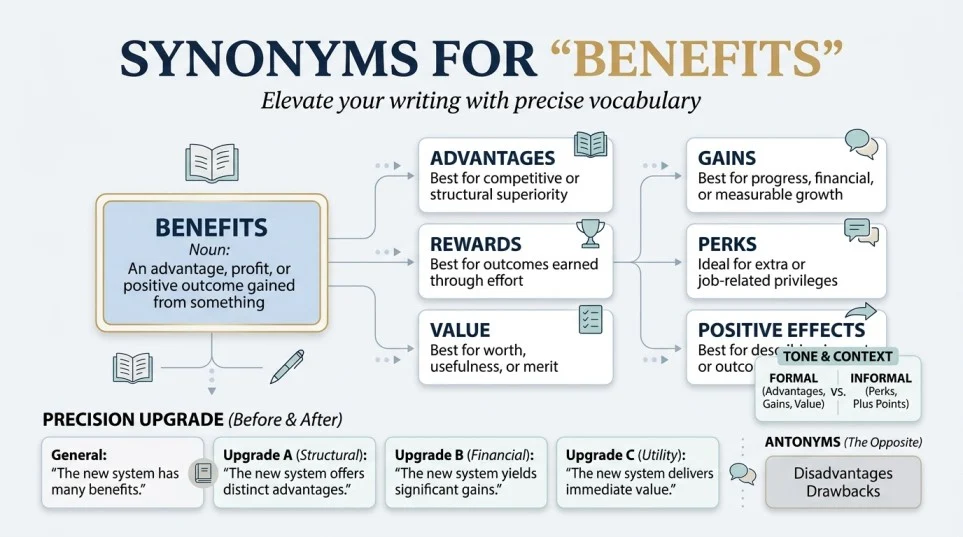
Benefits are advantages, helpful effects, or positive results that someone receives from an action, service, product, or situation. Common synonyms include advantages, perks, gains, rewards, and positive outcomes. In professional writing, advantages and value often work well, while perks suit casual conversations.
Meaning, Tone and Context
What Does Benefits Mean?
The word benefits describes the good things, useful effects, or advantages that come from something. For example, exercise offers health benefits, employee benefits support workers, and a new strategy may bring financial benefits to a business.
The best synonym depends on what you want to describe. A benefit might be a practical advantage, a financial gain, an emotional reward, or a formal workplace provision.
Part of Speech
Benefits can function as a plural noun or as a verb.
| Word Form | Meaning | Example |
|---|---|---|
| Benefit, noun | One advantage or helpful result | One benefit of reading is better concentration. |
| Benefits, plural noun | Several advantages or positive effects | The program offers several benefits. |
| Benefit, verb | To help or improve something | Regular practice can benefit your writing. |
| Beneficial, adjective | Helpful or useful | A balanced diet is beneficial to health. |
| Beneficiary, noun | A person who receives a benefit | She is the main beneficiary of the scholarship. |
Tone and Formality
Benefits usually has a positive, neutral, and widely accepted tone. It works in casual conversations, academic essays, workplace reports, marketing materials, and personal discussions.
Its level of formality is flexible. However, a more specific word can make your meaning clearer and your writing more convincing.
Common Uses of Benefits
Benefits commonly appears in these situations:
- Health: The benefits of regular exercise.
- Business: The benefits of a new marketing strategy.
- Employment: Health insurance and retirement benefits.
- Education: The benefits of learning a second language.
- Personal growth: The benefits of building healthy habits.
- Technology: The benefits of using automation tools.
When and How to Use Benefits
Use benefits when you want to explain what someone gains from a choice, activity, service, or opportunity. The word is especially useful when discussing several positive effects together.
Professional example: The new software offers several benefits, including faster reporting and fewer manual errors.
Academic example: The study examines the benefits of regular physical activity for students.
Personal example: One of the biggest benefits of walking every day is that it helps me feel more energetic.
Social media example: Discover the benefits of a simple morning routine and start your day with more focus.
In each example, benefits communicates a positive result. You can make the sentence more precise by replacing it with advantages, improvements, rewards, or gains, depending on the intended meaning.
Another Word for Benefits
The best single replacement for benefits is usually advantages when you are describing useful features or positive aspects of something. However, other words may fit better when you mean financial returns, personal rewards, workplace perks, or measurable improvements.
| Writing Situation | Best Alternative | Example |
|---|---|---|
| Professional writing | Advantages | The proposal offers several advantages. |
| Academic writing | Positive effects | Researchers studied the positive effects of sleep. |
| Casual conversation | Perks | One of the perks of working remotely is flexibility. |
| Emotional writing | Rewards | The rewards of helping others can be deeply meaningful. |
| Creative writing | Blessings | She appreciated the blessings of a peaceful life. |
| Resume or workplace use | Contributions | My contributions helped improve team performance. |
| Social media captions | Upsides | Explore the upsides of a healthier routine. |
| Stronger meaning | Significant gains | The company achieved significant gains in productivity. |
| Softer meaning | Helpful aspects | One helpful aspect of the course is its flexible schedule. |
Remember that these words are not interchangeable in every sentence. For example, employee benefits usually refers to compensation or workplace provisions, so replacing it with employee advantages may sound unnatural.
When Not to Use Benefits
Although benefits is versatile, it can sound vague when the reader needs a specific explanation of value.
| Vague Sentence | More Precise Sentence | Why It Is Better |
|---|---|---|
| The plan has many benefits. | The plan reduces costs and saves time. | Identifies measurable advantages. |
| Exercise has many benefits. | Exercise improves strength and supports heart health. | Names specific health outcomes. |
| The job offers good benefits. | The job includes health insurance and paid vacation. | Clarifies the employment package. |
| The training benefits employees. | The training improves employees skills. | Uses a direct verb to describe the result. |
| The product has benefits. | The product makes daily tasks easier. | Explains its practical value. |
Avoid choosing an impressive sounding synonym simply to make a sentence look sophisticated. A familiar, accurate word is often more effective than an uncommon one.
Words Commonly Confused With Benefits
Several related words describe positive outcomes, but each has a slightly different meaning.
| Word | Main Difference | Best Use |
|---|---|---|
| Advantages | Favorable features or circumstances | Comparing two choices |
| Rewards | Something received in return for effort or behavior | Personal achievement and recognition |
| Gains | Increases or improvements | Money, knowledge, skills, or performance |
| Perks | Extra advantages, often informal | Workplace extras and lifestyle features |
| Outcomes | Results that follow an action | Projects, research, and decisions |
| Value | The usefulness or worth of something | Business decisions and product evaluation |
The main distinction is simple: benefits is a broad term, advantages describes favorable aspects, rewards often suggests something earned, gains emphasizes improvement, perks suggests extras, outcomes describes results, and value focuses on usefulness or worth.
Best Synonym by Context for Benefits
Choose a synonym that matches the purpose of your sentence rather than replacing benefits automatically.
| Context | Best Synonym | Why It Works | Example |
|---|---|---|---|
| Formal writing | Advantages | Clear and professional | The proposal offers several advantages. |
| Academic writing | Positive effects | Focuses on outcomes | The research explores the positive effects of exercise. |
| Business communication | Value | Emphasizes usefulness | The service delivers value to customers. |
| Resume writing | Contributions | Highlights what you provide | My contributions improved customer satisfaction. |
| Casual conversation | Perks | Sounds friendly and natural | The best perk is flexible scheduling. |
| Creative writing | Blessings | Adds warmth and emotion | She counted the blessings in her life. |
| Emotional writing | Rewards | Suggests personal fulfillment | The rewards of teaching extend beyond salary. |
| Strong positive impact | Gains | Emphasizes measurable improvement | The team recorded substantial gains. |
| Mild or neutral tone | Helpful aspects | Avoids exaggeration | Flexibility is one helpful aspect of the role. |
| Social media captions | Upsides | Short and conversational | Discover the upsides of daily reading. |
| Health and wellness | Positive effects | Describes improvements | Walking has positive effects on mood. |
| Financial writing | Returns | Focuses on financial results | The investment generated strong returns. |
| Employee compensation | Employee perks | Refers to workplace extras | Employee perks include gym access. |
| Product descriptions | Features | Identifies specific product elements | The device features a long lasting battery. |
| Education | Learning gains | Emphasizes progress | The tutoring program produced learning gains. |
| Technology | Improvements | Describes better performance | Automation brought major improvements. |
Which Synonym Should You Choose?
The right synonym depends on five things.
1. Meaning: Use advantages for favorable features, gains for increases, rewards for something earned, and perks for additional extras.
2. Formality: Choose advantages, positive effects, or value for formal writing. Perks and upsides are usually better for informal communication.
3. Emotional intensity: Rewards and blessings can express personal satisfaction. Positive effects and advantages usually sound more neutral.
4. Professional value: Use measurable language in resumes and business reports. Words such as improvements, savings, contributions, and returns can explain concrete results.
5. Sentence context: Check what follows the word. A company offers employee benefits, an investment produces returns, and a training program improves skills.
A practical rule is to replace benefits only when the new word makes the sentence more specific, natural, or useful.
Real Life Examples of Benefits in Sentences
Here are examples showing how to use benefits and stronger alternatives in everyday situations.
| Situation | Example Sentence |
|---|---|
| School | One advantage of group study is the chance to exchange ideas. |
| Workplace | The new scheduling system delivers significant time savings. |
| Writing | Clear headings improve readability and make articles easier to scan. |
| Conversation | The biggest perk of living nearby is the short commute. |
| Social media | Enjoy the upsides of spending more time outdoors. |
| Resume | My contributions helped increase customer retention. |
| The proposed changes offer several practical advantages. | |
| Storytelling | Her greatest reward was seeing her family succeed. |
| Business | The software provides measurable value through faster processing. |
| Health | Daily movement can have positive effects on overall well being. |
These examples also show why the best alternative changes with the situation. A word that works in a friendly conversation may be less suitable for an academic paper or business report.
18 Synonyms for Benefits
The following 18 words and phrases are useful alternatives. Some are close synonyms, while others fit particular meanings of benefits.
| Synonym | Simple Meaning | Best Used For | Example Sentence |
|---|---|---|---|
| 1. Advantages | Favorable features | Comparisons and formal writing | The new policy offers several advantages. |
| 2. Gains | Increases or improvements | Progress and performance | The team made impressive gains in efficiency. |
| 3. Rewards | Positive results received or earned | Effort and achievement | The rewards of hard work became clear over time. |
| 4. Perks | Extra advantages | Casual conversation and employment | Flexible hours are one of the job perks. |
| 5. Profits | Financial earnings after costs | Business and finance | The company increased its profits this year. |
| 6. Returns | Results gained from an investment or effort | Finance and business | The project delivered strong returns. |
| 7. Value | Usefulness or worth | Products and services | The course offers excellent value for beginners. |
| 8. Merits | Positive qualities or points | Formal discussion and evaluation | The proposal has several merits. |
| 9. Strengths | Positive qualities or capabilities | Reviews and assessments | The report highlights the strengths of the approach. |
| 10. Upsides | Favorable aspects | Informal writing | One upside of remote work is less commuting. |
| 11. Pluses | Positive points | Casual comparisons | The main pluses are convenience and flexibility. |
| 12. Boons | Helpful or welcome things | Literary and expressive writing | The new library was a boon to the community. |
| 13. Blessings | Things that bring happiness or gratitude | Emotional and personal writing | Good health is one of her greatest blessings. |
| 14. Improvements | Changes that make something better | Performance and quality | The update brought noticeable improvements. |
| 15. Positive effects | Favorable results | Academic and health writing | Exercise can have positive effects on sleep. |
| 16. Contributions | Things given or done to help | Workplace and community settings | Her contributions strengthened the entire team. |
| 17. Savings | Money, time, or resources preserved | Financial and practical contexts | The new system produced substantial savings. |
| 18. Opportunities | Chances for progress or success | Career and personal development | The program creates opportunities for young professionals. |
Best overall choice: Advantages is a strong general replacement. For financial benefits, consider returns or profits. For employee benefits, retain the original phrase when discussing insurance, retirement plans, or paid leave.
Synonym Groups and Usage Differences
Professional vs. Personal Synonyms
Professional writing often focuses on measurable results, practical value, and performance. Advantages, improvements, contributions, savings, and returns work well when explaining how a decision helps an organization.
Personal writing often focuses on satisfaction, comfort, happiness, and growth. Rewards, perks, blessings, and upsides can sound more natural when describing life experiences.
For example, a manager might discuss the advantages of a new policy, while an employee might describe the perks of a flexible schedule.
Formal vs. Conversational Synonyms
Use formal alternatives when accuracy and clarity matter most. Advantages, merits, positive effects, and value suit reports, essays, speeches, and business emails.
In casual conversations, perks, upsides, and pluses feel more relaxed. They work well in text messages, informal blog posts, and everyday discussions.
Formal: The proposed changes offer several advantages.
Conversational: One of the biggest perks is the extra free time.
Academic Synonyms
Academic writing benefits from precise descriptions of outcomes. Positive effects, gains, improvements, and advantages are useful when discussing research, learning, health, or social issues.
Choose the word that matches your evidence. If a study measures an increase in test scores, learning gains may be more accurate than general benefits. If it examines health outcomes, positive effects may fit better.
Avoid using rewards or blessings in a research paper unless the subject specifically involves those meanings.
Professional and Business Synonyms
Business writing should explain how something helps customers, employees, or an organization. Useful alternatives include value, advantages, savings, returns, improvements, and contributions.
For example, a proposal may offer cost savings, a product may deliver value, and an employee may make valuable contributions to a project.
On a resume, describe the result whenever possible. Instead of saying you provided many benefits to a team, explain that you reduced processing time, improved customer satisfaction, or helped increase revenue. Include figures only when you can support them.
Creative or Literary Synonyms
Creative writing may need words that express gratitude, hope, discovery, or personal growth. Blessings, boons, rewards, and gains can add more feeling than the general word benefits.
For example, the sentence The journey brought many benefits sounds broad. The journey brought unexpected rewards suggests a more personal experience.
Use expressive words when they match the mood. A serious business report usually needs a more direct term.
Slang or Modern Synonyms
There is no single slang replacement that works in every situation. Perks, upsides, and pluses are common informal alternatives, although they are not necessarily slang.
They suit casual posts, conversations, and lifestyle content. For academic papers, formal proposals, and professional reports, advantages or positive effects are usually safer choices.
Strongest vs. Weaker Synonyms
These words differ in emphasis rather than following one universal scale of strength.
| Intensity | Word or Phrase | Example |
|---|---|---|
| Mild | Helpful aspects | Flexibility is one helpful aspect of the course. |
| Mild | Pluses | The main pluses are its price and convenience. |
| Moderate | Advantages | The new process has several advantages. |
| Moderate | Improvements | The update brought noticeable improvements. |
| Strong | Significant gains | The company recorded significant gains in productivity. |
| Strong | Substantial savings | The change generated substantial savings. |
| Strong, expressive | Blessings | She viewed her supportive family as one of life’s greatest blessings. |
Use strong terms only when the situation supports them. Calling a small convenience a major gain can make your writing sound exaggerated.
Emotional vs. Neutral Synonyms
Neutral terms communicate information without adding much emotion. Advantages, positive effects, value, improvements, and outcomes are useful when the goal is clarity.
Emotional terms suggest personal meaning or satisfaction. Rewards, blessings, and boons can make a sentence feel warmer or more expressive.
Compare these examples:
Neutral: One advantage of volunteering is gaining practical experience.
Emotional: One of the greatest rewards of volunteering is knowing that you helped someone.
The second sentence emphasizes personal fulfillment rather than a practical advantage.
Antonyms of Benefits
The opposite of benefits depends on the intended meaning. Disadvantages and drawbacks are direct opposites when benefits means favorable aspects. Other words describe costs, damage, or negative outcomes in specific contexts.
| Antonym | Meaning | Example Sentence |
|---|---|---|
| 1. Disadvantages | Unfavorable aspects | The disadvantages include higher costs. |
| 2. Drawbacks | Features that make something less desirable | One drawback is the limited storage space. |
| 3. Harms | Damaging effects | The report examines the harms caused by pollution. |
| 4. Losses | Reductions in money, resources, or value | The business reported financial losses. |
| 5. Costs | Money or resources required | The costs may outweigh the advantages. |
| 6. Risks | Possibilities of harm or loss | The plan carries several risks. |
| 7. Liabilities | Obligations or sources of potential loss | The company reviewed its financial liabilities. |
| 8. Penalties | Punishments or imposed consequences | Late submissions may result in penalties. |
| 9. Damages | Harm or financial compensation for harm | The court considered the damages caused by the incident. |
| 10. Burdens | Difficult responsibilities or demands | The extra paperwork became a burden. |
| 11. Setbacks | Problems that delay progress | Unexpected delays created setbacks for the team. |
| 12. Adverse effects | Unwanted or harmful results | The treatment may have adverse effects. |
| 13. Deficits | Shortfalls or amounts below what is needed | The department faced a budget deficit. |
| 14. Disservices | Actions that harm rather than help | The misleading advice did the public a disservice. |
| 15. Disadvantages of a choice | Negative consequences of an option | We considered the disadvantages before deciding. |
Not all these words are direct dictionary antonyms of benefits. They are context dependent opposites, so choose one that matches the kind of benefit being discussed.
Comparison: Benefits vs. Similar Words
Benefits vs. Advantages
Main difference: Benefits are positive results or helpful effects. Advantages are favorable features that make something better than another option.
Which is stronger? Neither is always stronger. Advantages often suggests comparison, while benefits can describe outcomes.
Which is more formal? Both are suitable for formal writing.
Examples:
Benefits: One benefit of reading is improved vocabulary.
Advantages: One advantage of this method is its simplicity.
Benefits vs. Perks
Main difference: Benefits is broader and can describe positive effects or formal employee provisions. Perks usually refers to extra advantages or enjoyable extras.
Which is stronger? Perks often sounds more appealing in a casual setting, but it does not necessarily describe a greater benefit.
Which is more formal? Benefits is generally more suitable for formal writing.
Examples:
Benefits: The position includes health insurance and retirement benefits.
Perks: The position offers perks such as free coffee and flexible hours.
Benefits vs. Rewards
Main difference: Benefits are helpful results or advantages. Rewards are things received in return for effort, achievement, or behavior.
Which is stronger? Rewards can carry a stronger sense of personal satisfaction or recognition.
Which is more formal? Both can be formal, depending on context.
Examples:
Benefits: Exercise offers several health benefits.
Rewards: The reward for completing the challenge was a certificate.
Benefits vs. Gains
Main difference: Benefits describes positive effects broadly, while gains emphasizes an increase or improvement.
Which is stronger? Gains can sound more measurable when the result involves growth.
Which is more formal? Both work in formal writing.
Examples:
Benefits: The course provides benefits for new employees.
Gains: Employees made measurable gains in technical skills.
Benefits vs. Outcomes
Main difference: Benefits are favorable effects. Outcomes are the results of an action, which may be positive, negative, or neutral.
Which is stronger? Neither is inherently stronger. Benefits is positive, while outcomes is more neutral.
Which is more formal? Outcomes is common in research and evaluation, and benefits also works in those settings.
Examples:
Benefits: The program offers educational benefits.
Outcomes: The evaluation measured the outcomes of the program.
Benefits vs. Value
Main difference: Benefits are specific advantages or positive effects. Value refers to the usefulness, worth, or importance of something.
Which is stronger? Value can be more persuasive when discussing overall usefulness, but the words are not interchangeable in every sentence.
Which is more formal? Both are appropriate for business and academic writing.
Examples:
Benefits: The service provides benefits to small businesses.
Value: The service offers excellent value for small businesses.
Common Phrases and Expressions with Benefits
1. Health Benefits
Meaning: Positive effects on physical or mental health.
Example sentence: Regular exercise can provide important health benefits.
2. Employee Benefits
Meaning: Workplace provisions such as health insurance, retirement plans, or paid leave.
Example sentence: The company offers employee benefits to support its staff.
3. Mutual Benefits
Meaning: Advantages that help two or more people or groups.
Example sentence: The partnership creates mutual benefits for both organizations.
4. Long Term Benefits
Meaning: Positive effects that become noticeable over an extended period.
Example sentence: Consistent reading can bring long term benefits to language learners.
5. Financial Benefits
Meaning: Positive effects involving money, income, savings, or financial security.
Example sentence: The new system offers financial benefits by reducing operating costs.
6. Potential Benefits
Meaning: Advantages that may occur but are not guaranteed.
Example sentence: Researchers are studying the potential benefits of the new approach.
7. Reap the Benefits
Meaning: Enjoy the positive results of an action or effort.
Example sentence: Students who practice regularly often reap the benefits of their hard work.
8. Weigh the Benefits
Meaning: Compare the positive aspects of an option with its disadvantages or costs.
Example sentence: Before changing jobs, weigh the benefits against the financial risks.
Common Mistakes to Avoid
1. Using Benefits When a Specific Result Is Clearer
Weak: The new system has many benefits.
Better: The new system reduces processing time and lowers operating costs.
Specific details help readers understand exactly why something is useful.
2. Confusing Benefits With Rewards
A benefit is an advantage or positive effect. A reward is something received for effort, achievement, or behavior.
For example, flexible working hours are a benefit, while a performance bonus may be a reward.
3. Using Casual Words in Formal Writing
Perks and upsides work well in everyday conversation, but they may sound too informal in a research paper or formal report.
Use advantages, positive effects, or value when the situation calls for a professional tone.
4. Choosing an Overly Dramatic Word
Blessings and boons can add emotion, but they may sound exaggerated when describing a minor convenience.
For example, say One advantage of the app is its simple design instead of calling the design a life changing blessing.
5. Repeating Benefits Too Often
Repeating the same word throughout an article can make your writing feel monotonous.
Replace it with an accurate alternative when appropriate, or rewrite the sentence to describe the actual result.
6. Choosing the Wrong Meaning
Not every synonym fits every type of benefit. Returns usually refers to results from an investment or effort, while employee benefits can refer to insurance, retirement plans, and paid leave.
Always check whether the alternative preserves the original meaning.
FAQs About Synonyms for Benefits
1. What is the best synonym for benefits?
Advantages is the best general synonym for benefits in many situations. Gains, rewards, perks, and positive effects work better when describing specific kinds of value.
2. What is a formal synonym for benefits?
Advantages, merits, positive effects, and value are useful formal alternatives. Choose the term that best explains the practical result, favorable feature, or overall usefulness.
3. What is an informal synonym for benefits?
Perks, upsides, and pluses are common informal alternatives. They work well in casual conversations, friendly emails, lifestyle articles, and social media captions.
4. What is another word for benefits in professional writing?
Value, advantages, improvements, savings, and contributions are useful in professional writing. Choose a word that explains the business result or practical improvement clearly.
5. What is the difference between benefits and advantages?
Benefits often describe positive results or helpful effects, while advantages describe favorable features or circumstances. Both words can overlap, depending on the sentence.
6. What is the opposite of benefits?
Disadvantages and drawbacks are common opposites when benefits means favorable aspects. Costs, losses, risks, and adverse effects can express negative consequences in specific contexts.
Conclusion
Synonyms for benefits help you explain positive results, useful features, financial gains, and personal rewards with greater clarity. Advantages is a reliable general alternative, while perks, returns, improvements, value, and positive effects suit more specific situations.
The best word depends on your audience, purpose, tone, and intended meaning. When writing an essay, email, resume, report, or social media caption, focus on what the benefit actually provides.
Vocabulary tip: Instead of asking only which word can replace benefits, ask what kind of value you want to describe. That simple habit makes your writing more precise, natural, and useful.
Discover More Post:
- 50+ Synonyms for Dedication | Meanings, Examples, and Best …
- 50+ Synonyms for For | Expert Word Choices to Elevate Your …
- 50+ Synonyms for Vivid | Meanings, Examples, and Best …