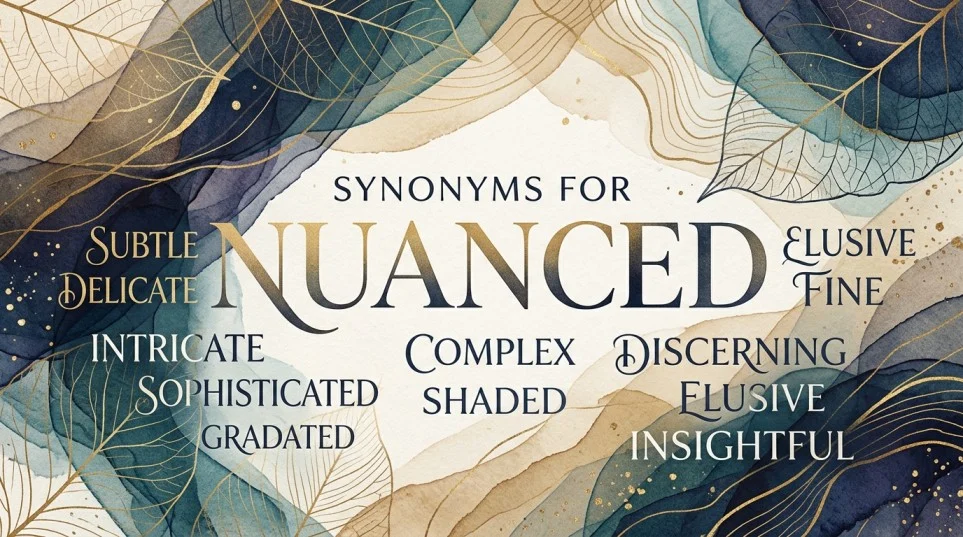
Have you ever used the word nuanced several times in an essay, email, or professional report and struggled to find a better alternative? Repeating the same word can make your writing feel less engaging, even when your ideas are strong. Choosing the right synonym can help you communicate more clearly and naturally.
Understanding synonyms for nuanced is especially useful for students, writers, professionals, and English learners. Words such as subtle, layered, sophisticated, and complex can express similar ideas, but each has a slightly different meaning. This guide explains how to use these alternatives in everyday conversations, academic writing, workplace communication, resumes, and creative work. You will learn how to choose words that match your meaning, tone, and audience.
What Does Nuanced Mean?
Nuanced means showing subtle differences, small distinctions, or shades of meaning rather than presenting something as simple or one sided. The best synonyms include subtle for small differences, layered for multiple meanings, sophisticated for advanced thinking, and multifaceted for subjects with several aspects.
Meaning, Tone and Context
Simple Definition
Nuanced describes something that contains subtle details, meaningful distinctions, or different shades of meaning. It often suggests that a person understands a subject carefully instead of making a simple judgment.
For example, a nuanced opinion considers different viewpoints and recognizes that a situation may not have one obvious answer.
Part of Speech
Nuanced is an adjective. It describes a noun, such as an argument, opinion, explanation, performance, discussion, or character.
The related noun is nuance, which means a small but meaningful difference in meaning, feeling, or expression. The verb nuance means to give something subtle shades of meaning or expression.
Tone and Formality
Nuanced usually has a positive or neutral tone. It often suggests careful thinking, fairness, depth, and attention to detail.
The word is moderately formal and works well in academic essays, professional reports, business discussions, reviews, and literary analysis. In casual conversation, words such as subtle, complicated, or thoughtful may sound more natural, depending on the situation.
Common Use Cases
Use nuanced when describing:
- An opinion that considers different viewpoints.
- An argument that recognizes exceptions and details.
- A character with mixed motives or emotions.
- A discussion that avoids oversimplifying an issue.
- A performance that communicates several emotions.
- An explanation that recognizes important distinctions.
Important Word Forms
| Word | Meaning | Example |
|---|---|---|
| Nuance | A subtle difference in meaning or feeling | I noticed a nuance in her response. |
| Nuanced | Showing subtle differences or complexity | He offered a nuanced explanation. |
| Nuancing | Adding subtle distinctions or shades of meaning | The writer is nuancing the original argument. |
The adjective nuanced usually describes something that already shows subtle detail. The verb nuancing describes the process of adding or expressing that detail.
When and How to Use Nuanced
Use nuanced when you want to show that an idea, response, or situation deserves careful consideration. It is particularly useful when a simple label would leave out important information.
Professional example: The manager gave a nuanced assessment of the team’s performance.
This sentence suggests that the manager considered strengths, weaknesses, and circumstances rather than making a sweeping judgment.
Academic example: The essay presents a nuanced interpretation of the novel.
This means the interpretation recognizes themes and details that support more than one reading.
Creative example: Her nuanced performance made the character feel believable.
Here, nuanced suggests that the actor communicated several emotions rather than relying on one obvious feeling.
Personal example: He has a nuanced view of the disagreement.
This indicates that he recognizes both sides and understands why the disagreement may be complicated.
Another Word for Nuanced
The best replacement depends on what you want to communicate. No single synonym fits every sentence.
| Situation | Best alternative | Example |
|---|---|---|
| Professional writing | Sophisticated | She presented a sophisticated analysis of the problem. |
| Academic writing | Subtle | The researcher identified subtle differences in the results. |
| Casual conversation | Complicated | It is a complicated issue with no easy answer. |
| Emotional writing | Layered | The character has a layered emotional life. |
| Creative writing | Rich | The novel offers a rich portrayal of family relationships. |
| Resume or workplace use | Analytical | Delivered an analytical review of competing proposals. |
| Social media captions | Thoughtful | A thoughtful perspective on a difficult subject. |
| Stronger emphasis on complexity | Multifaceted | The challenge has multifaceted causes. |
| Softer emphasis on small details | Subtle | Her subtle expression revealed concern. |
Best overall choice: Subtle is often the closest alternative when nuanced refers to small differences. Use layered when several meanings or feelings coexist, and sophisticated when an idea demonstrates advanced understanding.
When Not to Use Nuanced
Although nuanced is useful, it is not always the clearest word. Sometimes a more direct alternative helps readers understand your point faster.
| Situation | Less suitable sentence | Clearer alternative |
|---|---|---|
| You mean difficult to understand | The instructions are nuanced. | The instructions are complicated. |
| You mean a small visual difference | The colors are nuanced. | The colors are subtly different. |
| You mean several separate parts | The problem is nuanced. | The problem has multiple causes. |
| You mean advanced skill | She has a nuanced understanding of the software. | She has an advanced understanding of the software. |
| You mean a personal preference | My nuanced choice is blue. | My considered choice is blue. |
Avoid using nuanced simply to make your writing sound more academic. Use it when meaningful distinctions, subtle details, or multiple perspectives are genuinely present.
Words Commonly Confused With Nuanced
These related words overlap with nuanced, but each emphasizes a different quality.
| Word | Main difference | Best use |
|---|---|---|
| Complex | Has many connected parts or difficulties | Complicated systems and problems |
| Subtle | Not obvious or easy to detect | Small differences and quiet signals |
| Sophisticated | Shows advanced knowledge, skill, or development | Expert analysis and refined methods |
| Detailed | Includes many specific facts or particulars | Reports, instructions, and descriptions |
| Layered | Contains several levels of meaning or feeling | Stories, characters, and arguments |
| Ambiguous | Can be understood in more than one way | Unclear statements or uncertain meanings |
A nuanced argument can be complex without being confusing. It can also be detailed without being nuanced. The key difference is that nuance draws attention to meaningful distinctions, not merely the amount of information.
Best Synonym by Context for Nuanced
Choose a synonym that reflects what makes the subject nuanced. A business report may need precise analytical language, while a story may benefit from a word that suggests emotional depth.
| Context | Best synonym | Why it works | Example |
|---|---|---|---|
| Formal writing | Sophisticated | Suggests careful, advanced thinking | The report offers a sophisticated analysis. |
| Academic writing | Subtle | Highlights small but meaningful distinctions | The study reveals subtle differences between groups. |
| Business communication | Analytical | Emphasizes reasoned evaluation | We need an analytical review of the proposal. |
| Resume | Insightful | Highlights useful understanding | Developed insightful recommendations for the team. |
| Casual conversation | Complicated | Uses familiar language for difficult issues | The situation is complicated. |
| Creative writing | Layered | Suggests multiple levels of meaning | The story features a layered protagonist. |
| Emotional description | Multifaceted | Shows several emotions or qualities | She has a multifaceted personality. |
| Strong emphasis on complexity | Intricate | Highlights interconnected details | The novel follows an intricate plot. |
| Gentle emphasis on detail | Subtle | Suggests delicate differences | His subtle reaction changed the mood. |
| Social media captions | Thoughtful | Sounds natural and accessible | A thoughtful take on an important subject. |
| Literary criticism | Rich | Suggests depth and interpretive value | The poem offers a rich view of memory. |
| Scientific analysis | Precise | Emphasizes accuracy and clear distinctions | The paper provides a precise account of the findings. |
| Personal opinions | Balanced | Highlights consideration of different sides | She gave a balanced response. |
| Art and performance | Expressive | Emphasizes communication through detail | The actor delivered an expressive performance. |
For US English, all these alternatives are standard. There is no special American spelling of nuanced that requires a different synonym from British English. The best choice depends on meaning and audience rather than location.
Which Synonym Should You Choose?
Use these practical questions before replacing nuanced in a sentence.
1. What do you mean? Choose subtle for small differences, layered for multiple meanings, and complex for something with many connected parts.
2. How formal is the writing? Sophisticated, multifaceted, and analytical often work in professional or academic settings. Complicated and thoughtful feel more conversational.
3. How strong should the word sound? Intricate suggests considerable complexity. Subtle suggests a gentler distinction. Detailed focuses on the amount of information.
4. What quality do you want to highlight? Use balanced for fairness, insightful for useful understanding, and precise for accuracy.
5. Will readers understand it quickly? If nuanced or its replacement makes the sentence harder to follow, explain the specific difference instead.
A useful editing tip is to replace the word only when the alternative adds precision. Synonyms are not interchangeable in every context.
Real Life Examples of Nuanced in Sentences
These examples show how different synonyms can make sentences more specific and natural.
| Situation | Example sentence |
|---|---|
| School | The student wrote a subtle interpretation of the poem. |
| Workplace | Our manager gave a balanced assessment of the team’s progress. |
| Essay writing | The author presents a sophisticated argument about social change. |
| Conversation | It is a complicated situation, so we should hear both sides. |
| Social media | A thoughtful perspective can change how we see the issue. |
| Resume | Provided insightful analysis to support business decisions. |
| Could you share a more detailed explanation of the proposed changes? | |
| Storytelling | The writer created a layered character with conflicting goals. |
| Research | The results reveal subtle differences between the two groups. |
| Film review | The actor delivered a multifaceted portrayal of a troubled character. |
Notice that the alternatives do more than avoid repetition. Each one tells readers which feature matters most.
18 Synonyms for Nuanced
The following 18 words are useful alternatives, but their meanings differ slightly. Choose according to the sentence rather than treating them as exact replacements.
| Synonym | Simple meaning | Best used for | Example sentence |
|---|---|---|---|
| Subtle | Slight or not immediately obvious | Small distinctions | The painting contains subtle changes in color. |
| Sophisticated | Advanced or carefully developed | Analysis and ideas | Her sophisticated argument considered several possibilities. |
| Layered | Having several levels | Stories and emotions | The film presents a layered view of family life. |
| Complex | Made up of many connected parts | Problems and systems | Climate policy is a complex subject. |
| Multifaceted | Having many different aspects | People and issues | The issue requires a multifaceted response. |
| Intricate | Containing many detailed connections | Designs and plots | The detective uncovered an intricate scheme. |
| Refined | Improved through careful development | Taste, expression, and methods | His refined style makes the essay engaging. |
| Detailed | Including specific information | Reports and explanations | She wrote a detailed account of the meeting. |
| Elaborate | Carefully developed with many parts | Plans and descriptions | They proposed an elaborate solution. |
| Balanced | Giving fair attention to different sides | Opinions and arguments | The article offers a balanced assessment. |
| Thoughtful | Showing care and reflection | Opinions and responses | He shared a thoughtful response to the criticism. |
| Insightful | Showing a deep or useful understanding | Analysis and observations | Her insightful comments improved the discussion. |
| Perceptive | Quick to notice important details | People and judgments | The perceptive reviewer noticed a hidden theme. |
| Discerning | Able to judge differences carefully | Decisions and evaluations | A discerning reader can recognize weak evidence. |
| Expressive | Communicating feelings or ideas clearly | Art and performance | The actor gave an expressive performance. |
| Rich | Full of meaning, detail, or variety | Literature and descriptions | The novel provides a rich picture of city life. |
| Precise | Exact and clearly defined | Technical and academic writing | The researcher used precise language. |
| Comprehensive | Covering all or most important aspects | Reports and reviews | The committee prepared a comprehensive review. |
Important distinction: Comprehensive means covering a broad range of relevant material, while nuanced means recognizing meaningful subtleties. A report can be comprehensive without being nuanced.
Synonym Groups and Usage Differences
Professional vs. Personal Synonyms
Professional writing often benefits from sophisticated, analytical, insightful, and precise. These words help communicate reasoning and judgment in reports, presentations, and workplace discussions.
Personal writing may sound more natural with thoughtful, layered, subtle, or complex. These alternatives work well when describing relationships, emotions, and personal opinions.
For example, a professional review might present an analytical assessment, while a personal reflection might explore layered emotions.
Formal vs. Conversational Synonyms
Formal alternatives include sophisticated, multifaceted, intricate, and discerning. They are useful when the subject requires careful analysis.
Conversational alternatives include complicated, thoughtful, subtle, and detailed. These words are generally easier to understand in everyday speech, though the best option depends on the sentence.
Instead of saying the issue is multifaceted in a casual conversation, you might say it has several sides.
Academic Synonyms
Academic writing benefits from words that identify the exact quality being discussed.
- Subtle: Use for small but meaningful distinctions.
- Complex: Use for interconnected factors or difficult systems.
- Sophisticated: Use for advanced reasoning or methods.
- Precise: Use for exact definitions and claims.
- Multifaceted: Use when a topic has several distinct aspects.
Do not use sophisticated to praise an argument that lacks evidence. A strong academic sentence should explain what makes the argument convincing.
Professional and Business Synonyms
For emails, reports, resumes, and presentations, consider analytical, insightful, balanced, precise, and detailed.
For example, instead of writing that you have a nuanced understanding of customer needs, you could write that you developed insightful recommendations from customer feedback. This version explains the practical value of your understanding.
On a resume, a specific achievement is often stronger than a general adjective. Whenever possible, support your description with an action or measurable result.
Creative or Literary Synonyms
Layered, rich, expressive, subtle, and intricate are especially useful for creative work.
A layered character may have conflicting motivations. A rich description may include sensory details and cultural meaning. A subtle performance may communicate sadness without an obvious display of emotion.
Choose the word that describes the artistic quality you actually want readers to notice.
Slang or Modern Synonyms
Nuanced does not have one widely accepted slang equivalent that preserves its full meaning. Casual expressions such as complicated, having layers, or not that simple may communicate the idea in everyday conversation.
For example, saying this issue has layers suggests that it involves more than one perspective. However, such expressions are too informal for many academic essays and business reports.
Strongest vs. Weaker Synonyms
This is a practical scale of emphasis, not a strict ranking of synonym strength. The words describe different qualities, so their intensity depends on context.
| Level | Word | Typical emphasis |
|---|---|---|
| 1 | Subtle | Small distinctions |
| 2 | Thoughtful | Careful consideration |
| 3 | Detailed | Specific information |
| 4 | Complex | Several connected elements |
| 5 | Layered | Multiple levels of meaning |
| 6 | Intricate | Many fine connections and details |
A more intense word is not automatically better. Subtle may be more accurate than intricate when the difference is small.
Emotional vs. Neutral Synonyms
Neutral words include subtle, detailed, complex, and precise. They generally describe qualities without expressing strong approval or disapproval.
Words such as insightful, thoughtful, and perceptive often communicate praise. Layered and rich can suggest depth, particularly in literary or emotional descriptions.
Sophisticated can sound positive when describing skillful reasoning, but it may sound overly complimentary if the work does not support that judgment.
Antonyms of Nuanced
Nuanced does not have 15 exact antonyms. Its opposite depends on whether you mean a lack of detail, oversimplification, obvious differences, or limited understanding. The following words are contextual opposites rather than interchangeable antonyms.
| Antonym | Meaning | Example sentence |
|---|---|---|
| Simplistic | Ignoring important details | His simplistic explanation missed the main issue. |
| Simple | Not complicated | The problem has a simple solution. |
| Basic | Covering only essential points | The report gives a basic overview. |
| General | Not focused on specific details | She offered a general description of the plan. |
| Broad | Covering a wide area without fine distinctions | The article makes a broad comparison. |
| Superficial | Concerned only with the surface | Their superficial review missed several risks. |
| Shallow | Lacking depth or understanding | The essay offers a shallow analysis. |
| Crude | Rough or insufficiently developed | The model provides a crude estimate. |
| Blunt | Direct without much subtlety | He gave a blunt response to the criticism. |
| Obvious | Easy to notice or understand | The difference was obvious to everyone. |
| Clear cut | Having easily defined boundaries | The decision was not clear cut. |
| One dimensional | Showing only one side or aspect | The article presents a one dimensional view of the debate. |
| Uncomplicated | Not difficult or complex | The process is uncomplicated. |
| Undifferentiated | Not separated into meaningful categories | The report treats the groups as undifferentiated. |
| Narrow | Limited in scope or perspective | A narrow viewpoint can overlook important evidence. |
Use simplistic or superficial when criticizing a lack of depth. Use simple or uncomplicated when you only mean that something is easy to understand. Those meanings are not the same.
Comparison: Nuanced vs. Similar Words
Nuanced vs. Subtle
Main difference: Nuanced suggests meaningful shades of meaning or differences. Subtle emphasizes something that is not immediately obvious.
Which is stronger? Nuanced often suggests a broader understanding, while subtle focuses on a small or delicate quality.
Which is more formal? Both work in formal writing.
Examples:
- Nuanced: The report presents a nuanced view of the issue.
- Subtle: The report identifies subtle changes in behavior.
Nuanced vs. Complex
Main difference: Nuanced emphasizes fine distinctions. Complex emphasizes multiple connected parts or factors.
Which is stronger? Complex emphasizes difficulty or interconnectedness, not necessarily greater depth.
Which is more formal? Both are appropriate for academic and professional writing.
Examples:
- Nuanced: She offered a nuanced interpretation of the results.
- Complex: The research addresses a complex scientific problem.
Nuanced vs. Sophisticated
Main difference: Nuanced highlights subtle distinctions. Sophisticated suggests advanced understanding, development, or skill.
Which is stronger? Sophisticated often gives a stronger impression of advanced ability.
Which is more formal? Both are common in formal writing.
Examples:
- Nuanced: His response considered the differences between the proposals.
- Sophisticated: His response used an advanced analytical framework.
Nuanced vs. Detailed
Main difference: Nuanced focuses on subtle meaning. Detailed focuses on specific facts or information.
Which is stronger? Neither is inherently stronger. Each emphasizes a different quality.
Which is more formal? Both are suitable for reports and essays.
Examples:
- Nuanced: The article offers a nuanced account of the conflict.
- Detailed: The article provides a detailed timeline of the conflict.
Nuanced vs. Layered
Main difference: Nuanced emphasizes fine distinctions. Layered emphasizes multiple levels of meaning, motivation, or feeling.
Which is stronger? Layered is often more vivid when describing fiction or emotions.
Which is more formal? Both work in formal and creative writing.
Examples:
- Nuanced: The critic offers a nuanced reading of the novel.
- Layered: The novel features a layered protagonist with competing goals.
Nuanced vs. Ambiguous
Main difference: Nuanced suggests meaningful complexity or subtle distinctions. Ambiguous means something can have multiple interpretations or is unclear.
Which is stronger? Ambiguous emphasizes uncertainty, not necessarily depth.
Which is more formal? Both are appropriate for academic and professional contexts.
Examples:
- Nuanced: Her explanation considers several possible reasons.
- Ambiguous: Her explanation leaves the intended meaning unclear.
Common Phrases and Expressions With Nuanced
These expressions are useful in essays, reviews, workplace communication, and everyday writing.
1. A nuanced perspective
Meaning: A viewpoint that recognizes different sides of an issue.
Example sentence: A nuanced perspective helps us understand why reasonable people may disagree.
2. A nuanced understanding
Meaning: An understanding that recognizes subtle differences and important details.
Example sentence: The course gave students a nuanced understanding of American history.
3. A nuanced approach
Meaning: A method that considers the specific needs and details of a situation.
Example sentence: The team adopted a nuanced approach to customer feedback.
4. A nuanced argument
Meaning: An argument that recognizes distinctions, exceptions, and competing evidence.
Example sentence: Her nuanced argument acknowledged both the benefits and the risks.
5. A nuanced portrayal
Meaning: A detailed and thoughtful depiction of a person, character, or situation.
Example sentence: The film offers a nuanced portrayal of family relationships.
6. A nuanced analysis
Meaning: An examination that considers subtle differences and multiple factors.
Example sentence: The analyst delivered a nuanced analysis of the market changes.
7. A nuanced response
Meaning: A reply that avoids an oversimplified or one sided judgment.
Example sentence: The director gave a nuanced response to the employee concerns.
8. A nuanced interpretation
Meaning: An explanation that considers several possible meanings or important details.
Example sentence: The student developed a nuanced interpretation of the poem.
Common Mistakes to Avoid
1. Using nuanced when you mean complicated
A complicated issue may have many parts without requiring subtle distinctions.
Instead of saying the instructions are nuanced, say they are complicated if the real problem is that they are difficult to follow.
2. Confusing nuanced with ambiguous
Nuanced writing can be precise. Ambiguous writing may leave readers unsure about the intended meaning.
Use nuanced to describe depth and ambiguity to describe uncertainty.
3. Choosing an overly formal synonym
Words such as multifaceted and sophisticated can sound unnatural in a simple conversation.
Use several sides, complicated, or thoughtful when these expressions communicate your meaning more clearly.
4. Using dramatic language for a minor difference
Intricate may exaggerate a small distinction. Subtle is often more accurate when the difference is slight.
Match the strength of the word to the importance of the detail.
5. Repeating nuanced too often
Using the same adjective in every paragraph can make an essay sound repetitive.
Alternate it with precise alternatives such as layered, subtle, balanced, or insightful when their meanings fit.
6. Choosing a synonym with the wrong tone
A sophisticated argument may sound advanced, while a balanced argument emphasizes fairness. These qualities are related but different.
Before replacing nuanced, ask what you want the reader to understand about the subject.
FAQs
1. What is the best synonym for nuanced?
Subtle is often the closest synonym when describing small differences. Layered works for multiple meanings, while sophisticated suits advanced reasoning and analysis.
2. What is a formal synonym for nuanced?
Sophisticated, multifaceted, and intricate are useful formal alternatives. Choose sophisticated for advanced thinking and multifaceted when a subject has several distinct aspects.
3. What is an informal synonym for nuanced?
Complicated, thoughtful, and not that simple can work in casual conversation. The best choice depends on whether you mean difficulty, careful thought, or multiple perspectives.
4. What is another word for nuanced in professional writing?
Analytical, insightful, balanced, and precise are strong options. Analytical suits evaluations, insightful highlights useful understanding, and balanced emphasizes fair consideration of different viewpoints.
5. What is the difference between nuanced and complex?
Nuanced emphasizes subtle distinctions and shades of meaning. Complex describes something with many connected parts. A subject can be both nuanced and complex.
6. What is the opposite of nuanced?
Simplistic is a useful opposite when an explanation ignores important details. Superficial also works when an analysis lacks depth, but simple is not always negative.
Conclusion
Nuanced describes ideas, opinions, and expressions that recognize subtle differences and meaningful details. The best synonyms for nuanced include subtle, layered, sophisticated, complex, insightful, and multifaceted, depending on the intended meaning.
For professional writing, analytical and precise can improve clarity. For creative work, layered and rich can add depth. In casual conversation, complicated or thoughtful may sound more natural.
The most useful vocabulary tip is to choose a word that explains the exact quality you mean rather than simply replacing a repeated word. A precise synonym makes your writing clearer, more natural, and easier to understand.
Discover More Post:
- 50+ Synonyms for Dedication | Meanings, Examples, and Best …
- 50+ Synonyms for For | Expert Word Choices to Elevate Your …
- 50+ Synonyms for Vivid | Meanings, Examples, and Best …