Repeating the word “butt” can make everyday writing, captions, essays, and conversations sound less precise. The right alternative can make your language more polite, professional, humorous, descriptive, or natural for a US audience.
This guide to synonyms for butt explains the subtle differences among common choices, including formal terms, casual expressions, slang, and creative alternatives. You will learn which word fits a workplace email, academic sentence, friendly conversation, social post, or humorous piece of writing.
What Does “Butt” Mean?
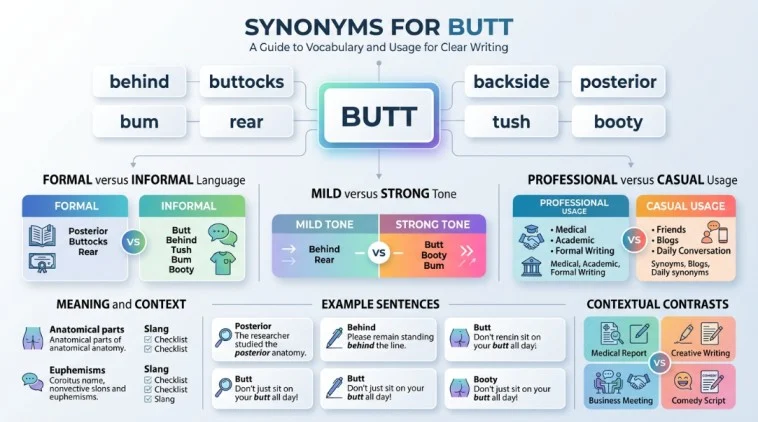
“Butt” commonly means the rear part of the human body, especially the buttocks. Depending on context, alternatives include buttocks for neutral or formal writing, behind for polite conversation, rear for neutral language, and tush, bum, or booty for casual use.
Meaning, Tone and Context
Simple definition
As a noun, butt commonly refers to a person’s buttocks or the rear part of the body.
The word can also have other meanings. As a verb, to butt means to strike or push with the head, horns, or a similar part of the body.
It can also refer to the person who receives a joke or criticism, as in “the butt of the joke.”
Part of speech
Butt is primarily a noun and a verb.
As a noun, it can describe a body part or the target of humor. As a verb, it can describe striking something with the head.
Tone
When butt refers to the body, it is generally informal and conversational.
It is not necessarily offensive, but it can sound too casual in formal, academic, or highly professional writing.
Formality level
Buttocks is more formal and anatomically precise.
Behind and rear are polite, neutral alternatives. Tush, bum, booty, buns, and keister are more casual or playful.
Common use cases
You may see butt in:
- Casual conversation
- Friendly messages
- Humor
- Social media captions
- Fitness discussions
- Informal storytelling
- Everyday American English
Important related forms
Buttocks: formal or neutral noun referring to the two rounded parts of the body.
Butt: informal noun and verb.
Butted: past tense of the verb “butt.”
Butting: present participle of the verb “butt.”
Butt in: to interrupt a conversation or situation, usually without being invited.
When and How to Use “Butt”
“Butt” works best when the setting is informal and the subject does not require anatomical precision.
Casual
“He fell right on his butt.”
Fitness
“The exercise works your butt and legs.”
Personal
“My jeans are tight around the butt.”
Humorous
“That chair made my butt numb after an hour.”
Social media
“This workout seriously burned my butt.”
Storytelling
“He slipped on the ice and landed on his butt.”
Informal conversation
“Move your butt before we miss the movie.”
In formal writing, a more precise alternative usually sounds better.
Another Word for “Butt”
There is no single best replacement for every situation. The right choice depends on tone and meaning.
| Situation | Best Choice |
|---|---|
| Professional writing | rear |
| Academic writing | buttocks |
| Casual conversation | behind |
| Emotional writing | backside |
| Creative writing | rear or hindquarters |
| Resume or workplace use | posterior or buttocks when anatomically relevant |
| Social media captions | booty, buns, or behind |
| Stronger or vulgar meaning | ass |
| Softer meaning | behind |
| Humorous writing | tush or caboose |
For most polite everyday situations, behind is one of the safest alternatives.
For anatomy, fitness, healthcare, or educational writing, buttocks is usually more precise.
When Not to Use “Butt”
When anatomical precision matters
In educational or medical writing, “butt” can sound too informal.
Less precise: “The injury affected his butt.”
More precise: “The injury affected his buttocks.”
When writing formally
A business document usually benefits from neutral vocabulary.
Less suitable: “The chair supports your butt.”
Better: “The chair provides support for your lower body.”
When a softer expression is appropriate
“Behind” can sound more polite than “butt” in family friendly or sensitive conversations.
When the meaning is ambiguous
“Butt” has several meanings, so readers may need context.
For example, “He became the butt of the joke” has nothing to do with anatomy.
Words Commonly Confused With “Butt”
Butt vs. Buttocks
Butt is informal. Buttocks is more formal and anatomically precise.
Butt vs. Behind
Behind is a softer, more polite way to refer to the same general body area.
Butt vs. Rear
Rear is neutral and can describe the back part of a person, animal, object, or vehicle.
Butt vs. Ass
Ass is much more vulgar in many contexts. It can be acceptable in casual speech but is usually unsuitable for formal writing.
Butt vs. Booty
Booty is playful and strongly associated with casual American speech, popular culture, music, and social media.
Butt vs. Rump
Rump is a somewhat old fashioned or humorous term. It is also commonly used for animals.
Best Synonym by Context for “Butt”
| Context | Best Synonym | Why It Works | Example |
|---|---|---|---|
| Formal writing | Buttocks | Anatomically precise | The injury affected the buttocks. |
| Academic writing | Buttocks | Neutral and precise | The study examined pressure around the buttocks. |
| Professional use | Rear | Polite and neutral | The chair supports the rear comfortably. |
| Resume use | Posterior | Appropriate only when relevant | The exercise strengthens the posterior region. |
| Casual conversation | Behind | Natural and polite | She landed on her behind. |
| Creative writing | Rump | Adds descriptive character | The horse shook its rump. |
| Emotional tone | Backside | Softer than vulgar terms | He fell on his backside. |
| Strong intensity | Ass | Very informal and vulgar | He fell hard on his ass. |
| Soft tone | Tush | Gentle and playful | The child sat on her tush. |
| Social media | Booty | Modern and casual | Her workout targets the booty. |
| US usage | Butt | Very common in everyday American English | He fell on his butt. |
| UK usage | Bum | Common informal British English | He landed on his bum. |
Which Synonym Should You Choose?
Start by identifying what you actually mean.
- If you are discussing anatomy, choose buttocks.
- If you want polite everyday language, choose behind or backside.
- If you want neutral language, choose rear.
- If you are writing something humorous, tush, caboose, or rump can work.
For casual American speech, butt is natural. For slang or social media, booty may fit, but it should not replace a more precise term in formal writing.
Real Life Examples of “Butt” in Sentences
School:
The student slipped and landed on his butt during the field trip.
Workplace:
The employee joked that the office chair was hurting her butt.
Writing:
The character fell backward and landed on his butt.
Conversation:
“Get your butt over here when you have a minute.”
Social media:
This workout really targets your butt and legs.
Email:
Please note that this exercise can place pressure on the buttocks.
Storytelling:
He lost his balance, tumbled down the hill, and landed on his butt.
Professional fitness writing:
The movement primarily targets the gluteal muscles rather than simply describing the area as the butt.
25 Synonyms for “Butt”
Because “butt” has several meanings and levels of formality, these alternatives are not interchangeable in every sentence.
| Synonym | Simple Meaning | Best Used For | Example Sentence |
|---|---|---|---|
| Buttocks | The two rounded parts at the back of the body | Formal and anatomical writing | The injury caused pain in the buttocks. |
| Behind | The back part of the body | Polite conversation | She fell on her behind. |
| Rear | The back part of a person or thing | Neutral writing | He sat down on his rear. |
| Backside | The back part of the body | Polite and casual writing | She slipped and landed on her backside. |
| Posterior | The back or rear part of the body | Formal and anatomical contexts | The examination focused on the posterior region. |
| Rump | The rear part of a body, often an animal | Literary and humorous writing | The horse lifted its rump. |
| Hindquarters | The rear section of a body or animal | Descriptive writing | The rider controlled the horse’s hindquarters. |
| Seat | The part of the body used for sitting | Polite or older usage | The wooden bench was hard on his seat. |
| Tush | A playful word for buttocks | Family friendly conversation | The child sat on her tush. |
| Bum | An informal term for buttocks | British English and casual speech | He fell on his bum. |
| Booty | A slang term for buttocks | Casual speech and social media | The workout focuses on the booty. |
| Buns | A playful term for buttocks | Humor and casual speech | Those exercises work your buns. |
| Fanny | A casual term for buttocks in American English | Informal speech | He landed on his fanny. |
| Keister | A humorous informal term for buttocks | Humor and casual speech | Sit your keister down. |
| Caboose | A humorous term for the rear end | Playful writing | The dog wagged its caboose. |
| Tail | A casual or figurative term for the rear | Informal and literary contexts | The animal tucked its tail between its legs. |
| Rear end | The back part of the body | Neutral conversation | He landed hard on his rear end. |
| Back end | The rear portion of something | Informal description | The horse kicked with its back end. |
| Ass | A vulgar informal term for buttocks | Strong casual speech | He fell on his ass. |
| Arse | A vulgar term, especially associated with British English | Informal British usage | He fell on his arse. |
| Can | A slang term for buttocks | Humorous casual speech | Get your can over here. |
| Cheeks | Informal reference to the two sides of the buttocks | Casual speech | She sat carefully on her cheeks. |
| Gluteal region | Anatomical area containing the buttocks | Medical and technical writing | The exercise strengthens the gluteal region. |
| Gluteals | Muscles in the buttock area | Fitness and anatomy | Squats strengthen the gluteals. |
| Hind end | The rear portion of a person or animal | Informal descriptive writing | The dog shook its hind end. |
Synonym Groups and Usage Differences
Professional vs. Personal Synonyms
Professional writing usually favors buttocks, posterior, rear, or gluteal region, depending on the subject.
Personal conversations allow more flexibility. Butt, behind, backside, tush, and rear end can sound natural when the situation is informal.
Formal vs. Conversational Synonyms
For reports, essays, educational material, and formal communication, buttocks is generally the safest direct alternative.
For conversations and texts, behind and backside are more relaxed while remaining relatively polite.
Academic Synonyms
Academic writing should prioritize precision rather than variety.
When the subject is anatomy or physical movement, buttocks, posterior, gluteal region, and gluteals can be appropriate.
Using a slang term simply to avoid repetition can actually make academic writing less precise.
Professional and Business Synonyms
Business writing rarely needs a direct synonym for “butt.”
When the subject involves office furniture, ergonomics, fitness, healthcare, or workplace safety, choose a term that accurately describes the relevant body area.
For example, “buttocks” is preferable to “booty” in an ergonomic report.
Creative or Literary Synonyms
Creative writing gives you more freedom.
Rump, caboose, hindquarters, backside, and rear end can create humor, personality, or a particular narrative voice.
The best choice depends on the character and the mood of the scene.
Slang or Modern Synonyms
Booty, buns, cheeks, can, and ass are informal.
They can work in casual dialogue, humorous content, music related language, or social media. They generally do not belong in academic papers, professional reports, or formal emails.
Strongest vs. Weaker Synonyms
A rough intensity scale can help:
Behind → backside → rear end → butt → booty → buns → ass
This is not a strict dictionary scale because these words differ in formality and cultural associations rather than simply intensity.
Ass is the most vulgar choice on this list.
Emotional vs. Neutral Synonyms
Buttocks, rear, and posterior tend to remain neutral.
Tush and caboose can sound playful.
Booty can sound flirtatious or playful depending on context.
Ass can add anger, humor, emphasis, or vulgarity.
Antonyms of “Butt”
“Butt” does not have 15 true dictionary antonyms when it means the body part. A body part does not have a direct opposite in the same way that “hot” contrasts with “cold.”
The table below therefore provides contextual contrasts, not strict antonyms. Some apply to other meanings of “butt,” such as striking or being the target of humor.
| Contextual Contrast | Meaning | Example Sentence |
|---|---|---|
| Front | Opposite physical direction | The logo appears on the front. |
| Face | Front part of the head | He turned his face toward the camera. |
| Chest | Front area of the torso | The badge was placed on his chest. |
| Abdomen | Front central area of the torso | The movement engages the abdomen. |
| Head | Opposite body location in general context | She rested her head on the pillow. |
| Retreat | Move away instead of advancing or striking | The animal chose to retreat. |
| Withdraw | Move away from a confrontation | He decided to withdraw from the argument. |
| Avoid | Stay away instead of making contact | She tried to avoid the collision. |
| Miss | Fail to make contact | The ball missed the target. |
| Protect | Defend instead of attacking | The shield helped protect him. |
| Defend | Act against an attack | The player moved back to defend. |
| Compliment | Positive remark rather than criticism | Her manager gave her a compliment. |
| Praise | Express approval instead of ridicule | The teacher praised the student’s work. |
| Respect | Treat someone positively instead of making them a joke | Everyone treated him with respect. |
| Subject of praise | Person receiving positive attention instead of ridicule | She became the subject of praise after the performance. |
Comparison: “Butt” vs. Similar Words
Butt vs. Buttocks
Main difference: “Butt” is informal, while “buttocks” is anatomically precise.
Stronger: Neither is inherently stronger.
More formal: Buttocks.
Examples:
“Butt”: He landed on his butt.
“Buttocks”: The injury affected his buttocks.
Butt vs. Behind
Main difference: “Behind” is softer and more polite.
Stronger: Butt sounds more direct.
More formal: Behind is generally more polite, although both are informal.
Examples:
“Butt”: He fell on his butt.
“Behind”: He fell on his behind.
Butt vs. Rear
Main difference: “Rear” is neutral and can describe people, animals, and objects.
Stronger: Butt is more direct.
More formal: Rear is generally more neutral.
Examples:
“Butt”: The chair supports your butt.
“Rear”: The chair supports your rear.
Butt vs. Ass
Main difference: “Ass” is more vulgar.
Stronger: Ass usually sounds more forceful.
More formal: Neither is appropriate for formal writing, but butt is less vulgar.
Examples:
“Butt”: He fell on his butt.
“Ass”: He fell on his ass.
Butt vs. Booty
Main difference: Booty has a playful slang quality.
Stronger: Neither is inherently stronger.
More formal: Butt is less slangy.
Examples:
“Butt”: The exercise works your butt.
“Booty”: The workout focuses on your booty.
Butt vs. Bum
Main difference: “Bum” is especially common in British English, while “butt” is very common in American English.
Stronger: Neither is inherently stronger.
More formal: Neither is formal, although bum can sound softer.
Examples:
“Butt”: He landed on his butt.
“Bum”: He landed on his bum.
Common Phrases and Expressions with “Butt”
1. Move your butt
Meaning: Hurry up or start moving.
Example sentence: Move your butt or we will be late for the movie.
2. Kick butt
Meaning: Perform extremely well or defeat someone.
Example sentence: Our team is ready to kick butt in the final.
3. Bust your butt
Meaning: Work extremely hard.
Example sentence: She busted her butt to finish the project before Friday.
4. Get your butt in gear
Meaning: Start acting quickly or become more productive.
Example sentence: I need to get my butt in gear before the deadline.
5. Save your butt
Meaning: Help someone avoid trouble or a bad outcome.
Example sentence: Her quick thinking saved my butt during the presentation.
6. Put your butt on the line
Meaning: Take a significant risk or accept responsibility.
Example sentence: He put his butt on the line to support the new strategy.
7. The butt of the joke
Meaning: The person who becomes the target of a joke.
Example sentence: Nobody wanted to become the butt of the joke.
8. Sit on your butt
Meaning: Sit without taking action.
Example sentence: You cannot sit on your butt all day and expect the problem to disappear.
Common Mistakes to Avoid
1. Using “butt” when precision matters
Use buttocks or gluteal region when discussing anatomy, healthcare, or technical subjects.
2. Assuming every synonym has the same tone
“Behind” sounds polite, while “ass” is vulgar. They are not interchangeable in every setting.
3. Using slang in formal writing
Avoid terms such as booty, buns, can, and ass in academic essays and professional reports.
4. Choosing an overly dramatic word
A simple sentence does not need an elaborate expression such as hindquarters unless the context calls for it.
5. Repeating “butt” too often
Instead of forcing a synonym into every sentence, restructure the sentence or use a more precise anatomical term.
6. Ignoring emotional tone
“Booty” can sound playful, while “ass” can sound vulgar or aggressive. Consider how the reader will interpret the word.
7. Confusing slang with universal American English
Some expressions are strongly regional, cultural, or generational. Always consider your audience before using them.
FAQs
What is the best synonym for “butt”?
Behind is a strong everyday alternative because it sounds natural, polite, and less blunt than “butt.” Use buttocks for anatomical precision.
What is a formal synonym for “butt”?
Buttocks is the best formal direct synonym when referring to the human body. Posterior can also work in anatomical contexts.
What is an informal synonym for “butt”?
Common informal alternatives include behind, backside, bum, tush, booty, buns, and rear end, depending on tone and region.
What is another word for “butt” in professional writing?
Use buttocks when referring specifically to anatomy. In general workplace writing, rear or a more precise body area may be preferable.
What is the difference between “butt” and “behind”?
“Butt” is more direct and informal, while “behind” is softer and more polite. Both can refer to the rear part of the body.
What is the opposite of “butt”?
There is no single true antonym when “butt” means a body part. Front is a contextual contrast, while other opposites depend on the meaning.
Conclusion
For casual American English, butt remains natural. Words such as booty, buns, tush, and bum add different levels of humor, softness, or slang.
The most useful vocabulary habit is simple: do not replace a word just for variety. Choose the synonym that communicates the exact meaning and tone your reader expects.
Source verification note: Before publishing a dictionary based definition, verify meanings and usage with trusted references such as Cambridge Dictionary, Oxford English Dictionary, Merriam Webster, Collins Dictionary, or Britannica.
Discover More Post:
- 25+ Synonyms for Determine | Meanings, Examples, and Best …
- 25+ Synonyms for Saying | Meanings, Examples, and Best …
- 25+ Synonyms for Compassion | Meanings, Examples, and …