The word “way” appears everywhere. You may use it in an email, essay, resume, caption, conversation, presentation, or everyday sentence without noticing how often it repeats.
The good news is that English offers many alternatives. The best choice depends on whether you mean a method, route, direction, manner, opportunity, process, or style.
This guide explains synonyms for way with clear meanings, natural examples, tone differences, and practical recommendations. You will learn which alternatives sound professional, academic, casual, emotional, or creative, so your writing becomes more precise without sounding forced.
What Does “Way” Mean?
“Way” can mean a method, route, direction, manner, style, or means of achieving something. Formal alternatives include method and approach, while casual choices include path, route, or style, depending on context.
Meaning, Tone and Context
Simple Definition
“Way” is a versatile English word with several meanings. It can describe how something is done, where someone travels, a direction, a method, or a particular manner or style.
For example, “She found a way to solve the problem” uses “way” to mean a method or solution.
In “We are on our way home,” the word refers to movement toward a destination.
Part of Speech
“Way” is primarily a noun.
Examples include:
“Find a better way.”
“She knows the way.”
“There are several ways to improve your writing.”
The word can also appear in common expressions and fixed phrases that give it meanings beyond its basic definition.
Tone
“Way” is generally neutral. It works naturally in casual conversation, academic writing, professional communication, and creative writing.
Its flexibility is one reason it is so common. However, frequent repetition can make writing sound vague or less polished.
Formality Level
“Way” is neither strongly formal nor informal. It is an everyday word that fits most situations.
In professional or academic writing, a more precise synonym can sometimes communicate the intended meaning better.
For example:
“Find a better way to measure results.”
can become:
“Find a more effective method for measuring results.”
The second sentence gives the reader more specific information.
Common Uses
“Way” commonly refers to:
- A method
- A route
- A direction
- A manner
- A style
- A process
- A means of achieving something
- An opportunity or possibility
- A path toward a goal
- A general approach to a situation
Important Word Forms and Related Words
The main noun is “way.”
Related expressions include “ways,” “wayward,” and several compounds and phrases built around the word.
Its meaning changes considerably depending on the surrounding words, which is why context matters when choosing a synonym.
When and How to Use “Way”
“Way” is useful when the exact meaning is already clear from the sentence. It is especially natural when talking about methods, routes, personal styles, or possibilities.
Here are realistic examples from everyday communication.
Professional
“We need to find a better way to communicate with customers.”
Here, “way” means method or approach.
Personal
“I like the way you handled the situation.”
Here, “way” means manner.
Academic
“This study provides a new way to understand consumer behavior.”
Here, “way” means approach or method.
Emotional
“Her kindness changed the way I saw the world.”
Here, “way” refers to a manner of thinking or perceiving.
Creative
“Moonlight showed us the way through the forest.”
Here, “way” means path or route.
Social Media
“Sometimes the best way forward is to start again.”
Here, “way” refers to a course or direction in life.
“Could you suggest a better way to organize these files?”
Here, “way” means method or approach.
Another Word for “Way”
The best single replacement for “way” depends on what you mean.
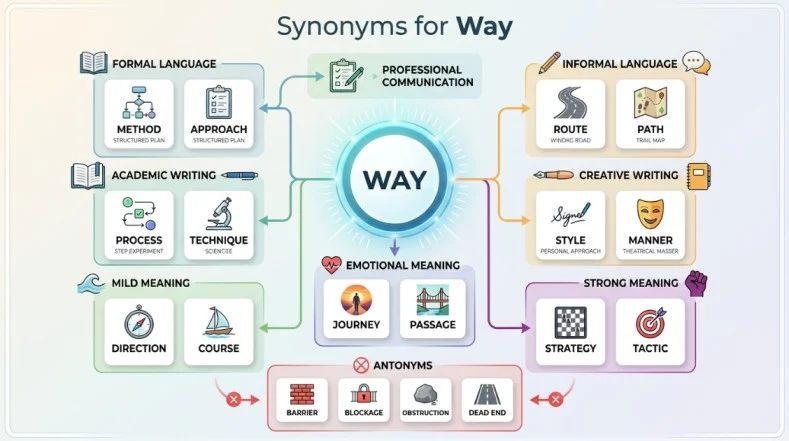
For professional writing, “approach,” “method,” or “process” often works well.
- For academic writing, “method,” “approach,” “procedure,” or “means” can provide greater precision.
- For casual conversation, “way,” “route,” “path,” or “style” usually sounds natural.
- For emotional writing, “path,” “direction,” or “course” can create more feeling.
- For creative writing, “path,” “trail,” “passage,” or “route” can add imagery.
- For resumes and workplace writing, “method,” “approach,” “strategy,” and “process” can sound more specific and professional.
- For social media captions, “path,” “journey,” “route,” or “style” may feel more expressive.
- For a stronger meaning, “strategy,” “procedure,” or “method” can be more specific than the broad word “way.”
- For a softer meaning, “approach,” “style,” or “manner” can sound less rigid.
When Not to Use “Way”
“Way” is not wrong in most everyday sentences, but it can be too broad when your reader needs precise information.
When “way” is too vague
Instead of:
“We need a new way to solve this.”
Try:
“We need a new strategy to solve this.”
“Strategy” tells the reader that the solution involves deliberate planning.
When “way” sounds too general
Instead of:
“She explained the way she completed the research.”
Try:
“She explained the method she used to complete the research.”
“Method” is more appropriate for academic or technical contexts.
When “way” repeats too often
Instead of:
“The way he writes is different from the way he speaks, and the way he presents ideas is also unusual.”
Try:
“His writing style differs from his speaking manner, and his presentation approach is also distinctive.”
The revised version avoids repetition while preserving the meaning.
When a route is intended
Instead of:
“Which way should we take to Chicago?”
You can say:
“Which route should we take to Chicago?”
“Route” is more precise when discussing travel.
When professional precision matters
Instead of:
“This is the best way to improve performance.”
Try:
“This is the most effective approach to improving performance.”
The second sentence sounds more deliberate and professional.
Words Commonly Confused With “Way”
Way vs. Method
“Way” is broad and flexible. “Method” specifically refers to a particular procedure or technique used to accomplish something.
Use “way” for general communication and “method” when precision matters.
Way vs. Manner
“Manner” focuses on how something is done or expressed.
“The way she spoke was reassuring.”
“The manner in which she spoke was reassuring.”
“Manner” is usually more formal.
Way vs. Route
“Route” refers specifically to a path or course used to reach a destination.
Use “route” for travel, transportation, navigation, or movement.
Way vs. Path
“Path” can mean a physical trail or a figurative course toward a goal.
It often has a more personal, emotional, or inspirational quality than “way.”
Way vs. Approach
“Approach” often means a particular method, attitude, or strategy for dealing with something.
It is especially useful in professional and academic writing.
Way vs. Means
“Means” refers to a method or resource used to accomplish something.
It often sounds more formal than “way,” particularly in phrases such as “a means of communication.”
Best Synonym by Context for “Way”
| Context | Best Synonym | Why It Works | Example |
|---|---|---|---|
| Formal writing | Method | Precise and professional | The method produced consistent results. |
| Academic writing | Approach | Fits analytical and research contexts | This approach offers a useful framework. |
| Professional or business use | Strategy | Highlights planning and purpose | The team developed a new strategy. |
| Resume | Method | Shows a specific way of working | Developed methods to improve efficiency. |
| Casual conversation | Route | Natural for directions and travel | This route is faster. |
| Creative writing | Path | Creates imagery and symbolism | She followed a quiet path through the woods. |
| Emotional tone | Course | Suggests direction or life movement | His choices changed the course of his life. |
| Strong intensity | Strategy | Suggests deliberate planning | The company adopted a strategy for growth. |
| Soft or moderate tone | Approach | Sounds measured and flexible | We need a different approach. |
| Social media captions | Path | Works well for personal and inspirational ideas | Trust your own path. |
| US usage | Way | Extremely common and natural | We found a better way to do it. |
| UK usage | Way | Equally standard in everyday English | There is another way to solve it. |
Which Synonym Should You Choose?
Start by identifying what “way” means in your sentence.
- If you mean how something is done, choose “method,” “approach,” “manner,” “technique,” or “procedure.”
- If you mean where someone travels, choose “route,” “path,” “road,” “trail,” or “passage.”
- If you mean a plan for achieving something, choose “strategy,” “approach,” or “course.”
- If you mean a personal style, choose “manner,” “style,” “fashion,” or “mode.”
- If you are writing an academic paper, favor precise words such as “method,” “approach,” “procedure,” and “technique.”
For casual conversation, “way” is usually the most natural choice. You do not need to replace it simply to sound sophisticated.
The strongest vocabulary choice is not always the most complicated word. It is the word that communicates the intended meaning most accurately.
Real Life Examples of “Way” in Sentences
School
“The teacher showed us a simple way to remember the formula.”
A more academic version could use “method.”
Workplace
“We need a more efficient way to manage customer requests.”
“Approach” or “process” may be better when describing a structured workplace system.
Writing
“The author has a unique way of describing ordinary experiences.”
“Style” would be a more precise alternative here.
Conversation
“Do you know the way to the train station?”
“Route” may be preferable when discussing navigation.
Social Media
“Finding your own way takes time.”
“Path” could create a more inspirational tone.
Resume
“Created a new way to organize project information.”
A stronger resume version would be:
“Developed a new method for organizing project information.”
“Could we find another way to resolve this issue?”
“Approach” could sound more professional:
“Could we consider another approach to resolving this issue?”
Storytelling
“He searched for a way through the dark forest.”
“Path,” “trail,” or “passage” could create a more visual description.
25 Synonyms for “Way”
| Synonym | Simple Meaning | Best Used For | Example Sentence |
|---|---|---|---|
| Method | A particular way of doing something | Academic and professional writing | The researchers developed a reliable method for collecting data. |
| Manner | The way something is done or expressed | Formal and descriptive writing | She answered the question in a calm manner. |
| Approach | A particular way of dealing with something | Business, academic, and professional use | The manager took a practical approach to the problem. |
| Means | A method or resource used to achieve something | Formal writing | Education can be a means of creating new opportunities. |
| Route | A path used to reach a destination | Travel and navigation | We chose a shorter route to the airport. |
| Path | A physical or figurative course | Travel, personal growth, and creative writing | He chose a different path after graduation. |
| Road | A physical route or figurative direction | Travel and figurative writing | The road to success requires patience. |
| Trail | A marked or natural path | Outdoor activities and descriptive writing | The hikers followed a narrow trail. |
| Direction | A course or orientation | Travel, planning, and personal development | She needed a clear direction for her career. |
| Course | A particular direction or progression | Formal and figurative contexts | The decision changed the course of the project. |
| Manner | A distinctive way of behaving or doing something | Formal descriptions | His manner of speaking was confident. |
| Style | A distinctive way of doing or expressing something | Writing, art, fashion, and communication | Her writing style is easy to recognize. |
| Fashion | A particular manner or style | Formal and literary contexts | The instructions were presented in a simple fashion. |
| Mode | A particular form or manner of operation | Technical and formal writing | The device has several operating modes. |
| Procedure | An established series of actions | Workplace, academic, and technical contexts | Follow the correct procedure before submitting the form. |
| Process | A series of actions that produces a result | Business, education, and technical writing | The hiring process takes several weeks. |
| Technique | A specific skill or method | Art, sports, education, and professional work | She learned a new technique for improving pronunciation. |
| System | An organized method or structure | Business, technology, and administration | The company introduced a new system for tracking orders. |
| Strategy | A planned approach for reaching a goal | Business, competition, and problem solving | The team created a strategy for increasing sales. |
| Practice | A customary or established way of doing something | Professional and social contexts | Regular feedback is common practice in the department. |
| Avenue | A possible means of achieving something | Formal and figurative writing | Networking can provide an avenue for career growth. |
| Channel | A means through which something is communicated or achieved | Business, media, and communication | Email remains an important channel for customer support. |
| Passage | A route through or across something | Travel and literary writing | The narrow passage led into the garden. |
| Pathway | A route or course toward a destination or goal | Education, careers, and figurative writing | The program provides a pathway to advanced training. |
| Access | A means of reaching or obtaining something | Technology, business, and formal contexts | The new policy gives employees access to additional resources. |
Synonym Groups and Usage Differences
Professional vs. Personal Synonyms
Professional writing usually benefits from precise terms.
“Method,” “approach,” “strategy,” “process,” “procedure,” and “technique” are strong workplace choices.
Personal writing can use more expressive words such as “path,” “direction,” “course,” and “journey,” especially when discussing life decisions or emotions.
Compare:
“She found a new way to build her career.”
with:
“She developed a new strategy for advancing her career.”
The second sentence emphasizes planning and professional action.
Formal vs. Conversational Synonyms
“Way” is highly conversational and remains perfectly acceptable in everyday speech.
“Method,” “manner,” “means,” “procedure,” and “mode” tend to sound more formal.
For an email to a coworker, “approach” is usually natural:
“We should try a different approach.”
For a casual text, “way” sounds simpler:
“Maybe there is another way.”
Choose the word that matches the relationship with your reader and the purpose of the message.
Academic Synonyms
Academic writing benefits from precision rather than unnecessary complexity.
- Use “method” when discussing how research was conducted.
- Use “approach” when discussing a framework or perspective.
- Use “technique” when describing a specific skill or procedure.
- Use “procedure” when describing an established sequence of actions.
- Use “means” when discussing how something can be achieved.
For example:
“The researchers used a new method to analyze the data.”
is more precise than:
“The researchers used a new way to analyze the data.”
Professional and Business Synonyms
In workplace communication, the best synonym depends on the specific meaning.
- Use “strategy” for planned action.
- Use “process” for a series of organized steps.
- Use “method” for a particular technique.
- Use “approach” for a general way of handling an issue.
- Use “channel” for communication or distribution.
- Use “procedure” for established workplace instructions.
For example:
“We need a better way to handle customer complaints.”
can become:
“We need a more effective process for handling customer complaints.”
That revision gives the reader a clearer understanding of what needs improvement.
Creative or Literary Synonyms
Creative writing often benefits from words that create movement or imagery.
“Path,” “trail,” “road,” “passage,” and “course” can make descriptions more vivid.
Consider:
“She searched for a way through the forest.”
A more visual version is:
“She searched for a narrow path through the forest.”
The second sentence gives the reader a clearer mental image.
Slang or Modern Synonyms
There is no single slang replacement for “way” that works across all meanings.
Informal expressions often depend on the specific meaning.
For example, “route” can sound casual when discussing travel, while “style” can describe someone’s personal manner.
Avoid forcing slang into professional or academic writing simply to make the language sound modern.
Natural vocabulary is more effective than vocabulary chosen only for novelty.
Strongest vs. Weaker Synonyms
There is no universal intensity ranking because each synonym changes the meaning rather than simply making “way” stronger.
A useful scale for specificity is:
Way → approach → method → procedure → technique
“Way” is broad.
“Approach” suggests a general perspective or plan.
“Method” suggests a defined way of doing something.
“Procedure” suggests established steps.
“Technique” often suggests a specialized skill or method.
For planning, another useful progression is:
Way → approach → strategy
The strongest choice depends on the sentence, not on the length or complexity of the word.
Emotional vs. Neutral Synonyms
“Method,” “process,” “procedure,” and “system” usually remain neutral.
“Path,” “journey,” “road,” and “course” can carry emotional or symbolic meaning.
Compare:
“She chose a new method for improving her skills.”
with:
“She chose a new path for her life.”
The first is practical. The second feels personal and emotional.
Antonyms of “Way”
Because “way” has many meanings, it does not have one universal opposite. The following words function as contextual opposites when “way” refers to access, movement, progress, possibility, or a method.
| Antonym | Meaning | Example Sentence |
|---|---|---|
| Barrier | Something that prevents movement or progress | The language barrier made communication difficult. |
| Blockage | Something that stops movement or access | The blockage prevented traffic from moving. |
| Obstruction | Something that blocks a route or process | The fallen tree was an obstruction on the road. |
| Hindrance | Something that makes progress difficult | Lack of funding became a major hindrance. |
| Impasse | A situation with no apparent progress | The negotiations reached an impasse. |
| Dead end | A route or situation that does not lead anywhere useful | The investigation eventually reached a dead end. |
| Closure | The act of closing access or an opening | The closure prevented visitors from entering. |
| Restriction | A rule or condition that limits action | The new restriction reduced public access. |
| Prohibition | An official ban on an action | The prohibition prevented the activity. |
| Inaccessibility | The condition of being difficult or impossible to reach | The area’s inaccessibility delayed the project. |
| Inability | Lack of capacity to accomplish something | His inability to adapt created difficulties. |
| Indecision | Failure to choose a course of action | Her indecision delayed the project. |
| Inaction | Failure to take action | Continued inaction allowed the problem to grow. |
| Stagnation | A lack of movement or progress | The organization experienced years of stagnation. |
| Closure point | A point beyond which progress cannot continue | The discussion reached a closure point without agreement. |
Comparison: “Way” vs. Similar Words
“Way” vs. “Method”
Main difference: “Way” is broad, while “method” usually refers to a specific way of doing something.
Which one is stronger: “Method” is more precise.
Which one is more formal: “Method” is more formal.
Example with way:
“We found a better way to organize the information.”
Example with method:
“We developed a better method for organizing the information.”
“Way” vs. “Approach”
Main difference: “Approach” often describes how someone handles a problem, subject, or situation.
Which one is stronger: “Approach” is more specific in analytical contexts.
Which one is more formal: “Approach” is generally more professional.
Example with way:
“We need another way to handle the issue.”
Example with approach:
“We need another approach to handling the issue.”
“Way” vs. “Manner”
Main difference: “Manner” focuses on how something is performed, expressed, or presented.
Which one is stronger: Neither is inherently stronger.
Which one is more formal: “Manner” is generally more formal.
Example with way:
“I liked the way she explained the concept.”
Example with manner:
“I liked the manner in which she explained the concept.”
“Way” vs. “Route”
Main difference: “Route” specifically refers to a course used to reach a destination.
Which one is stronger: “Route” is more precise for navigation.
Which one is more formal: Both are standard, but “route” is more specific.
Example with way:
“Which way should we go?”
Example with route:
“Which route should we take?”
“Way” vs. “Path”
Main difference: “Path” can describe a physical route or a figurative direction in life.
Which one is stronger: “Path” can sound more expressive.
Which one is more formal: Neither is strongly formal.
Example with way:
“She found a way to reach her goal.”
Example with path:
“She found a path toward her goal.”
“Way” vs. “Strategy”
Main difference: “Strategy” implies deliberate planning to achieve a particular goal.
Which one is stronger: “Strategy” is more specific and purposeful.
Which one is more formal: “Strategy” is more professional in business contexts.
Example with way:
“We need a better way to increase sales.”
Example with strategy:
“We need a stronger strategy for increasing sales.”
Common Phrases and Expressions with “Way”
1. Find a way
Meaning: Discover a method or solution for achieving something.
Example sentence:
“We will find a way to complete the project on time.”
2. On the way
Meaning: Traveling toward a destination or moving toward a particular point.
Example sentence:
“I will call you on the way home.”
3. By the way
Meaning: Used to introduce an additional or related point in conversation.
Example sentence:
“By the way, the meeting has been moved to Friday.”
4. In the way
Meaning: Blocking movement, progress, or access.
Example sentence:
“Please move that chair because it is in the way.”
5. Out of the way
Meaning: Away from the main area or no longer causing an obstruction.
Example sentence:
“We moved the boxes out of the way.”
6. All the way
Meaning: Completely or for the entire distance.
Example sentence:
“She drove all the way across the state.”
7. Make way
Meaning: Move aside to allow someone or something to pass.
Example sentence:
“The crowd made way for the emergency vehicle.”
8. Way of life
Meaning: The typical habits, values, and practices of a person or community.
Example sentence:
“Fishing has been an important part of their way of life.”
Common Mistakes to Avoid
1. Using “way” when a more precise synonym is available
“Way” can be vague in professional and academic writing.
Instead of “a new way,” consider “a new method,” “approach,” “strategy,” or “process” when the context supports it.
2. Confusing “way” with “route”
“Way” can refer to a route, but “route” specifically describes a course used to reach a destination.
Use “route” when navigation is the main meaning.
3. Using a casual synonym in formal writing
Words such as “way” are not incorrect, but a formal document may benefit from “method,” “procedure,” or “approach.”
Always choose based on meaning rather than formality alone.
4. Using an overly dramatic synonym
“Path” may sound inspiring in a motivational caption, but it can feel unnecessarily emotional in a technical report.
Match the vocabulary to the purpose.
5. Repeating “way” too often
Repeated use can make writing feel flat.
Replace some instances with precise alternatives when the meaning changes, but do not replace every occurrence mechanically.
6. Choosing the wrong emotional tone
“Method” sounds practical.
“Path” can sound personal.
“Course” can sound formal or reflective.
“Strategy” sounds deliberate.
Choosing the wrong word can subtly change the message.
7. Using slang in academic or professional writing
Informal vocabulary may be suitable for texts and casual posts, but academic essays, resumes, and business reports usually require clearer standard English.
Precision should come before trendiness.
FAQs
What is the best synonym for “way”?
The best synonym depends on context. “Method” works for procedures, “approach” for problem solving, “route” for travel, and “path” for physical or figurative direction.
What is a formal synonym for “way”?
“Method,” “manner,” “means,” “procedure,” and “approach” are formal alternatives. The best choice depends on whether you mean a process, style, or strategy.
What is an informal synonym for “way”?
“Route,” “path,” and “style” can work informally when their meanings match. In ordinary conversation, “way” itself is already natural and appropriate.
What is another word for “way” in professional writing?
“Approach,” “method,” “strategy,” “process,” and “procedure” are strong professional alternatives. Choose the word that describes the exact workplace meaning.
What is the difference between “way” and “method”?
“Way” has many meanings and is very broad. “Method” specifically describes a particular procedure or technique used to accomplish something.
What is the opposite of “way”?
There is no single universal antonym because “way” has several meanings. Contextual opposites include barrier, blockage, obstruction, impasse, and dead end.
Conclusion
The word “way” is useful because it can describe a method, route, direction, manner, style, process, or possibility. Its flexibility makes it common in both spoken and written English.
The best synonyms for way depend on context. Use “method” for a specific procedure, “approach” for problem solving, “strategy” for planned action, “route” for travel, “path” for physical or figurative direction, and “manner” for how something is done.
The most useful vocabulary tip is simple: do not replace “way” just to use a bigger word. Replace it when another word expresses your exact meaning more clearly.
Discover More Post:
- 25+ Synonyms for Affect | Meanings, Examples, and Best …
- 25+ Synonyms for Achieve | Meanings, Examples, and Best …
- 25+ Synonyms for Real | Meanings, Examples, and Best …