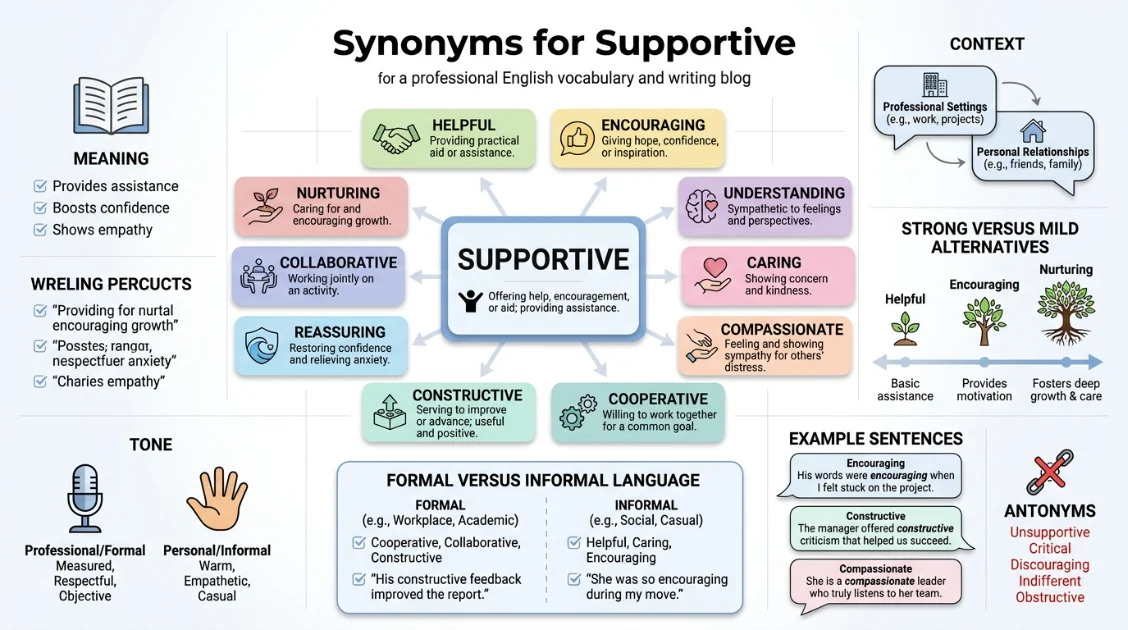
Using the word supportive again and again can make an email, essay, caption, resume, or conversation sound repetitive. The good news is that English offers many alternatives, but each one carries a slightly different meaning, tone, or level of warmth.
Words such as encouraging, helpful, understanding, cooperative, compassionate, and reassuring can all describe support, yet they are not interchangeable in every sentence. Choosing the right synonym makes your writing more precise and helps readers understand exactly what kind of support you mean.
This guide explains the meaning of supportive, shows another word for supportive in different situations, and compares 25 useful alternatives. You will also find professional, academic, emotional, casual, and creative choices that work naturally in American English.
What Does “Supportive” Mean?
Supportive means providing help, encouragement, approval, understanding, or practical assistance. The best synonym depends on context: encouraging for motivation, helpful for assistance, cooperative for teamwork, compassionate for emotional care, and constructive for useful feedback.
Meaning, Tone and Context
Simple Definition
Supportive describes someone or something that gives help, encouragement, approval, protection, or assistance to another person, idea, goal, or activity.
For example, a supportive friend listens during difficult moments and encourages you to keep going.
Part of Speech
Supportive is an adjective.
It describes a person, attitude, environment, action, relationship, comment, workplace, family, or system.
Example:
“She has always been supportive of my career goals.”
Tone
Supportive generally has a positive tone.
It suggests kindness, encouragement, cooperation, understanding, or useful assistance. The exact feeling depends on the surrounding sentence.
Formality Level
Supportive is neutral and versatile.
It works well in casual conversations, professional emails, academic writing, resumes, personal statements, reviews, social media captions, and creative writing.
Common Use Cases
Supportive is commonly used for:
- Friends and family
- Teachers and mentors
- Coworkers and managers
- Workplaces
- Relationships
- Communities
- Feedback
- Learning environments
- Personal goals
- Emotional situations
Related Word Forms
Support is the related noun and verb.
Supportively is the adverb, although it is less common in everyday writing.
Supporter is a noun for a person who provides support.
Opposing, unsupportive, and discouraging can express contrasting ideas depending on context.
When and How to Use “Supportive”
Use supportive when you want to describe someone or something that actively helps, encourages, understands, or strengthens another person or goal.
The word is especially useful when the exact type of assistance is broader than simple physical or practical help.
Professional
“My manager has been supportive throughout the transition.”
This describes a manager who provides encouragement, guidance, or assistance.
Personal
“My family has always been supportive of my decisions.”
Here, supportive communicates acceptance and encouragement.
Academic
“The professor created a supportive learning environment.”
The word suggests an environment where students receive encouragement and useful assistance.
Emotional
“She was incredibly supportive when I was going through a difficult period.”
The emphasis is on emotional understanding and care.
“Thank you for being so supportive during this project.”
This sounds appreciative and professional without being overly formal.
Resume
“Built supportive relationships with clients and team members.”
For a resume, a more specific word such as collaborative or cooperative may sometimes communicate the skill more clearly.
Social Media
“Grateful for the supportive people who keep believing in me.”
The word works naturally in personal captions because it feels warm and sincere.
Another Word for “Supportive”
There is no single perfect replacement for supportive because the intended meaning changes with context.
- Professional writing: cooperative or constructive
- Academic writing: encouraging or constructive
- Casual conversation: helpful or encouraging
- Emotional writing: compassionate or understanding
- Creative writing: caring or nurturing
- Resume or workplace use: collaborative or cooperative
- Social media captions: encouraging or uplifting
- Stronger meaning: compassionate or nurturing
- Softer meaning: considerate or understanding
If you need one broadly useful alternative, helpful is often the safest choice for practical support. For emotional support, understanding or compassionate is usually more precise.
When Not to Use “Supportive”
Supportive can sometimes sound too general.
For example:
“The manager was supportive.”
This does not explain what the manager actually did.
A more precise sentence could be:
“The manager provided constructive feedback and helped the team solve the problem.”
Supportive may also sound too emotional in highly technical writing. In those situations, words such as cooperative, effective, practical, or constructive may provide clearer information.
Avoid replacing supportive with an extremely emotional word when the situation only involves ordinary assistance.
Words Commonly Confused With “Supportive”
Supportive vs. Helpful
Helpful focuses strongly on providing assistance.
Supportive is broader and can include emotional encouragement, approval, or practical help.
Supportive vs. Encouraging
Encouraging focuses on motivation and confidence.
Supportive can involve encouragement, but it can also mean practical or emotional assistance.
Supportive vs. Sympathetic
Sympathetic means showing understanding or concern for another person’s difficulty.
Supportive usually suggests an active willingness to help or encourage.
Supportive vs. Cooperative
Cooperative means willing to work with others.
Supportive can describe cooperation, but it can also describe emotional or personal support.
Supportive vs. Compassionate
Compassionate emphasizes concern for another person’s suffering and a desire to help.
Supportive is broader and does not always involve hardship.
Supportive vs. Reassuring
Reassuring means reducing fear, worry, or uncertainty.
A supportive person may be reassuring, but support can take many other forms.
Best Synonym by Context for “Supportive”
| Context | Best Synonym | Why It Works | Example |
|---|---|---|---|
| Formal writing | Constructive | Suggests useful and positive contribution | The committee provided constructive feedback. |
| Academic writing | Encouraging | Fits motivation and learning | The instructor created an encouraging classroom. |
| Professional use | Cooperative | Highlights teamwork and willingness to work together | She is cooperative with colleagues. |
| Business communication | Helpful | Clear and practical | The representative was helpful throughout the process. |
| Resume | Collaborative | Highlights teamwork and professional relationships | Developed collaborative relationships across departments. |
| Casual conversation | Helpful | Natural and familiar | My neighbor was really helpful. |
| Creative writing | Caring | Adds warmth and emotional depth | Her caring nature made everyone feel welcome. |
| Emotional tone | Compassionate | Highlights concern and kindness | He offered compassionate support during the crisis. |
| Strong intensity | Nurturing | Suggests sustained care and development | She provided a nurturing environment for young learners. |
| Soft tone | Considerate | Suggests thoughtfulness without strong emotion | He was considerate of everyone’s concerns. |
| Social media | Encouraging | Sounds positive and personal | Thankful for such encouraging friends. |
| Feedback | Constructive | Indicates useful improvement focused input | The editor gave constructive suggestions. |
| Teamwork | Cooperative | Emphasizes working well with others | The staff remained cooperative under pressure. |
| Mentoring | Guiding | Suggests direction and advice | Her guiding influence helped me grow. |
| Emotional reassurance | Reassuring | Reduces anxiety or uncertainty | His reassuring message calmed the team. |
Which Synonym Should You Choose?
Start by identifying what kind of support the sentence describes.
- Choose helpful when someone provides practical assistance.
- Choose encouraging when someone increases confidence or motivation.
- Choose understanding when someone respects another person’s feelings or situation.
- Choose compassionate when the situation involves suffering, hardship, or emotional pain.
- Choose cooperative when the main idea involves teamwork.
- Choose constructive when support comes through useful feedback, suggestions, or criticism.
- Choose caring when you want a warm and personal tone.
- Choose nurturing when someone helps another person develop, grow, or gain confidence over time.
- The strongest choice is not necessarily the most sophisticated word. The best synonym is the one that communicates the intended meaning naturally and precisely.
Real Life Examples of “Supportive” in Sentences
School
“A supportive teacher can make students feel more confident about participating in class.”
Workplace
“Our team has a supportive manager who listens to concerns and encourages new ideas.”
Writing
“The author creates a supportive community that helps the main character grow.”
Conversation
“My sister has always been supportive of my choices.”
Social Media
“I am grateful for everyone who has been supportive of my journey.”
Resume
“Maintained supportive relationships with customers and internal teams.”
“Thank you for your supportive feedback and guidance.”
Storytelling
“Despite the difficult circumstances, she found a supportive friend who never stopped believing in her.”
25 Synonyms for “Supportive”
| Synonym | Simple Meaning | Best Used For | Example Sentence |
|---|---|---|---|
| Helpful | Giving useful assistance | Everyday and professional situations | The assistant was helpful throughout the process. |
| Encouraging | Giving confidence or motivation | School, work, personal goals | Her encouraging words helped me continue. |
| Understanding | Showing awareness of another person’s feelings | Personal and emotional situations | My supervisor was understanding about the situation. |
| Caring | Showing concern and affection | Relationships and personal writing | He is a caring friend who always checks in. |
| Compassionate | Showing concern for suffering | Emotional and serious situations | The nurse provided compassionate care. |
| Sympathetic | Showing concern for someone’s difficulty | Emotional conversations | She was sympathetic when I explained the problem. |
| Reassuring | Making someone feel calmer or safer | Anxiety, uncertainty, and emotional situations | His reassuring response eased my concerns. |
| Constructive | Providing useful guidance for improvement | Feedback, education, and work | The editor offered constructive criticism. |
| Cooperative | Willing to work with others | Teams and workplaces | The department was cooperative during the transition. |
| Collaborative | Working effectively with others | Professional and academic settings | The project required a collaborative approach. |
| Considerate | Thinking about other people’s needs and feelings | Personal and professional communication | She was considerate of everyone’s schedule. |
| Nurturing | Helping someone develop and grow | Education, parenting, mentoring | The coach created a nurturing environment. |
| Attentive | Giving careful attention | Customer service and relationships | The staff was attentive to every guest. |
| Responsive | Reacting quickly and appropriately to needs | Business, customer service, and technology | The support team was responsive to our requests. |
| Affirming | Showing acceptance or positive recognition | Emotional and personal communication | Her affirming comments increased his confidence. |
| Approving | Expressing acceptance or agreement | Decisions, ideas, and personal situations | His approving response encouraged the team. |
| Validating | Recognizing that someone’s feelings or concerns are understandable | Emotional communication | Her validating response made me feel heard. |
| Protective | Trying to keep someone safe from harm | Family and relationships | His protective nature came from genuine concern. |
| Facilitative | Making a process easier or more effective | Formal and professional writing | The facilitator used a facilitative approach. |
| Enabling | Making an action or outcome possible | Professional and technical contexts | The new system enabled more efficient communication. |
| Beneficial | Producing a positive effect | Academic and formal writing | The program had beneficial effects on student learning. |
| Favorable | Expressing approval or positive conditions | Formal and business writing | The company received favorable feedback. |
| Assisting | Providing direct help | Formal and professional contexts | The staff played an assisting role during the event. |
| Uplifting | Making someone feel more hopeful or positive | Emotional and creative writing | Her uplifting message brightened my day. |
| Guiding | Providing direction or advice | Mentoring, education, and personal growth | His guiding advice helped me make the right choice. |
Synonym Groups and Usage Differences
Professional vs. Personal Synonyms
Professional writing often benefits from words that describe observable behavior.
Collaborative, cooperative, constructive, responsive, and helpful are strong workplace choices because they communicate specific forms of support.
Personal writing can use warmer words such as caring, compassionate, understanding, reassuring, and nurturing.
The best choice depends on whether you want to emphasize performance or emotional connection.
Formal vs. Conversational Synonyms
In reports and professional documents, constructive, cooperative, collaborative, facilitative, and responsive can sound precise.
In casual conversations, helpful, caring, encouraging, and understanding usually sound more natural.
A sophisticated synonym is not automatically better. Natural language is generally more effective than unnecessarily complicated vocabulary.
Academic Synonyms
Academic writing benefits from precise language.
Constructive works well for feedback. Facilitative works well when describing something that makes learning or a process easier. Beneficial works well when describing a positive effect.
Encouraging can also work when discussing motivation, confidence, or educational environments.
Professional and Business Synonyms
For workplace communication, consider what the person actually did.
- Use cooperative for teamwork.
- Use collaborative for shared work.
- Use responsive for timely reactions.
- Use constructive for useful feedback.
- Use helpful for practical assistance.
- Use considerate for thoughtful behavior.
These words provide more information than simply saying someone was supportive.
Creative or Literary Synonyms
Creative writing often benefits from words that communicate emotional character.
Caring, compassionate, nurturing, reassuring, uplifting, and protective can create stronger emotional impressions.
For example, “a supportive mother” gives a general impression, while “a nurturing mother” suggests someone who actively helps another person grow.
Slang or Modern Synonyms
There are informal expressions such as “hype,” “cheerleader,” or “in your corner” that can communicate support in modern conversational English.
These expressions are highly context dependent.
They can work in social media captions, texts, and casual conversations, but they are usually inappropriate for academic essays, formal reports, resumes, and professional documents.
Strongest vs. Weaker Synonyms
A useful intensity scale can look like this:
Mild: considerate, helpful
Moderate: understanding, encouraging, cooperative
Strong: caring, reassuring, compassionate
Very strong: nurturing, protective
The exact strength depends on context. A word can feel stronger because of emotional meaning rather than because it literally represents a greater amount of support.
Emotional vs. Neutral Synonyms
Neutral choices include helpful, cooperative, responsive, collaborative, and constructive.
More emotional choices include caring, compassionate, nurturing, reassuring, and uplifting.
Choose neutral language when accuracy and professionalism matter most. Choose emotional language when relationships, feelings, or personal experiences are central to the sentence.
Antonyms of “Supportive”
| Antonym | Meaning | Example Sentence |
|---|---|---|
| Unsupportive | Not providing support | His unsupportive response made the situation harder. |
| Discouraging | Reducing confidence or motivation | The discouraging comments affected her confidence. |
| Opposing | Actively resisting an idea or action | The group was opposing the proposed change. |
| Critical | Focusing on faults or problems | The review was highly critical of the proposal. |
| Hostile | Unfriendly or strongly against someone | The audience became hostile toward the speaker. |
| Dismissive | Treating something as unimportant | Her dismissive response ended the discussion. |
| Indifferent | Showing little concern | He seemed indifferent to their concerns. |
| Uncooperative | Unwilling to work with others | The uncooperative employee delayed the project. |
| Unsympathetic | Showing little understanding of another person’s difficulty | The response sounded unsympathetic. |
| Unhelpful | Failing to provide useful assistance | The instructions were confusing and unhelpful. |
| Neglectful | Failing to give needed care or attention | The neglectful approach caused additional problems. |
| Resistant | Unwilling to accept or cooperate with something | The team was resistant to the new policy. |
| Adverse | Creating an unfavorable effect or condition | The decision had adverse consequences. |
| Detrimental | Causing harm or disadvantage | The change could be detrimental to productivity. |
| Obstructive | Making progress difficult or preventing it | His obstructive behavior slowed the discussion. |
Comparison: “Supportive” vs. Similar Words
Supportive vs. Helpful
Main difference: Supportive can include emotional encouragement, approval, and practical assistance. Helpful focuses more directly on providing useful assistance.
Which one is stronger: Supportive can sound more personal, while helpful can sound more practical.
Which one is more formal: Both are neutral and widely accepted.
Supportive example: “She was supportive when I changed careers.”
Helpful example: “She was helpful when I prepared my resume.”
Supportive vs. Encouraging
Main difference: Encouraging focuses on motivation and confidence.
Which one is stronger: Encouraging can feel more motivational, while supportive is broader.
Which one is more formal: Both work in professional and academic writing.
Supportive example: “My professor was supportive throughout the semester.”
Encouraging example: “My professor gave encouraging feedback after my presentation.”
Supportive vs. Understanding
Main difference: Understanding emphasizes awareness of someone’s feelings or circumstances.
Which one is stronger: Neither is universally stronger.
Which one is more formal: Both are neutral.
Supportive example: “My manager was supportive during the transition.”
Understanding example: “My manager was understanding when I needed additional time.”
Supportive vs. Compassionate
Main difference: Compassionate specifically suggests concern for someone experiencing hardship or suffering.
Which one is stronger: Compassionate usually carries stronger emotional weight.
Which one is more formal: Both can work in formal writing, depending on context.
Supportive example: “The organization was supportive of affected families.”
Compassionate example: “The organization offered compassionate assistance to affected families.”
Supportive vs. Cooperative
Main difference: Cooperative describes willingness to work together.
Which one is stronger: Supportive may feel more personal, while cooperative focuses on behavior within a shared task.
Which one is more formal: Cooperative often fits workplace writing especially well.
Supportive example: “The manager was supportive of the team.”
Cooperative example: “The manager was cooperative during the planning process.”
Supportive vs. Reassuring
Main difference: Reassuring specifically reduces worry, fear, or uncertainty.
Which one is stronger: Reassuring is more specific emotionally.
Which one is more formal: Both can be used professionally.
Supportive example: “Her message was supportive.”
Reassuring example: “Her message was reassuring and helped calm the team.”
Common Phrases and Expressions with “Supportive”
1. Supportive Environment
Meaning:
A setting where people receive encouragement, assistance, understanding, or acceptance.
Example sentence:
“The school aims to create a supportive environment for every student.”
2. Supportive Friend
Meaning:
A friend who provides encouragement, understanding, or assistance.
Example sentence:
“Having a supportive friend can make difficult moments easier.”
3. Supportive Family
Meaning:
A family that provides emotional or practical encouragement.
Example sentence:
“She credits her supportive family for helping her pursue her goals.”
4. Supportive Community
Meaning:
A group of people who encourage and assist one another.
Example sentence:
“The online group has become a supportive community for new writers.”
5. Supportive Workplace
Meaning:
A workplace that encourages employees and provides a healthy environment for growth.
Example sentence:
“Employees perform better in a supportive workplace.”
6. Supportive Relationship
Meaning:
A relationship based on encouragement, understanding, respect, and assistance.
Example sentence:
“A supportive relationship allows both people to grow.”
7. Supportive Role
Meaning:
A role focused on helping another person or group succeed.
Example sentence:
“She played a supportive role during the project.”
8. Supportive Feedback
Meaning:
Feedback intended to help someone improve rather than simply point out problems.
Example sentence:
“The editor gave supportive feedback that made the article stronger.”
Common Mistakes to Avoid
1. Using Supportive When a Precise Word Is Better
“The manager was supportive” is broad.
If the manager gave useful suggestions, “The manager provided constructive feedback” is more precise.
2. Confusing Supportive With Encouraging
Encouraging specifically relates to motivation.
Use supportive when the person provides broader emotional, practical, or interpersonal assistance.
3. Using a Casual Synonym in Formal Writing
Expressions such as “cheerleader” or “in your corner” can sound too casual in reports and academic essays.
Choose constructive, cooperative, or encouraging instead.
4. Using an Overly Dramatic Synonym
Do not use compassionate or nurturing when the situation only involves ordinary workplace cooperation.
A simpler word such as helpful or cooperative may be more accurate.
5. Repeating Supportive Too Often
Repeating the same adjective can make writing feel flat.
Replace it with a contextually accurate alternative instead of changing every occurrence automatically.
6. Choosing the Wrong Emotional Tone
Compassionate sounds more emotionally involved than cooperative.
Make sure the synonym matches the relationship and situation.
7. Using Slang in Academic or Professional Writing
Informal expressions may sound natural in conversation but weaken formal writing.
Use precise vocabulary that matches your audience.
FAQs
What is the best synonym for supportive?
The best synonym depends on meaning. Helpful works for practical assistance, encouraging for motivation, understanding for empathy, and cooperative for teamwork.
What is a formal synonym for supportive?
Constructive, cooperative, collaborative, facilitative, and responsive can work as formal alternatives when they accurately describe the type of support.
What is an informal synonym for supportive?
Helpful, caring, encouraging, and understanding are natural informal alternatives. Expressions such as “in your corner” are even more conversational.
What is another word for supportive in professional writing?
Collaborative, cooperative, constructive, responsive, and helpful are strong professional choices. Select the word that describes the specific workplace behavior.
What is the difference between supportive and encouraging?
Supportive is broader and can include practical or emotional assistance. Encouraging specifically focuses on building confidence, motivation, or hope.
What is the opposite of supportive?
Common opposites include unsupportive, discouraging, unhelpful, opposing, dismissive, uncooperative, and unsympathetic. The best antonym depends on context.
Conclusion
Supportive is a versatile adjective that describes help, encouragement, understanding, approval, and assistance. Because the word covers several ideas, the best synonym depends on what kind of support you want to communicate.
Use helpful for practical assistance, encouraging for motivation, understanding for empathy, compassionate for emotional care, cooperative for teamwork, and constructive for useful feedback.
When choosing among synonyms for supportive, focus on meaning first and tone second. A precise word is usually stronger than a complicated one.
A simple vocabulary tip is to ask what the person actually did. IThey encouraged you, use encouraging. If they worked with you, use cooperative. If they gave useful feedback, use constructive. This approach makes your writing clearer, more natural, and more effective.
Discover More Post:
- 25+ Synonyms for Determine | Meanings, Examples, and Best …
- 25+ Synonyms for Share | Meanings, Examples and Best …
- 25+ Synonyms for Affect | Meanings, Examples, and Best …