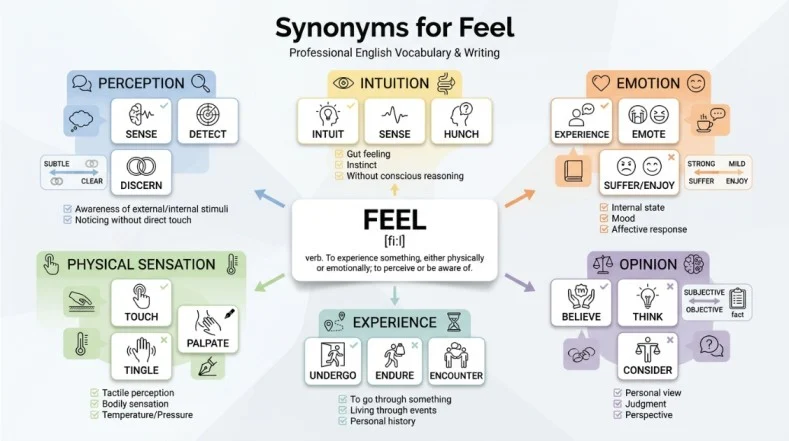
The word feel appears everywhere. You feel happy, feel nervous, feel the fabric, feel that something is wrong, or feel confident about a decision. In everyday English, it works beautifully, but repeating it too often can make writing sound flat.
Knowing the right synonyms for feel helps you express physical sensations, emotions, opinions, perceptions, and personal reactions with greater precision. The best replacement depends on your sentence, audience, tone, and intended meaning, especially in essays, resumes, emails, captions, and professional communication.
What Does “Feel” Mean?
Feel means to experience a physical sensation, emotion, belief, or impression. Depending on context, useful alternatives include sense, experience, perceive, believe, think, undergo, empathize, touch, notice, and detect.
Meaning, Tone and Context
Simple Definition
Feel means to experience something through your body, emotions, mind, or senses. It can also describe having an opinion or impression about something.
For example, you can feel cold, feel excited, feel the texture of a shirt, or feel that a decision is right.
Part of Speech
Feel is primarily a verb.
It can also function as a noun in expressions such as a feel for something, meaning an intuitive understanding of it.
Tone
The word feel is generally neutral. Its emotional tone depends on the words surrounding it.
For example, feel joyful has a positive tone, while feel disappointed has a negative tone.
Formality Level
Feel is common in everyday English and works in both casual and professional communication.
In formal or academic writing, a more precise word such as perceive, believe, experience, observe, or consider can sometimes communicate the intended meaning more clearly.
Common Use Cases
You may use feel when discussing:
- Physical sensations
- Emotions
- Personal opinions
- Intuition
- Perception
- Empathy
- Experiences
- Texture and touch
- Confidence or uncertainty
- Reactions to people or situations
Important Word Forms
Feel: verb
Feels: present tense verb for third person singular
Felt: past tense and past participle
Feeling: present participle and noun
Felt: also describes a type of material
When and How to Use “Feel”
Feel is useful when you want to describe an internal experience, physical sensation, emotional response, intuitive impression, or personal belief.
1. Professional
“I feel confident about presenting the proposal to the client.”
This works in conversation, although I am confident sounds more direct in formal business writing.
2. Personal
“I feel much happier after spending time with my family.”
Here, feel clearly describes an emotional state.
3. Academic
“Many students feel pressure before major examinations.”
The word is acceptable, although experience pressure may sound more precise in some academic contexts.
4. Emotional
“She felt deeply disappointed by the decision.”
Felt naturally communicates an emotional reaction.
5. Creative
“The room felt warm and peaceful.”
Here, felt describes the overall impression or atmosphere.
6. Social Media
“Feeling grateful for every little moment today.”
This shortened structure is common in captions and informal online writing.
7. Email
“I feel that the revised schedule will give the team enough time.”
For a more professional tone, I believe or I think may be more direct.
Another Word for “Feel”
There is no single replacement that works in every sentence. The best synonym depends on what feel means in that specific sentence.
| Situation | Best Replacement |
|---|---|
| Professional writing | believe |
| Academic writing | experience |
| Casual conversation | think |
| Emotional writing | experience |
| Creative writing | sense |
| Resume or workplace use | demonstrate |
| Social media captions | experience |
| Stronger meaning | undergo |
| Softer meaning | sense |
- For physical sensations, touch or sense may work better.
- For opinions, believe, think, or consider are often stronger choices.
- For emotions, experience, undergo, or sense can provide more precision.
When Not to Use “Feel”
Feel can become too vague when the reader needs to know exactly what you experienced or believed.
For example:
“I feel the project was successful.”
A clearer professional alternative is:
“I believe the project was successful.”
In a resume, feel can also sound subjective.
Instead of:
“I feel that I am a strong communicator.”
Use:
“Demonstrated strong communication skills.”
The second sentence provides evidence oriented language rather than simply expressing an opinion.
Words Commonly Confused With “Feel”
Feel vs. Think
Feel often suggests an emotional or intuitive response. Think usually presents a mental opinion or judgment.
“I feel that the plan is risky.”
“I think the plan needs more research.”
Feel vs. Sense
Feel is broad and can describe emotions, touch, and opinions. Sense often emphasizes perception or intuition.
“I feel something unusual.”
“I sense that something unusual is happening.”
Feel vs. Experience
Feel can describe an internal reaction. Experience emphasizes going through an event, condition, or situation.
“She felt nervous.”
“She experienced significant stress.”
Feel vs. Perceive
Feel is everyday vocabulary. Perceive is more precise and formal when discussing how someone interprets something.
“I feel the room is different.”
“I perceive a change in the team’s attitude.”
Feel vs. Believe
Feel can introduce an opinion with an intuitive or personal quality. Believe more directly expresses conviction.
“I feel this is the right decision.”
“I believe this is the right decision.”
Feel vs. Touch
Feel can mean physically experiencing something through touch. Touch specifically describes making physical contact.
“I felt the soft fabric.”
“I touched the soft fabric.”
Best Synonym by Context for “Feel”
| Context | Best Synonym | Why It Works | Example |
|---|---|---|---|
| Formal writing | perceive | Precise and professional | We perceive a change in demand. |
| Academic writing | experience | Clearly describes undergoing something | Students experience pressure during exams. |
| Professional or business use | believe | Directly communicates an opinion | I believe this approach will work. |
| Resume | demonstrate | Focuses on observable ability | Demonstrated strong leadership skills. |
| Casual conversation | think | Natural for everyday opinions | I think this looks better. |
| Creative writing | sense | Adds intuitive or atmospheric meaning | She sensed something unusual nearby. |
| Emotional tone | experience | Emphasizes lived emotion | He experienced deep disappointment. |
| Strong intensity | undergo | Suggests going through something significant | The company underwent major changes. |
| Soft or moderate tone | sense | Makes an impression sound less forceful | I sense some hesitation. |
| Social media captions | experience | Highlights personal moments | We experienced an unforgettable weekend. |
| US usage | feel | Natural and widely understood | I feel ready for the next step. |
| UK usage | feel | Also natural and widely understood | I feel ready for the next step. |
Which Synonym Should You Choose?
Start by identifying what feel means in your sentence.
- If it describes an emotion, choose experience, sense, or undergo depending on intensity.
- If it expresses an opinion, choose think, believe, consider, or suppose.
- If it describes perception, choose sense, perceive, detect, or notice.
- If it describes physical contact, choose touch or handle when the context supports that meaning.
- For professional writing, prioritize precision over variety. A synonym is useful only when it preserves the original meaning.
Real Life Examples of “Feel” in Sentences
School
“I feel more prepared for the exam after reviewing my notes.”
Workplace
“I feel confident that our team can meet the deadline.”
Writing
“The author makes the reader feel a strong sense of uncertainty.”
Conversation
“I feel like we should leave a little earlier.”
Social Media
“Feeling thankful for the people who make ordinary days special.”
Resume
Instead of saying, “I feel I am a good leader,” write, “Demonstrated effective leadership across multiple team projects.”
“I feel that the updated proposal addresses the client’s main concerns.”
Storytelling
“She felt a sudden wave of relief when she saw her family waiting outside.”
25 Synonyms for “Feel”
Because feel has several meanings, these alternatives apply to different senses rather than serving as interchangeable replacements in every sentence.
| Synonym | Simple Meaning | Best Used For | Example Sentence |
|---|---|---|---|
| Sense | Notice through perception or intuition | Perception and intuition | I sensed tension in the room. |
| Experience | Go through something personally | Events and emotions | She experienced considerable stress. |
| Perceive | Become aware of or interpret something | Formal and academic writing | Researchers perceived a clear pattern. |
| Detect | Notice something that may be subtle | Problems and changes | The sensor detected a small movement. |
| Notice | Become aware of something | Everyday observation | I noticed a change in his tone. |
| Discern | Recognize something with careful attention | Formal writing | She discerned a difference between the two samples. |
| Touch | Make physical contact with something | Physical sensation | He touched the rough surface. |
| Handle | Touch or manipulate something physically | Objects and materials | Workers carefully handled the equipment. |
| Believe | Accept something as true | Opinions and convictions | I believe this strategy is effective. |
| Think | Form an opinion or judgment | Casual and general communication | I think this option is better. |
| Consider | Regard something in a particular way | Formal and professional writing | We consider the proposal practical. |
| Suppose | Assume something is likely or true | Conversation and tentative opinions | I suppose the meeting could start earlier. |
| Reckon | Think or judge something | Informal and regional conversation | I reckon the trip will take two hours. |
| Deem | Judge or consider something | Formal writing | The committee deemed the proposal suitable. |
| Experience | Personally encounter a condition | Personal and emotional contexts | Many employees experience workplace pressure. |
| Undergo | Go through a significant process | Formal and professional contexts | The building underwent extensive repairs. |
| Suffer | Experience something unpleasant | Negative experiences | Patients may suffer from severe discomfort. |
| Endure | Continue through something difficult | Strong negative experiences | She endured months of uncertainty. |
| Encounter | Come across or experience something | Events and situations | We encountered several unexpected challenges. |
| Empathize | Understand another person’s feelings | Emotional communication | Good managers empathize with their employees. |
| Sympathize | Share concern for another person’s difficulty | Personal communication | I sympathize with your situation. |
| Relate | Understand because of a similar experience | Conversation and storytelling | Many readers can relate to her experience. |
| Understand | Grasp another person’s feelings or situation | Communication | I understand how frustrating this can be. |
| Intuit | Understand something without conscious reasoning | Creative and analytical contexts | She intuited that something was wrong. |
| Fancy | Like or imagine something | Informal British usage | I fancy a quiet afternoon at home. |
Note: Experience appears twice because it covers two distinct uses of feel, namely emotional experience and undergoing a condition. When building a synonym list for publication, it is better to preserve semantic accuracy than force unrelated words into the list.
Synonym Groups and Usage Differences
Professional vs. Personal Synonyms
Personal writing can comfortably use feel, think, and sense.
Professional writing often benefits from more precise choices such as believe, consider, perceive, or demonstrate.
For example, “I feel I can manage the project” is personal and subjective. “I have demonstrated project management skills” is more evidence focused.
Formal vs. Conversational Synonyms
Think, feel, and suppose are common in conversation.
Perceive, discern, consider, and deem sound more formal.
In a casual text, “I think we should go” sounds natural. In a formal report, “The analysis indicates” may be more precise than either expression.
Academic Synonyms
Academic writing should favor precise vocabulary.
Depending on the sentence, experience, perceive, detect, discern, and consider can communicate ideas more specifically than feel.
Avoid replacing every instance of feel simply to sound academic. Accuracy remains more important than formality.
Professional and Business Synonyms
In workplace communication, believe, consider, perceive, experience, and demonstrate can be useful.
For resumes, avoid subjective claims such as “I feel I am reliable.” Use evidence based language such as “Demonstrated reliability across multiple client projects.”
Creative or Literary Synonyms
Creative writing can benefit from sense, experience, endure, intuit, and relate.
These words can reveal perception, emotional depth, or character awareness without repeatedly using feel.
Slang or Modern Synonyms
There is no single modern slang synonym that safely replaces feel in every situation.
Expressions such as vibe with can communicate a sense of connection or compatibility in casual US English, but they are unsuitable for academic papers, formal emails, and resumes.
Strongest vs. Weaker Synonyms
A useful intensity scale is:
sense → notice → perceive → experience → undergo → endure → suffer
These words are not interchangeable, but the scale illustrates how the emotional or experiential force can increase.
Emotional vs. Neutral Synonyms
Words such as sense, perceive, and notice can remain relatively neutral.
Words such as suffer, endure, and empathize introduce stronger emotional meaning.
Choose the neutral option when you want factual language. Choose the emotionally stronger word when the sentence genuinely requires it.
Antonyms of “Feel”
There is no single opposite of feel because the word has several meanings. The following contextual opposites apply to different senses.
| Antonym | Meaning | Example Sentence |
|---|---|---|
| Ignore | Fail to give attention | He ignored the warning signs. |
| Overlook | Fail to notice | She overlooked the small error. |
| Miss | Fail to perceive or notice | I missed the subtle change. |
| Disregard | Treat something as unimportant | The manager disregarded the feedback. |
| Doubt | Lack confidence in an idea | She doubted the proposed solution. |
| Distrust | Lack confidence in someone | He distrusted the unfamiliar source. |
| Deny | Refuse to accept something as true | The report denied any wrongdoing. |
| Misunderstand | Fail to understand correctly | They misunderstood her intention. |
| Misjudge | Assess incorrectly | I misjudged the difficulty of the task. |
| Numb | Make sensation less noticeable | The cold numbed his fingers. |
| Suppress | Hold back an emotion | She suppressed her frustration. |
| Conceal | Keep feelings or information hidden | He concealed his disappointment. |
| Detach | Separate emotionally | She tried to detach herself from the conflict. |
| Disconnect | Lose an emotional or mental connection | He felt disconnected from the discussion. |
| Remain indifferent | Show little emotional response | She remained indifferent to the criticism. |
Comparison: Feel vs. Think
Main difference: Feel often suggests emotion or intuition, while think usually expresses a mental opinion.
Which one is stronger: Neither is automatically stronger. The intended meaning determines the choice.
Which one is more formal: Both are neutral. Think is often more direct when presenting an opinion.
Feel example: “I feel this is the right choice.”
Think example: “I think this is the right choice.”
Comparison: Feel vs. Sense
Main difference: Feel has many meanings, while sense emphasizes perception or intuition.
Which one is stronger: Neither is inherently stronger.
Which one is more formal: Sense can sound slightly more precise in certain contexts.
Feel example: “I feel something has changed.”
Sense example: “I sense that something has changed.”
Comparison: Feel vs. Experience
Main difference: Experience emphasizes going through an event, condition, or emotion.
Which one is stronger: Experience can sound more concrete.
Which one is more formal: Experience is often preferable in academic and professional writing.
Feel example: “She felt stress during the presentation.”
Experience example: “She experienced stress during the presentation.”
Comparison: Feel vs. Perceive
Main difference: Perceive emphasizes awareness or interpretation.
Which one is stronger: Perceive can sound more analytical.
Which one is more formal: Perceive is considerably more formal.
Feel example: “Customers feel a difference in service quality.”
Perceive example: “Customers perceive a difference in service quality.”
Comparison: Feel vs. Believe
Main difference: Feel can communicate an intuitive opinion, while believe directly expresses conviction.
Which one is stronger: Believe can sound more definite.
Which one is more formal: Believe is generally suitable for professional and academic communication.
Feel example: “I feel this is the best option.”
Believe example: “I believe this is the best option.”
Comparison: Feel vs. Touch
Main difference: Feel can describe the sensation produced by contact, while touch describes physical contact itself.
Which one is stronger: Neither is automatically stronger.
Which one is more formal: Both are standard English words.
Feel example: “I felt the smooth surface.”
Touch example: “I touched the smooth surface.”
Common Phrases and Expressions with “Feel”
1. Feel like
Meaning: Have an impression, desire, or inclination.
Example sentence: “I feel like taking a walk after dinner.”
2. Feel free
Meaning: Be comfortable doing something without needing special permission.
Example sentence: “Feel free to contact me if you need additional information.”
3. Feel better
Meaning: Experience an improvement in physical or emotional condition.
Example sentence: “I hope you feel better soon.”
4. Feel confident
Meaning: Have a strong sense of confidence.
Example sentence: “She feels confident about the upcoming presentation.”
5. Feel comfortable
Meaning: Experience physical or emotional ease.
Example sentence: “The new employee quickly felt comfortable with the team.”
6. Feel strongly about
Meaning: Have a strong opinion or emotional response.
Example sentence: “Many residents feel strongly about protecting the park.”
7. Feel at home
Meaning: Feel relaxed and comfortable in a place.
Example sentence: “Our guests immediately felt at home.”
8. Feel under pressure
Meaning: Experience stress caused by demands or expectations.
Example sentence: “He felt under pressure before the final interview.”
Common Mistakes to Avoid
1. Using “Feel” When a More Precise Word Is Better
“I feel a change in temperature” may be accurate, but detect or sense could be more precise depending on the context.
2. Confusing “Feel” With “Think”
When you are clearly expressing an opinion, think or believe may communicate the idea more directly.
3. Using a Casual Synonym in Formal Writing
Words such as reckon can sound natural in conversation but may feel too informal in academic or professional documents.
4. Using an Overly Dramatic Synonym
Do not replace feel uncomfortable with suffer intensely unless the situation genuinely involves significant distress.
5. Repeating “Feel” Too Often
Using the same word repeatedly can weaken an essay or article. Replace it only when the alternative adds meaningful precision.
6. Choosing the Wrong Emotional Tone
Suffer is much stronger than experience. Using it for a minor inconvenience can exaggerate the situation.
7. Using Slang in Academic or Professional Writing
Casual expressions can make writing sound less polished. Keep slang for appropriate social and conversational contexts.
FAQs
What is the best synonym for “feel”?
The best synonym depends on meaning. Use sense for intuition, experience for emotions, believe for opinions, and touch for physical contact.
What is a formal synonym for “feel”?
Perceive, consider, believe, and experience can work as formal alternatives when their meanings match the original sentence.
What is an informal synonym for “feel”?
Think, sense, and sometimes reckon can work informally. Reckon is especially conversational and should not be used in every formal setting.
What is another word for “feel” in professional writing?
Useful professional alternatives include believe, consider, perceive, experience, and demonstrate, depending on the intended meaning.
What is the difference between “feel” and “think”?
Feel can suggest emotion or intuition, while think usually presents a mental opinion, judgment, or conclusion.
What is the opposite of “feel”?
There is no universal opposite. Depending on meaning, contextual opposites include ignore, overlook, miss, doubt, deny, numb, suppress, and remain indifferent.
Conclusion
The word feel is versatile because it can describe physical sensations, emotions, opinions, intuition, and perception. That flexibility makes it useful, but it can also make writing less precise when repeated too frequently.
The best synonyms for feel depend on context. Choose sense for intuition, experience for personal events, perceive for formal observation, believe for opinions, and touch for physical contact.
The most useful vocabulary habit is simple: do not replace a word just because you want variety. Replace feel when another word expresses your exact meaning more clearly, naturally, and appropriately.
Discover More Post:
- 25+ Synonyms for Real | Meanings, Examples, and Best …
- 25+ Synonyms for Determine | Meanings, Examples, and Best …
- 25+ Synonyms for Determine | Meanings, Examples, and Best …