Using the word necessary again and again can make an email, essay, resume, caption, or everyday conversation sound repetitive. The good news is that English offers many alternatives, but each one carries a slightly different level of urgency, formality, or meaning.
The best synonym depends on what you are trying to communicate. A business report may need required or mandatory, an academic essay may benefit from essential, while a personal message may sound more natural with needed. Understanding these differences helps you choose words that are accurate, natural, and effective.
What Does “Necessary” Mean?
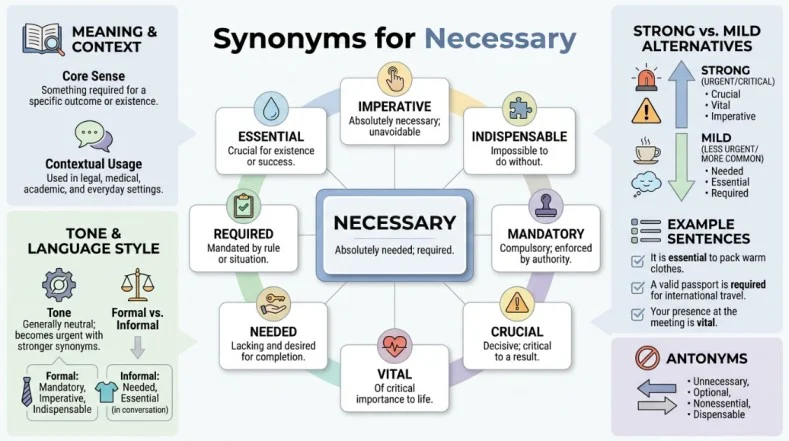
Necessary means needed or required for a particular purpose, result, situation, or action. Common alternatives include essential, required, needed, vital, crucial, mandatory, indispensable, and imperative, depending on tone and context.
Meaning, Tone and Context
Simple Definition
Necessary describes something that is needed or required because a particular result, purpose, or situation depends on it.
For example:
“Regular practice is necessary to improve your writing.”
Here, practice is presented as something needed for improvement.
Part of Speech
Necessary is primarily an adjective.
Example:
“Good communication is necessary in the workplace.”
The related noun is necessity, which means something that is needed or required.
Example:
“Reliable transportation is a necessity for many workers.”
The opposite forms include unnecessary and needless.
Tone
Necessary usually has a neutral tone. It can become stronger when used in a serious or urgent context.
Compare these sentences:
“Additional information is necessary.”
“Immediate action is imperative.”
The first sentence states a requirement. The second communicates a much stronger sense of urgency.
Formality Level
Necessary works well in casual conversation, academic writing, professional communication, business documents, resumes, and formal writing.
It is versatile because it does not sound excessively formal or informal.
Common Use Cases
Necessary frequently appears when discussing:
- Requirements
- Rules
- Workplace procedures
- Education
- Health and safety
- Planning
- Personal decisions
- Instructions
- Problem solving
- Professional communication
Important Word Forms
Necessary is an adjective.
Necessity is the related noun.
Necessarily is the related adverb.
Unnecessary is a common opposite.
Example:
“Careful planning is necessary.”
“Careful planning is a necessity.”
“The change is not necessarily permanent.”
“The extra step is unnecessary.”
When and How to Use “Necessary”
Use necessary when something is needed to achieve a goal, complete an action, meet a requirement, or handle a particular situation.
Professional
“Please provide the necessary documents before the meeting.”
Academic
“Additional research is necessary to support this conclusion.”
Personal
“Some preparation is necessary before the trip.”
Emotional
“It was necessary for me to take some time away and reflect.”
Creative
“Only the necessary light entered through the narrow window.”
Social Media
“Sometimes a necessary change creates the space for something better.”
“Please complete the necessary steps before submitting the application.”
Another Word for “Necessary”
The best single replacement is usually essential when you want to emphasize that something is extremely important or fundamental.
However, required is better when a rule or condition demands something. Needed sounds natural in everyday communication. Mandatory works when compliance is expected. Vital and crucial emphasize importance.
Here are practical choices by situation:
- Professional writing: required or essential
- Academic writing: essential or requisite
- Casual conversation: needed
- Emotional writing: important or vital
- Creative writing: indispensable or vital
- Resume or workplace use: essential or required
- Social media captions: essential or important
- Stronger meaning: indispensable or imperative
- Softer meaning: useful or advisable
When Not to Use “Necessary”
Necessary can sometimes be too general when you need to explain exactly why something is needed.
For example:
“Communication skills are necessary for this job.”
This is understandable, but a more precise sentence could be:
“Strong communication skills are essential for managing client relationships.”
The second version tells the reader more about the actual importance of the skill.
Necessary can also sound overly formal in casual conversation.
Instead of:
“Your attendance is necessary.”
A natural conversational alternative is:
“We need you there.”
The best choice depends on your audience and purpose.
Words Commonly Confused With “Necessary”
Necessary vs. Essential
Both describe something needed, but essential often emphasizes greater importance.
“Water is necessary for life.”
“Trust is essential to a strong relationship.”
Necessary vs. Required
Required usually suggests that a rule, condition, authority, or procedure demands something.
“Two forms of identification are required.”
Necessary can describe something that is needed without implying an official rule.
“Extra preparation is necessary.”
Necessary vs. Important
Important means having significant value or influence. It does not always mean something is required.
“Exercise is important for overall wellness.”
“Exercise may be necessary for reaching a specific training goal.”
Necessary vs. Vital
Vital is stronger and often suggests that something is critically important.
“Clear instructions are necessary.”
“Clear instructions are vital during an emergency.”
Necessary vs. Mandatory
Mandatory means officially required and generally leaves little or no choice.
“Attendance is mandatory.”
“Additional practice may be necessary.”
Necessary vs. Crucial
Crucial means extremely important to a successful outcome.
“Planning is necessary.”
“Planning is crucial to avoiding major delays.”
Best Synonym by Context for “Necessary”
| Context | Best Synonym | Why It Works | Example |
|---|---|---|---|
| Formal writing | Required | Clearly communicates a condition or need | The required documents must be submitted. |
| Academic writing | Essential | Sounds precise and emphasizes importance | Evidence is essential to the argument. |
| Professional or business use | Required | Works naturally for procedures and expectations | A signature is required before approval. |
| Resume | Essential | Highlights an important professional quality | Strong communication is essential in client service. |
| Casual conversation | Needed | Sounds natural and direct | We need a few more supplies. |
| Creative writing | Indispensable | Adds emphasis and descriptive strength | Her advice became indispensable to the team. |
| Emotional tone | Vital | Communicates deep importance | His support was vital during a difficult period. |
| Strong intensity | Imperative | Suggests urgent or critical necessity | Immediate action is imperative. |
| Soft or moderate tone | Advisable | Suggests something beneficial without demanding it | It is advisable to review the details. |
| Social media captions | Essential | Short and impactful | Rest is essential, not optional. |
| US usage | Necessary | Common, natural, and widely understood | The changes are necessary. |
| UK usage | Necessary | Also standard and widely understood | The changes are necessary. |
Which Synonym Should You Choose?
Start by asking what kind of necessity you mean.
- If something is needed for a result, use necessary or needed.
- If something is fundamental, use essential.
- If a rule demands it, use required or mandatory.
- If success depends heavily on it, use crucial or vital.
- If there is no practical substitute, use indispensable.
- If immediate action is needed, use imperative.
- If you want to recommend an action without making it sound compulsory, use advisable.
- For professional writing, prioritize precision over dramatic language. A strong synonym is useful only when its meaning matches the situation.
Real Life Examples of “Necessary” in Sentences
School
“Regular review is necessary before the final exam.”
A stronger academic alternative is:
“Consistent review is essential for retaining difficult concepts.”
Workplace
“Please provide the necessary information before Friday.”
A more precise version is:
“Please provide the required information before Friday.”
Writing
“Editing is necessary before publishing the article.”
A stronger version is:
“Careful editing is essential before publication.”
Conversation
“Is it necessary to bring all these documents?”
A more casual version is:
“Do we need to bring all these documents?”
Social Media
“Sometimes a necessary change leads to a better direction.”
A more expressive version is:
“Sometimes a crucial change opens the door to a better direction.”
Resume
“Developed the necessary skills to manage customer accounts.”
A stronger resume version is:
“Developed essential skills for managing customer accounts.”
“Please make any necessary changes before sending the proposal.”
This sentence is professional, flexible, and appropriate for workplace communication.
Storytelling
“The silence was necessary before she could finally explain what had happened.”
The word works well because it presents the silence as needed for the emotional development of the scene.
25 Synonyms for “Necessary”
| Synonym | Simple Meaning | Best Used For | Example Sentence |
|---|---|---|---|
| Essential | Absolutely needed or fundamental | Academic and professional writing | Clear communication is essential to successful teamwork. |
| Required | Needed because of a rule or condition | Business, forms, procedures | A valid identification document is required. |
| Needed | Wanted or necessary for a purpose | Casual and everyday communication | We need more time to finish the project. |
| Vital | Extremely important or necessary | Serious and emotional contexts | Trust is vital to a healthy partnership. |
| Crucial | Extremely important to an outcome | Academic and professional writing | Timing is crucial to the success of the launch. |
| Indispensable | So necessary that it cannot be easily replaced | Formal and professional writing | Her experience proved indispensable to the organization. |
| Imperative | Absolutely necessary, often with urgency | Formal, serious, or urgent situations | Immediate action is imperative. |
| Mandatory | Officially required | Rules, policies, workplaces | Safety training is mandatory for all employees. |
| Compulsory | Required by authority or regulation | Education and official contexts | Attendance at the orientation session is compulsory. |
| Requisite | Required for a particular purpose | Formal and academic writing | Applicants must have the requisite experience. |
| Important | Having significant value or influence | General and personal communication | Good preparation is important for a strong presentation. |
| Pressing | Needing attention soon | Urgent situations | The company must address this pressing concern. |
| Urgent | Requiring immediate attention or action | Emergencies and business | The team responded to the urgent request. |
| Fundamental | Basic and essential to something | Academic and explanatory writing | Respect is fundamental to effective leadership. |
| Integral | Necessary as part of a complete whole | Professional and academic writing | Feedback is an integral part of the learning process. |
| Critical | Extremely important to success or safety | Business, technical, and serious contexts | Accurate data is critical to the analysis. |
| Pivotal | Extremely important to a result or change | Storytelling and professional writing | Her decision was pivotal to the project’s success. |
| Appropriate | Suitable or necessary for a particular situation | Professional and social contexts | Please use the appropriate procedure for this request. |
| Advisable | Recommended because it is sensible or beneficial | Advice and professional communication | It is advisable to save a copy of the document. |
| Beneficial | Helpful or useful to an outcome | General and professional writing | Regular feedback is beneficial for improvement. |
| Useful | Helpful for achieving a purpose | Casual and practical contexts | A checklist is useful when preparing for a trip. |
| Inescapable | Impossible to avoid in a situation | Literary and serious writing | Change became an inescapable part of the process. |
| Unavoidable | Impossible or very difficult to prevent | Problems and circumstances | Some delays were unavoidable because of the weather. |
| Obligatory | Required as a duty or obligation | Formal and official contexts | The disclosure is obligatory under the agreement. |
| Nonnegotiable | Required and not open to compromise | Modern professional and personal contexts | Respectful communication is nonnegotiable in our workplace. |
Synonym Groups and Usage Differences
Professional vs. Personal Synonyms
Professional writing often benefits from required, essential, mandatory, requisite, and critical.
These words make expectations and conditions clear.
Personal writing can use needed, important, vital, or necessary without sounding overly technical.
For example:
“Your signature is required.”
“I needed your support.”
The first sentence describes a formal requirement. The second communicates a personal need.
Formal vs. Conversational Synonyms
Formal writing often uses essential, requisite, imperative, mandatory, obligatory, and indispensable.
Conversational English generally favors needed, important, necessary, useful, and helpful.
A text message might say:
“We need more time.”
A formal report might say:
“Additional time is required to complete the analysis.”
Both communicate a similar idea, but the tone is different.
Academic Synonyms
Academic writing benefits from precise words such as essential, crucial, fundamental, integral, requisite, and critical.
These terms can help explain relationships between conditions and outcomes.
For example:
“Reliable evidence is essential for evaluating the hypothesis.”
This is more precise than repeatedly saying that something is necessary.
Professional and Business Synonyms
For workplace emails, reports, presentations, and business documents, required and essential are usually safe choices.
Mandatory is appropriate when a policy or official rule applies.
Critical works when an issue has a major effect on success, safety, performance, or decision making.
Advisable is useful when you want to recommend an action without presenting it as compulsory.
Creative or Literary Synonyms
Creative writing gives you more freedom to choose expressive terms.
Vital, indispensable, pivotal, inescapable, and unavoidable can add emotional or narrative weight.
For example:
“Her presence was indispensable during those uncertain days.”
This creates more emotional emphasis than simply saying her presence was necessary.
Slang or Modern Synonyms
Necessary does not have many true slang equivalents.
In informal American English, phrases such as “need to,” “have to,” and “got to” can express necessity naturally.
For example:
“We need to leave.”
“You have to call them.”
These expressions are suitable for conversation but may be less appropriate in formal academic writing.
Strongest vs. Weaker Synonyms
A useful intensity scale is:
Useful → Advisable → Necessary → Required → Essential → Crucial → Vital → Indispensable → Imperative
This is not an absolute ranking because context changes the strength of each word.
For example, mandatory can be stronger than necessary when a formal rule is involved, even though it does not necessarily communicate emotional importance.
Emotional vs. Neutral Synonyms
Necessary is generally neutral.
Required is also relatively neutral but can sound procedural.
Essential emphasizes importance.
Vital adds stronger emotional or practical importance.
Indispensable suggests that something cannot realistically be replaced.
Imperative can communicate urgency and seriousness.
Choose the neutral option when accuracy matters more than emotional force.
Antonyms of “Necessary”
| Antonym | Meaning | Example Sentence |
|---|---|---|
| Unnecessary | Not needed | The extra step is unnecessary. |
| Optional | Available by choice rather than requirement | Attendance at the workshop is optional. |
| Needless | Not needed or useful | The argument created needless confusion. |
| Dispensable | Able to be removed without serious loss | Some features are dispensable. |
| Avoidable | Able to be prevented or avoided | The mistake was avoidable. |
| Voluntary | Done by personal choice | Participation is voluntary. |
| Elective | Chosen rather than required | The course is elective. |
| Nonessential | Not essential to the main purpose | The design includes several nonessential features. |
| Unwarranted | Not justified or needed | The criticism was unwarranted. |
| Superfluous | More than what is needed | The report contains several superfluous details. |
| Redundant | Unnecessarily repeated or extra | The final paragraph was redundant. |
| Gratuitous | Unnecessary and often unwanted | The comment was gratuitous. |
| Discretionary | Decided by personal choice or judgment | Additional spending is discretionary. |
| Expendable | Able to be removed or sacrificed without major harm | Several minor features are expendable. |
| Inessential | Not necessary to the essential purpose | Decorative elements are inessential to the function. |
Comparison: “Necessary” vs. Similar Words
Necessary vs. Essential
Main difference: Necessary means needed, while essential usually emphasizes that something is fundamental or extremely important.
Which one is stronger: Essential is generally stronger.
Which one is more formal: Both are suitable for formal writing, but essential often sounds more polished.
Example with necessary:
“Training is necessary before using the equipment.”
Example with essential:
“Training is essential for safe equipment use.”
Necessary vs. Required
Main difference: Required usually indicates an external rule, condition, or expectation.
Which one is stronger: Required can sound stronger when a formal obligation exists.
Which one is more formal: Required is especially common in official and professional writing.
Example with necessary:
“Additional preparation is necessary.”
Example with required:
“Additional preparation is required by the policy.”
Necessary vs. Important
Main difference: Important describes value or significance, while necessary describes need.
Which one is stronger: Necessary is stronger when something must be present or done.
Which one is more formal: Both are widely accepted in formal writing.
Example with necessary:
“A password is necessary to access the account.”
Example with important:
“A strong password is important for account security.”
Necessary vs. Vital
Main difference: Vital communicates a very high level of importance.
Which one is stronger: Vital is stronger.
Which one is more formal: Both can be formal, but vital often carries greater emotional or practical intensity.
Example with necessary:
“Accurate records are necessary.”
Example with vital:
“Accurate records are vital during an audit.”
Necessary vs. Mandatory
Main difference: Mandatory means officially required and generally not optional.
Which one is stronger: Mandatory is stronger when an authority or policy is involved.
Which one is more formal: Mandatory is more formal and procedural.
Example with necessary:
“Additional documentation may be necessary.”
Example with mandatory:
“Completion of the training is mandatory.”
Necessary vs. Crucial
Main difference: Crucial emphasizes that something has a major effect on the outcome.
Which one is stronger: Crucial is usually stronger.
Which one is more formal: Both work well in academic and professional contexts.
Example with necessary:
“Good planning is necessary.”
Example with crucial:
“Good planning is crucial to avoiding delays.”
Common Phrases and Expressions with “Necessary”
1. Necessary Steps
Meaning: The actions that must be taken to complete a process or achieve a result.
Example sentence:
“Please complete all necessary steps before submitting the application.”
2. Necessary Changes
Meaning: Adjustments that need to be made because of a problem, requirement, or goal.
Example sentence:
“The editor made the necessary changes before publication.”
3. Necessary Information
Meaning: Information needed to make a decision or complete an action.
Example sentence:
“Please provide the necessary information before the meeting.”
4. Necessary Documents
Meaning: Documents needed for a procedure, application, or official process.
Example sentence:
“Applicants should prepare the necessary documents in advance.”
5. Necessary Precautions
Meaning: Actions taken to reduce risk or prevent problems.
Example sentence:
“The team took the necessary precautions before beginning the experiment.”
6. Necessary Resources
Meaning: Materials, tools, money, people, or information needed for a purpose.
Example sentence:
“The organization provided the necessary resources for the project.”
7. If Necessary
Meaning: If circumstances make something needed or appropriate.
Example sentence:
“We can extend the deadline if necessary.”
8. When Necessary
Meaning: At times when something is needed.
Example sentence:
“Employees should ask for assistance when necessary.”
Common Mistakes to Avoid
1. Using Necessary When a More Precise Word Is Better
Necessary is broad.
If a rule requires something, required or mandatory may communicate the idea more accurately.
2. Confusing Necessary With Important
Something can be important without being necessary.
A feature may improve a product but still not be required for the product to work.
3. Using Casual Language in Formal Writing
Phrases such as “got to” and “have to” are natural in conversation but may sound too casual in academic or professional documents.
Use necessary, required, or essential when the situation calls for a formal tone.
4. Using an Overly Dramatic Synonym
Calling something imperative or vital can exaggerate a simple situation.
If an action is merely helpful, advisable or useful may be more accurate.
5. Repeating Necessary Too Often
Repeated use of the same adjective can make writing feel flat.
Replace some instances with required, essential, needed, crucial, or appropriate when the meaning genuinely fits.
6. Choosing the Wrong Emotional Tone
Indispensable and vital can sound much stronger than necessary.
Do not use an intense synonym simply to make a sentence sound impressive.
7. Using Slang in Academic or Professional Writing
Casual expressions can be useful in conversation but may weaken formal writing.
Choose vocabulary that matches the audience, purpose, and communication channel.
FAQs
What is the best synonym for necessary?
Essential is often the best synonym when something is extremely important or fundamental. Required is better when a rule or condition creates the need.
What is a formal synonym for necessary?
Requisite, indispensable, imperative, obligatory, and essential are formal alternatives. Required is also highly appropriate for professional and official writing.
What is an informal synonym for necessary?
Needed is the most natural informal alternative. In conversation, people also commonly use phrases such as “need to” and “have to.”
What is another word for necessary in professional writing?
Required is excellent for formal requirements, while essential works well when emphasizing importance. Mandatory is appropriate for official rules.
What is the difference between necessary and essential?
Necessary means something is needed, while essential usually emphasizes that it is fundamental or extremely important to the purpose or outcome.
What is the opposite of necessary?
The most direct opposite is unnecessary. Other alternatives include optional, needless, dispensable, avoidable, voluntary, elective, and nonessential.
Conclusion
Necessary means needed or required for a particular purpose, situation, or result. It is a versatile word that works naturally in everyday speech, academic writing, professional communication, resumes, emails, and creative writing.
The best synonym depends on the exact meaning. Use essential for fundamental importance, required for conditions, mandatory for official rules, needed for casual communication, crucial for major outcomes, vital for strong importance, and imperative when urgency is involved.
A useful vocabulary habit is to replace necessary only when the new word adds precision. Do not choose a complicated synonym simply because it sounds more advanced. The strongest word is the one that communicates your exact meaning naturally.
Discover More Post:
- 25+ Synonyms for Real | Meanings, Examples, and Best …
- 25+ Synonyms for Determine | Meanings, Examples, and Best …
- 25+ Synonyms for Determine | Meanings, Examples, and Best …