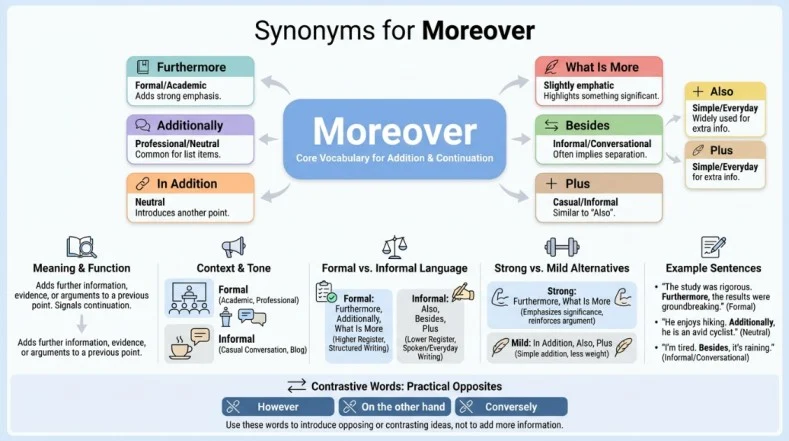
Using the same transition word again and again can make an essay, email, caption, or professional message feel repetitive. If moreover keeps appearing in your writing, a few carefully chosen alternatives can make your sentences smoother and more natural.
The key is not simply replacing one word with another. The best synonym depends on your purpose, tone, audience, and sentence meaning. This guide explains synonyms for moreover that work in academic writing, business communication, everyday conversation, creative writing, resumes, and online content.
What Does “Moreover” Mean?
Moreover means “in addition” or “also” and introduces information that adds to a previous point. The best alternatives include furthermore for formal writing, additionally for professional contexts, besides for conversational use, and what is more for emphasis.
Meaning, Tone and Context
Simple Definition
Moreover is used to introduce an additional fact, reason, idea, or point that supports or expands what was just stated.
For example:
“The course is affordable. Moreover, it offers flexible evening classes.”
The second sentence adds another reason to consider the course.
Part of Speech
Moreover is a conjunctive adverb, also called a linking adverb or transition word.
It connects ideas between sentences or clauses rather than functioning like an ordinary conjunction such as and or but.
Tone
Moreover is generally neutral in meaning, but it has a formal and polished tone.
It is more common in essays, reports, articles, formal correspondence, and structured arguments than in casual conversation.
Formality Level
Moreover is usually considered formal.
In everyday speech, speakers are more likely to say also, besides, in addition, plus, or what is more.
Common Use Cases
Moreover commonly appears in:
- Academic essays
- Research based writing
- Professional reports
- Business communication
- Formal presentations
- Persuasive writing
- Articles and opinion pieces
- Formal emails
Related Word Forms
Moreover does not have common adjective, noun, or verb forms because it is a linking adverb.
It is a standalone transition that adds information to an existing statement.
When and How to Use “Moreover”
Use moreover when the next point strengthens, expands, or adds important information to the previous point.
It often works best at the beginning of a sentence and is usually followed by a comma.
1. Academic
“The study found a strong connection between sleep and concentration. Moreover, students who followed a regular sleep schedule reported better focus.”
2. Professional
“The proposal reduces operating costs. Moreover, it can be implemented without major changes to the current system.”
3. Personal
“I enjoyed the workshop. Moreover, I met several people who shared my interests.”
4. Email
“The revised schedule gives the team more preparation time. Moreover, it allows us to avoid the busiest travel period.”
5. Creative
“The old house stood quietly at the edge of the forest. Moreover, its broken windows gave it an unsettling appearance.”
6. Social Media
“The new collection looks great. Moreover, several pieces are available at a surprisingly reasonable price.”
7. Persuasive
“The policy could reduce unnecessary spending. Moreover, it could make the process easier for employees.”
Another Word for “Moreover”
The best single replacement for moreover depends on the relationship between your ideas.
For formal writing, furthermore is one of the closest alternatives. For professional writing, additionally is clear and polished. For everyday conversation, besides or also often sounds more natural.
Here are practical recommendations by situation:
- Professional writing: additionally
- Academic writing: furthermore
- Casual conversation: besides
- Emotional writing: what is more
- Creative writing: on top of that
- Resume or workplace use: additionally
- Social media captions: plus
- Stronger meaning: what is more
- Softer meaning: also
The important point is that synonyms for moreover are not always interchangeable. Some emphasize addition, while others add emphasis or sound more conversational.
When Not to Use “Moreover”
Moreover can sound overly formal in relaxed conversation.
Instead of:
“Moreover, the restaurant was affordable.”
A casual speaker might say:
“Plus, the restaurant was affordable.”
Moreover can also be too general when the relationship between ideas needs to be more precise.
For example, if the second statement explains a result, therefore may be better. If it introduces a contrast, however is more accurate.
Avoid using moreover simply because you want your writing to sound sophisticated. Precision is more valuable than formality.
Words Commonly Confused With “Moreover”
Moreover vs. Furthermore
Both add supporting information and have a formal tone.
Furthermore can feel slightly more structured in academic and professional arguments, while moreover often adds another point that reinforces the previous statement.
Moreover vs. Additionally
Both introduce additional information.
Additionally is highly useful in reports, instructions, business writing, and professional communication because it sounds direct and neutral.
Moreover vs. Besides
Besides can introduce an additional reason, but it is generally more conversational.
Moreover is better suited to formal essays and reports.
Moreover vs. Also
Also is much more common in everyday English.
Moreover sounds more formal and usually gives the additional point greater rhetorical weight.
Moreover vs. However
These words perform opposite functions.
Moreover adds information, while however introduces a contrast or limitation.
Moreover vs. Therefore
Moreover adds another point.
Therefore shows a result or conclusion. Replacing moreover with therefore can completely change the meaning of a sentence.
Best Synonym by Context for “Moreover”
| Context | Best Synonym | Why It Works | Example |
|---|---|---|---|
| Formal writing | Furthermore | Polished and structured | Furthermore, the policy improves efficiency. |
| Academic writing | Furthermore | Strong for logical arguments | Furthermore, the findings support the original theory. |
| Professional or business use | Additionally | Clear and neutral | Additionally, the plan reduces costs. |
| Resume | Additionally | Professional and concise | Additionally, I trained new team members. |
| Casual conversation | Besides | Natural in everyday speech | Besides, we have plenty of time. |
| Creative writing | On top of that | Adds energy and emphasis | On top of that, the storm arrived early. |
| Emotional tone | What is more | Adds emphasis to the next point | What is more, she never gave up. |
| Strong intensity | What is more | Gives the next point extra weight | What is more, the results were unexpected. |
| Soft or moderate tone | Also | Simple and understated | The plan is affordable and also practical. |
| Social media captions | Plus | Short and conversational | Plus, the location is amazing. |
| US usage | Additionally | Common in polished American English | Additionally, the service includes support. |
| UK usage | Furthermore | Widely accepted in formal British English | Furthermore, the proposal meets current standards. |
Which Synonym Should You Choose?
Start by identifying what your second idea does.
If it simply adds information, choose also, additionally, or in addition.
If it strengthens an argument, choose furthermore or what is more.
If the tone is conversational, choose besides, plus, or on top of that.
If you are writing academically, favor precise formal transitions such as furthermore and additionally.
For professional communication, clarity usually matters more than sophistication. Additionally and in addition are often excellent choices.
For creative writing, a more expressive option such as on top of that can create a stronger sense of movement and emphasis.
Real Life Examples of “Moreover” in Sentences
School
“The assignment encourages independent research. Moreover, it helps students develop stronger analytical skills.”
Workplace
“The new software saves time. Additionally, it reduces the amount of manual data entry.”
Writing
“The argument is supported by several studies. Furthermore, the available evidence is consistent across different groups.”
Conversation
“The tickets are inexpensive. Besides, the venue is only a few minutes away.”
Social Media
“The view is beautiful. Plus, the coffee is excellent.”
Resume
“I managed several client accounts. Additionally, I trained new employees on company procedures.”
“The meeting has been moved to Thursday. In addition, the presentation deadline has been extended.”
Storytelling
“The traveler had lost his map. On top of that, the sun was beginning to set.”
25 Synonyms for “Moreover”
Some alternatives below are close functional replacements rather than perfect dictionary equivalents. Context matters because each transition carries a slightly different tone or emphasis.
| Synonym | Simple Meaning | Best Used For | Example Sentence |
|---|---|---|---|
| Furthermore | In addition | Academic and formal writing | Furthermore, the evidence supports the conclusion. |
| Additionally | Also or in addition | Professional writing | Additionally, the program offers flexible scheduling. |
| In addition | Added to that | Reports and essays | In addition, the plan improves customer service. |
| Also | Too or as well | Everyday and general writing | The apartment is affordable and also spacious. |
| Besides | In addition to that | Casual and persuasive language | Besides, we already have everything we need. |
| What is more | An additional important point | Emphasis | What is more, the service is available nationwide. |
| On top of that | In addition to everything else | Conversational and expressive writing | On top of that, the delivery arrived early. |
| Plus | And also | Casual speech and social media | Plus, the tickets are reasonably priced. |
| As well | Also or too | General English | The package includes installation as well. |
| Too | Also | Informal and conversational English | The hotel is comfortable, too. |
| Likewise | In the same way | Similar or parallel ideas | The second team performed well likewise. |
| Equally | To the same degree | Formal comparison | Equally important is the need for better communication. |
| Similarly | In a similar way | Comparative writing | Similarly, the second study found positive results. |
| Coupled with | Combined with | Formal analytical writing | Coupled with strong leadership, the strategy can succeed. |
| Along with that | Together with that | General communication | Along with that, the company provides technical support. |
| In the same way | Similarly | Explanatory writing | In the same way, regular practice improves fluency. |
| Not to mention | Adding another notable point | Conversational emphasis | Not to mention, the location is close to downtown. |
| Over and above that | In addition to that | Very formal or literary writing | Over and above that, the proposal offers long term value. |
| Further | In addition or to a greater extent | Formal and concise writing | Further, the report identifies several areas for improvement. |
| Added to that | Along with the previous point | Conversational writing | Added to that, the project requires fewer resources. |
| Beyond that | In addition to the previous point | Explanatory writing | Beyond that, the approach improves long term stability. |
| More importantly | Adds a more significant point | Persuasive writing | More importantly, the change protects customer information. |
| In addition to this | Adds another related point | Formal writing | In addition to this, the policy improves transparency. |
| Alongside this | Together with this | Formal and descriptive writing | Alongside this, the company introduced new training. |
| Over and above this | In addition to this | Formal emphasis | Over and above this, the plan offers measurable benefits. |
Synonym Groups and Usage Differences
Professional vs. Personal Synonyms
Professional writing benefits from direct and neutral transitions.
Additionally, furthermore, and in addition work well in reports, proposals, presentations, and business emails.
Personal writing can sound more natural with also, besides, plus, and on top of that.
Formal vs. Conversational Synonyms
Formal options include:
- Furthermore
- Additionally
- In addition
- Equally
- Coupled with
Conversational options include:
- Plus
- Besides
- On top of that
- Also
- Not to mention
Using a conversational expression in a research paper may make the writing feel less polished.
Academic Synonyms
Academic writing generally benefits from transitions that make the logical relationship between ideas easy to follow.
Furthermore, additionally, in addition, and similarly can work well when the ideas genuinely support or relate to each other.
Do not choose a synonym simply because it sounds academic. The transition must accurately describe the relationship between the ideas.
Professional and Business Synonyms
In business communication, additionally and in addition are especially useful because they are clear without sounding unnecessarily elaborate.
For example:
“The proposal reduces costs. Additionally, it simplifies the approval process.”
This is usually more direct than using a highly literary expression.
Creative or Literary Synonyms
Creative writing allows more expressive choices.
On top of that, what is more, and not to mention can add personality and rhythm.
For example:
“The rain had soaked his coat. On top of that, his phone had stopped working.”
The expression creates a more conversational storytelling rhythm.
Slang or Modern Synonyms
Plus is a modern, casual alternative that works well in speech, social posts, informal messages, and friendly writing.
It should generally be avoided in highly formal academic or legal writing.
Strongest vs. Weaker Synonyms
There is no universal intensity ranking because transition words express relationships rather than measurable levels of strength.
A useful practical scale is:
Mild: also, as well, too
Moderate: additionally, in addition, besides
Formal emphasis: furthermore, moreover, what is more
Conversational emphasis: on top of that, not to mention
The strongest choice depends on the sentence and the amount of emphasis you want.
Emotional vs. Neutral Synonyms
Neutral choices include additionally, also, in addition, and as well.
More expressive choices include what is more, on top of that, and not to mention.
Choose neutral transitions when accuracy and professionalism matter most. Choose expressive transitions when personality or emotional emphasis is useful.
Antonyms of “Moreover”
Moreover does not have true dictionary antonyms because it is a transition that signals addition. However, contrastive transitions can function as practical opposites when you want to move away from addition and introduce a different relationship.
| Antonym | Meaning | Example Sentence |
|---|---|---|
| However | Introduces contrast | The plan is affordable. However, it requires more time. |
| But | Shows contrast | The idea is useful, but it is expensive. |
| Nevertheless | Shows contrast despite a point | The task was difficult. Nevertheless, we completed it. |
| Nonetheless | Shows contrast despite a point | The process was slow. Nonetheless, the results were reliable. |
| Yet | Introduces an opposing idea | The product is expensive, yet customers continue to buy it. |
| Instead | Shows an alternative | We did not cancel the event. Instead, we changed the schedule. |
| Conversely | Shows an opposite situation | Sales increased in one region. Conversely, they declined elsewhere. |
| Otherwise | Indicates another outcome | Leave now; otherwise, you may miss the train. |
| Rather | Presents an alternative | The issue is not cost. Rather, it is a lack of time. |
| On the other hand | Introduces another perspective | The apartment is small. On the other hand, the location is excellent. |
| In contrast | Highlights difference | The first method is expensive. In contrast, the second is affordable. |
| By contrast | Shows a clear difference | The old system was slow. By contrast, the new system is efficient. |
| Although | Introduces a concession | Although the plan is costly, it may be worthwhile. |
| Whereas | Contrasts two situations | One option is flexible, whereas the other is more affordable. |
| Despite this | Signals a contrasting point | The forecast was poor. Despite this, the event continued. |
Comparison: “Moreover” vs. Similar Words
Moreover vs. Furthermore
Main difference: Both add information, but furthermore often sounds slightly more structured in formal arguments.
Which one is stronger: Neither is inherently stronger, although furthermore can feel more deliberate.
Which one is more formal: Both are formal.
Moreover: “The plan reduces costs. Moreover, it improves efficiency.”
Furthermore: “The plan reduces costs. Furthermore, it improves efficiency.”
Moreover vs. Additionally
Main difference: Both add information. Additionally often sounds especially neutral and professional.
Which one is stronger: Neither is inherently stronger.
Which one is more formal: Both are suitable for formal writing.
Moreover: “Moreover, the strategy supports long term growth.”
Additionally: “Additionally, the strategy supports long term growth.”
Moreover vs. Also
Main difference: Also is much more common in everyday English.
Which one is stronger: Moreover can give the added point greater rhetorical emphasis.
Which one is more formal: Moreover.
Moreover: “Moreover, the solution saves valuable time.”
Also: “The solution also saves valuable time.”
Moreover vs. Besides
Main difference: Besides is more conversational and can sometimes introduce an additional reason for an opinion.
Which one is stronger: Besides can sound more persuasive in casual speech.
Which one is more formal: Moreover.
Moreover: “Moreover, the program is affordable.”
Besides: “Besides, the program is affordable.”
Moreover vs. However
Main difference: Moreover adds information, while however introduces contrast.
Which one is stronger: Neither because they serve different functions.
Which one is more formal: Both can be formal.
Moreover: “The service is affordable. Moreover, it is reliable.”
However: “The service is affordable. However, it has limited availability.”
Moreover vs. Therefore
Main difference: Moreover adds another point, while therefore introduces a result.
Which one is stronger: They cannot be ranked because their meanings differ.
Which one is more formal: Both are common in formal writing.
Moreover: “The evidence is strong. Moreover, the results are consistent.”
Therefore: “The evidence is strong. Therefore, the conclusion is reasonable.”
Common Phrases and Expressions with “Moreover”
1. Moreover, it is important to
Meaning:
Used to introduce an additional point that deserves attention.
Example sentence:
“Moreover, it is important to consider how the change will affect employees.”
2. Moreover, the evidence suggests
Meaning:
Introduces supporting evidence in formal or academic writing.
Example sentence:
“Moreover, the evidence suggests that regular practice improves performance.”
3. Moreover, there is
Meaning:
Adds another fact or supporting detail.
Example sentence:
“Moreover, there is strong demand for affordable housing.”
4. Moreover, the results show
Meaning:
Adds another finding to a discussion.
Example sentence:
“Moreover, the results show a clear improvement in customer satisfaction.”
5. Moreover, this approach
Meaning:
Introduces another benefit or characteristic of an approach.
Example sentence:
“Moreover, this approach requires fewer resources.”
6. Moreover, it can
Meaning:
Adds another possible effect, advantage, or capability.
Example sentence:
“Moreover, it can help employees communicate more effectively.”
7. Moreover, research indicates
Meaning:
Introduces additional research based support.
Example sentence:
“Moreover, research indicates that consistent feedback can improve learning.”
Common Mistakes to Avoid
1. Using Moreover When a More Precise Word Is Better
Do not use moreover when you actually need a transition that shows contrast, cause, result, or sequence.
Choose however for contrast and therefore for results.
2. Confusing Moreover With However
Moreover adds information.
However changes direction by introducing an opposing or limiting point.
3. Using a Casual Synonym in Formal Writing
Words such as plus and on top of that can sound too conversational in academic essays or formal reports.
Use furthermore, additionally, or in addition instead.
4. Using an Overly Dramatic Alternative
Not to mention can add emphasis, but it may sound too expressive for a neutral report.
Choose the simplest accurate transition.
5. Repeating Moreover Too Often
Even a correct transition can become distracting when repeated throughout every paragraph.
Alternate between suitable transitions when the meaning remains accurate.
6. Choosing the Wrong Emotional Tone
On top of that can sound expressive or conversational.
Additionally is more neutral. Match the transition to the intended mood.
7. Using Slang in Academic or Professional Writing
Plus may work perfectly in a text message or caption, but it is usually less appropriate for formal academic work.
FAQs
What is the best synonym for moreover?
The best synonym is often furthermore in formal writing, while additionally works well in professional communication and besides sounds natural in casual conversation.
What is a formal synonym for moreover?
Furthermore is one of the closest formal synonyms for moreover. Additionally and in addition are also strong choices for academic and professional writing.
What is an informal synonym for moreover?
Besides, plus, also, and on top of that can replace moreover in informal communication, depending on the sentence and desired tone.
What is another word for moreover in professional writing?
Additionally is an excellent professional alternative because it clearly adds information without sounding overly formal or dramatic.
What is the difference between moreover and furthermore?
Both introduce additional information. Moreover can emphasize an added point, while furthermore is especially common in structured formal arguments.
What is the opposite of moreover?
Moreover has no exact dictionary opposite. However, contrastive transitions such as however, but, instead, and conversely perform an opposing function.
Conclusion
Moreover means that another point, fact, or reason is being added to what has already been stated. It is a formal transition that works especially well in academic, professional, persuasive, and structured writing.
The best synonym depends on context. Choose furthermore for formal arguments, additionally for professional communication, also for simple everyday language, besides for casual writing, and on top of that when a more expressive tone fits.
The most useful vocabulary habit is to choose a synonym based on meaning first and style second. A strong writer does not replace moreover randomly. Instead, the writer selects the transition that accurately shows how the next idea connects to the previous one.
Discover More Post:
- 25+ Synonyms for Real | Meanings, Examples, and Best …
- 25+ Synonyms for Determine | Meanings, Examples, and Best …
- 25+ Synonyms for Determine | Meanings, Examples, and Best …