Have you ever used the word “sneaky” several times and then realized that your writing needs a more precise word? The right alternative can make a sentence sound more professional, emotional, academic, or creative.
The best synonyms for sneaky depend on what you mean. A person may be stealthy when avoiding attention, sly when being clever and indirect, or underhanded when using dishonest methods.
This guide explains the meaning, tone, intensity, and context of each choice. You will also find practical examples for school, work, emails, conversations, social media, storytelling, and everyday writing.
What Does Sneaky Mean?
Sneaky describes someone or something that avoids attention, acts secretly, or uses indirect methods, sometimes dishonestly. Formal choices include surreptitious and underhanded, while casual choices include sly, shifty, and crafty.
Meaning, Tone and Context
Simple Definition
Sneaky means behaving secretly or indirectly, especially when someone wants to avoid being noticed or wants to gain an advantage.
The word can describe a harmless attempt to remain unnoticed, but it often suggests questionable, dishonest, or manipulative behavior.
For example:
The cat made a sneaky move toward the open door.
Here, sneaky is playful and harmless.
Compare that with:
He made a sneaky change to the agreement.
In this sentence, sneaky suggests that the person acted dishonestly or tried to hide an important change.
Part of Speech
Sneaky is an adjective.
Related forms include:
Sneak: a person who behaves secretly or a verb meaning to move secretly.
Sneakily: an adverb describing a secretive or indirect action.
Sneakiness: a noun describing the quality of being sneaky.
Sneaked: the past tense of the verb sneak.
Sneaking: the present participle of the verb sneak.
Tone
Sneaky usually has a negative or suspicious tone, but the context can make it playful or harmless.
A phrase such as “a sneaky shortcut” may simply mean a clever shortcut that is not immediately obvious.
A phrase such as “a sneaky business tactic” usually suggests questionable conduct.
Formality Level
Sneaky is common in everyday American English and is generally conversational.
For formal writing, more precise alternatives can work better. Depending on the meaning, you might choose surreptitious, covert, underhanded, devious, indirect, or deceitful.
Common Use Cases
You can use sneaky to describe:
- A person acting secretly
- A hidden action
- A dishonest tactic
- A clever trick
- A quiet movement
- A hidden change
- A questionable strategy
- A playful surprise
- An indirect attempt
- Something designed to avoid attention
When and How to Use Sneaky
Use sneaky when you want to emphasize secrecy, avoidance of attention, or questionable behavior.
Casual
That was a sneaky way to get the last slice of pizza.
Here, sneaky is playful and humorous.
Personal
My brother made a sneaky attempt to borrow my headphones without asking.
The word suggests that he wanted to avoid being noticed.
Professional
The manager noticed a sneaky change in the sales report.
This usage suggests that the change may have been made secretly or improperly.
Social Media
That was a sneaky little plot twist.
The expression is informal and works well when discussing entertainment or humor.
Another Word for Sneaky
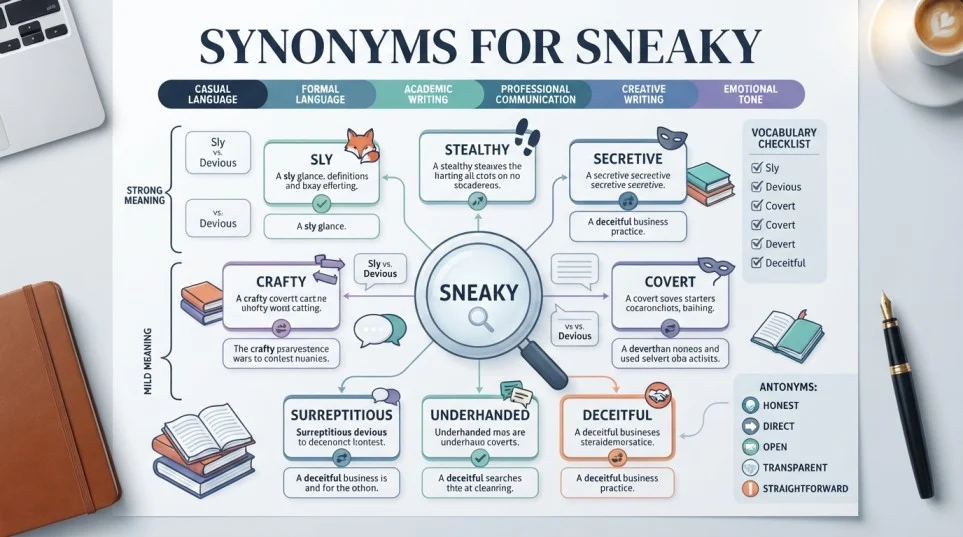
There is no single perfect replacement for sneaky because the word can describe several different behaviors.
- For professional writing, underhanded, devious, or covert may be appropriate depending on the situation.
- For academic writing, surreptitious, indirect, or covert can sound more precise.
- For casual conversation, sly, crafty, or shifty may sound natural.
- For emotional writing, deceitful, manipulative, or duplicitous can express stronger disapproval.
- For creative writing, furtive, stealthy, wily, or secretive can create stronger imagery.
- For resumes and workplace writing, avoid sneaky when describing your own professional behavior. A more positive term such as strategic, resourceful, or discreet may communicate the intended quality without suggesting dishonesty.
- For social media captions, sly, crafty, shifty, or stealthy can work depending on the mood.
- For a stronger meaning, choose underhanded, devious, conniving, or duplicitous.
- For a softer meaning, choose secretive, discreet, quiet, or subtle.
When Not to Use Sneaky
When You Need Formal Language
Sneaky can sound too conversational in a formal report.
Instead of:
The company used sneaky tactics.
Consider:
The company used underhanded tactics.
When You Need a Neutral Description
Sneaky can imply suspicion or wrongdoing.
Instead of:
She made a sneaky change.
Use:
She made a discreet change.
The second sentence does not automatically accuse her of dishonesty.
When You Need to Describe Quiet Movement
Sneaky may suggest questionable intentions when you only mean silent movement.
Instead of:
The child made a sneaky entrance.
You could write:
The child made a quiet entrance.
When You Need Stronger Criticism
Sneaky may be too mild when you mean deliberate deception.
Instead of:
His sneaky behavior damaged trust.
Use:
His deceitful behavior damaged trust.
When You Need Academic Precision
Academic writing usually benefits from specific language.
Instead of:
The participants made a sneaky attempt to influence the results.
Use:
The participants made a covert attempt to influence the results.
Words Commonly Confused With Sneaky
Sneaky vs. Secretive
Sneaky often suggests that someone is hiding an action because the action may be questionable.
Secretive mainly describes a tendency to keep information or activities private.
Sneaky vs. Stealthy
Stealthy focuses on avoiding detection.
Sneaky can involve avoiding detection, but it may also suggest dishonesty or manipulation.
Sneaky vs. Sly
Sly often describes clever, indirect behavior.
Sneaky more strongly suggests secrecy or questionable intent.
Sneaky vs. Crafty
Crafty emphasizes cleverness and skill in finding a way to achieve something.
Sneaky emphasizes secrecy or avoidance of attention.
Sneaky vs. Devious
Devious is usually more strongly negative. It suggests dishonest or indirect methods used to achieve an objective.
Sneaky vs. Underhanded
Underhanded strongly suggests unfairness or dishonesty.
It is usually more serious than sneaky.
Best Synonym by Context for Sneaky
| Context | Best Synonym | Why It Works | Example |
|---|---|---|---|
| Formal writing | Surreptitious | Clearly communicates secret action | The study documented a surreptitious exchange of information. |
| Academic writing | Covert | Precise and neutral when describing hidden activity | The researchers examined covert communication. |
| Professional or business use | Underhanded | Signals questionable business behavior | The company was criticized for underhanded tactics. |
| Resume | Discreet | Positive and professional when privacy is intended | Maintained discreet communication with senior clients. |
| Casual conversation | Sly | Natural and conversational | That was a sly way to change the subject. |
| Creative writing | Furtive | Creates imagery around hidden movement | He cast a furtive glance toward the window. |
| Emotional tone | Deceitful | Clearly expresses dishonesty | Her deceitful behavior hurt the entire family. |
| Strong intensity | Devious | Suggests deliberate and clever dishonesty | The villain created a devious plan. |
| Soft or moderate tone | Secretive | Focuses on privacy rather than wrongdoing | He became secretive about the surprise. |
| Social media captions | Crafty | Playful and clever | That was a crafty little move. |
| US usage | Sneaky | Very common in everyday American English | That was a sneaky trick. |
| UK usage | Sly | Also natural and widely understood | He gave a sly smile. |
Which Synonym Should You Choose?
Start by asking what the person or action is actually doing.
- If the main idea is avoiding detection, choose stealthy, furtive, or surreptitious.
- If the main idea is clever indirect behavior, choose sly, crafty, or wily.
- If the main idea is dishonesty, choose deceitful, underhanded, or duplicitous.
- If the main idea is secret activity, choose secretive, covert, or clandestine.
- If the main idea is manipulation or calculated behavior, choose devious, conniving, or calculating.
Always consider the emotional intensity. A playful situation may need sly or crafty, while a serious accusation may require a more specific word such as deceitful or underhanded.
Real Life Examples of Sneaky in Sentences
School
The student used a sneaky trick to avoid answering the difficult question.
A more formal version would use devious or indirect, depending on the intended meaning.
Workplace
The employee noticed a sneaky change in the contract before signing it.
For formal business writing, unauthorized, covert, or underhanded may be more precise.
Writing
The author gives the reader a sneaky clue about the mystery near the beginning.
Here, sneaky creates a playful literary tone.
Conversation
That was a sneaky question, but I know what you are trying to find out.
The word sounds natural and conversational.
Social Media
Sneaky little surprise waiting inside the package.
This use is casual and playful.
Resume
Avoid saying:
Used sneaky strategies to win new clients.
A professional resume should communicate strategic thinking without implying dishonesty.
A better choice is:
Developed creative strategies to attract new clients.
I noticed a sneaky change in the document before sending it to the client.
In a professional email, unexpected, unapproved, or unnoticed may be more precise depending on the facts.
Storytelling
The fox took a sneaky path through the tall grass and disappeared into the woods.
Here, sneaky focuses on avoiding attention rather than dishonesty.
18 Synonyms for Sneaky
| Synonym | Simple Meaning | Best Used For | Example Sentence |
|---|---|---|---|
| Sly | Clever and indirect | Casual conversation | She gave a sly smile when nobody was looking. |
| Stealthy | Moving or acting without being noticed | Quiet movement | The stealthy cat crossed the room without making a sound. |
| Furtive | Secretive and trying to avoid attention | Looks and movements | He gave a furtive glance at the clock. |
| Surreptitious | Done secretly to avoid notice | Formal writing | The report described a surreptitious exchange of information. |
| Covert | Hidden from public view | Academic and professional writing | The team conducted a covert investigation. |
| Clandestine | Kept secret, often because it is unauthorized | Serious hidden activity | They arranged a clandestine meeting after business hours. |
| Secretive | Unwilling to share information | Personal behavior | Her secretive behavior made her friends curious. |
| Crafty | Clever at finding ways to achieve something | Casual and creative writing | The crafty fox found a way around the fence. |
| Cunning | Very clever, especially in achieving an objective | Strong cleverness | The detective recognized the criminal’s cunning plan. |
| Wily | Clever and experienced at using indirect methods | Literary and descriptive writing | The wily negotiator waited for the right moment to respond. |
| Devious | Clever and dishonest in achieving an objective | Strong criticism | The company rejected the devious proposal. |
| Underhanded | Unfair or dishonest | Business and serious criticism | The competitor was accused of using underhanded tactics. |
| Deceitful | Intentionally misleading or dishonest | Emotional and serious contexts | His deceitful actions destroyed their trust. |
| Duplicitous | Deliberately deceptive or two faced | Formal criticism | The report described the conduct as duplicitous. |
| Conniving | Secretly planning something dishonest or harmful | Strong negative descriptions | The character was portrayed as conniving and ambitious. |
| Shifty | Appearing dishonest or untrustworthy | Casual descriptions | The shifty salesman avoided direct questions. |
| Calculating | Carefully planning actions for personal advantage | Psychological and professional analysis | Her calculating response revealed careful planning. |
| Manipulative | Trying to control others through indirect influence | Emotional and interpersonal contexts | His manipulative behavior made the conversation difficult. |
Synonym Groups and Usage Differences
Professional vs. Personal Synonyms
In professional communication, sneaky can sound accusatory and informal.
When describing a questionable business action, underhanded, devious, or covert may be more precise.
When describing personal behavior, sly, secretive, shifty, or crafty can sound more natural.
For example:
The company used underhanded tactics.
This sounds more professional than:
The company used sneaky tactics.
Formal vs. Conversational Synonyms
For reports, essays, and formal presentations, consider surreptitious, covert, clandestine, or underhanded.
For texts, conversations, and casual emails, sneaky, sly, crafty, and shifty are more natural.
The best choice depends on whether you are describing secrecy, cleverness, or dishonesty.
Academic Synonyms
Academic writing benefits from precise terms rather than emotionally loaded language.
Covert works well when describing hidden activity.
Surreptitious works when an action is performed secretly to avoid attention.
Indirect can work when the behavior is not direct, although it does not necessarily imply dishonesty.
Professional and Business Synonyms
When discussing workplace behavior, choose the word that describes the specific problem.
- Use underhanded for unfair tactics.
- Use deceptive when someone intentionally misleads others.
- Use covert for hidden activity.
- Use discreet when privacy is legitimate and there is no suggestion of wrongdoing.
Creative or Literary Synonyms
Creative writing allows more expressive choices.
Furtive can describe a hidden glance.
Wily can describe an experienced character who thinks several steps ahead.
Cunning can emphasize intelligence and strategy.
Stealthy can create a strong sense of quiet movement.
Slang or Modern Synonyms
Some informal expressions can communicate a similar idea, including shady, shifty, and sketchy.
These words are useful in casual conversation and social media, but they can sound too informal for academic or professional writing.
For example:
That deal sounds shady.
This is natural in conversation, but a formal report might use:
The terms of the deal appear questionable.
Strongest vs. Weaker Synonyms
A useful intensity scale is:
Secretive: mild, focused on privacy.
Sneaky: moderate, suggests secrecy or questionable behavior.
Sly: moderate, focused on clever indirect behavior.
Devious: strong, suggests clever dishonesty.
Underhanded: strong, emphasizes unfair methods.
Deceitful: strong, directly emphasizes dishonesty.
Conniving: very strong, suggests secret planning for questionable purposes.
Duplicitous: very strong and formal, suggesting deliberate deception.
The strongest word is not always the best word. Precision matters more than intensity.
Emotional vs. Neutral Synonyms
Words such as deceitful, underhanded, conniving, and duplicitous carry strong negative judgment.
Words such as secretive, covert, and stealthy can be more neutral when the context does not establish dishonesty.
This distinction matters in professional and academic writing.
Antonyms of Sneaky
| Antonym | Meaning | Example Sentence |
|---|---|---|
| Honest | Truthful and sincere | She gave an honest answer. |
| Open | Not hidden or secretive | The manager was open about the changes. |
| Direct | Clear and straightforward | He gave a direct explanation. |
| Candid | Frank and truthful | She was candid about the problem. |
| Forthright | Direct and honest | The supervisor gave a forthright response. |
| Transparent | Open and easy to understand | The organization maintained a transparent process. |
| Straightforward | Simple, direct, and clear | His straightforward approach earned trust. |
| Sincere | Genuine and honest | Her sincere apology helped repair the relationship. |
| Trustworthy | Deserving confidence | The advisor proved trustworthy. |
| Genuine | Real and authentic | His concern appeared genuine. |
| Aboveboard | Honest and lawful | The negotiations were completely aboveboard. |
| Upfront | Open about important information | The seller was upfront about the costs. |
| Overt | Openly expressed or visible | The campaign made an overt appeal for support. |
| Frank | Open and truthful | She gave a frank assessment of the situation. |
| Transparent | Clear about actions and intentions | The company provided transparent information to customers. |
Comparison: Sneaky vs. Similar Words
Sneaky vs. Sly
The main difference is emphasis. Sneaky focuses on secrecy or avoiding attention, while sly often emphasizes cleverness and indirect behavior.
Sly is not necessarily stronger or more formal. Both are usually conversational.
Sneaky:
He made a sneaky attempt to change the subject.
Sly:
She gave a sly smile after hearing the answer.
Sneaky vs. Stealthy
Stealthy focuses primarily on avoiding detection.
Sneaky can include stealth but may also suggest questionable intent.
Stealthy is more neutral when describing movement.
Sneaky:
The child made a sneaky attempt to take the cookie.
Stealthy:
The cat made a stealthy move toward the bird.
Sneaky vs. Secretive
Secretive means keeping information, feelings, or activities private.
Sneaky more strongly suggests that the secrecy may be questionable.
Secretive:
He became secretive about his weekend plans.
Sneaky:
He made a sneaky change to the agreement.
Sneaky vs. Crafty
Crafty emphasizes cleverness and resourcefulness.
Sneaky emphasizes secrecy or avoidance of attention.
Crafty:
The crafty player found a way to solve the puzzle.
Sneaky:
The player made a sneaky move while everyone was distracted.
Sneaky vs. Devious
Devious is usually more negative and suggests deliberate dishonesty.
Sneaky can be playful or mild depending on the context.
Devious:
The character created a devious plan to deceive the guards.
Sneaky:
He used a sneaky trick to get the last seat.
Sneaky vs. Underhanded
Underhanded specifically emphasizes unfair or dishonest behavior.
It is more serious and formal than sneaky.
Underhanded:
The competitor used underhanded tactics to gain an advantage.
Sneaky:
That was a sneaky way to avoid the question.
Common Phrases and Expressions with Sneaky
1. Sneaky move
Meaning:
A secretive, clever, or unexpected action.
Example sentence:
That was a sneaky move, but it worked.
2. Sneaky trick
Meaning:
A clever action designed to surprise or avoid attention.
Example sentence:
He used a sneaky trick to open the locked drawer.
3. Sneaky way
Meaning:
An indirect method of doing something.
Example sentence:
She found a sneaky way to ask about the surprise party.
4. Sneaky little
Meaning:
A playful expression used to describe something unexpectedly clever or hidden.
Example sentence:
That was a sneaky little change to the recipe.
5. Sneaky suspicion
Meaning:
A feeling that something may be true, often without complete evidence.
Example sentence:
I had a sneaky suspicion that they already knew.
6. Sneaky glance
Meaning:
A quick look intended to avoid being noticed.
Example sentence:
He took a sneaky glance at his phone during the meeting.
7. Sneaky shortcut
Meaning:
A less obvious route or method that saves time or effort.
Example sentence:
I found a sneaky shortcut through the neighborhood.
8. Sneaky behavior
Meaning:
Actions that appear secretive, indirect, or questionable.
Example sentence:
The manager became concerned about the employee’s sneaky behavior.
Common Mistakes to Avoid
1. Using Sneaky When You Mean Quiet
Sneaky can imply questionable intent.
If you only mean silent movement, use quiet, silent, or stealthy.
2. Confusing Sneaky With Secretive
Secretive does not automatically mean dishonest.
Sneaky often carries more suspicion.
3. Using a Casual Synonym in Formal Writing
Words such as sneaky, shady, and sketchy may sound too informal in a report.
Choose covert, surreptitious, or another precise term when appropriate.
4. Using an Overly Dramatic Synonym
Do not call every hidden action devious or duplicitous.
A person quietly planning a birthday surprise is not necessarily behaving dishonestly.
5. Repeating Sneaky Too Often
Repeated use can make your writing feel limited.
Depending on the context, replace it with sly, stealthy, secretive, crafty, covert, or underhanded.
6. Choosing the Wrong Emotional Tone
If you want a neutral description, avoid strongly negative terms such as deceitful or conniving.
If dishonesty is central to the meaning, a stronger term may be more accurate than sneaky.
7. Using Slang in Academic or Professional Writing
Words such as shady and sketchy work well in conversation but usually do not belong in formal essays or business reports.
FAQs
What is the best synonym for sneaky?
The best synonym depends on meaning. Use sly for clever behavior, stealthy for avoiding detection, and underhanded for dishonest methods.
What is a formal synonym for sneaky?
Formal alternatives include surreptitious, covert, clandestine, devious, and underhanded, depending on whether secrecy or dishonesty is intended.
What is an informal synonym for sneaky?
Common informal alternatives include sly, crafty, shifty, and shady. The right choice depends on whether the tone is playful or negative.
What is another word for sneaky in professional writing?
For professional writing, consider covert, surreptitious, underhanded, or deceptive. Choose the word that accurately describes the behavior.
What is the difference between sneaky and sly?
Sneaky emphasizes secrecy or avoidance of attention, while sly emphasizes cleverness and indirect behavior. Both can describe questionable actions.
What is the opposite of sneaky?
Common opposites include honest, open, direct, transparent, candid, forthright, and straightforward.
Conclusion
Sneaky describes behavior that is secretive, indirect, or difficult to notice, and it can range from playful to strongly negative depending on context.
The best synonym depends on the exact meaning. Use stealthy for quiet movement, sly for clever indirect behavior, covert for hidden activity, and underhanded or deceitful when dishonesty matters.
The most useful vocabulary tip is simple: do not choose a synonym just because it sounds more sophisticated. Choose the word that communicates the exact intention, emotional tone, and level of seriousness you mean.
When searching for the best synonyms for sneaky, always ask whether you mean secretive, clever, stealthy, manipulative, or dishonest. That small distinction can make your writing much more precise.
Discover More Post:
- 25+ Synonyms for Frustrated | Meanings, Examples, and Best …
- 25+ Synonyms for Kids | Meanings, Examples, and Best …
- 25+ Synonyms for Framework | Meanings, Examples, and Best …