Do you keep writing “decide” in emails, essays, captions, resumes, or everyday messages? The word is useful, but repeating it can make your writing sound flat when a more precise choice is available.
This guide explains synonyms for decide by meaning, tone, formality, and situation. You will see when to use words such as choose, determine, resolve, select, conclude, and opt, plus practical examples for school, work, conversation, and creative writing.
What Does Decide Mean?
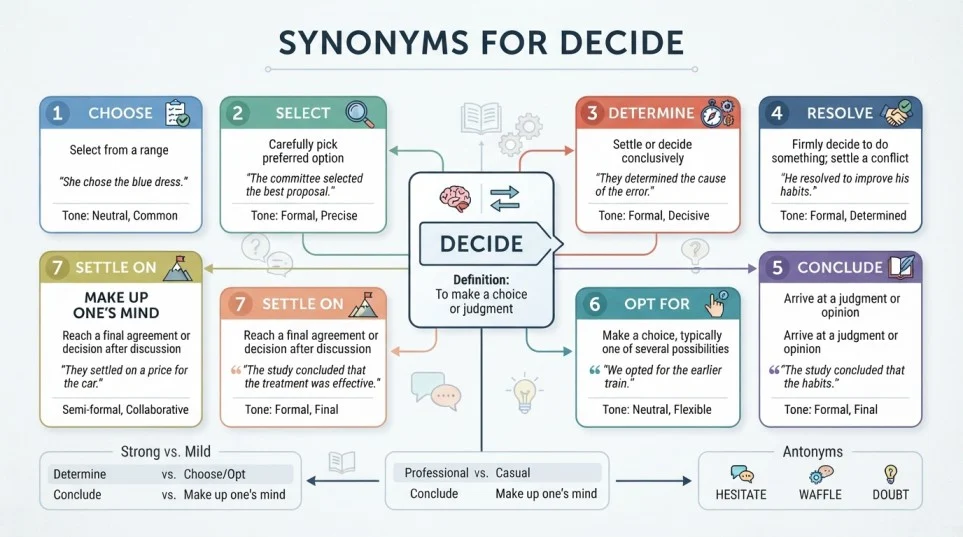
To decide means to make a choice after considering options, information, or preferences. Formal alternatives include determine and resolve, casual choices include choose and settle on, academic options include conclude, and professional choices include select and determine.
Meaning, Tone and Context
Simple definition
Decide means to make a choice or reach a judgment after thinking about available options or information.
For example:
“I decided to apply for the position.”
The sentence tells us that the speaker considered the situation and reached a choice.
Part of speech
Decide is a verb.
Common forms include:
• decide
• decides
• deciding
• decided
• decision, the noun form
• decisive, the adjective form
• decisively, the adverb form
• indecision, the noun describing difficulty making a choice
• undecided, the adjective describing someone who has not chosen
Tone
Decide usually has a neutral tone. It can sound positive when it suggests confidence and clarity, but it can also appear negative when the decision produces an unwanted result.
Compare:
“I decided to accept the offer.”
“I decided to ignore the warning.”
The word itself is not strongly emotional. The surrounding language creates most of the emotional effect.
Formality level
Decide works in almost every level of English. It is natural in casual conversation, professional emails, academic essays, and formal documents.
More formal choices include determine, resolve, adjudicate, and conclude when their specific meanings fit.
More conversational choices include choose, settle on, go with, and make up your mind.
Common use cases
Decide commonly appears when someone:
• chooses between alternatives
• reaches a conclusion
• settles an issue
• selects an action
• determines a plan
• makes a personal or professional choice
• reaches a judgment after reviewing evidence
When and How to Use Decide
Use decide when the main idea is reaching a choice, conclusion, or determination.
Professional
“The management team decided to revise the customer support process.”
This is clear and neutral for workplace communication.
Personal
“I decided to spend the weekend with my family.”
Choose decide when the sentence focuses on a personal choice.
Academic
“After reviewing the evidence, the researchers decided to conduct another analysis.”
In academic writing, determine or conclude may sometimes be more precise, depending on what actually happened.
Emotional
“After a difficult week, she decided to leave the situation behind.”
The emotional effect comes from the context, while decide remains neutral.
Another Word for Decide
There is no single replacement that works perfectly in every sentence. The best alternative depends on what kind of decision is being described.
Professional writing
Use determine when the decision involves facts, criteria, procedures, or official judgment.
Example: “The committee will determine the final outcome.”
Academic writing
Use conclude when a decision is actually a conclusion reached from evidence.
Example: “The authors concluded that further research was necessary.”
Casual conversation
Use choose, settle on, or go with.
Example: “We chose the Italian restaurant.”
Emotional writing
Use resolve when the decision shows determination.
Example: “She resolved to rebuild her confidence.”
Creative writing
Use settle on, resolve, elect, or make up one’s mind depending on the mood and character.
Example: “After hours of thought, he finally settled on the blue door.”
Resume or workplace use
Use determine, select, establish, or choose according to the actual task.
Example: “Selected vendors based on quality, cost, and delivery requirements.”
Social media captions
Choose simple words such as choose, go with, or settle on.
Example: “Finally settled on a weekend escape.”
Stronger meaning
Use resolve when the decision involves determination or commitment.
Softer meaning
Use lean toward when the person has a preference but has not fully decided.
When Not to Use Decide
Decide is sometimes too general.
If you are describing a formal conclusion based on evidence, conclude or determine may communicate the process more precisely.
General: “The study decided the issue.”
More precise: “The study concluded that the treatment required further testing.”
Decide can also sound too strong when someone has only expressed a preference.
Strong: “I decided on the blue jacket.”
Softer: “I am leaning toward the blue jacket.”
Do not replace decide with a dramatic word such as resolve when the situation is simple and routine. “We resolved to order pizza” can sound unnecessarily serious when “We decided to order pizza” is natural.
Words Commonly Confused With “Decide”
Decide vs. Choose
Decide focuses on reaching the decision. Choose focuses on selecting one option.
“I decided to take the course.”
“I chose the evening course.”
Decide vs. Determine
Determine often suggests establishing a fact, result, or official outcome. Decide usually emphasizes making a choice.
“The panel decided to meet again.”
“The test will determine the cause.”
Decide vs. Select
Select emphasizes choosing one item from a group, often after comparison.
“We selected three finalists.”
Decide vs. Resolve
Resolve can mean reach a decision, but it often adds a sense of determination or commitment.
“She decided to exercise more.”
“She resolved to exercise every morning.”
Decide vs. Conclude
Conclude usually means reaching an opinion or judgment from evidence or reasoning.
“The team decided to change the schedule.”
“The team concluded that the schedule was unrealistic.”
Decide vs. Opt
Opt means choose one possibility, usually from available alternatives. It often appears with “for” or “to.”
“We decided to stay.”
“We opted to stay.”
Best Synonym by Context for Decide
Which Synonym Should You Choose?
Start by asking what actually happened.
- If someone simply picked one option, choose is usually the clearest word.
- If someone established an outcome using facts or criteria, determine may be better.
- If evidence led someone to a reasoned conclusion, conclude is often more accurate.
- If the decision involved determination or a personal commitment, resolve adds useful meaning.
- If the choice was made from a group of items, select can be more precise.
- If the person has not reached a final choice, do not use decide. Use lean toward, consider, prefer, or be inclined toward instead.
The best synonym is not always the most sophisticated word. Precision matters more than formality.
Real Life Examples of Decide in Sentences
School
“After comparing the programs, Maya decided to study biology.”
Workplace
“The department decided to update its training materials.”
Writing
“The writer decided to remove the final paragraph.”
Conversation
“We decided to meet at six.”
Social media
“Finally decided to try something new.”
Resume
“Selected project priorities based on customer needs and available resources.”
“We have decided to move the meeting to Thursday.”
Storytelling
“After staring at the map for several minutes, he decided to take the northern road.”
18 Synonyms for Decide
The list below focuses on useful direct synonyms and close contextual alternatives. Some words overlap with decide only in particular meanings, so context still matters.
Synonym Groups and Usage Differences
Professional vs. Personal Synonyms
Professional decisions often benefit from precise verbs such as determine, select, establish, and conclude.
Personal decisions are more naturally expressed with choose, settle on, go with, or make up one’s mind.
Compare:
“The committee determined the final schedule.”
“I chose the earlier appointment.”
Formal vs. Conversational Synonyms
Formal writing favors determine, conclude, resolve, elect, rule, and adjudicate when their meanings fit.
Conversation usually sounds more natural with choose, settle on, go with, or make up one’s mind.
A formal word is not automatically a better word. Use it only when its meaning matches the situation.
Academic Synonyms
Academic writing often needs precision.
- Use determine when a study establishes a result.
- Use conclude when researchers reach a judgment from evidence.
- Use decide when people make a methodological or practical choice.
Example:
“The researchers decided to repeat the experiment.”
“The researchers concluded that the first result was unreliable.”
These sentences describe different actions.
Professional and Business Synonyms
Business communication often benefits from clear verbs.
Use determine for outcomes, select for choices among candidates or providers, establish for policies or standards, and decide for ordinary organizational choices.
For example:
“The hiring team selected three candidates.”
“The director decided to postpone the launch.”
“The review will determine the final recommendation.”
Creative or Literary Synonyms
Creative writing can use settle on, resolve, elect, or make up one’s mind to reveal personality and mood.
“After a long silence, she resolved to tell the truth.”
The word resolve adds emotional determination that decide does not necessarily carry.
Slang or Modern Synonyms
There is no universal slang synonym for decide.
Casual expressions such as go with, pick, and make up your mind are common in relaxed American English.
They are fine in conversation and informal social content, but they may sound too casual in academic or highly formal writing.
Strongest vs. Weaker Synonyms
A useful intensity scale is:
Mild preference: lean toward
Simple choice: choose
Deliberate selection: select
Reasoned determination: determine
Firm commitment: resolve
Official judgment: rule or adjudicate
The strongest choice depends on context. Resolve is not simply a stronger version of decide in every sentence because it adds determination.
Emotional vs. Neutral Synonyms
Neutral choices include decide, choose, select, and determine.
More emotional choices include resolve and commit to because they can suggest determination or personal dedication.
For factual writing, prefer the neutral option unless the emotional meaning is important.
Antonyms of Decide
The following are practical opposites or opposing expressions. Some are phrases rather than strict dictionary antonyms because English does not have 15 exact one word antonyms for decide.
Comparison: Decide vs. Similar Words
Decide vs. Choose
The main difference is focus. Decide emphasizes reaching the decision, while choose emphasizes selecting an option.
Decide is not necessarily stronger or more formal.
Example with decide: “We decided to leave early.”
Example with choose: “We chose the earlier train.”
Decide vs. Determine
Determine is usually more formal and often involves establishing a fact, result, or official outcome.
Determine can sound stronger in professional and academic contexts because it suggests a process or standard.
Example with decide: “The manager decided to change the schedule.”
Example with determine: “The review will determine the cause of the delay.”
Decide vs. Select
Select emphasizes careful choice from a defined group.
It is often more formal than choose and is common in workplace, technical, and application contexts.
Example with decide: “We decided to hire a consultant.”
Example with select: “We selected a consultant with industry experience.”
Decide vs. Resolve
Resolve can mean decide, but it often adds firmness and determination.
Resolve is more emotionally forceful than neutral decide when it describes a personal commitment.
Example with decide: “She decided to study every evening.”
Example with resolve: “She resolved to study every evening.”
Decide vs. Conclude
Conclude means reach a judgment after reasoning or reviewing evidence.
It is more appropriate than decide when the sentence describes an analytical conclusion.
Example with decide: “The team decided to continue the project.”
Example with conclude: “The team concluded that the project was financially viable.”
Decide vs. Opt
Opt means choose one option, often from several alternatives.
It is common in polished conversation and professional writing.
Example with decide: “They decided to work remotely.”
Example with opt: “They opted to work remotely.”
Common Phrases and Expressions with Decide
1. Decide to do something
Meaning: Choose to take a particular action.
Example sentence: “She decided to apply for the scholarship.”
2. Decide between two options
Meaning: Choose one possibility from two alternatives.
Example sentence: “I cannot decide between the two apartments.”
3. Decide on something
Meaning: Choose or settle on a particular option.
Example sentence: “Have you decided on a restaurant?”
4. Decide for yourself
Meaning: Make your own choice rather than letting another person choose.
Example sentence: “You should decide for yourself what works best.”
5. Decide once and for all
Meaning: Make a final choice and stop reconsidering it.
Example sentence: “We need to decide once and for all.”
6. Let someone decide
Meaning: Allow another person to make the choice.
Example sentence: “I am happy to let you decide where we eat.”
7. Help someone decide
Meaning: Give information or advice that makes a choice easier.
Example sentence: “The comparison chart helped me decide.”
Common Mistakes to Avoid
1. Using decide when a more precise word is better
“The test decided the cause” is usually less precise than “The test determined the cause.”
2. Confusing decide with choose
Choose describes selecting an option. Decide describes reaching the decision. The words often overlap, but they do not emphasize exactly the same thing.
3. Using a casual synonym in formal writing
Words such as go with and pick can sound too informal in a research paper or official report.
Use select or determine when the context requires more formal language.
4. Using an overly dramatic synonym
Resolve can imply determination. Do not use it for every ordinary choice.
“We resolved to order coffee” sounds more serious than “We decided to order coffee.”
5. Repeating decide too often
If the same paragraph contains several uses of decide, vary the wording only when the meaning changes.
Use choose, select, determine, conclude, or resolve when each one accurately expresses a different shade of meaning.
6. Choosing the wrong emotional tone
Do not use resolve if you only mean that someone made an ordinary choice.
Likewise, avoid lean toward when a final decision has already been made.
7. Using slang in academic or professional writing
Expressions such as go with may be natural in conversation but less suitable for a formal report.
Always match the word to the audience and purpose.
FAQs
What is the best synonym for decide?
Choose is the most natural everyday alternative, while determine, select, resolve, or conclude may be better when the context requires a more specific meaning.
What is a formal synonym for decide?
Determine is a strong formal alternative when you mean establish an outcome. Resolve and conclude can also work in specific contexts.
What is an informal synonym for decide?
Choose, go with, settle on, and make up one’s mind are natural informal alternatives, depending on the sentence and situation.
What is another word for decide in professional writing?
Determine, select, establish, and conclude can replace decide when they accurately describe the professional action or reasoning involved.
What is the difference between decide and choose?
Decide emphasizes reaching a decision, while choose emphasizes selecting an option. Both are common, but context determines which is more precise.
What is the opposite of decide?
Common opposites include hesitate, waver, vacillate, delay, defer, remain undecided, and suspend judgment. The best choice depends on the situation.
Conclusion
Decide is a versatile verb for describing the act of reaching a choice, but stronger vocabulary comes from choosing a word that matches the exact situation.
Use choose for everyday choices, select for careful selection, determine for formal outcomes, conclude for evidence based judgments, and resolve for firm personal commitment.
The best synonym for decide is not always the most formal word. Before replacing it, ask what the sentence is actually communicating, how strong the decision is, and who will read it.
A practical vocabulary tip is simple: do not replace decide just to sound sophisticated. Replace it when another word communicates the meaning more precisely.
Discover More Post:
- 25+ Synonyms for Kids | Meanings, Examples, and Best …
- 25+ Synonyms for Found | Meanings, Examples, and Best …
- 25+ Synonyms for Frustrated | Meanings, Examples, and Best …