Finding the right words to describe a positive feeling can be harder than it seems. If you keep writing “excited and happy” in emails, essays, captions, conversations, or professional messages, a more precise word can make your writing much stronger.
The best alternative depends on what you actually mean. You might feel thrilled about an upcoming event, delighted by good news, joyful because of a meaningful moment, or enthusiastic about a new opportunity.
This guide explains the most useful synonyms for excited and happy, including their meanings, emotional intensity, formality, and real world usage. You will also learn which words work best in school, business, resumes, social media, conversations, and creative writing.
What Does “Excited and Happy” Mean?
“Excited and happy” describes a positive emotional state involving pleasure, enthusiasm, anticipation, or joy. Useful alternatives include thrilled, delighted, joyful, enthusiastic, elated, overjoyed, cheerful, pleased, and exhilarated, depending on the situation.
Meaning, Tone and Context
The phrase “excited and happy” combines two closely related positive emotions.
Excited usually describes strong enthusiasm, anticipation, or emotional energy about something that is happening or may happen.
Happy describes a general feeling of pleasure, satisfaction, joy, or emotional well being.
Together, “excited and happy” can describe someone who feels both pleased and energized by a situation.
1. Simple Definition
Excited and happy means feeling strong positive emotion, often because of good news, an upcoming event, an achievement, a person, or a desirable opportunity.
For example:
“I am excited and happy about starting my new job.”
This sentence communicates both anticipation and pleasure.
2. Part of Speech
“Excited” is an adjective.
“Happy” is also an adjective.
Related word forms include:
Excite: verb
Excited: adjective
Excitement: noun
Happiness: noun
Happily: adverb
Joyful: adjective
Joy: noun
3. Positive, Negative, or Neutral Tone
The phrase has a strongly positive tone.
It normally communicates enthusiasm, pleasure, satisfaction, anticipation, or joy.
The emotional strength can vary. “Pleased” is relatively mild, while “ecstatic” communicates extremely strong positive emotion.
4. Formality Level
“Excited and happy” is natural in everyday American English.
It works well in personal conversations, friendly emails, social media posts, texts, and informal writing.
For formal or professional writing, a more precise word may sound stronger. For example, “pleased,” “enthusiastic,” or “delighted” may be more appropriate depending on the situation.
5. Common Use Cases
The phrase is commonly used when discussing:
- • Good news
- • Personal achievements
- • New opportunities
- • Celebrations
- • Relationships
- • Travel
- • School accomplishments
- • Career changes
- • Special events
- • Social media announcements
- • Positive professional developments
6. Important Related Forms
The phrase has several useful related forms.
“Excitement” describes the feeling of being excited.
“Happiness” describes the state of feeling happy.
“Joyful” emphasizes deep happiness.
“Enthusiastic” emphasizes strong interest and energy.
“Delighted” emphasizes pleasure and satisfaction.
“Thrilled” emphasizes strong excitement and happiness.
When and How to Use “Excited and Happy”
Use “excited and happy” when you want to communicate both positive emotion and enthusiasm.
The phrase is especially useful when the emotional experience involves anticipation.
Professional
“I am excited and happy to join the team and contribute to the project.”
For a more polished professional tone, you could write:
“I am enthusiastic about joining the team and contributing to the project.”
Personal
“I am so excited and happy that you can come visit this weekend.”
The phrase sounds warm and natural in personal communication.
Academic
“I was excited and happy to receive recognition for my research.”
In formal academic writing, “pleased” or “delighted” may sometimes provide a more controlled tone.
Emotional
“She was excited and happy when she heard the wonderful news.”
This wording clearly expresses a strong positive emotional response.
Creative
“He felt excited and happy as the long awaited journey finally began.”
A creative writer might replace the phrase with “thrilled,” “elated,” or “overjoyed” for greater emotional color.
Social Media
“Excited and happy to share that I finally graduated!”
For a caption, “thrilled,” “proud,” or “overjoyed” can create a more distinctive voice.
“I am excited and happy to confirm that I will be attending the event.”
A professional alternative could be:
“I am delighted to confirm that I will be attending the event.”
Another Word for “Excited and Happy”
There is no single perfect replacement in every situation.
The best synonym depends on whether you want to emphasize anticipation, happiness, enthusiasm, satisfaction, or intense joy.
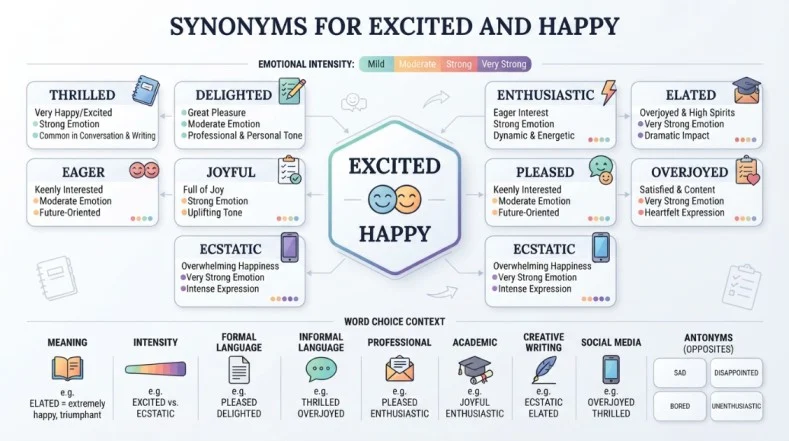
| Context | Recommended Word |
|---|---|
| Professional writing | Enthusiastic |
| Academic writing | Pleased |
| Casual conversation | Thrilled |
| Emotional writing | Overjoyed |
| Creative writing | Elated |
| Resume or workplace | Enthusiastic |
| Social media captions | Thrilled |
| Stronger meaning | Ecstatic |
| Softer meaning | Pleased |
Professional Writing
Enthusiastic is often a strong choice because it communicates positive energy without sounding overly emotional.
Academic Writing
Pleased can work well when describing a positive response in a measured way.
Casual Conversation
Thrilled sounds natural when you want to show strong excitement.
Emotional Writing
Overjoyed emphasizes deep happiness.
Creative Writing
Elated adds a more expressive and literary quality.
Resume or Workplace Use
Enthusiastic is particularly useful when describing interest in a role, project, responsibility, or opportunity.
Social Media Captions
Thrilled, overjoyed, and so happy work naturally in captions.
Stronger Meaning
Ecstatic indicates extremely strong happiness and excitement.
Softer Meaning
Pleased communicates positive feelings without excessive emotional intensity.
When Not to Use “Excited and Happy”
The phrase is useful, but it can become repetitive or vague.
When You Need Precision
Instead of:
“I am excited and happy about the opportunity.”
Consider:
“I am enthusiastic about the opportunity.”
This focuses specifically on interest and motivation.
When You Need a Formal Tone
Instead of:
“We are excited and happy to announce the results.”
You could write:
“We are pleased to announce the results.”
When the Emotion Is Extremely Strong
Instead of:
“She was excited and happy after winning.”
You might use:
“She was ecstatic after winning.”
When the Feeling Is Mainly Anticipation
If the person is looking forward to something, “eager” may be more precise.
When the Feeling Is Mainly Satisfaction
If someone feels good because something worked out, “pleased” may be more accurate.
Words Commonly Confused With “Excited and Happy”
Excited vs. Enthusiastic
“Excited” often emphasizes emotional anticipation.
“Enthusiastic” emphasizes strong interest, energy, or willingness.
“I am excited about the trip.”
“I am enthusiastic about the new project.”
Happy vs. Joyful
“Happy” is a broad everyday word.
“Joyful” often suggests deeper or more expressive happiness.
“She was happy with the result.”
“She felt joyful during the celebration.”
Thrilled vs. Delighted
“Thrilled” usually communicates stronger excitement.
“Delighted” emphasizes pleasure and satisfaction.
“I was thrilled to hear the news.”
“I was delighted to receive your invitation.”
Eager vs. Excited
“Eager” focuses on wanting something to happen soon.
“Excited” focuses more broadly on positive emotional anticipation.
“She is eager to begin.”
“She is excited about the opportunity.”
Pleased vs. Happy
“Pleased” is generally milder and more controlled.
“Happy” is broader and more conversational.
“I am pleased with the results.”
“I am happy with the results.”
Ecstatic vs. Excited
“Ecstatic” describes extremely strong happiness.
“Excited” can range from moderate enthusiasm to intense anticipation.
“She was excited about the announcement.”
“She was ecstatic when she won.”
Best Synonym by Context for “Excited and Happy”
| Context | Best Synonym | Why It Works | Example |
|---|---|---|---|
| Formal writing | Pleased | Controlled and professional | We are pleased with the outcome. |
| Academic writing | Pleased | Measured emotional language | The researchers were pleased with the findings. |
| Professional or business use | Enthusiastic | Shows positive interest | She is enthusiastic about the new role. |
| Resume | Enthusiastic | Communicates motivation | Enthusiastic about customer focused work. |
| Casual conversation | Thrilled | Natural and expressive | I am thrilled about the trip. |
| Creative writing | Elated | Adds emotional depth | He felt elated after hearing the news. |
| Emotional tone | Overjoyed | Highlights deep happiness | She was overjoyed to see her family. |
| Strong intensity | Ecstatic | Shows extreme happiness | They were ecstatic after the victory. |
| Soft or moderate tone | Pleased | Mild and polished | I am pleased with the decision. |
| Social media | Thrilled | Energetic and natural | Thrilled to share this news! |
| Anticipation | Eager | Emphasizes looking forward | I am eager to get started. |
| Deep happiness | Joyful | Emphasizes genuine joy | It was a joyful celebration. |
| Satisfaction | Delighted | Highlights pleasure | We were delighted by the response. |
| Energetic mood | Exhilarated | Communicates intense energy | She felt exhilarated after the adventure. |
| Modern casual use | So happy | Simple and natural | I am so happy for you. |
Which Synonym Should You Choose?
Start by identifying the main feeling you want to communicate.
- If you mean strong excitement, choose thrilled or exhilarated.
- If you mean deep happiness, choose joyful, overjoyed, or elated.
- If you mean professional interest, choose enthusiastic.
- If you mean polite satisfaction, choose pleased.
- If you mean strong pleasure, choose delighted.
- If you mean extreme happiness, choose ecstatic.
- If you mean anticipation, choose eager.
The most accurate synonym is usually the one that describes the specific emotion rather than simply replacing the original phrase.
Real Life Examples of “Excited and Happy” in Sentences
School
“I was excited and happy when my teacher selected my essay for the school magazine.”
A stronger alternative is:
“I was thrilled when my teacher selected my essay.”
Workplace
“I am excited and happy about the opportunity to work with this team.”
A more professional alternative is:
“I am enthusiastic about the opportunity to work with this team.”
Writing
“The author creates an excited and happy atmosphere through bright imagery.”
A more precise alternative could be:
“The author creates a joyful atmosphere through bright imagery.”
Conversation
“I am so excited and happy that you are coming.”
A natural alternative is:
“I am thrilled that you are coming.”
Social Media
“Excited and happy to announce that I graduated!”
A stronger caption could be:
“Thrilled to announce that I graduated!”
Resume
“I am excited and happy to develop new skills.”
A more professional version is:
“I am enthusiastic about developing new skills.”
“We are excited and happy to welcome you to the company.”
A polished version is:
“We are delighted to welcome you to the company.”
Storytelling
“She was excited and happy as she opened the letter.”
A more expressive version is:
“She was elated as she opened the letter.”
25 Synonyms for “Excited and Happy”
| Synonym | Simple Meaning | Best Used For | Example Sentence |
|---|---|---|---|
| Thrilled | Extremely pleased and excited | Casual and emotional situations | I was thrilled to hear the good news. |
| Delighted | Very pleased and happy | Professional and polite communication | We were delighted by the positive response. |
| Joyful | Full of happiness and joy | Emotional and creative writing | The room had a joyful atmosphere. |
| Enthusiastic | Showing strong interest and energy | Work, school, and professional contexts | She is enthusiastic about the new project. |
| Elated | Extremely happy and uplifted | Emotional and literary writing | He felt elated after receiving the award. |
| Overjoyed | Extremely happy | Personal and emotional situations | Her parents were overjoyed by the news. |
| Ecstatic | Extremely happy and excited | Very strong emotions | The fans were ecstatic after the victory. |
| Pleased | Happily satisfied | Formal and professional writing | We are pleased with the final results. |
| Glad | Feeling happy about something | Everyday conversation | I am glad you decided to come. |
| Cheerful | Noticeably happy and positive | Personality and mood descriptions | She remained cheerful throughout the day. |
| Exhilarated | Extremely energized and excited | Experiences and achievements | He felt exhilarated after completing the race. |
| Jubilant | Extremely joyful, often after success | Celebrations and major victories | The crowd was jubilant after the announcement. |
| Eager | Very interested and ready | Anticipation and motivation | She was eager to begin her new role. |
| Gleeful | Very happy in an energetic way | Informal and playful writing | The children were gleeful when they saw the surprise. |
| Buoyant | Cheerful and optimistic | Describing mood or outlook | Her buoyant mood lifted everyone around her. |
| Blissful | Extremely happy and peaceful | Personal and descriptive writing | They enjoyed a blissful afternoon together. |
| Exultant | Extremely joyful because of success | Formal and literary writing | The team was exultant after the achievement. |
| Upbeat | Positive, cheerful, and optimistic | Modern professional and casual language | He remained upbeat despite the busy schedule. |
| Animated | Full of energy and enthusiasm | Conversation and behavior | She became animated while discussing the idea. |
| Cheerily | In a cheerful way | Descriptive writing | He cheerily welcomed the guests. |
| Content | Satisfied and peacefully happy | Calm emotional situations | She felt content after finishing her work. |
| Satisfied | Pleased because expectations were met | Professional and practical contexts | The client was satisfied with the service. |
| Buoyant | Positive and emotionally energetic | Mood and attitude | His buoyant attitude encouraged the team. |
| Gleeful | Openly and energetically happy | Informal and playful contexts | He gave a gleeful laugh after hearing the news. |
| Triumphant | Extremely happy because of success | Achievement and victory | The team returned home triumphant. |
Synonym Groups and Usage Differences
Professional vs. Personal Synonyms
Professional writing usually benefits from controlled emotional language.
Words such as enthusiastic, pleased, delighted, and satisfied can communicate positivity without sounding excessive.
Personal writing gives you more freedom.
Words such as thrilled, overjoyed, ecstatic, and elated can express stronger feelings.
Formal vs. Conversational Synonyms
For reports, formal emails, essays, and workplace communication, consider:
Pleased
Delighted
Enthusiastic
Satisfied
For texts and casual conversations, consider:
Thrilled
Glad
So happy
Eager
Overjoyed
Academic Synonyms
Academic writing generally benefits from precise and measured language.
Pleased, enthusiastic, and satisfied can work when the emotional response is genuinely relevant.
Avoid overly dramatic choices such as “ecstatic” unless the context specifically calls for very strong emotion.
Professional and Business Synonyms
In workplace communication, enthusiastic is especially useful for expressing interest and motivation.
Pleased works well for announcements and formal responses.
Delighted can add warmth while remaining professional.
For example:
“We are pleased to announce the results.”
“I am enthusiastic about contributing to the project.”
“We are delighted to welcome our new members.”
Creative or Literary Synonyms
Creative writing allows stronger emotional vocabulary.
Elated, overjoyed, exultant, jubilant, and blissful can create a richer emotional atmosphere.
The best choice depends on the scene and the character.
Slang or Modern Synonyms
Casual expressions such as “so happy,” “super excited,” and “over the moon” are common in modern conversation and social media.
They can sound natural in personal communication but may be too casual for academic or formal professional writing.
Strongest vs. Weaker Synonyms
A useful general intensity scale is:
Content
↓
Pleased
↓
Happy
↓
Glad
↓
Delighted
↓
Thrilled
↓
Elated
↓
Overjoyed
↓
Exhilarated
↓
Ecstatic
The exact emotional strength depends on context, but this scale can help you avoid choosing an overly dramatic word.
Emotional vs. Neutral Synonyms
More emotional:
Ecstatic
Overjoyed
Elated
Jubilant
Exultant
More neutral or controlled:
Pleased
Satisfied
Content
Enthusiastic
Glad
Choose emotional vocabulary when you want readers to feel the intensity.
Choose neutral vocabulary when clarity and professionalism matter more than emotional expression.
Antonyms of “Excited and Happy”
Because “excited and happy” combines excitement and happiness, its opposites can describe sadness, low enthusiasm, emotional detachment, or disappointment.
| Antonym | Meaning | Example Sentence |
|---|---|---|
| Sad | Feeling unhappy | She felt sad after hearing the news. |
| Unhappy | Not feeling pleased or joyful | He was unhappy with the result. |
| Miserable | Extremely unhappy | She felt miserable after the argument. |
| Gloomy | Sad or lacking optimism | The gloomy mood affected everyone. |
| Dejected | Low in spirit after disappointment | He looked dejected after the loss. |
| Discouraged | Having lost confidence or enthusiasm | She felt discouraged after the setback. |
| Disappointed | Unhappy because expectations were not met | They were disappointed by the decision. |
| Bored | Feeling uninterested or unstimulated | The students were bored during the lecture. |
| Indifferent | Showing little interest or emotion | He seemed indifferent to the announcement. |
| Apathetic | Showing very little interest or concern | She appeared apathetic about the project. |
| Unenthusiastic | Lacking excitement or interest | He gave an unenthusiastic response. |
| Reluctant | Unwilling or hesitant | She was reluctant to accept the offer. |
| Worried | Anxious about something | He felt worried about the outcome. |
| Disheartened | Losing hope or confidence | The team was disheartened after the defeat. |
| Dejected | Deeply discouraged or downhearted | The player looked dejected after the result. |
Comparison: “Excited and Happy” vs. Similar Words
“Excited and Happy” vs. Thrilled
The phrase “excited and happy” covers two positive emotions.
“Thrilled” is more concise and usually stronger.
“Thrilled” is also more expressive, while the original phrase is more conversational.
Example:
“I am excited and happy about the trip.”
“I am thrilled about the trip.”
“Excited and Happy” vs. Delighted
“Delighted” focuses more strongly on pleasure.
“Excited and happy” can include anticipation and energy.
“Delighted” is generally more suitable for polite or professional communication.
Example:
“I am excited and happy to meet you.”
“I am delighted to meet you.”
“Excited and Happy” vs. Enthusiastic
“Enthusiastic” focuses on strong interest and willingness.
It is more useful in professional and academic settings.
Example:
“I am excited and happy about the project.”
“I am enthusiastic about the project.”
“Excited and Happy” vs. Joyful
“Joyful” emphasizes happiness rather than anticipation.
It often sounds more expressive and literary.
Example:
“She was excited and happy during the celebration.”
“She was joyful during the celebration.”
“Excited and Happy” vs. Eager
“Eager” focuses on anticipation and readiness.
It does not necessarily communicate deep happiness.
Example:
“I am excited and happy to start.”
“I am eager to start.”
“Excited and Happy” vs. Ecstatic
“Ecstatic” is much stronger.
It describes extremely intense happiness and excitement.
Example:
“She was excited and happy about the result.”
“She was ecstatic about the result.”
Common Phrases and Expressions with “Excited and Happy”
1. Thrilled to Be
Meaning:
A strong way to express happiness about being part of something.
Example sentence:
“I am thrilled to be part of this team.”
2. Over the Moon
Meaning:
A highly informal expression meaning extremely happy.
Example sentence:
“She was over the moon when she received the offer.”
3. Jumping for Joy
Meaning:
A playful expression for being extremely happy.
Example sentence:
“The children were jumping for joy when they heard the news.”
4. On Cloud Nine
Meaning:
A common expression for feeling extremely happy.
Example sentence:
“He has been on cloud nine since the announcement.”
5. Can’t Wait
Meaning:
An informal expression showing strong anticipation.
Example sentence:
“I can’t wait to see everyone this weekend.”
6. So Happy for You
Meaning:
A warm expression of happiness about another person’s success or good news.
Example sentence:
“I am so happy for you and your family.”
7. Full of Joy
Meaning:
Describes someone experiencing strong happiness.
Example sentence:
“She was full of joy during the celebration.”
8. Looking Forward To
Meaning:
Shows positive anticipation about something expected in the future.
Example sentence:
“I am looking forward to meeting the new team.”
Common Mistakes to Avoid
1. Using the Phrase When a Precise Word Is Better
“Excited and happy” is understandable, but sometimes a single word is more powerful.
Instead of saying:
“I am excited and happy about the opportunity.”
Try:
“I am enthusiastic about the opportunity.”
2. Confusing Excitement With Happiness
Excitement often involves anticipation and energy.
Happiness can simply describe a positive emotional state.
Someone can be happy without being excited.
3. Using a Casual Synonym in Formal Writing
Words such as “super excited” may sound too informal in a formal report or business document.
Use “enthusiastic,” “pleased,” or “delighted” when appropriate.
4. Using an Overly Dramatic Synonym
“Ecstatic” is a very strong word.
It may sound unnatural when describing a minor positive event.
For example, “I was ecstatic about receiving a routine email” may exaggerate the emotion.
5. Repeating the Same Word
Repeatedly using “happy” can make writing sound basic.
Replacing some instances with “pleased,” “delighted,” “joyful,” or “thrilled” can improve variety.
6. Choosing the Wrong Emotional Tone
“Content” suggests peaceful satisfaction.
“Thrilled” suggests high excitement.
“Ecstatic” suggests extreme happiness.
Choose according to the actual emotional intensity.
7. Using Slang in Academic or Professional Writing
Expressions such as “over the moon” and “jumping for joy” are colorful but may not suit formal contexts.
Use them primarily in casual, personal, or creative writing.
FAQs
What is the best synonym for “excited and happy”?
“Thrilled” is an excellent general alternative because it communicates strong happiness and excitement in a natural, concise way.
What is a formal synonym for “excited and happy”?
“Pleased” or “delighted” can work well in formal communication, while “enthusiastic” is useful when emphasizing interest or motivation.
What is an informal synonym for “excited and happy”?
“Thrilled,” “so happy,” and “over the moon” are natural informal alternatives for conversations, texts, and social media.
What is another word for “excited and happy” in professional writing?
“Enthusiastic” works particularly well when describing interest, motivation, or positive energy toward a role, project, opportunity, or responsibility.
What is the difference between “excited and happy” and “thrilled”?
“Excited and happy” describes two related positive feelings, while “thrilled” combines strong pleasure and excitement into one more expressive word.
What is the opposite of “excited and happy”?
Common opposites include sad, unhappy, disappointed, discouraged, bored, indifferent, apathetic, and unenthusiastic, depending on the intended meaning.
Conclusion
The best synonyms for “excited and happy” depend on the exact feeling you want to express.
Use thrilled for strong everyday excitement, delighted for pleasure, enthusiastic for professional interest, joyful for happiness, elated for elevated emotion, and ecstatic for extremely intense happiness.
The most important vocabulary tip is to choose a synonym based on meaning, tone, and intensity rather than replacing words mechanically. A precise word can make a simple sentence sound clearer, more natural, and more appropriate for its audience.
For definitions and final publication checks, verify word meanings and usage with trusted dictionaries such as Cambridge, Oxford, Merriam Webster, Collins, or Britannica.
Discover More Post:
- 25+ Synonyms for Values | Meanings, Examples, and Best …
- 25 Synonyms for Saw | Meanings, Examples, and Best …
- 25+ Synonyms for Dream | Meanings, Examples, and Best …