Do you keep using the word “thoughts” in emails, essays, captions, conversations, or professional writing? The word is useful, but repeating it can make your writing sound less precise.
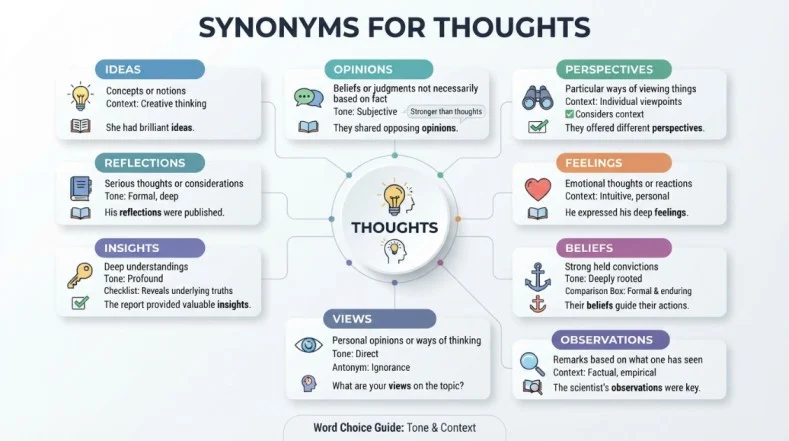
The best alternative depends on what you actually mean. You might be talking about ideas, opinions, beliefs, reflections, concerns, feelings, insights, or personal impressions.
This guide to synonyms for thoughts explains the differences between these words so you can choose vocabulary that matches your meaning, tone, and audience.
Whether you are writing a school essay, preparing a report, updating a resume, posting on social media, or simply trying to sound more natural in conversation, the right synonym can make your message clearer.
What Does “Thoughts” Mean?
“Thoughts” are ideas, opinions, feelings, or mental reflections that exist in a person’s mind. Depending on context, useful synonyms include ideas for general use, opinions for viewpoints, reflections for careful thinking, and insights for meaningful understanding.
Meaning, Tone and Context
Simple Definition
“Thoughts” are mental ideas, opinions, impressions, feelings, or reflections that occur in a person’s mind.
For example:
“I have several thoughts about the new project.”
Here, “thoughts” could refer to opinions, suggestions, concerns, or ideas about the project.
The exact meaning depends on the sentence and situation.
Part of Speech
“Thoughts” is a plural noun.
The singular form is “thought.”
For example:
“I had a thought.”
“I had several thoughts.”
The word “thought” is also the past tense and past participle of the verb “think,” but “thoughts” as a plural noun refers to things that exist in or arise from the mind.
Tone
“Thoughts” usually has a neutral tone.
It does not automatically suggest that an idea is positive, negative, emotional, intelligent, doubtful, or critical.
That neutrality makes it extremely flexible.
For example:
“Please share your thoughts.”
This could refer to opinions, suggestions, reactions, concerns, or general feedback.
Formality Level
“Thoughts” works in casual, personal, academic, creative, and professional communication.
However, a more precise word can sometimes make formal writing stronger.
For example:
“Please share your thoughts about the proposal.”
could become:
“Please share your recommendations about the proposal.”
The second sentence tells the reader more specifically what kind of response is wanted.
Common Use Cases
The word “thoughts” commonly appears when discussing:
- Personal opinions
- Ideas and suggestions
- Feelings
- Reflections
- Concerns
- Impressions
- Beliefs
- Academic analysis
- Creative inspiration
- Workplace feedback
Related Word Forms
The main related forms include:
Thought: a single mental idea or reflection.
Think: to use the mind to consider or understand something.
Thinking: the mental process of considering something.
Thoughtful: showing consideration or careful attention.
Thoughtfully: in a considerate or careful way.
Thoughtfulness: the quality of being considerate or reflective.
When and How to Use “Thoughts”
“Thoughts” is appropriate when you want to describe mental content without specifying exactly what kind of mental content it is.
1. Professional Context
“Please share your thoughts on the proposed marketing strategy.”
Here, “thoughts” politely invites feedback without restricting the response.
2. Personal Context
“I have been thinking about your thoughts on the situation.”
The word refers to another person’s opinions or reflections.
3. Academic Context
“The author presents several thoughts about the relationship between technology and education.”
In academic writing, a more precise word such as “arguments,” “ideas,” or “observations” may sometimes be better.
4. Emotional Context
“Her thoughts were filled with concern after hearing the news.”
Here, “thoughts” refers to mental and emotional reactions.
5. Creative Context
“The writer recorded her thoughts in a notebook.”
The word works naturally for personal reflections, creative ideas, and observations.
6. Social Media Context
“Just sharing a few thoughts about my recent trip.”
This is a natural casual use of the word.
7. Email Context
“I would appreciate hearing your thoughts before we finalize the plan.”
This sounds polite and professional.
Another Word for “Thoughts”
The best single replacement depends on what you mean.
- For professional writing, “opinions,” “perspectives,” “feedback,” or “recommendations” can be more precise.
- For academic writing, “ideas,” “arguments,” “observations,” or “interpretations” may work better.
- For casual conversation, “ideas,” “opinions,” and “views” sound natural.
- For emotional writing, “feelings,” “reflections,” and “sentiments” may be appropriate.
- For creative writing, “musings,” “reflections,” “imaginings,” and “ponderings” can add personality.
- For resumes and workplace writing, “insights,” “recommendations,” and “observations” often communicate professional value more clearly.
- For social media captions, “ideas,” “reflections,” “feelings,” and “musings” can sound natural.
- For a stronger meaning, consider “insights,” “convictions,” “judgments,” or “conclusions,” depending on the intended meaning.
- For a softer meaning, “impressions,” “feelings,” “musings,” or “reflections” may work better.
When Not to Use “Thoughts”
“Thoughts” is not always the most precise word.
When the Meaning Is Specifically an Opinion
Instead of:
“I want to hear your thoughts about the decision.”
You could write:
“I want to hear your opinion about the decision.”
“Opinion” clearly identifies a personal viewpoint.
When You Mean Professional Advice
Instead of:
“What are your thoughts about the strategy?”
Consider:
“What are your recommendations for the strategy?”
“Recommendations” suggests useful professional guidance.
When You Mean Evidence Based Understanding
Instead of:
“She shared her thoughts about the results.”
Consider:
“She shared her interpretation of the results.”
“Interpretation” is more precise when explaining the meaning of information.
When You Mean a Strong Belief
Instead of:
“He expressed his thoughts about the issue.”
Consider:
“He expressed his beliefs about the issue.”
“Beliefs” suggests ideas that a person accepts as true or important.
When You Mean Emotion
Instead of:
“She shared her thoughts after the experience.”
Consider:
“She shared her feelings after the experience.”
“Feelings” makes the emotional meaning clearer.
Words Commonly Confused With “Thoughts”
Thoughts vs. Ideas
“Thoughts” is broader. “Ideas” usually refers to concepts, suggestions, plans, or possible solutions.
“I have some thoughts about the project.”
“I have several ideas for improving the project.”
Thoughts vs. Opinions
An opinion is a personal judgment or viewpoint.
“Thoughts” can include opinions, but it can also include feelings, memories, reflections, and ideas.
Thoughts vs. Feelings
Feelings are emotional experiences.
Thoughts are mental content.
The two often interact, but they are not identical.
Thoughts vs. Beliefs
Beliefs are ideas or principles that a person accepts as true.
Thoughts can be temporary, uncertain, or exploratory.
Thoughts vs. Impressions
An impression is an initial or general feeling or perception about someone or something.
Thoughts can be much broader.
Thoughts vs. Reflections
Reflections usually involve deliberate consideration of an experience or subject.
“Thoughts” can happen spontaneously, while “reflections” often suggest deeper consideration.
Best Synonym by Context for “Thoughts”
| Context | Best Synonym | Why It Works | Example |
|---|---|---|---|
| Formal writing | Perspectives | Clearly describes viewpoints | The report examines different perspectives on the issue. |
| Academic writing | Ideas | Broad and natural for intellectual content | The essay develops several important ideas. |
| Professional or business use | Feedback | Clearly requests a response or evaluation | We would appreciate your feedback. |
| Resume | Insights | Highlights useful understanding | Provided insights that improved customer engagement. |
| Casual conversation | Opinions | Direct and familiar | What are your opinions about the movie? |
| Creative writing | Musings | Adds a reflective literary quality | His evening musings filled several pages. |
| Emotional tone | Feelings | Makes the emotional meaning explicit | She shared her feelings about the experience. |
| Strong intensity | Convictions | Suggests firmly held beliefs | His convictions shaped his decisions. |
| Soft or moderate tone | Impressions | Sounds tentative and less absolute | My first impressions were positive. |
| Social media captions | Reflections | Works well for personal observations | A few reflections from my weekend trip. |
| Professional feedback | Observations | Suggests specific things noticed | Her observations helped identify the problem. |
| Analytical writing | Interpretations | Useful when explaining meaning | Several interpretations of the data are possible. |
| Creative ideas | Imaginings | Suggests creative mental pictures | The story grew from the author’s imaginings. |
| Careful consideration | Reflections | Suggests deliberate thinking | His reflections changed his perspective. |
| General mental content | Ideas | Simple and widely understood | Several ideas came to mind. |
| Personal viewpoint | Viewpoints | Clearly identifies a position | The discussion included different viewpoints. |
Which Synonym Should You Choose?
Start by asking what you actually mean by “thoughts.”
- If you mean a general concept or suggestion, choose “ideas.”
- If you mean a personal judgment, choose “opinions.”
- If you mean a particular way of seeing an issue, choose “perspectives” or “viewpoints.”
- If you mean emotions, choose “feelings” or “sentiments.”
- If you mean careful consideration, choose “reflections” or “contemplations.”
- If you mean useful understanding, choose “insights.”
- If you mean uncertainty or possibility, choose “speculations.”
- If you mean a firmly held position, choose “convictions” or “beliefs.”
- If you want a creative and reflective tone, choose “musings.”
The best synonym is not necessarily the most sophisticated word. It is the word that communicates your intended meaning most accurately.
Real Life Examples of “Thoughts” in Sentences
School
“Her thoughts about the novel helped the class understand the main character.”
A stronger academic alternative could be “interpretations” or “observations.”
Workplace
“I would appreciate your thoughts before the meeting.”
For a more precise business tone, “feedback” may be better.
Writing
“The author’s thoughts become clearer in the final chapter.”
Depending on the context, “ideas,” “arguments,” or “reflections” may be more precise.
Conversation
“What are your thoughts on the new restaurant?”
“Opinion” or “view” could also work naturally.
Social Media
“Sharing a few thoughts after an unforgettable weekend.”
“Reflections” could create a more thoughtful tone.
Resume
“Shared thoughts with the leadership team.”
A resume could be stronger with:
“Provided insights to the leadership team.”
“I would love to hear your thoughts on the proposal.”
“Feedback” is useful when you specifically want an evaluation.
Storytelling
“Her thoughts wandered back to the summer she spent by the lake.”
“Memories” may be more precise if the sentence is specifically about remembered experiences.
25 Synonyms for “Thoughts”
| Synonym | Simple Meaning | Best Used For | Example Sentence |
|---|---|---|---|
| Ideas | Mental concepts or suggestions | General writing and conversation | She shared several ideas for the new project. |
| Opinions | Personal judgments or views | Discussions and feedback | Everyone had different opinions about the proposal. |
| Views | Personal positions about a subject | Formal and conversational writing | His views on education have changed over time. |
| Perspectives | Particular ways of seeing an issue | Professional and academic writing | The discussion included perspectives from several departments. |
| Beliefs | Ideas accepted as true or important | Personal, social, and philosophical topics | Her beliefs influence many of her decisions. |
| Reflections | Considered thoughts about an experience | Personal and reflective writing | His reflections on the trip filled several pages. |
| Feelings | Emotional responses or experiences | Personal and emotional communication | She explained her feelings honestly. |
| Impressions | General perceptions or initial reactions | Reviews and personal observations | My first impressions of the city were excellent. |
| Insights | Useful or deep understanding | Professional and academic contexts | Her insights helped the team solve the problem. |
| Observations | Things noticed through attention or analysis | Academic and professional writing | His observations revealed an important pattern. |
| Interpretations | Explanations of meaning | Academic and analytical writing | The researchers offered different interpretations of the findings. |
| Considerations | Matters taken into account | Formal and professional writing | Several considerations influenced the final decision. |
| Sentiments | Feelings, attitudes, or opinions | Formal and emotional writing | The letter expressed warm sentiments toward the community. |
| Musings | Casual or reflective thinking | Creative and personal writing | His morning musings often became ideas for stories. |
| Ponderings | Thoughts resulting from extended consideration | Literary and reflective writing | Her ponderings continued throughout the evening. |
| Contemplations | Deep and careful thoughts | Formal and philosophical writing | His contemplations focused on the meaning of success. |
| Speculations | Ideas based on incomplete information | Analysis and uncertain discussion | The report includes several speculations about future demand. |
| Concepts | Abstract ideas or principles | Academic and professional contexts | The course introduces several important concepts. |
| Assumptions | Ideas accepted without complete proof | Analysis and business writing | The plan depends on several assumptions. |
| Judgments | Conclusions or opinions formed after consideration | Decision making and evaluation | Her judgment was based on years of experience. |
| Perspectives | Individual or group viewpoints | Comparative discussions | Different perspectives can improve the discussion. |
| Theories | Explanatory ideas about how something works | Academic and scientific contexts | Several theories attempt to explain the results. |
| Imaginings | Creative mental pictures or possibilities | Fiction and creative writing | His imaginings inspired the central scene. |
| Memories | Recollections of past experiences | Personal and emotional writing | Childhood memories returned as she explored the old neighborhood. |
| Intentions | Plans or purposes behind actions | Personal and professional contexts | Her intentions became clear during the conversation. |
Note that some words above are context based alternatives rather than exact replacements in every sentence. “Thoughts” is a broad word, so precision matters more than finding a universal substitute.
Synonym Groups and Usage Differences
Professional vs. Personal Synonyms
Professional communication often benefits from specific language.
Instead of saying:
“Please share your thoughts.”
you might say:
“Please share your feedback.”
“Feedback” makes it clear that you want an evaluation or response.
In personal communication, “thoughts,” “feelings,” “opinions,” and “reflections” can sound more natural.
Formal vs. Conversational Synonyms
Formal writing often favors words such as “perspectives,” “considerations,” “interpretations,” and “observations.”
Conversational English often favors “thoughts,” “ideas,” “opinions,” and “views.”
For example:
Formal:
“The study considers several perspectives on the issue.”
Conversational:
“What are your thoughts on the issue?”
Academic Synonyms
Academic writing benefits from precision.
Useful alternatives include:
“ideas” for concepts
“arguments” for positions supported by reasoning
“interpretations” for explanations of meaning
“observations” for things noticed
“theories” for structured explanations
“assumptions” for ideas accepted as a starting point
“perspectives” for different ways of viewing an issue
The best word depends on the exact function of the sentence.
Professional and Business Synonyms
Business communication often requires clarity rather than elaborate vocabulary.
- Use “feedback” when requesting evaluation.
- Use “recommendations” when requesting advice.
- Use “insights” when discussing valuable understanding.
- Use “observations” when describing specific findings.
- Use “perspectives” when comparing different viewpoints.
- Use “considerations” when discussing factors that affect a decision.
Creative or Literary Synonyms
Creative writing allows more expressive choices.
“Musings” can sound informal and reflective.
“Ponderings” suggests extended thinking.
“Contemplations” can create a serious or philosophical atmosphere.
“Imaginings” works especially well for creative possibilities.
“Reflections” can create a calm, personal, or nostalgic mood.
Slang or Modern Synonyms
There is no single slang replacement for “thoughts” that works in every situation.
Casual expressions such as “takes” can sometimes mean opinions, especially in online conversations.
For example:
“What are your takes on the new movie?”
However, “takes” is much more casual than “opinions” or “perspectives.”
Avoid it in academic essays, formal reports, resumes, and serious business documents.
Strongest vs. Weaker Synonyms
A useful intensity scale is:
Mild: impressions
Moderate: thoughts, ideas, opinions
More specific: perspectives, observations, interpretations
Deeper: reflections, contemplations, insights
Strongly held: beliefs, convictions
The strongest word is not always the best word. Choose the level of intensity that matches your meaning.
Emotional vs. Neutral Synonyms
Neutral words include:
Thoughts
Ideas
Observations
Perspectives
Interpretations
More emotional choices include:
Feelings
Sentiments
Reflections
Memories
Musings
More strongly held choices include:
Beliefs
Convictions
Judgments
Antonyms of “Thoughts”
“Thoughts” does not have one universally accepted opposite because the word can refer to ideas, opinions, feelings, reflections, or mental activity.
The following are contextual contrasts rather than exact dictionary antonyms.
| Antonym or Contrast | Meaning | Example Sentence |
|---|---|---|
| Actions | Things done rather than mentally considered | Actions often communicate more than words. |
| Deeds | Completed acts or behaviors | His deeds demonstrated his commitment. |
| Behavior | The way someone acts | Her behavior revealed more than her private ideas. |
| Conduct | The way a person behaves | Professional conduct matters in the workplace. |
| Silence | Absence of spoken expression | He responded with silence instead of an explanation. |
| Speech | Spoken expression rather than internal thinking | Her speech focused on practical solutions. |
| Expression | Communicated thoughts or feelings | His expression revealed his reaction. |
| Reality | What actually exists rather than what is imagined | The plan had to be tested against reality. |
| Facts | Verified information rather than personal thinking | The report is based on facts. |
| Certainty | A state of being sure rather than considering possibilities | She spoke with certainty about the decision. |
| Knowledge | Established understanding rather than an individual thought | The course builds practical knowledge. |
| Inaction | Failure to take action | Continued inaction created additional problems. |
| Deeds | Actual behavior or accomplishments | Her deeds supported her stated values. |
| External events | Things happening outside the mind | External events changed his original plan. |
| Physical action | A concrete act rather than mental consideration | Physical action turned the idea into a result. |
Comparison: “Thoughts” vs. Similar Words
Thoughts vs. Ideas
The main difference is scope.
“Thoughts” can include ideas, feelings, opinions, memories, and reflections. “Ideas” usually refers to concepts, suggestions, plans, or possibilities.
“I have some thoughts about the project.”
“I have three ideas for improving the project.”
Neither is necessarily stronger or more formal. “Ideas” is more specific when discussing possible solutions.
Thoughts vs. Opinions
An opinion is a personal judgment or viewpoint.
“Thoughts” is broader because it can describe many types of mental content.
“What are your thoughts about the decision?”
“What is your opinion about the decision?”
“Opinion” is more specific when you want a personal judgment.
Thoughts vs. Views
“Views” usually means established opinions or positions.
“Thoughts” can describe temporary or developing ideas.
“Her thoughts about the proposal are still developing.”
“Her views about the proposal are well established.”
“Views” can sound slightly more formal and definite.
Thoughts vs. Feelings
“Feelings” are emotional experiences.
“Thoughts” are mental ideas or reflections.
“I have been thinking about the situation.”
“I feel worried about the situation.”
“Feelings” is stronger when emotion is the main subject.
Thoughts vs. Reflections
“Reflections” usually suggest deliberate consideration.
“Thoughts” can appear spontaneously.
“His thoughts changed quickly.”
“His reflections on the experience took several weeks.”
“Reflections” often sounds more formal, thoughtful, or literary.
Thoughts vs. Insights
An insight is a useful or deep understanding.
Not every thought is an insight.
“I had several thoughts about the problem.”
“I gained an important insight into the problem.”
“Insights” suggests that the thinking produced meaningful understanding.
Common Phrases and Expressions with “Thoughts”
1. Share Your Thoughts
Meaning:
A polite way to ask someone for their opinion, reaction, or feedback.
Example sentence:
“Please share your thoughts after reviewing the proposal.”
2. In My Thoughts
Meaning:
A phrase that can describe something occupying someone’s mind.
Example sentence:
“Her family remained in her thoughts throughout the journey.”
3. Food for Thought
Meaning:
An idea or piece of information that encourages deeper thinking.
Example sentence:
“The speaker’s final question gave everyone food for thought.”
4. Second Thoughts
Meaning:
Doubts or uncertainty about a decision that was previously made.
Example sentence:
“After reviewing the contract, she began to have second thoughts.”
5. Gather Your Thoughts
Meaning:
To organize your ideas before speaking or acting.
Example sentence:
“Give me a moment to gather my thoughts before I answer.”
6. Lost in Thought
Meaning:
Deeply focused on one’s own thinking.
Example sentence:
“He was so lost in thought that he did not hear the phone ring.”
7. Express Your Thoughts
Meaning:
To communicate what you are thinking or feeling.
Example sentence:
“The discussion gave everyone an opportunity to express their thoughts.”
Common Mistakes to Avoid
1. Using “Thoughts” When a Precise Synonym Is Better
“Thoughts” is broad.
If you specifically mean professional evaluation, “feedback” is clearer.
2. Confusing Thoughts With Feelings
Thoughts and feelings can influence each other, but they are different.
Use “feelings” when the sentence is primarily about emotions.
3. Using Casual Vocabulary in Formal Writing
Words such as “takes” may work online but can sound too casual in academic or professional writing.
Choose “opinions,” “perspectives,” or “views” when appropriate.
4. Using an Overly Dramatic Synonym
Words such as “convictions” suggest strongly held beliefs.
Do not use them when you simply mean ordinary opinions.
5. Repeating “Thoughts” Too Often
Repeated use can make a paragraph feel flat.
Replace some instances with precise alternatives such as “ideas,” “observations,” “opinions,” or “reflections.”
6. Choosing the Wrong Emotional Tone
“Insights” sounds analytical.
“Feelings” sounds emotional.
“Musings” sounds reflective and creative.
Choose according to the intended mood.
7. Using Slang in Academic or Professional Writing
Casual words can make formal writing sound less polished.
Always consider your audience before choosing an informal alternative.
FAQs
What is the best synonym for “thoughts”?
The best synonym depends on meaning. “Ideas” works broadly, “opinions” suits personal views, “reflections” suits careful thinking, and “insights” suggests valuable understanding.
What is a formal synonym for “thoughts”?
“Perspectives,” “considerations,” “reflections,” “observations,” and “interpretations” can serve as formal alternatives when their specific meanings fit the sentence.
What is an informal synonym for “thoughts”?
“Ideas,” “opinions,” “views,” and sometimes “takes” can work in informal conversation. “Takes” is especially casual and common in online discussion.
What is another word for “thoughts” in professional writing?
“Feedback,” “insights,” “observations,” “recommendations,” and “perspectives” are useful professional alternatives, depending on what response you want.
What is the difference between “thoughts” and “opinions”?
“Thoughts” is a broad term for mental content, while “opinions” specifically refers to personal judgments or viewpoints about a subject.
What is the opposite of “thoughts”?
There is no single exact opposite of “thoughts.” Depending on context, actions, deeds, facts, reality, or physical behavior can provide a useful contrast.
Conclusion
“Thoughts” is a flexible word that can describe ideas, opinions, feelings, reflections, beliefs, and other forms of mental activity.
The best synonym depends on your intended meaning. Use “ideas” for concepts, “opinions” for personal judgments, “perspectives” for viewpoints, “feelings” for emotions, “reflections” for careful consideration, and “insights” for useful understanding.
For professional communication, precision is usually more valuable than choosing the most sophisticated sounding word. Before replacing “thoughts,” ask what the reader actually needs to understand.
A simple vocabulary tip is to identify the exact type of thought first. Once you know whether you mean an opinion, feeling, idea, observation, belief, or insight, the right word becomes much easier to choose.
Use these synonyms for thoughts to make your writing more precise, natural, expressive, and appropriate for the situation.
Discover More Post:
- 25+ Synonyms for Values | Meanings, Examples, and Best …
- 25 Synonyms for Saw | Meanings, Examples, and Best …
- 25+ Synonyms for Dream | Meanings, Examples, and Best …