Have you ever written the word “greatly” several times in an essay, email, caption, or professional document and felt that every sentence sounded the same? Finding the right alternative can make your writing more precise and natural.
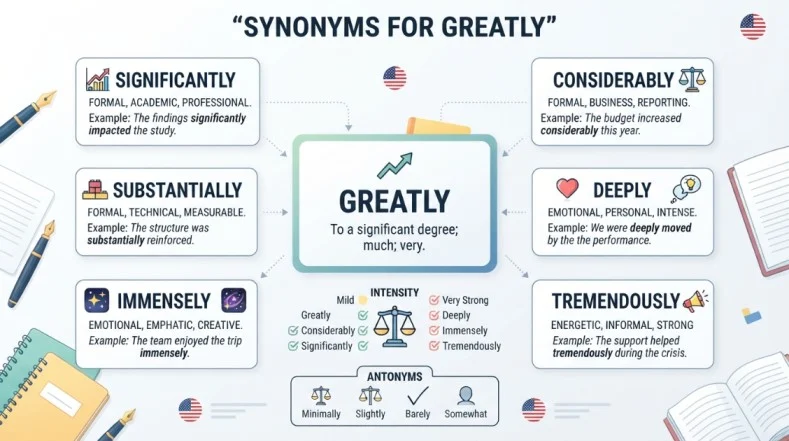
The best synonym depends on what you mean. Words such as “significantly,” “considerably,” and “substantially” work well in professional writing, while “tremendously,” “enormously,” and “immensely” can express stronger intensity.
This guide explains synonyms for greatly by meaning, tone, formality, intensity, and situation. You will also find practical examples for school, work, conversation, social media, resumes, emails, and creative writing.
What Does “Greatly” Mean?
“Greatly” means to a large degree or extent. Common alternatives include “significantly” for formal writing, “considerably” for academic contexts, “substantially” for business, “a lot” for casual speech, and “immensely” or “tremendously” for strong emotional emphasis.
Meaning, Tone and Context
Simple Definition
“Greatly” is an adverb that means to a large degree, extent, or amount.
For example:
“Your advice greatly helped me.”
This means that the advice helped the person to a large degree.
Part of Speech
“Greatly” is an adverb. It modifies a verb, adjective, or another adverb to show a high degree or strong effect.
Examples include:
“Sales increased greatly.”
“She was greatly impressed.”
“The decision greatly affected the team.”
Tone
“Greatly” is generally neutral and can also sound positive or negative depending on the sentence.
For example:
“Your support greatly improved my confidence.”
This has a positive tone.
“The mistake greatly affected the project.”
This has a negative tone.
Formality Level
“Greatly” is neutral to moderately formal. It works in everyday conversation, but more precise alternatives may sound stronger in academic, business, or professional writing.
Common Use Cases
You may use “greatly” when describing:
- A major improvement
- A strong effect
- A significant change
- A powerful emotional response
- A large amount of help
- A substantial difference
- A serious impact
Related Word Forms
“Greatly” comes from the adjective “great.”
Related forms include:
“Great” as an adjective.
“Greatness” as a noun.
“Greatly” as an adverb.
“Greater” as a comparative adjective.
“Greatest” as a superlative adjective.
When and How to Use “Greatly”
“Greatly” is useful when you want to emphasize that something happened to a considerable degree. It is especially natural with verbs such as appreciate, improve, affect, influence, benefit, admire, value, regret, and reduce.
1. Professional
“The new system greatly improved customer service.”
This tells the reader that the improvement was substantial.
2. Personal
“I greatly appreciate everything you have done for me.”
This is a common and natural expression of sincere gratitude.
3. Academic
“Regular reading greatly improves vocabulary development.”
The word emphasizes the strength of the relationship being described.
4. Emotional
“She was greatly relieved when she received the good news.”
Here, “greatly” strengthens the emotional response.
5. Creative
“The discovery greatly changed the direction of his life.”
The word emphasizes the importance of the change.
6. Social Media
“Greatly inspired by everyone who supported this journey.”
This works in a reflective or appreciative caption.
7. Email
“I greatly appreciate your time and consideration.”
This sounds polite and professional without being excessively formal.
Another Word for “Greatly”
The best single replacement for “greatly” is often “significantly” when you want a clear, neutral, and professional expression.
However, the ideal choice changes according to context.
| Context | Recommended Alternative |
|---|---|
| Professional writing | Significantly |
| Academic writing | Considerably |
| Business writing | Substantially |
| Casual conversation | A lot |
| Emotional writing | Deeply |
| Creative writing | Profoundly |
| Resume or workplace | Significantly |
| Social media | Tremendously |
| Strong meaning | Immensely |
| Softer meaning | Considerably |
Professional Writing
Use “significantly” or “substantially” when describing measurable change or impact.
Academic Writing
Use “considerably,” “significantly,” or “substantially” when the evidence supports a meaningful degree of change.
Casual Conversation
“A lot” is more natural in everyday speech.
Emotional Writing
“Deeply” works well with emotions, appreciation, regret, concern, and personal reactions.
Creative Writing
“Profoundly” can suggest a deep or lasting effect.
Resume or Workplace Use
“Significantly” and “substantially” are useful when describing measurable achievements.
Social Media Captions
“Tremendously,” “immensely,” and “deeply” can sound expressive without becoming overly formal.
Stronger Meaning
Use “immensely,” “enormously,” “tremendously,” or “profoundly” when you want greater intensity.
Softer Meaning
Use “considerably,” “appreciably,” or “noticeably” when you want emphasis without sounding dramatic.
When Not to Use “Greatly”
Although “greatly” is versatile, it is not always the most precise choice.
When a Measurable Result Matters
Instead of:
“Profits increased greatly.”
Try:
“Profits increased substantially.”
“Substantially” makes the sentence sound more precise and business focused.
When the Effect Is Clearly Significant
Instead of:
“The decision greatly affected the company.”
Try:
“The decision significantly affected the company.”
“Significantly” is often clearer in analytical writing.
When Describing Deep Emotion
Instead of:
“I greatly miss my family.”
Try:
“I deeply miss my family.”
“Deeply” communicates emotional intensity more naturally.
When Writing Casual Dialogue
Instead of:
“I greatly enjoyed the movie.”
Try:
“I really enjoyed the movie.”
The second version sounds more conversational.
When the Sentence Needs Stronger Emphasis
Instead of:
“The experience greatly changed her.”
Try:
“The experience profoundly changed her.”
“Profoundly” suggests a deep and lasting transformation.
Words Commonly Confused With “Greatly”
Greatly vs. Really
“Really” is broader and more conversational. “Greatly” usually sounds more formal and emphasizes a high degree.
Greatly vs. Significantly
“Significantly” often suggests meaningful or important change, especially in academic and professional contexts. “Greatly” mainly emphasizes degree.
Greatly vs. Considerably
“Considerably” means by a noticeable or substantial amount. It is especially useful when discussing measurable differences.
Greatly vs. Deeply
“Deeply” is strongly associated with emotions, beliefs, feelings, and personal reactions.
Greatly vs. Extremely
“Extremely” emphasizes a very high degree. It often modifies adjectives and adverbs, while “greatly” frequently modifies verbs.
Greatly vs. Substantially
“Substantially” suggests a large or meaningful amount and is particularly common in business, finance, research, and formal writing.
Best Synonym by Context for “Greatly”
| Context | Best Synonym | Why It Works | Example |
|---|---|---|---|
| Formal writing | Significantly | Clear and professional | The policy significantly improved access. |
| Academic writing | Considerably | Precise and measured | Reading considerably improved comprehension. |
| Professional use | Substantially | Works well for measurable change | The process substantially reduced costs. |
| Resume | Significantly | Highlights meaningful results | Increased productivity significantly. |
| Business | Materially | Suggests meaningful business impact | The change materially affected revenue. |
| Casual conversation | A lot | Natural in everyday speech | I learned a lot from that experience. |
| Creative writing | Profoundly | Suggests deep impact | The journey profoundly changed her outlook. |
| Emotional writing | Deeply | Natural for feelings | I deeply appreciate your support. |
| Strong intensity | Immensely | Communicates very high degree | The opportunity immensely benefited his career. |
| Mild or moderate emphasis | Considerably | Strong but controlled | The situation has considerably improved. |
| Social media | Tremendously | Expressive and positive | I am tremendously grateful for this support. |
| US and UK usage | Significantly | Widely understood in both varieties | The results significantly improved. |
Which Synonym Should You Choose?
Start by identifying what “greatly” is doing in your sentence.
- If you are describing measurable change, choose “significantly,” “substantially,” or “considerably.”
- If you are describing feelings, “deeply” is often more natural.
- If you want very strong emphasis, consider “immensely,” “enormously,” or “tremendously.”
For casual speech, “a lot” or “really” may sound more natural.
For academic and professional writing, prefer precise words that communicate the type and degree of impact rather than simply adding emphasis.
A useful rule is this: choose the synonym that explains the kind of intensity you mean, not simply a word that sounds stronger.
Real Life Examples of “Greatly” in Sentences
School
“Reading fiction greatly improved her understanding of different writing styles.”
Workplace
“The new software greatly increased the team’s efficiency.”
Writing
“Editing greatly improved the clarity of the article.”
Conversation
“I greatly appreciate your help with this.”
Social Media
“This experience has greatly changed the way I see the world.”
Resume
“Greatly improved customer satisfaction through faster response times.”
For a resume, however, “significantly improved customer satisfaction” may sound more precise.
“I greatly appreciate your feedback and time.”
Storytelling
“The unexpected meeting greatly changed the course of his journey.”
25 Synonyms for “Greatly”
| Synonym | Simple Meaning | Best Used For | Example Sentence |
|---|---|---|---|
| Significantly | By an important amount | Professional and academic writing | The update significantly improved performance. |
| Considerably | By a fairly large amount | Formal and academic contexts | Her confidence increased considerably. |
| Substantially | By a large or meaningful amount | Business and measurable results | The changes substantially reduced expenses. |
| Immensely | To a very great degree | Strong positive emphasis | The opportunity immensely benefited the organization. |
| Enormously | To a very large degree | Strong emphasis | The project enormously increased public interest. |
| Tremendously | To a very great extent | Positive and expressive writing | We tremendously value your contribution. |
| Profoundly | In a deep or lasting way | Emotional and creative writing | The experience profoundly affected him. |
| Deeply | To a strong emotional degree | Feelings and personal reactions | She deeply appreciated their kindness. |
| Markedly | In a clearly noticeable way | Formal and analytical writing | The patient’s condition improved markedly. |
| Substantively | In a meaningful or substantial way | Formal analysis | The proposal substantively changed the discussion. |
| Materially | In a significant practical way | Business and legal contexts | The decision materially affected operations. |
| Exceedingly | To an unusually high degree | Very formal writing | The results were exceedingly encouraging. |
| Exceptionally | To an unusually high degree | Formal praise and description | She performed exceptionally well. |
| Extraordinarily | To an unusually great degree | Strong formal emphasis | The team worked extraordinarily hard. |
| Intensely | With great strength | Emotions and experiences | He intensely focused on the final task. |
| Vastly | By a very large amount | Comparisons and differences | The new method is vastly more efficient. |
| Dramatically | In a striking or sudden way | Major changes | Sales increased dramatically after the launch. |
| Drastically | To a very large and often sudden degree | Major reductions or changes | The company drastically changed its strategy. |
| Appreciably | To a noticeable degree | Moderate formal emphasis | The quality has improved appreciably. |
| Noticeably | In an easily observed way | Everyday and descriptive writing | Her mood noticeably improved. |
| Heavily | To a large degree in certain contexts | Dependence, influence, or involvement | The industry relies heavily on technology. |
| Strongly | With considerable force or intensity | Opinions, influence, and reactions | The evidence strongly supports the conclusion. |
| Really | To a high degree | Casual conversation | I really enjoyed the presentation. |
| A lot | To a large degree | Informal speech | Your advice helped me a lot. |
| By far | By a very large margin | Comparisons and emphasis | This was by far the most useful lesson. |
Synonym Groups and Usage Differences
Professional vs. Personal Synonyms
Professional writing usually benefits from “significantly,” “substantially,” “considerably,” or “materially.”
Personal writing can use “deeply,” “immensely,” “tremendously,” or “really,” depending on the emotional tone.
Compare:
“The training significantly improved performance.”
“I deeply appreciate your support.”
The first focuses on measurable impact. The second communicates personal feeling.
Formal vs. Conversational Synonyms
Formal writing favors “significantly,” “considerably,” “substantially,” and “markedly.”
Conversational English often favors “really,” “a lot,” and “so much.”
In an academic essay, write:
“The intervention significantly improved outcomes.”
In a casual conversation, say:
“That helped me a lot.”
Academic Synonyms
For essays and research based writing, “significantly,” “considerably,” “substantially,” and “markedly” are useful because they sound measured and precise.
However, avoid choosing these words merely to make writing sound academic. The evidence should support the degree of emphasis.
Professional and Business Synonyms
Business writing commonly uses “significantly,” “substantially,” “materially,” and “considerably.”
For example:
“The revised process substantially reduced processing time.”
This sounds more specific than:
“The revised process greatly reduced processing time.”
Creative or Literary Synonyms
Creative writing can benefit from “profoundly,” “deeply,” “immensely,” or “dramatically.”
These choices can communicate emotional depth, transformation, or intensity.
For example:
“The loss profoundly changed her understanding of home.”
Slang or Modern Synonyms
There is no single slang equivalent that works in every context.
Casual expressions such as “a lot,” “really,” and “so much” are common in everyday American English.
Avoid them in formal academic or professional documents when a more precise alternative is appropriate.
Strongest vs. Weaker Synonyms
A rough intensity scale can help, although the exact strength depends on context.
Mild:
Noticeably
Appreciably
Considerably
Moderate:
Significantly
Substantially
Markedly
Strong:
Tremendously
Enormously
Immensely
Very strong:
Profoundly
Exceptionally
Extraordinarily
The scale is not absolute. Sentence meaning and context can change how intense a word feels.
Emotional vs. Neutral Synonyms
Neutral choices include:
Significantly
Considerably
Substantially
Markedly
Emotional choices include:
Deeply
Profoundly
Immensely
Tremendously
Use neutral words for reports and analysis. Use emotional words when the sentence intentionally communicates personal feeling or intensity.
Antonyms of “Greatly”
Because “greatly” expresses degree, its antonyms generally describe a small, limited, weak, or barely noticeable degree.
| Antonym | Meaning | Example Sentence |
|---|---|---|
| Slightly | By a small amount | Prices increased slightly. |
| Minimally | By a very small amount | The change minimally affected the result. |
| Marginally | By a small or limited amount | Performance improved marginally. |
| Barely | Only just or almost not | The temperature barely changed. |
| Scarcely | Almost not at all | The new rule scarcely affected employees. |
| Hardly | Almost not | The announcement hardly changed public opinion. |
| Mildly | To a small degree | She was mildly surprised. |
| Weakly | With little strength | The signal improved only weakly. |
| Faintly | In a barely noticeable way | He smiled faintly at the comment. |
| Negligibly | By an amount too small to matter | The adjustment negligibly affected costs. |
| Insignificantly | Without meaningful importance | The results changed insignificantly. |
| Lightly | To a limited degree | The surface was lightly damaged. |
| Little | To a small extent | The decision did little to solve the problem. |
| Modestly | To a moderate or limited extent | Revenue increased modestly. |
| Moderately | To a medium rather than high degree | Demand increased moderately. |
Comparison: “Greatly” vs. Similar Words
Greatly vs. Significantly
The main difference is emphasis. “Greatly” focuses on a high degree, while “significantly” often suggests an important or meaningful effect.
“Significantly” is generally more formal.
Example:
“The new system greatly improved efficiency.”
“The new system significantly improved efficiency.”
Greatly vs. Considerably
Both indicate a substantial degree. “Considerably” often sounds more measured and is useful for describing noticeable changes.
“Considerably” can sound more formal.
Example:
“Costs have greatly increased.”
“Costs have increased considerably.”
Greatly vs. Substantially
“Substantially” often emphasizes a large, meaningful amount and works particularly well in business and analytical contexts.
“Substantially” is generally more formal.
Example:
“The changes greatly reduced expenses.”
“The changes substantially reduced expenses.”
Greatly vs. Deeply
“Deeply” is usually more emotional than “greatly.”
Neither is universally stronger because they express different types of intensity.
Example:
“I greatly appreciate your help.”
“I deeply appreciate your help.”
The second sentence sounds more emotionally personal.
Greatly vs. Extremely
“Extremely” usually modifies adjectives or adverbs.
“Greatly” often modifies verbs.
Example:
“The decision greatly affected the team.”
“The team was extremely concerned.”
Greatly vs. Really
“Really” is common in casual American English and can express emphasis broadly.
“Greatly” sounds more formal and is especially natural with verbs such as appreciate, affect, improve, and benefit.
Example:
“I really enjoyed the event.”
“I greatly enjoyed the event.”
The first sounds more conversational.
Common Phrases and Expressions with “Greatly”
1. Greatly appreciate
Meaning:
To express strong gratitude.
Example sentence:
“I greatly appreciate your help with the project.”
2. Greatly improve
Meaning:
To improve something by a large amount.
Example sentence:
“The new training program greatly improved employee performance.”
3. Greatly benefit
Meaning:
To receive a substantial advantage.
Example sentence:
“Students can greatly benefit from regular practice.”
4. Greatly affect
Meaning:
To have a strong influence on something.
Example sentence:
“Poor communication can greatly affect team morale.”
5. Greatly increase
Meaning:
To become substantially larger or higher.
Example sentence:
“The campaign greatly increased awareness of the program.”
6. Greatly reduce
Meaning:
To decrease something by a considerable amount.
Example sentence:
“The upgrade greatly reduced loading times.”
7. Greatly influence
Meaning:
To have a strong effect on a person, decision, or outcome.
Example sentence:
“Her mentor greatly influenced her career direction.”
Common Mistakes to Avoid
1. Using “Greatly” When a More Precise Word Is Better
“Greatly” can be vague.
Instead of:
“Revenue greatly increased.”
Consider:
“Revenue increased substantially.”
The second version gives the sentence a more precise professional tone.
2. Confusing “Greatly” With “Great”
“Greatly” is an adverb, while “great” is an adjective.
Correct:
“The decision greatly affected us.”
Correct:
“It was a great decision.”
Incorrect:
“The decision was greatly.”
3. Using a Casual Synonym in Formal Writing
“A lot” works well in conversation but may sound too informal in an academic paper.
Use “significantly” or “considerably” when the context calls for formal language.
4. Choosing an Overly Dramatic Synonym
Not every small change should be described as “profoundly” or “extraordinarily.”
Match the intensity of the word to the actual situation.
5. Repeating “Greatly” Too Often
Repeated use can make writing feel limited.
Instead of writing “greatly” several times, select alternatives according to meaning.
Use “significantly” for measurable impact and “deeply” for emotion.
6. Choosing the Wrong Emotional Tone
“Deeply” can sound emotional, while “significantly” is more neutral.
Choose according to whether you want the sentence to communicate feeling or factual impact.
7. Using Slang in Academic or Professional Writing
Expressions such as “a lot” and “really” are natural in conversation but may weaken the formal tone of an essay, report, or business document.
FAQs
What is the best synonym for “greatly”?
“Significantly” is often the best general alternative because it is clear, natural, and suitable for professional and academic writing.
What is a formal synonym for “greatly”?
“Substantially,” “considerably,” and “significantly” are strong formal alternatives. The best choice depends on whether you mean amount, impact, or importance.
What is an informal synonym for “greatly”?
“A lot” and “really” are common informal alternatives. They sound natural in conversation, texts, and casual messages.
What is another word for “greatly” in professional writing?
“Significantly” is a reliable professional alternative. “Substantially” works especially well when describing measurable changes or business results.
What is the difference between “greatly” and “deeply”?
“Greatly” expresses a high degree generally, while “deeply” often describes strong emotions, appreciation, concern, regret, or personal impact.
What is the opposite of “greatly”?
Common opposites include “slightly,” “minimally,” “barely,” “scarcely,” “hardly,” and “marginally,” depending on the sentence.
Conclusion
“Greatly” means to a large degree or extent, and it works naturally in many types of English. However, the best alternative depends on your intended meaning, audience, and tone.
Use “significantly” for professional and academic writing, “substantially” for measurable business changes, “deeply” for emotional meaning, and “a lot” for casual conversation.
The most useful vocabulary habit is to choose synonyms by context rather than simply searching for a stronger word. When you understand the difference between intensity, formality, and emotional tone, your writing becomes clearer and more natural.
Discover More Post:
- 25+ Synonyms for Dream | Meanings, Examples, and Best …
- 25+ Synonyms for Even Though | Meanings, Examples, and …
- 25+ Synonyms for Yelled | Meanings, Examples, and Best …