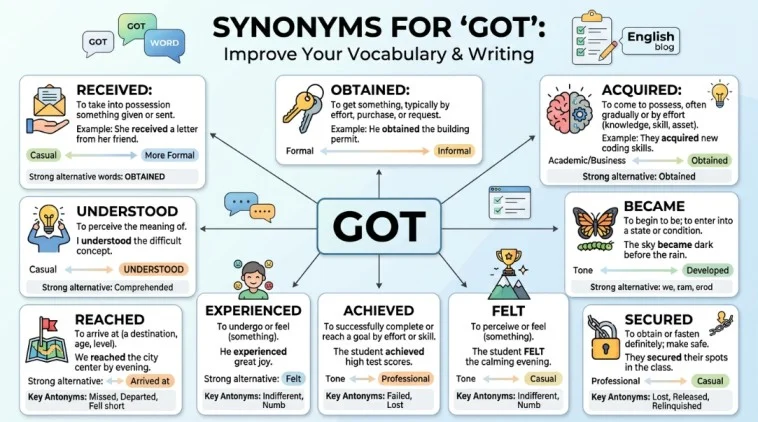
The word “got” appears everywhere. You might use it in an email, essay, text message, caption, resume, or everyday conversation without noticing how often it appears.
The problem is that “got” can mean many different things. Depending on the sentence, it can mean received, obtained, understood, became, arrived, acquired, or experienced.
Knowing the right alternative helps you sound more precise and natural. This guide explains synonyms for got by meaning, tone, context, and situation so you can choose the word that fits your message.
What Does “Got” Mean?
“Got” is the past tense of “get” and can mean received, obtained, understood, became, arrived, or experienced. The best synonym depends on context, such as received for formal use, obtained for academic writing, and acquired for professional writing.
Meaning, Tone and Context
1. Simple Definition
“Got” is the past tense of “get.” It has several meanings, so there is no single synonym that works in every sentence.
For example, “I got an email” means “I received an email,” while “I got tired” means “I became tired.”
2. Part of Speech
“Got” is primarily a verb. It is used as the past tense of “get” and appears in many common verb phrases.
Its exact meaning depends on the words around it.
3. Tone
“Got” is generally neutral, but it often sounds conversational and informal.
In professional, academic, or formal writing, a more precise verb can make the sentence clearer and stronger.
4. Formality Level
“Got” is very common in everyday American English. It is perfectly natural in conversation, texts, and casual messages.
In formal writing, alternatives such as received, obtained, acquired, secured, understood, or became may communicate the intended meaning more precisely.
5. Common Use Cases
“Got” can describe:
- Receiving something
- Obtaining something
- Understanding something
- Becoming something
- Arriving somewhere
- Experiencing something
- Catching something
- Purchasing something
- Reaching a condition
- Having something
6. Important Word Forms
The main related forms include get, got, gotten, getting, and gettable in specialized usage.
In American English, “gotten” is commonly used as a past participle in meanings such as “has gotten better.” “Got” is also used as a past participle in expressions such as “has got to.”
When and How to Use “Got”
“Got” works well when the meaning is already clear from context. It is especially natural in conversation and informal communication.
Here are realistic examples:
Professional: I got your email this morning.
Personal: I got a birthday card from my sister.
Academic: I got a better understanding of the topic after reading the chapter.
Emotional: I got nervous before the presentation.
Creative: She got quiet as the room grew darker.
Social media: Finally got tickets to the concert!
Casual: I got your message. I will call you later.
Another Word for “Got”
The best single replacement depends on what “got” means in your sentence.
- Professional writing: received, obtained, acquired
- Academic writing: obtained, achieved, understood
- Casual conversation: received, picked up, got hold of
- Emotional writing: became, felt, experienced
- Creative writing: became, encountered, reached
- Resume or workplace use: achieved, secured, acquired, earned
- Social media captions: scored, landed, picked up
- Stronger meaning: secured, achieved, captured
- Softer meaning: received, experienced, noticed
The most useful strategy is to replace “got” according to its meaning rather than simply searching for a substitute that looks similar.
When Not to Use “Got”
“Got” is not wrong simply because it is informal. However, it can sound vague when your sentence needs a more exact description.
For example:
“I got a promotion.”
This is understandable, but “I earned a promotion” can emphasize achievement.
“I got the documents.”
“ I received the documents” is clearer in a professional email.
“She got angry.”
“She became angry” can sound more polished in formal or narrative writing.
The goal is not to eliminate “got.” The goal is to choose a more precise word when precision matters.
Words Commonly Confused With “Got”
Got vs. Received
“Received” specifically means that something came to you.
“I got your letter” and “I received your letter” can have the same meaning, but “received” is more formal.
Got vs. Obtained
“Obtained” means successfully acquired or gained something.
Use it when the process of acquiring something matters.
Got vs. Became
“Became” describes a change in state or condition.
“She got tired” means “She became tired.”
Got vs. Understood
“Understood” is appropriate when “got” means comprehended.
“I got the lesson” means “I understood the lesson.”
Got vs. Acquired
“Acquired” often suggests gaining something over time, such as knowledge, skills, property, or experience.
“She acquired valuable skills” is more precise than “She got valuable skills.”
Got vs. Reached
“Reached” works when “got” means arrived at a destination, level, point, or condition.
“We got home at nine” can become “We reached home at nine,” although “got home” is more natural in many US English contexts.
Best Synonym by Context for “Got”
| Context | Best Synonym | Why It Works | Example |
|---|---|---|---|
| Formal writing | Received | Clearly describes taking delivery | We received your application. |
| Academic writing | Obtained | Precise for gaining information or results | The researchers obtained useful data. |
| Professional use | Acquired | Strong for skills, knowledge, or assets | She acquired new technical skills. |
| Resume | Achieved | Highlights accomplishment | Achieved a 20 percent increase in sales. |
| Casual conversation | Received | Natural and understandable | I received your message. |
| Creative writing | Became | Describes a change in condition | The sky became darker. |
| Emotional tone | Experienced | Emphasizes an emotional event | He experienced intense disappointment. |
| Strong intensity | Secured | Suggests successful acquisition | The company secured a major contract. |
| Soft or moderate tone | Received | Neutral and factual | We received your request. |
| Social media captions | Scored | Casual and energetic | Scored tickets for tonight! |
| US English | Got | Very common and natural | I got home late. |
| UK English | Got | Also standard and widely used | I got your message. |
Which Synonym Should You Choose?
Start by asking what “got” actually means in your sentence.
- If something was delivered to you, choose received.
- If you successfully obtained something, consider obtained, acquired, or secured.
- If you changed into a condition, use became.
- If you understood an idea, use understood or comprehended.
- If you achieved something, use earned, achieved, or secured, depending on the situation.
For professional writing, choose the most specific word rather than automatically replacing every instance of “got.”
Real Life Examples of “Got” in Sentences
School
“I got a better understanding of the assignment after the teacher explained it.”
A more formal version is:
“I developed a better understanding of the assignment after the teacher explained it.”
Workplace
“I got an email from the client.”
A professional alternative is:
“I received an email from the client.”
Writing
“She got interested in environmental science.”
A more polished alternative is:
“She became interested in environmental science.”
Conversation
“I got what you meant.”
A clearer alternative is:
“I understood what you meant.”
Social Media
“Got my new camera today!”
A more expressive caption could be:
“Picked up my new camera today!”
Resume
“I got several awards during my career.”
A stronger resume version is:
“Earned several awards during my career.”
“I got the files you sent.”
A professional alternative is:
“I received the files you sent.”
Storytelling
“He got nervous when he heard the footsteps.”
A more descriptive version is:
“He became nervous when he heard the footsteps.”
25 Synonyms for “Got”
| Synonym | Simple Meaning | Best Used For | Example Sentence |
|---|---|---|---|
| Received | Took or accepted something sent to you | Emails, letters, packages | We received your application yesterday. |
| Obtained | Successfully acquired something | Academic and formal writing | The team obtained permission to continue. |
| Acquired | Gained or developed possession or knowledge | Skills, knowledge, assets | She acquired valuable leadership skills. |
| Earned | Received through effort or achievement | Money, awards, respect | He earned a promotion through consistent performance. |
| Achieved | Successfully reached a goal | Goals and results | The company achieved its annual target. |
| Secured | Successfully obtained or protected something | Jobs, contracts, opportunities | She secured a position at the firm. |
| Gained | Increased or obtained something valuable | Experience, knowledge, support | He gained valuable experience during the internship. |
| Attained | Successfully reached a level or goal | Formal and academic writing | She attained a senior leadership position. |
| Accomplished | Successfully completed something | Goals and tasks | The team accomplished its main objective. |
| Became | Changed into a particular state | Conditions and emotions | He became more confident with practice. |
| Understood | Comprehended an idea | Academic and conversational use | I understood the explanation immediately. |
| Comprehended | Fully understood something | Formal and academic writing | The students comprehended the main concept. |
| Experienced | Went through an event or feeling | Emotions and situations | She experienced significant stress during the project. |
| Encountered | Came across something | Problems and situations | We encountered several technical issues. |
| Reached | Arrived at or attained something | Places, levels, goals | They reached the station before noon. |
| Arrived | Reached a destination | Travel and location | We arrived at the hotel late. |
| Purchased | Bought something | Formal and professional writing | The department purchased new equipment. |
| Bought | Paid money for something | Everyday conversation | I bought a new laptop. |
| Captured | Successfully took or recorded something | Images, attention, moments | The photographer captured the sunset beautifully. |
| Collected | Gathered something | Data, items, payments | The researchers collected additional data. |
| Picked up | Obtained, collected, or learned something | Casual conversation | I picked up the package after work. |
| Scored | Obtained something desirable | Casual speech and social media | She scored two tickets to the show. |
| Landed | Successfully obtained something desirable | Jobs and opportunities | He landed an exciting new role. |
| Picked | Selected or chose something | Choices and selection | She picked the blue notebook. |
| Caught | Successfully captured or encountered something | Transportation, illness, attention | I caught the early train. |
More Synonyms for “Got”
Because “got” has many meanings, additional alternatives become appropriate when the context changes.
Here are more useful choices:
Accepted: received or agreed to something.
Adopted: took up an idea, method, or practice.
Accomplished: successfully completed an objective.
Developed: gained or formed a skill, quality, or condition.
Discovered: found something previously unknown.
Found: located or encountered something.
Inherited: received something from a previous owner or relative.
Learned: gained knowledge or information.
Noticed: became aware of something.
Reclaimed: got something back.
Recovered: got something back or returned to a previous condition.
Regained: obtained something again.
Retrieved: got something back from a particular place.
Won: received something through victory or success.
Won over: successfully gained someone’s support or approval.
Generated: produced or created something.
Produced: made or created something.
Reached: arrived at or attained something.
Sustained: received or maintained something over a period, depending on context.
Secured: successfully obtained something important.
Experienced: went through an event or condition.
Developed: gradually acquired a characteristic or skill.
Contracted: acquired an illness or condition in a specific context.
Inherited: received property, money, or characteristics from a predecessor.
Obtained: gained possession through effort or action.
Earned: gained through work or merit.
Synonym Groups and Usage Differences
Professional vs. Personal Synonyms
Personal communication often favors simple words such as got, received, bought, picked up, and became.
Professional communication benefits from precise alternatives such as received, obtained, acquired, achieved, secured, and earned.
For example, “I got the documents” is perfectly understandable. “I received the documents” sounds more polished in a workplace email.
Formal vs. Conversational Synonyms
Conversational English commonly uses “got,” “bought,” “picked up,” “scored,” and “landed.”
Formal writing often favors “received,” “obtained,” “acquired,” “attained,” and “achieved.”
The right choice depends on the audience. A casual text and a university essay do not need the same vocabulary.
Academic Synonyms
Academic writing benefits from words that identify the exact action.
Use “obtained” for results or information, “acquired” for knowledge or skills, “achieved” for measurable goals, and “comprehended” when discussing understanding.
Avoid replacing “got” with an impressive sounding word unless the meaning remains accurate.
Professional and Business Synonyms
In workplace communication, “received” is useful for emails, documents, payments, applications, and requests.
“Secured” works well for contracts and opportunities. “Achieved” highlights measurable results. “Acquired” works well for skills, knowledge, customers, assets, or companies.
On resumes, “earned,” “achieved,” “secured,” “developed,” and “increased” are usually stronger than vague phrases built around “got.”
Creative or Literary Synonyms
Creative writing gives you more flexibility.
Words such as became, encountered, discovered, captured, reached, experienced, and reclaimed can add specific meaning and atmosphere.
Instead of writing “She got scared,” a writer might say “She became frightened” or “Fear seized her,” depending on the intended style.
Slang or Modern Synonyms
Some alternatives are highly casual.
“Scored” can mean successfully obtained something desirable. “Landed” can describe successfully getting a job, opportunity, or deal. “Picked up” can mean obtained, collected, or learned something.
These expressions work well in conversation and social media but may sound too casual in academic or formal business writing.
Strongest vs. Weaker Synonyms
A rough intensity scale can help:
Mild: received, got, experienced
Moderate: obtained, acquired, gained
Strong: secured, achieved, earned, accomplished
Remember that intensity is not the only factor. “Received” may be the most accurate choice even when it sounds less forceful.
Emotional vs. Neutral Synonyms
Neutral alternatives include received, obtained, acquired, and reached.
More emotional alternatives include experienced, suffered, celebrated, overcame, or endured when the context supports those meanings.
For example, “She got a difficult experience” is unnatural. “She experienced a difficult period” communicates the idea much more naturally.
Antonyms of “Got”
Because “got” has multiple meanings, its opposites also depend on the specific sense.
| Antonym | Meaning | Example Sentence |
|---|---|---|
| Gave | Transferred something to another person | She gave him the book. |
| Lost | No longer had something | He lost his wallet. |
| Returned | Gave something back | She returned the package. |
| Rejected | Refused to accept something | The committee rejected the proposal. |
| Refused | Chose not to accept or do something | He refused the offer. |
| Missed | Failed to catch or reach something | We missed the train. |
| Left | Departed from a place | They left before noon. |
| Departed | Went away from a place | The guests departed early. |
| Forgot | Failed to remember something | I forgot the appointment. |
| Ignored | Chose not to notice or respond | She ignored the message. |
| Misunderstood | Failed to understand correctly | He misunderstood the instructions. |
| Declined | Politely refused something | She declined the invitation. |
| Surrendered | Gave up possession or control | The team surrendered the advantage. |
| Released | Let something go or set it free | He released the bird. |
| Abandoned | Gave up or left something completely | They abandoned the plan. |
Comparison: “Got” vs. Similar Words
“Got” vs. “Received”
Main difference: “Received” specifically focuses on something coming to you.
Which one is stronger: Neither is inherently stronger.
Which one is more formal: Received is more formal.
Example: “I got your email.”
“I received your email.”
“Got” vs. “Obtained”
Main difference: “Obtained” emphasizes successfully acquiring something.
Which one is stronger: Obtained can sound more deliberate.
Which one is more formal: Obtained is more formal.
Example: “We got permission.”
“We obtained permission.”
“Got” vs. “Acquired”
Main difference: “Acquired” often suggests gaining something through a process or over time.
Which one is stronger: Acquired can suggest deliberate development or acquisition.
Which one is more formal: Acquired is more formal.
Example: “She got new skills.”
“She acquired new skills.”
“Got” vs. “Became”
Main difference: “Became” describes a change in state.
Which one is stronger: Became is more precise when a condition changes.
Which one is more formal: Became is generally more polished.
Example: “He got angry.”
“He became angry.”
“Got” vs. “Understood”
Main difference: “Understood” specifically describes comprehension.
Which one is stronger: Understood is more precise.
Which one is more formal: Understood is suitable for both formal and conversational contexts.
Example: “I got the point.”
“I understood the point.”
“Got” vs. “Achieved”
Main difference: “Achieved” means successfully reaching a goal or desired result.
Which one is stronger: Achieved emphasizes accomplishment.
Which one is more formal: Achieved is more appropriate for professional and academic contexts.
Example: “She got good results.”
“She achieved excellent results.”
Common Phrases and Expressions with “Got”
1. Got it
Meaning:
This means “I understand” or “I understand what you are saying.”
Example sentence:
“Got it. I will send the report this afternoon.”
2. Got to
Meaning:
This expression can indicate obligation, as in “I have got to leave.”
Example sentence:
“I have got to finish this assignment tonight.”
3. Got back
Meaning:
This can mean returned to a place or received a response.
Example sentence:
“I got back home around midnight.”
4. Got through
Meaning:
This can mean successfully completed something or connected with someone.
Example sentence:
“She got through the interview successfully.”
5. Got away
Meaning:
This can mean escaped or left a place.
Example sentence:
“The children got away before the rain started.”
6. Got along
Meaning:
This means having a good relationship with someone.
Example sentence:
“I have always got along well with my coworkers.”
7. Got over
Meaning:
This can mean recovered emotionally or physically from something.
Example sentence:
“He eventually got over his disappointment.”
8. Got hold of
Meaning:
This means obtained, contacted, or reached someone or something.
Example sentence:
“I finally got hold of the information I needed.”
Common Mistakes to Avoid
1. Using “Got” When a Precise Word Is Better
“I got an award” is understandable, but “I earned an award” can better emphasize achievement.
2. Confusing “Got” With “Became”
“Got tired” means “became tired,” not “received tired.”
Always consider whether the sentence describes a change in condition.
3. Using Casual Language in Formal Writing
“Got your email” is natural in conversation.
“I received your email” is generally better for a formal business message.
4. Using an Overly Dramatic Synonym
Not every situation needs a powerful word.
If you simply received a document, “received” is better than a dramatic alternative such as “secured.”
5. Repeating “Got” Too Often
Repeated use can make writing sound vague.
Instead of writing “She got a job, got a promotion, and got more responsibilities,” consider “She secured a job, earned a promotion, and took on additional responsibilities.”
6. Choosing the Wrong Emotional Tone
“Experienced,” “suffered,” “enjoyed,” and “endured” carry different emotional meanings.
Choose based on what actually happened rather than choosing the most impressive word.
7. Using Slang in Academic or Professional Writing
Words such as “scored” and “landed” can be useful in casual writing but may not fit a research paper or formal report.
FAQs
What is the best synonym for “got”?
The best synonym depends on meaning. Use received for something delivered, obtained for something acquired, became for a changed condition, and achieved for a successful result.
What is a formal synonym for “got”?
Common formal synonyms include received, obtained, acquired, attained, achieved, and secured. The correct choice depends on what “got” means in the sentence.
What is an informal synonym for “got”?
Casual alternatives include picked up, scored, landed, bought, caught, and got hold of. Some are appropriate only for specific meanings and situations.
What is another word for “got” in professional writing?
Professional alternatives include received, obtained, acquired, achieved, secured, earned, and attained. Choose the word that precisely describes the action.
What is the difference between “got” and “received”?
“Got” has many meanings, while “received” specifically describes accepting or taking delivery of something. “Received” is also more formal than “got.”
What is the opposite of “got”?
There is no single opposite because “got” has many meanings. Depending on context, opposites include gave, lost, returned, rejected, missed, left, refused, and declined.
Conclusion
“Got” is one of the most flexible words in English, but that flexibility can also make it vague. The best synonym depends on the meaning you intend.
Use received for messages and documents, obtained for acquired information or permission, acquired for skills and knowledge, became for changes in condition, and achieved for goals and results.
The most useful vocabulary habit is simple: do not replace “got” automatically. First identify what “got” means in your sentence, then choose the most precise word for your audience and purpose.
If you are writing a resume, essay, email, caption, or professional message, a precise synonym can make your writing clearer, stronger, and more natural.
Discover More Post