Using free repeatedly can make otherwise strong writing feel flat. A student may write that a service is free, a professional may call an offer free, and a writer may use free to describe independence, availability, or a lack of restrictions.
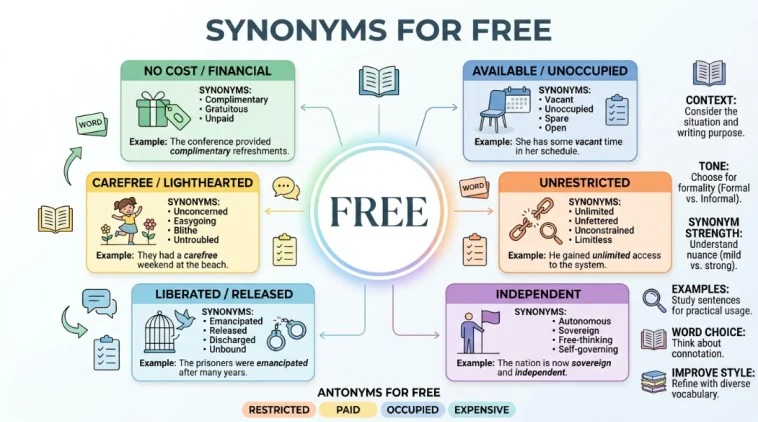
The right alternative depends on what you actually mean. Synonyms for free can range from complimentary and costless to independent, unrestricted, available, and liberated. Choosing the precise word makes emails, essays, resumes, captions, conversations, and creative writing sound clearer and more natural.
What Does “Free” Mean?
Free can mean costing nothing, being unrestricted, being available, or being independent. Useful alternatives include complimentary for formal offers, gratis for financial contexts, available for time, unrestricted for rules, independent for personal freedom, and liberated for emotional or creative writing.
Meaning, Tone and Context
Simple Definition
Free has several important meanings. It can describe something that costs nothing, a person who is not controlled, something without restrictions, or time when someone is available.
For example, a free product costs nothing, while a free person may have independence or personal liberty.
Part of Speech
Free is commonly used as an adjective and adverb. It can also function as a verb in expressions such as “free the prisoner.”
Examples include:
Adjective: The workshop is free.
Adverb: Children under five enter free.
Verb: The organization worked to free the hostages.
Tone
The word free is generally neutral and often positive.
Its emotional effect changes according to context. Free education sounds positive, free from fear sounds emotional, and free from responsibility can sometimes sound negative.
Formality Level
Free is common in everyday American English and works in casual, academic, professional, and creative contexts.
The best synonym changes according to the intended meaning and level of formality.
Common Use Cases
The word commonly appears in:
- Prices and services
- Personal independence
- Time and availability
- Rules and restrictions
- Speech and expression
- Emotional writing
- Business offers
- Academic writing
- Social media captions
- Creative descriptions
Important Word Forms
Related forms include:
Free: adjective or verb
Freely: adverb
Freedom: noun
Freed: past tense and past participle of the verb
Freeing: present participle
Freer: comparative adjective
Freest: superlative adjective
When and How to Use “Free”
Use free when the meaning is clear from the surrounding sentence. It is especially useful when describing zero cost, personal independence, availability, or the absence of restrictions.
Professional
The consultation is free for all new customers.
Personal
I finally feel free to make my own decisions.
Academic
Students are free to select a topic that interests them.
Emotional
She felt free after leaving an unhealthy situation.
Creative
The birds moved freely across the open sky.
Social Media
Enjoying a free afternoon with no plans.
Please let me know when you are free for a quick meeting.
Another Word for “Free”
There is no single best replacement for free because the word has several meanings.
- Professional writing: complimentary, available, unrestricted
- Academic writing: independent, voluntary, unrestricted
- Casual conversation: available, open, spare
- Emotional writing: liberated, unrestrained, independent
- Creative writing: unbound, unfettered, liberated
- Resume or workplace use: available, flexible, independent
- Social media captions: complimentary, costless, carefree
- Stronger meaning: unrestricted, liberated, unfettered
- Softer meaning: available, open, flexible
When Not to Use “Free”
Avoid free when the sentence needs a more precise meaning.
If you mean that something costs nothing, complimentary may sound more polished in business communication.
Instead of:
The hotel gives free breakfast.
Use:
The hotel provides complimentary breakfast.
If you mean that someone has time available, available is clearer.
Instead of:
Are you free tomorrow?
Use:
Are you available tomorrow?
If you mean complete freedom from restrictions, unrestricted provides greater precision.
Instead of:
The account has free access.
Use:
The account provides unrestricted access.
Words Commonly Confused With “Free”
Free vs. Available
Free can mean available, but available specifically describes something that can be used, obtained, or scheduled.
The word available is better for appointments, resources, rooms, and time.
Free vs. Complimentary
Both can describe something that costs nothing.
Complimentary is more common in professional, hospitality, marketing, and customer service contexts.
Free vs. Independent
Both can relate to personal freedom.
Independent emphasizes self reliance or freedom from outside control rather than simply having no restrictions.
Free vs. Unrestricted
Both can describe a lack of limitations.
Unrestricted is more precise when rules, access, movement, or usage limitations are involved.
Free vs. Liberated
Both can describe emotional or personal freedom.
Liberated has a stronger emotional meaning and often suggests release from control, pressure, or oppression.
Free vs. Vacant
Both can sometimes describe availability.
Vacant normally refers to an empty place or position, while free can refer to time, space, or opportunity.
Best Synonym by Context for “Free”
| Context | Best Synonym | Why It Works | Example |
|---|---|---|---|
| Formal writing | Complimentary | Sounds polished when something costs nothing | Guests receive complimentary breakfast. |
| Academic writing | Independent | Expresses freedom from outside control | The researcher remained independent. |
| Professional or business use | Available | Clearly describes time or resources | I am available after two. |
| Resume | Independent | Highlights self directed ability | Independent decision making improved team efficiency. |
| Casual conversation | Available | Natural for everyday scheduling | Are you available tonight? |
| Creative writing | Unbound | Creates a stronger image of freedom | Her imagination felt unbound. |
| Emotional tone | Liberated | Suggests emotional release | He felt liberated after the decision. |
| Strong intensity | Unrestricted | Clearly suggests absence of limits | Members receive unrestricted access. |
| Soft or moderate tone | Open | Sounds flexible and approachable | I am open this afternoon. |
| Social media captions | Carefree | Adds a relaxed emotional feeling | A carefree day by the water. |
| Price related use | Costless | Directly emphasizes no financial cost | The guide is costless to download. |
| Hospitality | Complimentary | Common in customer service | Complimentary drinks are included. |
Which Synonym Should You Choose?
Start by identifying the exact meaning of free.
- If something costs nothing, choose complimentary, gratis, or costless depending on the context.
- If someone has time, choose available, open, or unoccupied.
- If someone has personal independence, choose independent, autonomous, or self governing.
- If something has no restrictions, choose unrestricted, unconfined, or unfettered.
- If the sentence describes emotional release, choose liberated or unburdened.
The best synonym should preserve the original meaning while matching the formality, emotional intensity, and audience of the sentence.
Real Life Examples of “Free” in Sentences
School
Students are free to choose their presentation topics.
Workplace
I am free after three o’clock if you want to discuss the project.
Writing
The author wanted a word that expressed free movement without sounding informal.
Conversation
Are you free this weekend?
Social Media
Finally enjoying a free afternoon with friends.
Resume
Worked independently while managing multiple client projects.
Please let me know when you are free for a short call.
Storytelling
The horse ran free across the wide open field.
25 Synonyms for “Free”
Because free has several meanings, these alternatives are grouped according to the specific sense they express.
| Synonym | Simple Meaning | Best Used For | Example Sentence |
|---|---|---|---|
| Complimentary | Given without payment | Business and hospitality | Guests receive complimentary breakfast. |
| Gratis | Provided without charge | Formal financial contexts | The legal consultation was offered gratis. |
| Costless | Having no cost | Price focused writing | The resource provides costless access to basic lessons. |
| Available | Ready to use or meet | Time, resources, appointments | The manager is available this afternoon. |
| Open | Not occupied or committed | Scheduling and opportunities | I am open after lunch. |
| Vacant | Empty and available | Rooms, positions, spaces | The apartment is currently vacant. |
| Unoccupied | Not being used | Spaces and places | Several seats remained unoccupied. |
| Independent | Free from outside control | People and decisions | She became financially independent. |
| Autonomous | Able to act independently | Academic and professional contexts | The team operates as an autonomous unit. |
| Self governing | Managing itself without outside control | Organizations and communities | The group became self governing. |
| Unrestricted | Without limitations | Access, movement, usage | Members have unrestricted access to the archive. |
| Unconfined | Not limited to a particular area | Movement and physical space | The animals moved unconfined through the reserve. |
| Unfettered | Completely free from restraints | Formal and creative writing | The artist enjoyed unfettered creativity. |
| Unbound | Not tied or restrained | Creative and literary contexts | Her imagination remained unbound. |
| Liberated | Released from control or restriction | Emotional and personal contexts | She felt liberated after leaving the job. |
| Unrestrained | Not held back | Behavior and emotion | His laughter was unrestrained. |
| At liberty | Free to act or choose | Formal and legal contexts | You are at liberty to decline the offer. |
| Voluntary | Done by choice rather than force | Actions and participation | Attendance at the event is voluntary. |
| Willing | Ready to act by choice | Personal decisions | He was willing to help the team. |
| Spare | Available and unused | Time and capacity | I have a spare hour this evening. |
| Carefree | Without worry or responsibility | Emotional and creative writing | They enjoyed a carefree afternoon. |
| Unburdened | Free from a burden | Emotional contexts | She felt unburdened after sharing the truth. |
| Unrestricted | Without limits or controls | Access and rules | The plan provides unrestricted data access. |
| Unimpeded | Able to proceed without obstruction | Movement and progress | Traffic moved unimpeded through the intersection. |
| Unhampered | Not prevented or slowed | Progress and activity | The team worked unhampered by unnecessary rules. |
Synonym Groups and Usage Differences
Professional vs. Personal Synonyms
Professional writing often benefits from precise words such as complimentary, available, independent, and unrestricted.
Personal writing can use warmer alternatives such as carefree, liberated, unburdened, and open.
The best choice depends on whether you are describing price, time, independence, access, or emotion.
Formal vs. Conversational Synonyms
Gratis, at liberty, unfettered, and autonomous tend to sound more formal.
Available, open, spare, and willing are more natural in everyday conversation.
For emails, choose the word that sounds natural for your relationship with the reader. In most workplace situations, available is clearer than a more elaborate alternative.
Academic Synonyms
Academic writing benefits from precision.
- Use independent when describing research or judgment without outside influence.
- Use unrestricted when discussing access or limitations.
- Use autonomous when discussing systems, organizations, or decision making.
Avoid replacing free simply for variety if the alternative changes the intended meaning.
Professional and Business Synonyms
Business writing frequently uses complimentary for products or services that cost nothing.
- Use available for schedules, appointments, resources, and staff.
Use unrestricted when describing access.
- Use independent when discussing decision making, operations, or professional work.
Creative or Literary Synonyms
Creative writing gives you more freedom to use expressive alternatives.
Words such as unbound, unfettered, liberated, and unrestrained can create stronger imagery.
For example, “Her thoughts were unbound” feels more literary than “Her thoughts were free.”
Slang or Modern Synonyms
There is no single slang synonym for free that works in every context.
Expressions such as no cost, on the house, and zero cost may sound casual or promotional.
Use casual expressions in conversation, advertising, captions, or informal content rather than academic essays.
Strongest vs. Weaker Synonyms
A useful intensity scale is:
Available → Open → Unrestricted → Unconfined → Unrestrained → Unfettered → Liberated
The early words are relatively neutral. The later words suggest stronger freedom or release.
Emotional vs. Neutral Synonyms
Neutral choices include available, open, independent, and unrestricted.
More emotional choices include liberated, carefree, unburdened, and unfettered.
Choose an emotional synonym only when the sentence genuinely communicates an emotional experience.
Antonyms of “Free”
Because free has multiple meanings, its antonyms also depend on context.
| Antonym | Meaning | Example Sentence |
|---|---|---|
| Expensive | Costing a lot of money | The service is expensive. |
| Costly | Requiring substantial payment | The repair was costly. |
| Restricted | Limited by rules or conditions | Access is restricted to members. |
| Limited | Available only in a small amount | The offer has limited availability. |
| Controlled | Directed by another person or system | The process is tightly controlled. |
| Confined | Kept within boundaries | The animals remained confined. |
| Captive | Unable to leave or escape | The animal was held captive. |
| Imprisoned | Kept in prison or confinement | The suspect was imprisoned for the offense. |
| Occupied | Already being used or filled | Every seat was occupied. |
| Busy | Not available because of other activities | I am busy this afternoon. |
| Unavailable | Not accessible or ready for use | The manager is unavailable today. |
| Obligated | Required to do something | Employees are obligated to follow the policy. |
| Forced | Made to act without genuine choice | She felt forced to accept the offer. |
| Dependent | Relying on another person or thing | The organization became dependent on outside funding. |
| Burdened | Carrying a responsibility or difficulty | He felt burdened by the extra workload. |
Comparison: “Free” vs. Similar Words
Free vs. Available
Main difference: Free can mean available, but available specifically focuses on something being ready for use or a person having time.
Which one is stronger: Neither is inherently stronger.
Which one is more formal: Available is often more precise in professional contexts.
Examples:
I am free after lunch.
I am available after lunch.
Free vs. Complimentary
Main difference: Both can mean something costs nothing, but complimentary is especially common for services, gifts, and hospitality.
Which one is stronger: Neither.
Which one is more formal: Complimentary.
Examples:
The hotel offers free breakfast.
The hotel offers complimentary breakfast.
Free vs. Independent
Main difference: Free emphasizes freedom broadly, while independent emphasizes freedom from reliance or outside control.
Which one is stronger: Independent is more specific rather than stronger.
Which one is more formal: Independent.
Examples:
She wanted to be free.
She wanted to become financially independent.
Free vs. Unrestricted
Main difference: Free can have many meanings, while unrestricted specifically means without limits or controls.
Which one is stronger: Unrestricted can express a more complete absence of limitations.
Which one is more formal: Unrestricted.
Examples:
Users are free to browse the site.
Users have unrestricted access to the site.
Free vs. Liberated
Main difference: Free is neutral and broad. Liberated usually suggests release from emotional, social, physical, or psychological restriction.
Which one is stronger: Liberated.
Which one is more formal: Liberated can sound more literary or formal.
Examples:
She felt free after leaving.
She felt liberated after leaving.
Free vs. Vacant
Main difference: Free can describe available time or space. Vacant usually describes an empty room, property, position, or location.
Which one is stronger: Neither.
Which one is more formal: Vacant.
Examples:
Is this seat free?
The seat is vacant.
Common Phrases and Expressions with “Free”
1. Free of Charge
Meaning:
Something is provided without requiring payment.
Example sentence:
The museum offers free of charge admission on certain days.
2. Free Time
Meaning:
Time when someone has no scheduled responsibilities.
Example sentence:
I usually read during my free time.
3. Free Speech
Meaning:
The ability to express opinions without improper restriction.
Example sentence:
Free speech is an important principle in democratic societies.
4. Free Will
Meaning:
The ability to make choices independently.
Example sentence:
She believed that people should make decisions through free will.
5. Set Free
Meaning:
To release someone or something from control or confinement.
Example sentence:
The organization worked to set the rescued animals free.
6. Free Trial
Meaning:
A period when a product or service can be used without payment.
Example sentence:
The software company offers a free trial to new users.
7. Free Hand
Meaning:
Permission to act or make decisions without detailed supervision.
Example sentence:
The designer was given a free hand with the project.
8. Free Market
Meaning:
An economic system in which prices and trade are influenced primarily by competition and voluntary exchange.
Example sentence:
The discussion focused on how a free market affects consumer choice.
Common Mistakes to Avoid
1. Using “Free” When a More Precise Word Is Better
Saying “I am free tomorrow” is understandable, but “I am available tomorrow” can sound more precise in professional communication.
2. Confusing Free With Available
Free can mean available, but not every use of free should be replaced with available.
A free product may have no cost, while an available product is simply ready to obtain or use.
3. Using a Casual Synonym in Formal Writing
Expressions such as “on the house” can sound too casual for reports, academic work, and formal business communication.
Use complimentary when appropriate.
4. Using an Overly Dramatic Synonym
Using liberated to describe an empty afternoon can sound exaggerated.
For ordinary scheduling, available or free is more natural.
5. Repeating “Free” Too Often
If several sentences use the word repeatedly, identify the exact meaning each time.
You may need complimentary, available, independent, or unrestricted instead.
6. Choosing the Wrong Emotional Tone
Carefree suggests happiness and a lack of worry, while liberated suggests release from restriction.
They are not interchangeable in every emotional sentence.
7. Using Slang in Academic or Professional Writing
Informal expressions can weaken otherwise polished writing.
Use clear standard English unless the audience and purpose specifically call for casual language.
FAQs
What is the best synonym for “free”?
The best synonym depends on meaning. Use complimentary for no cost, available for time, unrestricted for access, independent for autonomy, and liberated for emotional freedom.
What is a formal synonym for “free”?
Formal alternatives include complimentary, gratis, unrestricted, autonomous, independent, and at liberty. The correct choice depends on the specific meaning of free.
What is an informal synonym for “free”?
Common conversational alternatives include available, open, spare, and willing. The best choice depends on whether free refers to time, opportunity, or willingness.
What is another word for “free” in professional writing?
Available is usually best when discussing time. Complimentary works well for services, while unrestricted is useful for access and independent works for autonomy.
What is the difference between “free” and “available”?
Free can mean available, but available specifically means ready for use, access, or scheduling. Free can also mean without cost or without restrictions.
What is the opposite of “free”?
The opposite depends on meaning. Common antonyms include expensive, restricted, occupied, unavailable, controlled, confined, forced, and dependent.
Conclusion
Free is a versatile word that can describe zero cost, availability, independence, unrestricted access, or emotional release. That range makes context especially important when selecting a replacement.
The best alternatives include complimentary for no cost, available for time, independent for personal autonomy, unrestricted for access, and liberated for emotional freedom.
When choosing among synonyms for free, do not replace the word simply to sound sophisticated. First identify its exact meaning, then select the alternative that preserves the meaning and matches your audience.
A practical vocabulary tip is to ask yourself what kind of freedom the sentence describes. Price, time, rules, independence, and emotion each call for different vocabulary.
Discover More Post:
- 25+ Synonyms for Navigate | Meanings, Examples, and Best …
- 25+ Synonyms for Share | Meanings, Examples and Best …
- 25+ Synonyms for We | Meanings, Examples, and Best …