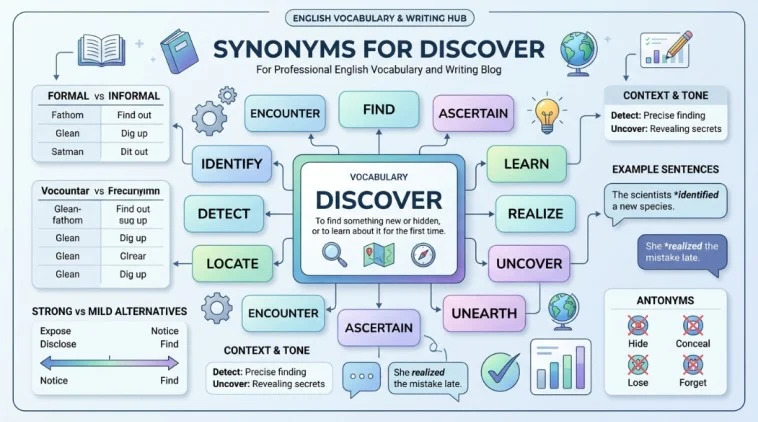
Using the word “discover” again and again can make an essay, email, caption, resume, or story feel repetitive. The right alternative can make your writing more precise, professional, natural, or emotionally engaging.
The best synonyms for discover depend on what you actually mean. You might find something unexpectedly, learn new information, identify something clearly, uncover something hidden, or realize something for the first time. Choosing the exact word gives your sentence more meaning and makes your vocabulary stronger.
What Does “Discover” Mean?
Discover means to find, learn, notice, or become aware of something that was previously unknown or unnoticed. Depending on context, useful alternatives include find, uncover, detect, identify, learn, realize, locate, reveal, and ascertain.
Meaning, Tone and Context
Simple Definition
Discover means to find something, learn something, or become aware of something that was previously unknown, hidden, or unnoticed.
For example:
“I discovered a great coffee shop near my office.”
Here, discover means that the speaker found something they did not know about before.
The word can also describe gaining new knowledge.
“Researchers discovered a new pattern in the data.”
In this sentence, discover means learning or identifying something through investigation.
Part of Speech
Discover is a verb.
Its common forms include:
Discover
Discovers
Discovered
Discovering
Discovery
The noun form is “discovery.”
Tone
Discover usually has a neutral and positive tone.
It can sound exciting when describing something new or unexpected.
“I discovered a beautiful hiking trail.”
It can also be neutral or serious when discussing research, investigations, mistakes, or facts.
“The audit discovered several accounting errors.”
Formality Level
Discover works in casual, academic, professional, creative, and everyday English.
It is a flexible word, but a more specific synonym can sometimes communicate your meaning better.
For example, “detect” is more precise for identifying a problem, while “ascertain” is more formal for determining a fact.
Common Use Cases
Discover is commonly used when talking about:
• Finding something new
• Learning information
• Identifying problems
• Exploring places
• Recognizing facts
• Research and science
• Personal experiences
• Stories and creative writing
• Business and workplace situations
• Social media experiences
Important Word Forms
Verb: discover
Past tense: discovered
Present participle: discovering
Noun: discovery
Related noun: discoverer
Opposite idea: overlook, miss, conceal, or remain unaware of something, depending on context
When and How to Use “Discover”
Use discover when something becomes known, noticed, found, or understood for the first time.
The word works especially well when the new information has some sense of significance, curiosity, or surprise.
1. Professional
“Our team discovered an issue during the quality review.”
This sounds natural in workplace communication.
2. Personal
“I discovered that I really enjoy cooking.”
Here, discover describes learning something about yourself.
3. Academic
“The researchers discovered a significant relationship between the two variables.”
Discover works well when describing research findings.
4. Emotional
“She discovered the truth after years of uncertainty.”
The word can carry emotional weight when the information changes someone’s understanding.
5. Creative
“As the sun disappeared, they discovered a quiet village beyond the forest.”
Discover can create a feeling of exploration and surprise.
6. Social Media
“I just discovered this amazing little bookstore downtown.”
This casual use is common when sharing something newly found.
7. Email
“I discovered an error in the attached report and corrected it.”
The word is appropriate for professional email when the discovery itself is important.
Another Word for “Discover”
There is no single replacement that works perfectly in every sentence.
- For professional writing, identify, detect, determine, or uncover may be more precise.
- For academic writing, identify, establish, ascertain, or determine can sound more exact.
- For casual conversation, find, come across, and find out are natural choices.
- For emotional writing, realize, learn, or uncover can better express the nature of the discovery.
- For creative writing, unearth, encounter, stumble upon, and chance upon can add atmosphere.
- For resumes and workplace communication, identified, detected, and uncovered can emphasize useful results.
- For social media captions, found, came across, and stumbled upon often sound relaxed and conversational.
- For a stronger meaning, choose uncover, unearth, detect, or expose, depending on the situation.
- For a softer meaning, choose notice, learn, realize, or come across.
When Not to Use “Discover”
Discover can be too general when you need to explain exactly how something became known.
For example:
“I discovered an error.”
This is correct, but “I detected an error” is more precise when the error was identified through careful checking.
“I discovered the location.”
If you mean you searched for a specific place successfully, “I located the address” may be better.
“I discovered the answer.”
If you mean you learned information, “I found out the answer” sounds more conversational.
“I discovered a hidden document.”
“Uncovered” may be stronger because it suggests something concealed was brought to attention.
Avoid replacing discover with an overly dramatic word when the situation is ordinary. A simple “found” may be more natural than “unearthed.”
Words Commonly Confused With “Discover”
Discover vs. Find
Find is broader and often refers to locating something.
Discover can suggest that something was previously unknown or unnoticed.
“I found my keys.”
“I discovered a new solution.”
Discover vs. Learn
Learn focuses on gaining information or knowledge.
Discover can include learning, but it often emphasizes the moment something becomes known.
“I learned about the policy.”
“I discovered a problem with the policy.”
Discover vs. Detect
Detect means noticing or identifying something, especially something difficult to see or recognize.
“Doctors detected the early signs of the condition.”
Discover is broader and less technical.
Discover vs. Identify
Identify means determining exactly what something is.
“The analyst identified the main cause.”
Discover can describe the broader process of finding or learning something.
Discover vs. Locate
Locate specifically means finding the position or place of something.
“The technician located the damaged cable.”
Discover is not limited to physical location.
Discover vs. Realize
Realize means becoming aware of a fact or understanding something.
“I realized that I had forgotten my wallet.”
Discover can also express new awareness, but realize is often more natural for personal understanding.
Best Synonym by Context for “Discover”
| Context | Best Synonym | Why It Works | Example |
|---|---|---|---|
| Formal writing | Ascertain | Clearly expresses determining a fact | The committee sought to ascertain the cause. |
| Academic writing | Identify | Sounds precise and research focused | Researchers identified a recurring pattern. |
| Professional use | Detect | Works well for problems and irregularities | The system detected an unusual error. |
| Resume | Uncovered | Highlights valuable findings | Uncovered several workflow problems. |
| Casual conversation | Find | Simple and natural | I found a great new restaurant. |
| Creative writing | Encounter | Adds a sense of experience | They encountered a forgotten village. |
| Emotional tone | Realize | Expresses personal awareness | She realized the truth at last. |
| Strong intensity | Uncover | Suggests revealing something hidden | The investigation uncovered new evidence. |
| Soft tone | Notice | Feels less dramatic | I noticed a small change. |
| Social media captions | Stumble upon | Sounds casual and spontaneous | I stumbled upon this beautiful trail. |
| Research | Determine | Emphasizes reaching a conclusion | The study determined the likely cause. |
| Hidden information | Unearth | Suggests bringing something buried or forgotten to light | Historians unearthed new records. |
| Physical location | Locate | Specifically means finding a position | We located the missing file. |
| New information | Learn | Focuses on gaining knowledge | I learned something surprising today. |
Which Synonym Should You Choose?
Start by asking what kind of discovery your sentence describes.
- If you physically found something, find or locate may be best.
- If you gained information, choose learn or find out.
- If you became aware of something, realize or notice may fit better.
- If you identified a problem, detect is often more precise.
- If you revealed something hidden, consider uncover, expose, or unearth.
For formal communication, use words such as ascertain, determine, or identify when they accurately describe the action.
For casual speech, simpler choices such as find, come across, and stumble upon usually sound more natural.
Always prioritize meaning over variety. A synonym is useful only when it preserves the intended meaning of the original sentence.
Real Life Examples of “Discover” in Sentences
School
“Students discovered a new interpretation of the poem.”
Workplace
“Our team discovered a reporting error before the presentation.”
Writing
“The author discovered a more effective way to explain the concept.”
Conversation
“I discovered that my neighbor works at the same company.”
Social Media
“I discovered this hidden gem while exploring the city.”
Resume
“Discovered process inefficiencies and helped improve the reporting workflow.”
“I discovered a small formatting issue in the document and updated it.”
Storytelling
“While exploring the old house, she discovered a room no one had mentioned.”
25 Synonyms for “Discover”
| Synonym | Simple Meaning | Best Used For | Example Sentence |
|---|---|---|---|
| Find | Locate or come upon something | Everyday situations | I found an interesting article online. |
| Uncover | Reveal something hidden | Investigations and hidden facts | The audit uncovered several inconsistencies. |
| Unearth | Find something buried, forgotten, or hidden | History and research | The team unearthed records from the early twentieth century. |
| Detect | Notice or identify something difficult to see | Problems and technical contexts | The software detected an unusual pattern. |
| Identify | Recognize exactly what something is | Academic and professional writing | The researcher identified the primary cause. |
| Locate | Find the exact position of something | Physical objects and information | We located the missing document. |
| Encounter | Come across something or someone | Experiences and travel | She encountered an unexpected challenge. |
| Stumble upon | Find something by chance | Casual and conversational writing | We stumbled upon a charming bookstore. |
| Come across | Find or encounter unexpectedly | Everyday conversation | I came across an old photograph yesterday. |
| Chance upon | Find unexpectedly | Literary and conversational use | They chanced upon a quiet beach. |
| Learn | Gain new information | Knowledge and facts | I learned about the change this morning. |
| Ascertain | Determine something with certainty | Formal writing | The investigators worked to ascertain the facts. |
| Determine | Establish or figure out something | Professional and academic use | The study determined the likely source of the problem. |
| Realize | Become aware of something | Personal understanding | He realized that he had misunderstood the instructions. |
| Notice | Become aware through observation | Everyday situations | She noticed a small crack in the wall. |
| Spot | See or recognize something | Casual and visual contexts | I spotted the missing book on the shelf. |
| Observe | Notice through careful attention | Academic and professional contexts | Scientists observed a change in behavior. |
| Recognize | Identify something from familiarity or knowledge | People, patterns, and ideas | She recognized the importance of the discovery. |
| Reveal | Make something known or visible | Information and secrets | The report revealed several important details. |
| Expose | Bring hidden or secret information to light | Problems and wrongdoing | The investigation exposed serious weaknesses. |
| Discern | Recognize or understand something with difficulty | Formal and intellectual writing | Experts discerned a subtle difference in the results. |
| Ferret out | Search for and find something hidden | Informal investigations | The reporter ferreted out additional details. |
| Track down | Find something after a deliberate search | People, objects, and information | We tracked down the original source. |
| Dig up | Find forgotten or hidden information | Informal research | She dug up an old interview for the article. |
| Hit upon | Discover an idea or solution unexpectedly | Ideas and problem solving | The engineer hit upon a simple solution. |
Synonym Groups and Usage Differences
Professional vs. Personal Synonyms
Professional writing benefits from precise verbs.
Identify, detect, determine, uncover, and ascertain can communicate a clear professional action.
Personal writing can use more conversational choices.
Find, come across, stumble upon, and realize often sound more natural when describing everyday experiences.
Formal vs. Conversational Synonyms
Formal writing often favors:
Ascertain
Determine
Identify
Discern
Uncover
Conversational English often favors:
Find
Come across
Stumble upon
Find out
Spot
A word that sounds excellent in a research paper may sound unnatural in a text message. Match the word to your audience.
Academic Synonyms
Academic writing requires precision rather than unnecessary complexity.
Identify, determine, observe, detect, and ascertain are useful when their meanings accurately describe the research process.
For example:
“Researchers identified three major patterns in the data.”
This is more precise than repeatedly using “discovered.”
Professional and Business Synonyms
In workplace communication, choose words that show exactly what happened.
- Use identified for recognizing an issue.
- Use detected for noticing a problem or irregularity.
- Use uncovered for revealing an important issue.
- Use determined for reaching a conclusion.
- Use located for finding something physically or digitally.
Creative or Literary Synonyms
Creative writing can benefit from words that create a sense of surprise or exploration.
Encounter, chance upon, stumble upon, unearth, and uncover can add atmosphere.
For example:
“She stumbled upon a forgotten letter beneath the floorboards.”
The wording creates a stronger sense of discovery than simply saying:
“She found a letter.”
Slang or Modern Synonyms
Discover does not have many true slang equivalents.
Casual expressions such as dig up, come across, and stumble upon are useful in relaxed communication.
They should generally be avoided in formal academic or business writing when a clearer professional verb is available.
Strongest vs. Weaker Synonyms
A useful intensity scale is:
Notice → find → identify → detect → uncover → expose
The exact strength depends on context.
“Notice” can describe a simple observation.
“Uncover” often suggests that something was hidden.
“Expose” can imply that something important or problematic was deliberately brought to public attention.
Emotional vs. Neutral Synonyms
Neutral choices include:
Find
Locate
Identify
Determine
Detect
More emotional or dramatic choices can include:
Uncover
Unearth
Expose
Stumble upon
Encounter
Choose neutral vocabulary when accuracy matters more than atmosphere.
Antonyms of “Discover”
There is no single opposite of discover in every situation. The best antonym depends on whether discover means finding, learning, noticing, or revealing something.
| Antonym | Meaning | Example Sentence |
|---|---|---|
| Miss | Fail to notice or find | We missed an important detail. |
| Overlook | Fail to notice something | The reviewer overlooked the error. |
| Ignore | Deliberately pay no attention | He ignored the warning signs. |
| Conceal | Keep something hidden | The company concealed the information. |
| Hide | Keep something from view | She hid the letter in a drawer. |
| Suppress | Prevent information from becoming known | Officials suppressed the report. |
| Forget | Fail to remember | I forgot the address. |
| Lose | No longer have or know the location of something | She lost her keys. |
| Misplace | Put something somewhere and cannot find it | I misplaced my notebook. |
| Deny | Refuse to accept or acknowledge something | He denied the evidence. |
| Disregard | Treat something as unimportant | The manager disregarded the warning. |
| Neglect | Fail to give proper attention | The team neglected an important detail. |
| Obscure | Make something difficult to see or understand | The wording obscured the main point. |
| Cover | Put something out of sight | The papers covered the original label. |
| Withhold | Keep information from someone | The organization withheld important details. |
Comparison: Discover vs. Similar Words
Discover vs. Find
Main difference: Find is broader, while discover often suggests learning or finding something previously unknown.
Which one is stronger: Discover can imply greater significance.
Which one is more formal: Both are acceptable, but find is simpler.
Discover: “She discovered a new method.”
Find: “She found a useful article.”
Discover vs. Learn
Main difference: Learn focuses on gaining knowledge.
Which one is stronger: Discover can suggest a notable or unexpected realization.
Which one is more formal: Both work in formal writing.
Discover: “The researchers discovered a new pattern.”
Learn: “The students learned about the pattern.”
Discover vs. Detect
Main difference: Detect means notice or identify something, often through careful observation or a tool.
Which one is stronger: Detect is more precise for problems or hidden signs.
Which one is more formal: Detect often sounds more technical.
Discover: “The team discovered an issue.”
Detect: “The system detected an issue.”
Discover vs. Identify
Main difference: Identify means determine exactly what something is.
Which one is stronger: Identify is more precise when naming or classifying something.
Which one is more formal: Identify is especially common in academic and professional writing.
Discover: “Researchers discovered a pattern.”
Identify: “Researchers identified the pattern.”
Discover vs. Locate
Main difference: Locate specifically concerns finding a place, position, or object.
Which one is stronger: Locate is more exact for physical or digital position.
Which one is more formal: Locate often sounds more professional.
Discover: “We discovered the missing file.”
Locate: “We located the missing file.”
Discover vs. Realize
Main difference: Realize means becoming mentally aware of something.
Which one is stronger: Neither is universally stronger.
Which one is more formal: Both can work in formal writing, depending on context.
Discover: “She discovered the truth.”
Realize: “She realized that the story was false.”
Common Phrases and Expressions with “Discover”
1. Discover something new
Meaning: Find or learn something that was previously unknown.
Example sentence: “Every trip gives me a chance to discover something new.”
2. Discover the truth
Meaning: Learn what is actually true.
Example sentence: “The investigation helped the team discover the truth.”
3. Discover a problem
Meaning: Find or notice an issue.
Example sentence: “We discovered a problem during the final review.”
4. Discover a talent
Meaning: Realize that you have a natural ability.
Example sentence: “She discovered a talent for photography in college.”
5. Discover a passion
Meaning: Find an activity or subject that creates strong interest.
Example sentence: “He discovered a passion for teaching.”
6. Discover a hidden gem
Meaning: Find something excellent that is not widely known.
Example sentence: “We discovered a hidden gem while exploring the neighborhood.”
7. Discover for yourself
Meaning: Learn or experience something personally rather than being told about it.
Example sentence: “Travel gives you opportunities to discover new perspectives for yourself.”
8. Discover the cause
Meaning: Determine why something happened.
Example sentence: “The engineers worked for weeks to discover the cause of the failure.”
Common Mistakes to Avoid
1. Using Discover When a More Precise Word Is Better
“Discover” is broad.
If you mean identifying a technical problem, detect may communicate the action more clearly.
2. Confusing Discover With Find
Find does not always imply that something was previously unknown.
“I found my wallet” simply means you located it.
“I discovered an old letter” can suggest that the letter was previously unknown or forgotten.
3. Using a Casual Synonym in Formal Writing
Expressions such as dig up and stumble upon can sound too conversational in academic writing.
Use precise alternatives such as identify, determine, or uncover when appropriate.
4. Using an Overly Dramatic Synonym
Do not use expose when you simply noticed something ordinary.
“I exposed a typo” sounds unnecessarily dramatic.
“I noticed a typo” is more natural.
5. Repeating Discover Too Often
Repeating the same verb can make writing feel monotonous.
Replace it with an accurate alternative when the meaning remains intact.
6. Choosing the Wrong Emotional Tone
Uncover can suggest something hidden.
Find sounds neutral.
Stumble upon suggests chance.
Expose can imply wrongdoing or something negative.
Consider the emotional effect before choosing a replacement.
7. Using Slang in Academic or Professional Writing
Casual expressions can weaken formal communication.
For example, “The researchers dug up new evidence” is conversational.
“The researchers uncovered new evidence” is generally more suitable for formal writing.
FAQs
What is the best synonym for discover?
The best synonym depends on context. Use find for general situations, identify for precision, detect for problems, uncover for hidden information, and learn for new knowledge.
What is a formal synonym for discover?
Ascertain, determine, identify, detect, and uncover can serve as formal alternatives when their specific meanings match the intended sentence.
What is an informal synonym for discover?
Find, come across, stumble upon, spot, and dig up can work in casual conversation, depending on the exact meaning and situation.
What is another word for discover in professional writing?
Identify, detect, determine, locate, and uncover are strong professional alternatives because they communicate specific actions more clearly.
What is the difference between discover and find?
Find usually means locating or obtaining something, while discover often suggests finding or learning something previously unknown or unnoticed.
What is the opposite of discover?
Common opposites include miss, overlook, ignore, hide, conceal, suppress, and withhold. The correct choice depends on the intended meaning.
Conclusion
Discover is a versatile verb that can mean finding something, learning new information, recognizing a fact, or becoming aware of something previously unknown. Its flexibility makes it useful in everyday speech, academic writing, professional communication, and creative work.
The best synonym depends on the situation. Choose find for simple everyday use, identify for precision, detect for problems, locate for positions, learn for information, realize for personal awareness, and uncover for hidden information.
The most useful vocabulary habit is to choose synonyms based on meaning rather than simply trying to avoid repetition. Before replacing discover, consider what actually happened, how formal the sentence should sound, and what emotional effect you want the word to create.
Discover More Post:
- 25+ Synonyms for Navigate | Meanings, Examples, and Best …
- 25+ Synonyms for Share | Meanings, Examples and Best …
- 25+ Synonyms for We | Meanings, Examples, and Best …