Using the word “design” again and again can make an essay, resume, email, caption, or professional message feel repetitive. The right alternative can make your writing more precise, polished, creative, or persuasive without changing your intended meaning.
The best synonyms for design depend on context. You might choose “plan” for a strategy, “create” for making something, “blueprint” for a detailed structure, or “style” when discussing appearance. Understanding these differences helps you choose words that sound natural and purposeful.
What Does “Design” Mean?
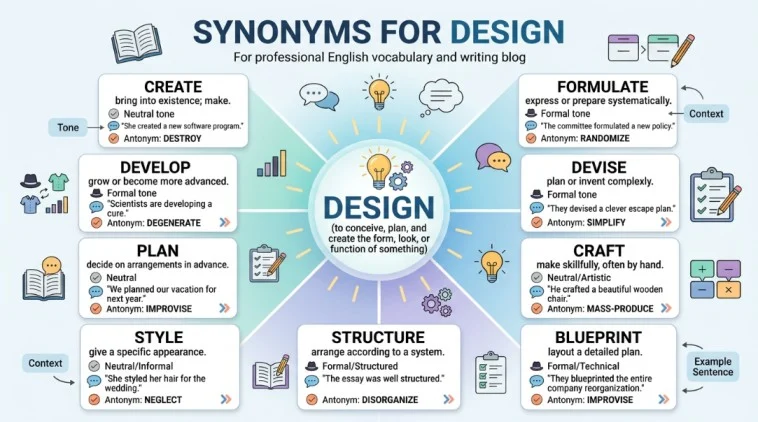
Design means to plan, create, arrange, or develop something with a particular purpose or appearance. Depending on context, useful synonyms include plan, create, develop, formulate, blueprint, style, structure, arrange, devise, and craft.
Meaning, Tone and Context
Simple Definition
Design means to plan or create something intentionally. It can describe the process of developing an object, system, appearance, strategy, structure, or experience.
As a noun, design can mean a plan, arrangement, appearance, or intended purpose.
Example: “The design of the website makes it easy to navigate.”
As a verb, design means to create or plan something for a particular purpose.
Example: “The team designed a new training program.”
Part of Speech
“Design” works primarily as both a noun and a verb.
As a noun, it can refer to a plan, structure, appearance, arrangement, or intention.
As a verb, it means to plan, create, develop, or arrange something deliberately.
Tone
Design is generally neutral. It can sound professional, technical, creative, academic, or everyday depending on the sentence.
Formality Level
Design is appropriate in casual conversation, academic writing, workplace communication, marketing, technical writing, creative writing, and professional documents.
Common Use Cases
Design commonly appears when discussing:
- Websites
- Products
- Buildings
- Clothing
- Graphics
- Business strategies
- Systems
- Research projects
- User experiences
- Marketing materials
- Engineering solutions
- Interior spaces
Important Word Forms
Common related forms include:
Design, noun and verb
Designer, noun
Designed, past tense and past participle
Designing, present participle
Designed, adjective in some contexts
When and How to Use “Design”
Use “design” when you want to communicate intentional planning, creative development, visual arrangement, or purposeful construction.
The word is especially useful when something has been deliberately created to achieve a particular goal.
1. Professional
“The marketing team designed a campaign to increase brand awareness.”
2. Academic
“The researchers designed a study to examine student learning habits.”
3. Personal
“She designed a comfortable workspace for her home office.”
4. Creative
“The artist designed an imaginative character for the story.”
5. Social Media
“I designed a simple graphic for today’s announcement.”
6. Resume
“Designed promotional materials for multiple digital campaigns.”
7. Email
“We designed the presentation around the client’s main concerns.”
Another Word for “Design”
The best single replacement for design depends on what you mean.
- Professional writing: develop
- Academic writing: formulate
- Casual conversation: create
- Emotional writing: craft
- Creative writing: envision
- Resume or workplace use: develop
- Social media captions: create
- Stronger meaning: engineer
- Softer meaning: arrange
If design refers specifically to appearance, “style” may be more accurate. If it refers to a detailed plan, “blueprint” may communicate the idea more clearly.
When Not to Use “Design”
Avoid “design” when a more precise word explains your meaning better.
For example, “We designed a solution” is understandable, but “We developed a solution” may sound more natural in professional communication.
Likewise, “She designed the room” can be less precise than “She decorated the room” if the main activity involved choosing colors, furniture, and accessories.
In academic writing, “formulated” may work better when describing a theory, hypothesis, or research framework.
In casual conversation, “made” or “created” may sound more natural than the more intentional word “designed.”
Words Commonly Confused With “Design”
Design vs. Create
Create is broader. It means to bring something into existence, while design emphasizes planning and intention.
“Create” works when the making process is the main idea.
Design vs. Develop
Develop often suggests building, improving, or advancing something over time.
Design can describe the planning stage, while develop can include implementation and refinement.
Design vs. Plan
Plan focuses on deciding what should happen and how it should happen.
Design can involve planning, but it often adds a creative or structural element.
Design vs. Construct
Construct means to build or assemble something.
Design usually happens before construction, although the two processes can overlap.
Design vs. Style
Style focuses mainly on appearance, visual character, or manner.
Design is broader because it can involve function, structure, purpose, and appearance.
Design vs. Devise
Devise means to think of or develop a method, solution, or plan.
It is especially useful when emphasizing problem solving rather than visual appearance.
Best Synonym by Context for “Design”
| Context | Best Synonym | Why It Works | Example |
|---|---|---|---|
| Formal writing | Develop | Sounds professional and precise | The company developed a new operating system. |
| Academic writing | Formulate | Fits theories, frameworks, and approaches | Researchers formulated a new hypothesis. |
| Professional use | Develop | Highlights purposeful creation | The team developed a customer strategy. |
| Resume | Create | Clearly communicates production | Created visual assets for marketing campaigns. |
| Casual conversation | Create | Natural and easy to understand | I created a new logo for my project. |
| Creative writing | Craft | Suggests careful creative work | She crafted an elegant setting for the novel. |
| Emotional tone | Envision | Adds imagination and personal feeling | He envisioned a better future for the community. |
| Strong intensity | Engineer | Suggests deliberate and sophisticated planning | Engineers engineered a complex safety system. |
| Soft or moderate tone | Arrange | Works for organization and appearance | She arranged the furniture around the window. |
| Social media captions | Create | Short and conversational | Created something new today. |
| Visual appearance | Style | Focuses on appearance and aesthetic character | The room is styled in a modern way. |
| Detailed planning | Blueprint | Suggests a structured plan | The proposal became a blueprint for expansion. |
| Problem solving | Devise | Highlights inventive thinking | The team devised a practical solution. |
Which Synonym Should You Choose?
Start by identifying what “design” means in your sentence.
If you mean making something, choose “create.” If you mean improving or building something, “develop” is often better.
You mean creating a plan, consider “plan,” “formulate,” or “devise.” For detailed structure, “blueprint” can be effective.
For visual appearance, “style,” “decorate,” or “arrange” may be more precise.
Consider formality as well. “Create” is flexible and conversational, while “formulate” sounds more academic and “devise” often emphasizes clever problem solving.
Real Life Examples of “Design” in Sentences
School
“The students designed a survey for their science project.”
Workplace
“Our team designed a training program for new employees.”
Writing
“The author designed the chapter structure to build suspense.”
Conversation
“I designed this schedule to give everyone more flexibility.”
Social Media
“I designed a fresh graphic for our latest post.”
Resume
“Designed and managed digital content for several marketing campaigns.”
“We designed the proposal around your company’s specific requirements.”
Storytelling
“The writer designed the fictional world with its own history, language, and traditions.”
25 Synonyms for “Design”
| Synonym | Simple Meaning | Best Used For | Example Sentence |
|---|---|---|---|
| Plan | Decide how something should happen | Strategies and activities | We planned the project several months in advance. |
| Create | Make something new | General and creative use | She created a fresh logo for the business. |
| Develop | Build or improve something | Professional and technical use | The team developed a new customer portal. |
| Formulate | Develop carefully through thought | Academic and formal writing | Researchers formulated a new approach to the problem. |
| Devise | Think of an effective method | Problem solving | The engineers devised a practical solution. |
| Craft | Make something with care and skill | Creative writing and communication | She crafted a compelling presentation. |
| Construct | Build or assemble | Physical and technical contexts | The architects constructed a detailed model. |
| Arrange | Put things into a particular order | Layout and organization | She arranged the images across the page. |
| Style | Give something a particular appearance | Fashion, interiors, and visuals | The designer styled the room with simple furniture. |
| Draft | Prepare an initial version | Documents and plans | He drafted the first version of the proposal. |
| Blueprint | Create or provide a detailed plan | Strategy and structure | The report became a blueprint for future growth. |
| Engineer | Deliberately create or arrange | Technical and complex systems | The team engineered a reliable communication system. |
| Shape | Influence how something develops | Ideas, projects, and outcomes | Experience shaped her approach to leadership. |
| Structure | Organize parts into a coherent whole | Writing and systems | The editor structured the article around key themes. |
| Compose | Put elements together thoughtfully | Writing, music, and visual work | She composed a balanced page layout. |
| Produce | Make or deliver something | Business and creative work | The studio produced a series of promotional materials. |
| Invent | Create something new or original | Products and ideas | The scientist invented a useful testing device. |
| Conceive | Form an idea or concept | Formal and creative contexts | The architect conceived an innovative public space. |
| Envision | Imagine something as a future possibility | Vision and creative thinking | The founders envisioned a more accessible service. |
| Draft | Prepare an early version | Plans and documents | The manager drafted a proposal for the new initiative. |
| Organize | Put elements into a useful order | Information and systems | She organized the content into clear sections. |
| Decorate | Improve appearance with visual elements | Rooms and physical spaces | They decorated the office with artwork and plants. |
| Illustrate | Represent an idea visually | Education and publishing | The artist illustrated the concept with simple graphics. |
| Model | Represent something through a structured example | Engineering and research | The researchers modeled several possible outcomes. |
| Map | Represent relationships, stages, or processes | Planning and strategy | The consultant mapped the customer journey. |
Synonym Groups and Usage Differences
Professional vs. Personal Synonyms
Professional writing often benefits from words such as develop, formulate, devise, engineer, and structure.
Personal writing can use create, craft, arrange, shape, and envision.
For example, a professional report might say, “The team developed a new workflow.”
A personal statement might say, “I crafted a career path around my interests.”
Formal vs. Conversational Synonyms
Formal writing favors words such as formulate, devise, construct, and develop.
Conversational English usually sounds more natural with create, make, plan, arrange, or build.
Choosing a simpler word does not make writing less intelligent. In many cases, simple vocabulary makes the message clearer.
Academic Synonyms
Academic writing benefits from precise vocabulary.
“Formulate” works well for hypotheses, theories, and frameworks.
“Develop” is useful for research methods and arguments.
“Construct” can describe models, measurements, or theoretical frameworks.
“Devise” works when researchers create a method or strategy to solve a specific problem.
Professional and Business Synonyms
Business writing often favors develop, formulate, devise, structure, produce, and create.
For resumes, choose action oriented words that show what you accomplished.
Instead of “Designed marketing materials,” you might write “Created marketing materials for multiple campaigns.”
For a strategy, “Developed a customer retention strategy” can communicate more than the broader word “designed.”
Creative or Literary Synonyms
Creative writing benefits from words that suggest imagination and craftsmanship.
Craft, envision, shape, compose, and conceive can add depth to descriptions.
For example, “The novelist crafted a tense atmosphere” sounds more expressive than “The novelist designed a tense atmosphere.”
Slang or Modern Synonyms
There are few true slang synonyms for design because the word works naturally in modern English already.
Words such as “make,” “build,” and “create” are informal alternatives in everyday speech.
Use them in conversation, casual captions, texts, and relaxed online communication.
Avoid replacing design with highly casual wording in academic or professional documents if the casual word reduces precision.
Strongest vs. Weaker Synonyms
A useful intensity scale can look like this:
Mild: arrange
Moderate: plan
Clear and purposeful: design
Strong: develop
Highly deliberate: devise
Highly technical or deliberate: engineer
The strongest choice depends on the sentence. A stronger word is not automatically a better word.
Emotional vs. Neutral Synonyms
Neutral choices include plan, develop, arrange, structure, and create.
More expressive choices include craft, envision, conceive, and shape.
Use expressive words when you want to communicate imagination, care, ambition, or personal involvement.
Antonyms of “Design”
Because design has several meanings, its opposite depends on the sense being used. The following words describe the absence of planning, organization, purpose, or intentional creation.
| Antonym | Meaning | Example Sentence |
|---|---|---|
| Neglect | Fail to give something needed attention | Neglect caused the system to deteriorate. |
| Ignore | Give no attention to something | The team ignored the warning signs. |
| Abandon | Stop developing or supporting something | The company abandoned the original project. |
| Disorganize | Remove structure or order | Poor management disorganized the workflow. |
| Disorder | Lack of organization or arrangement | The files were left in disorder. |
| Chaos | Complete lack of order | The unexpected change created chaos. |
| Randomness | Lack of deliberate pattern or planning | The arrangement appeared to result from randomness. |
| Accident | Something that happens without intention | The result was an accident rather than a planned outcome. |
| Improvisation | Creating something without prior planning | The presentation relied heavily on improvisation. |
| Spontaneity | Acting without advance planning | The event succeeded through spontaneity rather than preparation. |
| Aimlessness | Lack of direction or purpose | The project suffered from aimlessness. |
| Purposelessness | Lack of a clear objective | The process seemed marked by purposelessness. |
| Haphazardness | Lack of careful organization | The haphazardness of the layout confused readers. |
| Destruction | The act of damaging or ruining something | The fire caused extensive destruction. |
| Dismantling | Taking something apart | Workers began dismantling the old structure. |
Comparison: “Design” vs. Similar Words
Design vs. Create
The main difference is intention and planning.
Create is broader and simply means to make something new.
Design more strongly suggests deliberate planning or arrangement.
“Create” is usually more general, while “design” is more specific.
Example: “She created a poster for the event.”
Example: “She designed a poster for the event.”
Design vs. Develop
Develop often suggests that something grows, improves, or becomes more complete over time.
Design focuses more strongly on planning and structure.
Develop is often more suitable for business, technology, and professional projects.
Example: “We designed a new training system.”
Example: “We developed a new training system.”
Design vs. Plan
Plan emphasizes deciding what will happen.
Design emphasizes how something will be structured, created, or arranged.
Plan is often more conversational.
Example: “We planned the event.”
Example: “We designed the event around small group activities.”
Design vs. Devise
Devise emphasizes clever thinking and problem solving.
Design is broader and can refer to visual, structural, strategic, or functional creation.
Devise is often more formal.
Example: “The team designed a solution.”
Example: “The team devised a solution to the unusual problem.”
Design vs. Style
Style mainly concerns appearance or presentation.
Design can include appearance, function, structure, and purpose.
Style is therefore narrower than design.
Example: “The designer styled the room.”
Example: “The designer designed the entire interior.”
Design vs. Construct
Construct means to build something.
Design generally describes the planning or creation of the concept before or during construction.
Construct is especially useful for physical structures and technical models.
Example: “The architect designed the building.”
Example: “The builders constructed the building.”
Common Phrases and Expressions with “Design”
1. Design a Plan
Meaning:
Create a structured approach for achieving a goal.
Example sentence:
“The team designed a plan to improve customer service.”
2. Design a Strategy
Meaning:
Develop a purposeful approach to reaching an objective.
Example sentence:
“The company designed a strategy for entering new markets.”
3. Design a Product
Meaning:
Plan and create the appearance, function, and user experience of a product.
Example sentence:
“The company designed a product for first time users.”
4. Design a System
Meaning:
Plan how different parts of a system will work together.
Example sentence:
“The engineers designed a system that can process large amounts of data.”
5. By Design
Meaning:
Intentionally or deliberately rather than accidentally.
Example sentence:
“The simple layout was minimal by design.”
6. Design for a Purpose
Meaning:
Create something specifically to meet a particular need.
Example sentence:
“The tool was designed for small businesses.”
7. Design Around
Meaning:
Organize something around a particular person, need, idea, or feature.
Example sentence:
“We designed the program around student feedback.”
8. Design From Scratch
Meaning:
Create something from the beginning without relying on an existing version.
Example sentence:
“The developer designed the website from scratch.”
Common Mistakes to Avoid
1. Using “Design” When “Create” Is More Natural
Not everything that is made is designed.
If you simply mean bringing something into existence, “create” may be clearer.
2. Confusing Design With Style
Style usually describes appearance, while design can include function and structure.
Choose “style” when appearance is the main focus.
3. Using a Casual Synonym in Formal Writing
Words such as “make” can sound too general in a formal report.
“Develop,” “formulate,” or “construct” may communicate the intended meaning more precisely.
4. Using an Overly Dramatic Synonym
“Engineer” can imply sophisticated or highly deliberate planning.
Using it for a simple poster or casual arrangement may sound exaggerated.
5. Repeating Design Too Often
Repeating the same word can make writing feel mechanical.
Replace it only when the alternative preserves the original meaning.
6. Choosing the Wrong Emotional Tone
“Craft” can suggest care and creativity.
“Formulate” sounds analytical.
“Devise” suggests problem solving.
Choose according to the feeling you want to create.
7. Using Slang in Academic or Professional Writing
Casual alternatives may be appropriate in conversation but can reduce precision in essays, reports, resumes, and formal emails.
FAQs
What is the best synonym for “design”?
“Create” is the most flexible alternative, while “develop,” “plan,” “formulate,” and “devise” are better when the sentence requires more specific meaning.
What is a formal synonym for “design”?
“Formulate,” “develop,” “devise,” and “construct” can work as formal synonyms, depending on whether you mean a plan, idea, system, or structure.
What is an informal synonym for “design”?
“Create,” “make,” “plan,” and “arrange” are natural informal alternatives when the context does not require technical language.
What is another word for “design” in professional writing?
“Develop” is often the strongest professional alternative because it suggests purposeful creation, improvement, and practical implementation.
What is the difference between “design” and “create”?
Create is a broad word for making something new, while design emphasizes deliberate planning, arrangement, structure, or intended function.
What is the opposite of “design”?
Depending on context, possible opposites include randomness, chaos, disorder, accident, improvisation, neglect, and aimlessness because they lack deliberate planning.
Conclusion
Design means to plan, create, arrange, or develop something intentionally. The best synonym depends on the exact meaning you want to communicate.
Use “create” for general making, “develop” for professional projects, “formulate” for academic ideas, “devise” for problem solving, “craft” for creative work, and “style” when appearance is the main focus.
Good vocabulary is not about replacing every repeated word. It is about choosing the most accurate word for the situation. Before changing “design,” identify its meaning, consider your audience, and select the synonym that adds clarity rather than unnecessary complexity.
Discover More Post:
- 25+ Synonyms for Navigate | Meanings, Examples, and Best …
- 25+ Synonyms for Share | Meanings, Examples and Best …
- 25+ Synonyms for We | Meanings, Examples, and Best …