Using the word “flexible” again and again can make an email, essay, resume, caption, or conversation sound repetitive. The good news is that English offers many alternatives, but each one carries a slightly different meaning, tone, or level of formality.
The best choice depends on what you mean by flexible. You may need a professional word such as adaptable, an academic option such as versatile, a physical description such as pliable, or a softer conversational choice such as accommodating. Understanding these differences helps you sound more precise and natural.
What Does “Flexible” Mean?
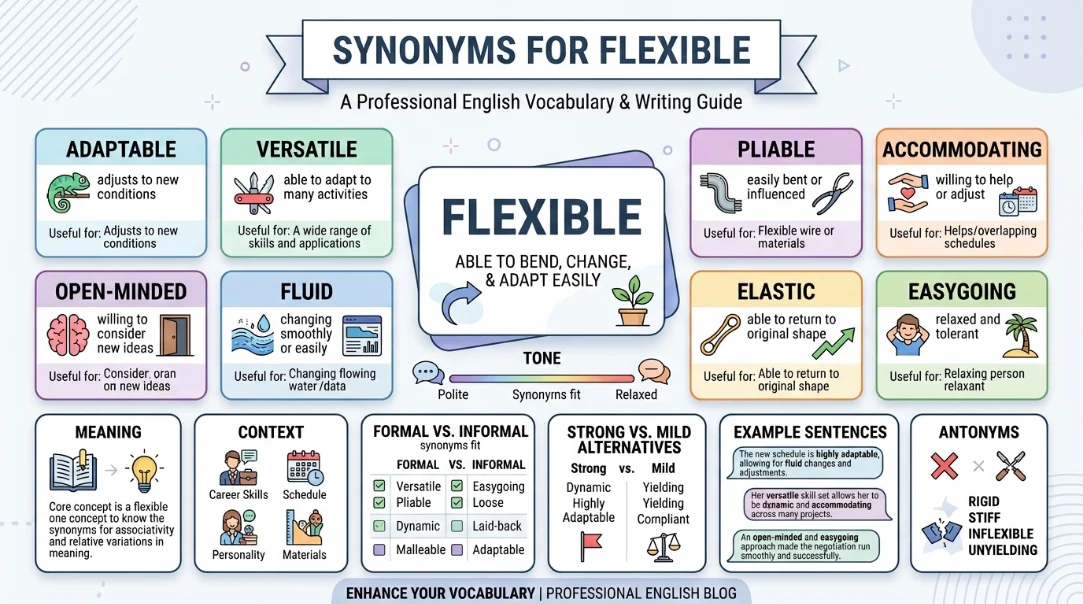
Flexible means able to change, adjust, bend, or respond easily to different conditions. Depending on context, useful alternatives include adaptable for professional writing, versatile for skills, accommodating for people, pliable for physical objects, and open minded for attitudes.
Meaning, Tone and Context
Simple Definition
Flexible describes something or someone that can change, adjust, bend, or respond without difficulty.
For example, a flexible schedule can change when necessary. A flexible employee can adapt to changing responsibilities. A flexible material can bend without breaking.
Part of Speech
Flexible is primarily an adjective.
Examples:
“Her schedule is flexible.”
“He is flexible about meeting times.”
“The material is flexible enough to bend.”
Tone
Flexible is generally neutral and often positive.
When describing people, it can suggest adaptability, cooperation, patience, or willingness to compromise.
When describing objects, it usually refers to the ability to bend, move, stretch, or change shape.
Formality Level
Flexible works well in casual, academic, professional, and formal communication.
It is especially common in workplace language, resumes, job descriptions, scheduling discussions, and descriptions of materials or systems.
Common Use Cases
Flexible commonly describes:
- Work schedules
- Employees and managers
- Rules and policies
- Plans and arrangements
- Materials
- Skills
- Personal attitudes
- Learning styles
- Business strategies
- Physical movement
Important Word Forms
The main related forms include:
Flexibility, a noun describing the ability to change or adapt.
Flexibly, an adverb describing an adaptable action.
Inflexible, an adjective describing something that is difficult or unwilling to change.
When and How to Use “Flexible”
Use flexible when you want to communicate the ability to adjust without suggesting that change is necessarily negative.
Professional
“Our team needs a flexible approach to changing client requirements.”
This suggests adaptability in a workplace setting.
Personal
“I am flexible about where we meet.”
Here, flexible means willing to consider different options.
Academic
“A flexible learning environment can support students with different needs.”
The word describes an environment that can adapt.
Emotional
“She remained flexible when the original plan changed.”
This presents adaptability as a positive personal quality.
Creative
“The flexible design allows the artist to experiment with different layouts.”
Here, flexible refers to the freedom to modify something.
Social Media
“Keeping my weekend plans flexible so I can enjoy whatever comes up.”
The word sounds natural and relaxed in a caption.
“I am flexible with the meeting time and can adjust to your availability.”
This is professional, polite, and clear.
Another Word for “Flexible”
There is no single perfect replacement for flexible in every sentence. The best synonym depends on the exact meaning.
- Professional writing: adaptable
- Academic writing: versatile or adaptable
- Casual conversation: open
- Emotional writing: accommodating
- Creative writing: fluid
- Resume or workplace use: adaptable
- Social media captions: easygoing
- Stronger meaning: highly adaptable
- Softer meaning: accommodating
If flexible describes a physical object, words such as pliable, supple, elastic, or bendable may be more accurate.
When Not to Use “Flexible”
Flexible can sometimes sound too broad. In professional writing, saying “I am flexible” may not explain what you can actually adapt to.
For example:
“I am flexible.”
A more useful statement is:
“I am adaptable to changing project priorities.”
The second sentence gives the reader more information.
Flexible can also be too general when describing physical materials. If you specifically mean that something bends easily, pliable or bendable may be more precise.
Likewise, using flexible to describe someone’s personality may not communicate whether that person is cooperative, open minded, patient, or willing to compromise.
Words Commonly Confused With “Flexible”
| Word | Difference |
|---|---|
| Adaptable | Focuses on adjusting successfully to new conditions. |
| Versatile | Focuses on being useful in many different situations or roles. |
| Pliable | Usually describes something that can bend or be shaped easily. |
| Elastic | Suggests stretching and returning toward an original shape. |
| Accommodating | Describes willingness to adjust to another person’s needs. |
| Open minded | Describes willingness to consider new ideas or opinions. |
Best Synonym by Context for “Flexible”
| Context | Best Synonym | Why It Works | Example |
|---|---|---|---|
| Formal writing | Adaptable | Sounds precise and professional | The company needs an adaptable strategy. |
| Academic writing | Versatile | Shows usefulness across situations | The method is versatile enough for several applications. |
| Professional use | Adaptable | Highlights workplace adjustment | She is highly adaptable to changing priorities. |
| Resume | Versatile | Communicates broad abilities | Versatile professional with experience across multiple roles. |
| Casual conversation | Easygoing | Sounds natural and relaxed | He is easygoing about weekend plans. |
| Creative writing | Fluid | Suggests movement or natural change | The story follows a fluid structure. |
| Emotional tone | Accommodating | Emphasizes consideration for others | She was accommodating when plans changed. |
| Strong intensity | Highly adaptable | Emphasizes strong adjustment skills | He is highly adaptable under pressure. |
| Soft tone | Open | Sounds simple and approachable | I am open to changing the schedule. |
| Social media captions | Easygoing | Feels casual and natural | Keeping things easygoing this weekend. |
| Physical objects | Pliable | Clearly describes something bendable | The clay is soft and pliable. |
| Materials | Supple | Suggests softness and easy movement | The leather remains supple after years of use. |
Which Synonym Should You Choose?
Start by identifying what kind of flexibility you mean.
- If you mean adjusting to change, choose adaptable.
- If you mean having many uses or abilities, choose versatile.
- If you mean bending physically, choose pliable, bendable, or supple.
- If you mean willingness to help or compromise, choose accommodating.
- If you mean accepting different ideas, choose open minded.
- If you want a relaxed personality description, easygoing may work better.
For professional communication, choose the synonym that explains the specific behavior instead of simply replacing flexible with another broad adjective.
Real Life Examples of “Flexible” in Sentences
School
“Students benefit from a flexible learning schedule that accommodates different study habits.”
Workplace
“Our manager takes a flexible approach to changing project requirements.”
Writing
“The author uses a flexible structure that allows the argument to develop naturally.”
Conversation
“I am flexible, so we can meet whenever works best for you.”
Social Media
“Keeping the schedule flexible and enjoying the day as it comes.”
Resume
“Adaptable professional with experience managing changing priorities.”
“I have a flexible schedule this week and can meet at several different times.”
Storytelling
“Her flexible attitude helped the group recover when their original plan failed.”
25 Synonyms for “Flexible”
| Synonym | Simple Meaning | Best Used For | Example Sentence |
|---|---|---|---|
| Adaptable | Able to adjust to change | People, plans, workplaces | She is adaptable when priorities shift. |
| Versatile | Useful in many different situations | Skills, tools, people | His versatile skills make him valuable to the team. |
| Pliable | Easy to bend or shape | Materials and physical objects | The pliable material can be shaped by hand. |
| Supple | Soft and able to move or bend easily | Materials, bodies, descriptions | The supple leather feels comfortable and durable. |
| Elastic | Able to stretch and return toward its original form | Materials and physical properties | The elastic fabric stretches without losing its shape. |
| Bendable | Able to bend without breaking | Physical objects | The bendable frame is easy to adjust. |
| Malleable | Able to be shaped or changed | Materials, ideas, systems | The malleable material can be formed into different shapes. |
| Adjustable | Able to be changed to fit a need | Settings, furniture, schedules | The adjustable desk works for different users. |
| Accommodating | Willing to adjust for others | People and service | Our host was accommodating about the schedule. |
| Amenable | Open or willing to accept a suggestion | Formal communication | The committee was amenable to the proposed changes. |
| Open minded | Willing to consider different ideas | Opinions and attitudes | She is open minded about alternative approaches. |
| Easygoing | Relaxed and not demanding | Personality and social situations | He is easygoing about changes to the plan. |
| Fluid | Able to change or move smoothly | Plans, situations, writing | The project timeline remains fluid. |
| Dynamic | Characterized by change and activity | Businesses, systems, environments | The company operates in a dynamic market. |
| Adjustable | Capable of being modified | Settings and arrangements | The adjustable schedule gives employees more choice. |
| Changeable | Likely or able to change | Conditions and plans | The weather is changeable this time of year. |
| Modifiable | Able to be altered | Designs, systems, documents | The template is easily modifiable. |
| Customizable | Able to be changed according to preferences | Products, software, experiences | The platform offers a customizable dashboard. |
| Yielding | Giving way under pressure or influence | Materials and behavior | The yielding surface reduces impact. |
| Compliant | Willing to follow requirements or requests | Formal and regulatory contexts | The system remains compliant with updated standards. |
| Responsive | Able to react effectively to changes or needs | Businesses, systems, people | The team is responsive to customer feedback. |
| Resourceful | Able to find effective solutions in changing situations | People and workplaces | Her resourceful approach helped solve the problem. |
| Plastic | Capable of being shaped or molded | Materials and technical contexts | The plastic material becomes easier to shape when heated. |
| Transformable | Able to change into another form | Designs, objects, concepts | The transformable furniture saves space. |
| Permissive | Allowing considerable freedom or choice | Rules and policies | The school has a permissive policy regarding course selection. |
Note that some alternatives are context specific rather than interchangeable in every sentence. For example, elastic is mainly physical, while accommodating usually describes a person’s willingness to adjust.
Synonym Groups and Usage Differences
Professional vs. Personal Synonyms
Professional contexts favor words such as adaptable, versatile, responsive, resourceful, and accommodating.
These choices communicate useful workplace qualities without sounding overly casual.
Personal conversations may use easygoing, open minded, accommodating, or open.
The right word depends on whether you are describing someone’s personality, behavior, availability, or attitude.
Formal vs. Conversational Synonyms
Formal writing often benefits from adaptable, amenable, modifiable, responsive, and versatile.
Conversational English commonly uses easygoing, open, adjustable, or simply flexible.
For an email to a manager, adaptable may sound more polished. For a text to a friend, easygoing may feel more natural.
Academic Synonyms
Academic writing benefits from precise terms such as adaptable, versatile, modifiable, dynamic, and fluid.
Choose the word according to the specific idea.
For example, versatile describes something useful in multiple applications, while adaptable describes the ability to respond to changing conditions.
Professional and Business Synonyms
In resumes and workplace communication, adaptable, versatile, responsive, and resourceful are particularly useful.
Instead of writing “flexible employee,” describe the actual strength.
For example, “Adaptable professional experienced in managing shifting priorities” communicates a clearer workplace benefit.
Creative or Literary Synonyms
Creative writing can use fluid, supple, pliable, dynamic, or yielding when the context supports them.
Fluid works especially well for movement, writing style, plans, relationships, and changing situations.
Supple is more descriptive when you want to create an image of graceful physical movement.
Slang or Modern Synonyms
There is no universal slang synonym for flexible.
In casual modern English, easygoing can sometimes express a relaxed willingness to adapt, especially when describing a person’s attitude.
It should not replace flexible when discussing technical properties, physical materials, or precise professional requirements.
Strongest vs. Weaker Synonyms
A useful intensity scale is:
Mild: open
Moderate: flexible
Strong: adaptable
Very strong: highly adaptable
For physical flexibility, the scale changes according to the material. Pliable, supple, elastic, and bendable each describe different physical properties rather than simply different levels of flexibility.
Emotional vs. Neutral Synonyms
Flexible is generally neutral.
Accommodating adds a sense of consideration toward other people.
Easygoing suggests a relaxed personality.
Open minded suggests acceptance of different ideas.
Amenable suggests willingness to agree or cooperate and is more formal.
Choosing the right synonym can subtly change how the reader perceives the person or situation.
Antonyms of “Flexible”
| Antonym | Meaning | Example Sentence |
|---|---|---|
| Inflexible | Unable or unwilling to change | The policy is too inflexible for unusual situations. |
| Rigid | Strict and resistant to change | The rigid schedule leaves little room for adjustments. |
| Fixed | Set and not intended to change | The meeting time is fixed. |
| Firm | Not easily changed or moved | She remained firm about the deadline. |
| Unyielding | Refusing to give way or compromise | His unyielding position made negotiations difficult. |
| Stubborn | Unwilling to change an opinion or decision | He was stubborn about following the original plan. |
| Uncompromising | Unwilling to make concessions | The negotiator took an uncompromising position. |
| Strict | Closely controlled by rules | The school has strict attendance requirements. |
| Resistant | Opposed to change or influence | The organization was resistant to new methods. |
| Unadaptable | Unable to adjust effectively | An unadaptable system may struggle during rapid change. |
| Brittle | Likely to break instead of bend | The brittle material cracked under pressure. |
| Stiff | Difficult to bend or move | The fabric feels stiff rather than soft. |
| Unchangeable | Not capable of being altered | The decision is considered unchangeable. |
| Invariable | Remaining the same | The system follows an invariable sequence. |
| Unaccommodating | Unwilling to adjust for others | The service felt unaccommodating to customers. |
Comparison: “Flexible” vs. Similar Words
Flexible vs. Adaptable
Main difference: Flexible emphasizes the ability or willingness to adjust, while adaptable emphasizes successfully adjusting to new circumstances.
Which one is stronger: Adaptable often suggests a more active ability to handle change.
Which one is more formal: Both are suitable for professional writing, but adaptable is especially strong on resumes.
Flexible: “She has a flexible approach to scheduling.”
Adaptable: “She is adaptable when project requirements change.”
Flexible vs. Versatile
Main difference: Flexible focuses on adjustment, while versatile focuses on usefulness across different purposes.
Which one is stronger: Neither is universally stronger because they describe different qualities.
Which one is more formal: Both work well in professional and academic contexts.
Flexible: “The schedule is flexible.”
Versatile: “She is a versatile writer who works across several formats.”
Flexible vs. Pliable
Main difference: Flexible can describe people, plans, ideas, and objects. Pliable usually describes physical materials.
Which one is stronger: Pliable gives a more specific physical meaning.
Which one is more formal: Both can be formal depending on context.
Flexible: “The material is flexible.”
Pliable: “The pliable material bends easily without cracking.”
Flexible vs. Elastic
Main difference: Elastic usually describes something that stretches and returns toward its original shape.
Which one is stronger: Neither is stronger because they describe different physical properties.
Which one is more formal: Both are appropriate when used precisely.
Flexible: “The material is flexible enough to bend.”
Elastic: “The elastic band stretches and returns to its original length.”
Flexible vs. Accommodating
Main difference: Flexible can mean adaptable in general. Accommodating specifically suggests willingness to adjust for another person’s needs.
Which one is stronger: Accommodating carries a stronger interpersonal meaning.
Which one is more formal: Accommodating works well in professional communication.
Flexible: “I am flexible about the meeting time.”
Accommodating: “The coordinator was accommodating when several guests needed different arrangements.”
Flexible vs. Open Minded
Main difference: Flexible concerns adjustment, while open minded concerns willingness to consider different ideas.
Which one is stronger: Open minded is more specific when discussing opinions or beliefs.
Which one is more formal: Both can be used professionally and academically.
Flexible: “She is flexible when plans change.”
Open minded: “She is open minded about different approaches to the problem.”
Common Phrases and Expressions with “Flexible”
1. Flexible Schedule
Meaning:
A schedule that can be changed according to needs or circumstances.
Example sentence:
“I prefer a flexible schedule that allows me to handle unexpected responsibilities.”
2. Flexible Hours
Meaning:
Working hours that are not restricted to one exact schedule.
Example sentence:
“The company offers flexible hours to eligible employees.”
3. Flexible Approach
Meaning:
A method that can be adjusted when circumstances change.
Example sentence:
“We need a flexible approach because customer needs may change.”
4. Flexible Working
Meaning:
A work arrangement that gives employees some choice about when or where they work.
Example sentence:
“Flexible working can help employees manage different responsibilities.”
5. Flexible Plan
Meaning:
A plan that can be modified when necessary.
Example sentence:
“Keep the travel plan flexible in case the weather changes.”
6. Flexible Policy
Meaning:
A rule or policy that allows reasonable adjustments.
Example sentence:
“The company introduced a more flexible policy for scheduling.”
7. Flexible Material
Meaning:
A material that can bend or move without easily breaking.
Example sentence:
“The flexible material is suitable for products that require regular movement.”
Common Mistakes to Avoid
1. Using Flexible When a More Precise Word Is Better
“I have flexible skills” is vague.
“I’m versatile across content writing, editing, and research” gives the reader a clearer idea.
2. Confusing Flexible With Adaptable
Flexible and adaptable overlap, but adaptable often emphasizes successful adjustment to new circumstances.
Use adaptable when describing a person’s ability to handle change.
3. Using a Casual Synonym in Formal Writing
Words such as easygoing can sound too informal in academic or professional contexts.
Use adaptable, versatile, or accommodating when a more professional tone is appropriate.
4. Using an Overly Dramatic Synonym
Do not use highly expressive words when a simple meaning is intended.
For example, fluid may sound unnecessarily descriptive if you simply mean that a meeting time can change.
5. Repeating Flexible Too Often
Repeating the same word throughout an article or essay can make the writing feel limited.
Replace it with a precise alternative when the meaning genuinely changes.
6. Choosing the Wrong Emotional Tone
Accommodating suggests consideration for others, while adaptable emphasizes handling change.
Choosing one simply because it appears in a synonym list can change the intended meaning.
7. Using Slang in Academic or Professional Writing
Casual terms such as easygoing may work in conversation but can weaken formal writing.
Always consider the audience and purpose before selecting a synonym.
FAQs
What is the best synonym for flexible?
The best synonym depends on context. Adaptable works well for people and work, versatile for skills, pliable for materials, and accommodating for interpersonal situations.
What is a formal synonym for flexible?
Adaptable is one of the best formal alternatives. Amenable, versatile, modifiable, and responsive can also work when their specific meanings fit.
What is an informal synonym for flexible?
Easygoing can be an informal alternative when describing someone’s relaxed attitude toward plans or changes.
What is another word for flexible in professional writing?
Adaptable is usually an excellent professional choice. Versatile, responsive, resourceful, and accommodating may be better when describing specific workplace strengths.
What is the difference between flexible and adaptable?
Flexible emphasizes the ability or willingness to adjust. Adaptable emphasizes the ability to adjust successfully to new circumstances.
What is the opposite of flexible?
Common opposites include inflexible, rigid, fixed, stubborn, strict, unyielding, and uncompromising. The best antonym depends on the context.
Conclusion
Flexible is a useful word because it can describe people, schedules, plans, materials, systems, attitudes, and skills. However, the best synonym depends on the exact meaning you want to communicate.
Use adaptable for handling change, versatile for multiple abilities or uses, accommodating for consideration toward others, pliable for materials, open minded for ideas, and easygoing for a relaxed personality.
The most useful vocabulary habit is to choose synonyms by meaning rather than simply choosing words that look similar in a thesaurus. A precise word makes your writing clearer, more natural, and more effective.
Discover More Post:
- 25+ Synonyms for Navigate | Meanings, Examples, and Best …
- 25+ Synonyms for Share | Meanings, Examples and Best …
- 25+ Synonyms for We | Meanings, Examples, and Best …