Do you keep using the word “conversation” in emails, essays, captions, stories, or everyday speech? The word is useful, but repeating it can make your writing feel predictable.
Choosing a more precise alternative can show whether you mean a casual chat, a serious discussion, a professional exchange, or an emotional talk. This guide explains the best synonyms for conversation and shows exactly when to use each one.
What Does Conversation Mean?
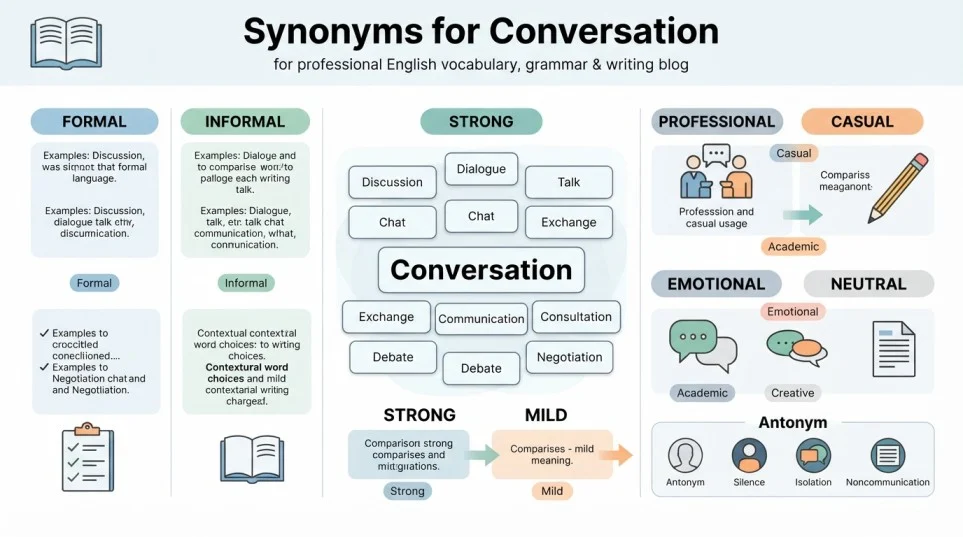
A conversation is an exchange of spoken or written communication between two or more people. Depending on context, useful synonyms include discussion, dialogue, chat, talk, exchange, consultation, interview, and communication.
Meaning, Tone and Context
Simple Definition
A conversation is an interaction in which people communicate ideas, information, questions, opinions, feelings, or experiences with one another.
The word can describe something as simple as a friendly chat or as serious as a structured discussion about an important issue.
Part of Speech
“Conversation” is a noun.
Examples:
- We had a long conversation after dinner.
- The conversation focused on career development.
- Their conversation helped resolve the misunderstanding.
Tone
Conversation is generally neutral. It does not automatically suggest a positive or negative situation.
The surrounding words determine the emotional tone. A “friendly conversation” sounds positive, while a “difficult conversation” suggests tension or discomfort.
Formality Level
Conversation is a common and flexible word. It works in casual speech, professional communication, academic writing, and creative writing.
More formal alternatives include discussion, dialogue, consultation, deliberation, and discourse. More casual options include chat, talk, and catch up.
Common Use Cases
Conversation commonly appears when discussing:
- Everyday communication
- Workplace communication
- Personal relationships
- Interviews
- Academic discussions
- Customer service
- Negotiations
- Storytelling
- Social media interactions
- Difficult or emotional topics
Word Forms and Related Words
The main related forms include:
- Conversation, noun
- Converse, verb
- Conversational, adjective
- Conversationally, adverb
For example, “conversational” describes language that feels natural, relaxed, and similar to ordinary speech.
When and How to Use Conversation
Use “conversation” when you want to describe a general exchange between people without emphasizing a particular structure, purpose, or emotional intensity.
Professional
“We had a productive conversation about the new project.”
Here, conversation sounds natural and professional while remaining approachable.
Personal
“I had a great conversation with my sister yesterday.”
The word fits naturally because the exchange was informal and personal.
Academic
“The conversation about social responsibility continued after the lecture.”
Conversation can work in academic contexts when the exchange is relatively informal.
Emotional
“She finally had a conversation with her friend about what happened.”
The context makes the emotional importance clear without making the word itself dramatic.
Another Word for Conversation
The best single replacement depends on what kind of interaction you mean.
- Professional writing: discussion or exchange
- Academic writing: discussion or dialogue
- Casual conversation: chat or talk
- Emotional writing: heart to heart talk or discussion
- Creative writing: dialogue
- Resume or workplace use: discussion, consultation, or communication
- Social media captions: chat, talk, or exchange
- Stronger meaning: debate or deliberation
- Softer meaning: chat or informal talk
If you need one broadly useful alternative, discussion is often the safest choice when the participants are exchanging ideas about a specific subject.
When Not to Use Conversation
“Conversation” can sometimes be too general. If you know exactly what happened, a more specific word can make the sentence clearer.
For example:
“We had a conversation about the contract.”
This is correct, but “discussion” may be more precise if the participants were examining the contract in detail.
“We had a discussion about the contract.”
Similarly, “interview” is better when one person is asking structured questions, while “debate” is better when people are presenting opposing views.
Choosing a precise synonym helps readers understand not only that people communicated, but also what kind of communication took place.
Words Commonly Confused With Conversation
Conversation vs. Discussion
A conversation can cover almost any topic. A discussion usually focuses more clearly on a particular subject.
Conversation vs. Dialogue
Dialogue emphasizes an exchange between people. It is especially common in literature, drama, communication studies, and discussions involving opposing perspectives.
Conversation vs. Debate
A debate usually involves competing viewpoints or arguments. A conversation does not require disagreement.
Conversation vs. Interview
An interview normally follows a more structured question and answer format. A conversation can be much more spontaneous.
Conversation vs. Communication
Communication is the broader concept. It can include speaking, writing, gestures, visual signals, and other forms of information exchange.
Conversation vs. Chat
Chat usually sounds more informal and relaxed. Conversation is more neutral and works in both casual and professional settings.
Best Synonym by Context for Conversation
| Context | Best Synonym | Why It Works | Example |
|---|---|---|---|
| Formal writing | Discussion | Sounds professional and focused | The discussion addressed several concerns. |
| Academic writing | Dialogue | Highlights an exchange of ideas | The dialogue between the researchers continued. |
| Professional or business use | Exchange | Emphasizes information shared between people | The exchange clarified the project requirements. |
| Resume | Communication | Highlights an important workplace skill | Strong communication skills support effective teamwork. |
| Casual conversation | Chat | Sounds relaxed and natural | We had a quick chat after work. |
| Creative writing | Dialogue | Fits spoken interaction between characters | The dialogue revealed her true feelings. |
| Emotional tone | Talk | Feels personal and direct | We need to have a serious talk. |
| Strong intensity | Debate | Suggests competing positions | The debate became increasingly detailed. |
| Soft or moderate tone | Chat | Makes the interaction sound easygoing | We had a pleasant chat over coffee. |
| Social media captions | Talk | Short and natural | We need to talk about this. |
| US usage | Conversation | Extremely common and versatile | We had a conversation about college. |
| UK usage | Conversation | Also standard and widely understood | They had a conversation before leaving. |
Which Synonym Should You Choose?
Choosing another word for conversation starts with identifying what actually happened.
If people shared ideas
Choose discussion.
If the exchange was informal
Choose chat or talk.
If the exchange was structured
Choose interview, consultation, or meeting, depending on the situation.
If people had opposing opinions
Choose debate or argument, depending on the level of conflict.
If the interaction appears in a story
Choose dialogue.
If information moved between people
Choose exchange.
If the subject was formal or intellectual
Choose discourse, dialogue, or discussion, depending on the exact context.
The best synonym should preserve the original meaning while adding useful information about purpose, tone, structure, or intensity.
Real Life Examples of Conversation in Sentences
School
“The students had a thoughtful conversation about the novel.”
Workplace
“Our conversation about the project helped clarify the next steps.”
Writing
“The author uses the conversation between the characters to reveal their disagreement.”
Everyday Speech
“I had a short conversation with my neighbor this morning.”
Social Media
“That conversation belongs in the comments.”
Resume
“Led client conversations to identify project requirements and improve communication.”
“Thank you for the conversation earlier today. Your feedback was very helpful.”
Storytelling
“The conversation became quiet when she mentioned the unexpected news.”
18 Synonyms for Conversation
| Synonym | Simple Meaning | Best Used For | Example Sentence |
|---|---|---|---|
| Discussion | An exchange focused on a subject | Academic and professional contexts | The discussion covered several important issues. |
| Dialogue | An exchange between people | Literature, formal discussion, and communication | The dialogue between the characters felt realistic. |
| Talk | An informal exchange of ideas or feelings | Personal and casual contexts | We need to have a talk about what happened. |
| Chat | A relaxed and informal conversation | Friendly everyday situations | I had a quick chat with my coworker. |
| Exchange | Communication in which people share information | Professional and neutral writing | The email exchange resolved the confusion. |
| Communication | The process of sharing information | Workplace and general contexts | Clear communication is essential for teamwork. |
| Consultation | A discussion for advice or professional guidance | Business, medical, legal, and professional settings | The client scheduled a consultation with the advisor. |
| Interview | A structured exchange involving questions | Employment, journalism, and research | She completed an interview with the hiring manager. |
| Debate | A structured exchange involving opposing views | Academic, political, and public contexts | The debate focused on education policy. |
| Argument | A heated disagreement or exchange | Conflict and disagreement | Their argument continued for several minutes. |
| Discourse | Formal communication about a subject | Academic and intellectual writing | The paper examines public discourse about technology. |
| Deliberation | Careful discussion before making a decision | Formal decision making | The committee reached its decision after careful deliberation. |
| Negotiation | Discussion intended to reach an agreement | Business and conflict resolution | The negotiation resulted in a revised contract. |
| Interaction | Communication or activity involving people | Professional and social contexts | Positive customer interaction can build trust. |
| Interviewing | The act of asking and answering questions | Research and employment | Interviewing helped the researcher understand their experiences. |
| Meeting | A planned gathering for communication or decisions | Workplace and organizational contexts | The team held a meeting on Monday morning. |
| Conference | A formal meeting involving discussion or presentations | Professional and academic settings | She attended a conference on digital education. |
| Colloquy | A formal or scholarly conversation | Literary and academic contexts | The essay presents a thoughtful colloquy between two viewpoints. |
Synonym Groups and Usage Differences
Professional vs. Personal Synonyms
Professional communication often benefits from words such as discussion, exchange, consultation, negotiation, and communication.
Personal situations usually sound more natural with conversation, talk, chat, or dialogue.
For example, “client consultation” sounds more professional than “client chat,” while “a chat with my brother” sounds more natural than “a personal consultation.”
Formal vs. Conversational Synonyms
Formal writing often favors discussion, discourse, deliberation, consultation, and exchange.
Everyday speech commonly uses conversation, talk, chat, and discussion.
An email to a colleague might say, “Thank you for the discussion.” A text to a friend might say, “Thanks for the chat.”
Academic Synonyms
Academic writing should prioritize precision.
Discussion works well when analyzing a topic. Dialogue works when emphasizing interaction between perspectives. Discourse is useful when examining broader patterns of language, ideas, or public communication.
Debate is appropriate when opposing positions are central to the subject.
Professional and Business Synonyms
In business writing, discussion, consultation, negotiation, exchange, meeting, and communication are especially useful.
For example:
“We had a productive discussion about the proposal.”
“The consultation helped identify the client’s priorities.”
“The negotiation resulted in an agreement.”
Each word communicates a slightly different purpose.
Creative or Literary Synonyms
Dialogue is usually the most useful creative alternative because it directly describes what characters say to one another.
Talk can create a natural feeling, while exchange can emphasize a brief verbal interaction.
For example:
“Their dialogue revealed a growing sense of distrust.”
This is more specific than simply saying:
“Their conversation revealed a growing sense of distrust.”
Slang or Modern Synonyms
There is no single slang replacement that works everywhere.
Words such as chat, talk, catch up, and shoot the breeze can sound informal. Use them in friendly speech, casual messages, and relaxed creative writing.
Avoid very casual expressions in academic essays, formal reports, professional applications, and serious business communication.
Strongest vs. Weaker Synonyms
A useful intensity scale looks like this:
Chat: very relaxed
Talk: relaxed and personal
Conversation: neutral
Discussion: focused and purposeful
Exchange: neutral and precise
Dialogue: structured or expressive
Debate: opposing viewpoints
Argument: conflict or disagreement
Deliberation: careful and serious decision making
The strongest choice depends on what actually happened. A simple chat should not be described as a debate merely to make the sentence sound more impressive.
Emotional vs. Neutral Synonyms
Conversation is generally neutral.
Talk can feel more personal, especially in phrases such as “a serious talk.”
Dialogue can sound thoughtful or literary.
Argument introduces conflict.
Heart to heart talk introduces emotional intimacy.
Discussion generally remains neutral and focused.
Antonyms of Conversation
Conversation does not have a perfect single antonym. The following terms describe situations that contrast with conversation in particular contexts, such as lack of communication, separation, or absence of interaction.
| Antonym or Contextual Opposite | Meaning | Example Sentence |
|---|---|---|
| Silence | Absence of spoken communication | The room fell into silence. |
| Quiet | A state with little or no sound | The library remained quiet. |
| Solitude | Being alone rather than interacting with others | She enjoyed the solitude of the countryside. |
| Isolation | Separation from other people | Prolonged isolation can reduce social interaction. |
| Separation | Being apart from another person | Their separation made communication difficult. |
| Disconnection | Lack of connection or communication | The disagreement created a sense of disconnection. |
| Withdrawal | Moving away from social interaction | His withdrawal made collaboration difficult. |
| Solitary activity | An activity performed alone | Reading was a solitary activity for her. |
| Noncommunication | Failure or absence of communication | Noncommunication created unnecessary confusion. |
| Inactivity | Lack of active participation | The discussion ended in complete inactivity. |
| Seclusion | Being kept away from other people | The retreat offered complete seclusion. |
| Avoidance | Deliberately staying away from an interaction | His avoidance prevented a useful discussion. |
| Detachment | Emotional or social distance | Her detachment made the exchange feel distant. |
| Estrangement | A condition of being distant from someone | Years of estrangement made reconciliation difficult. |
| Muteness | Absence of speech | His muteness during the meeting was noticeable. |
Comparison: Conversation vs. Similar Words
Conversation vs. Discussion
The main difference is focus. A conversation can cover anything, while a discussion usually centers on a specific subject.
Discussion is often more purposeful and can sound slightly more formal.
Example:
“We had a conversation after lunch.”
“The team had a discussion about the budget.”
Conversation vs. Dialogue
Conversation is a broad everyday term. Dialogue emphasizes an exchange between people and is especially common in literature and formal analysis.
Dialogue can sound more formal or literary.
Example:
“The conversation lasted an hour.”
“The dialogue between the two characters revealed their different goals.”
Conversation vs. Talk
Talk is usually more casual and personal.
Conversation is more neutral and works across a wider range of settings.
Example:
“We had a conversation about the project.”
“We had a talk about the project.”
The second sentence can feel more direct and personal.
Conversation vs. Chat
Chat is more informal and relaxed.
Conversation is suitable for both casual and professional situations.
Example:
“I had a chat with my friend.”
“I had a conversation with the client.”
Conversation vs. Debate
A debate involves competing viewpoints. A conversation does not necessarily involve disagreement.
Debate is stronger when opposing arguments are central.
Example:
“The conversation was friendly.”
“The debate became intense.”
Conversation vs. Argument
An argument generally involves disagreement or conflict.
Conversation is neutral and does not imply hostility.
Example:
“They had a conversation about their plans.”
“They had an argument about their plans.”
The second sentence suggests conflict.
Common Phrases and Expressions with Conversation
1. Have a conversation
Meaning: To communicate with another person about a subject.
Example sentence: “We should have a conversation about your goals.”
2. Start a conversation
Meaning: To begin talking with someone.
Example sentence: “She started a conversation with a new colleague.”
3. Keep the conversation going
Meaning: To continue talking rather than allowing the interaction to stop.
Example sentence: “He asked another question to keep the conversation going.”
4. Lead a conversation
Meaning: To guide or direct an exchange.
Example sentence: “The manager led the conversation about workplace improvements.”
5. Join a conversation
Meaning: To become involved in an exchange that is already happening.
Example sentence: “I joined the conversation after hearing my name.”
6. A difficult conversation
Meaning: A discussion involving a sensitive or uncomfortable subject.
Example sentence: “The supervisor prepared carefully for the difficult conversation.”
7. A meaningful conversation
Meaning: An exchange that has emotional or intellectual value.
Example sentence: “We had a meaningful conversation about our future plans.”
8. A casual conversation
Meaning: A relaxed exchange without a serious or formal purpose.
Example sentence: “The interview began with a casual conversation about travel.”
Common Mistakes to Avoid
1. Using “conversation” when a more precise synonym is better
If people are negotiating a contract, “negotiation” may communicate the situation more accurately than “conversation.”
2. Confusing conversation with debate
A conversation does not automatically involve opposing arguments. Use debate when competing positions are central.
3. Using a casual synonym in formal writing
Words such as chat may sound too relaxed in an academic essay or formal business report.
4. Using an overly dramatic synonym
Calling a friendly exchange an argument can completely change the meaning.
5. Repeating “conversation” too often
If the same word appears repeatedly, replace some instances with discussion, dialogue, exchange, talk, or another accurate alternative.
6. Choosing the wrong emotional tone
A serious personal exchange may require talk, while a neutral professional exchange may be better described as a discussion.
7. Using slang in academic or professional writing
Highly casual expressions may weaken the credibility and clarity of formal writing.
FAQs
What is the best synonym for conversation?
Discussion is a strong general alternative when people are exchanging ideas about a particular topic. For casual situations, chat or talk may sound more natural.
What is a formal synonym for conversation?
Discussion, dialogue, discourse, consultation, and deliberation can work as formal alternatives, depending on the purpose and structure of the exchange.
What is an informal synonym for conversation?
Chat and talk are common informal alternatives. Chat usually sounds relaxed and friendly, while talk can feel more personal or direct.
What is another word for conversation in professional writing?
Discussion, exchange, communication, consultation, and negotiation can work in professional writing when they accurately describe the interaction.
What is the difference between conversation and discussion?
Conversation is a broad exchange between people. Discussion usually has a clearer subject or purpose and therefore often sounds more focused.
What is the opposite of conversation?
There is no perfect single antonym. Silence, isolation, separation, withdrawal, and noncommunication can describe contrasting situations involving little or no interaction.
Conclusion
Conversation is a flexible word for an exchange of communication between people. Because it is neutral and widely understood, it works in personal, academic, creative, and professional settings.
The best synonym depends on your intended meaning. Use chat for relaxed interaction, discussion for focused topics, dialogue for expressive exchanges, exchange for shared information, consultation for professional guidance, and debate when opposing views are central.
A useful vocabulary tip is to ask yourself what makes the interaction distinctive. Is it casual, formal, emotional, structured, argumentative, or professional? Once you identify that feature, the right synonym becomes much easier to choose.
Discover More Post:
- 25+ Synonyms for Access | Meanings, Examples, and Best …
- 25+ Synonyms for Acknowledge | Meanings, Examples, and …
- 25+ Synonyms for Attention | Meanings, Examples, and Best …