Do you keep using the word “ambitious” in resumes, essays, emails, captions, or everyday conversations? The word is useful, but repeating it can make your writing feel predictable.
Choosing a more precise alternative can show exactly what you mean. You might want to describe someone as driven, determined, visionary, motivated, aspiring, enterprising, or goal focused.
This guide explains synonyms for ambitious by meaning, tone, intensity, and situation. You will find practical examples for school, work, resumes, professional communication, social media, creative writing, and everyday conversation.
What Does Ambitious Mean?
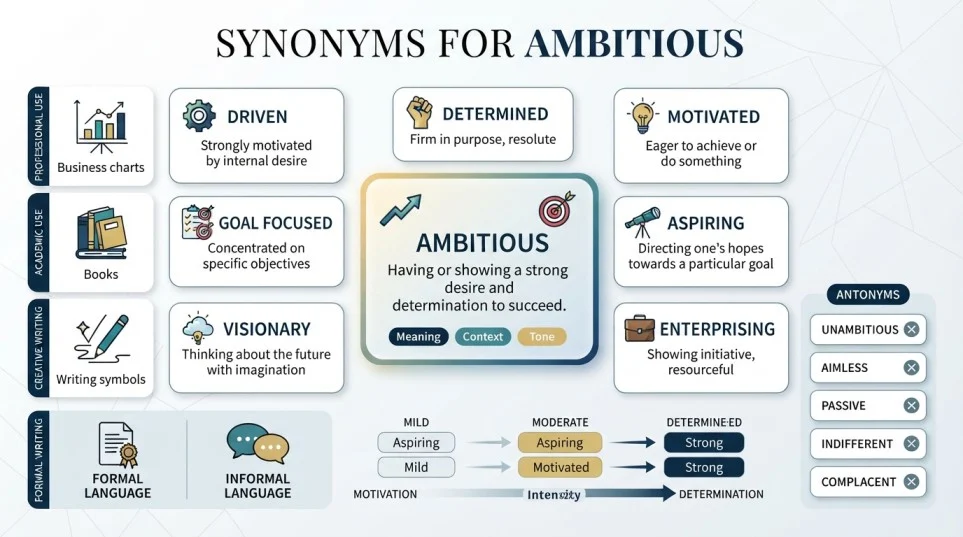
Ambitious means strongly motivated to achieve important goals or success. Depending on context, useful alternatives include driven for professional writing, aspiring for academic use, motivated for everyday communication, visionary for creative contexts, and determined for emotional emphasis.
Meaning, Tone and Context
Simple Definition
Ambitious describes someone who has strong goals and wants to achieve something significant.
An ambitious person may want professional success, financial growth, leadership, recognition, personal achievement, creative accomplishment, or another meaningful goal.
For example:
“She is ambitious and hopes to lead the company someday.”
The word focuses on the desire to accomplish something substantial, rather than simply being interested in it.
Part of Speech
“Ambitious” is an adjective.
It describes a person, goal, plan, project, idea, or undertaking.
Examples:
“She is an ambitious student.”
“He has an ambitious career plan.”
“The team proposed an ambitious project.”
“The company announced an ambitious expansion strategy.”
Positive, Negative, or Neutral Tone
“Ambitious” is usually positive or neutral.
In professional and academic settings, it can suggest motivation, confidence, initiative, and a desire to improve.
However, the word can sometimes have a negative implication when a person’s goals appear excessive, unrealistic, selfish, or focused too heavily on status.
Compare:
“She is an ambitious young professional.”
This usually sounds positive.
“He is excessively ambitious and will do anything to get promoted.”
Here, the surrounding language creates a negative impression.
The context determines whether ambition sounds admirable or excessive.
Formality Level
“Ambitious” works well in casual, academic, professional, and formal communication.
It is common in:
- Resumes
- Cover letters
- Interviews
- Business writing
- Academic essays
- Personal statements
- Social media captions
- Conversations
- Creative writing
- Performance reviews
Because the word is versatile, choosing a more specific synonym can make your writing more precise.
Common Use Cases
You can use “ambitious” to describe:
- A person’s career goals
- A student’s educational plans
- A company’s growth plans
- A difficult project
- A creative goal
- A political or social objective
- A personal aspiration
- A long term vision
- A challenging schedule
- A large scale undertaking
Word Forms and Related Words
The main adjective is “ambitious.”
The noun form is “ambition.”
The adverb form is “ambitiously.”
The related noun “ambition” refers to a strong desire to achieve something.
Examples:
“Her ambition is to become a physician.”
“He ambitiously pursued a career in technology.”
“She has ambitious goals for her business.”
When and How to Use Ambitious
Use “ambitious” when you want to communicate that someone has significant goals or that something requires substantial effort and achievement.
The word works especially well when the desired outcome is larger than ordinary expectations.
Professional Example
“Marcus is an ambitious employee who consistently looks for opportunities to take on greater responsibility.”
This presents ambition as a workplace strength.
Academic Example
“She is an ambitious student who plans to complete her degree and pursue advanced research.”
Here, ambitious describes strong educational goals.
Personal Example
“I have always been ambitious about building a career that gives me both financial independence and creative freedom.”
The word communicates personal motivation.
Creative Example
“The novel follows an ambitious young artist determined to change the direction of her career.”
In storytelling, the word can establish a character’s motivation.
Another Word for “Ambitious”
The best single replacement depends on what you want to emphasize.
- If you mean strong motivation, “driven” is often a natural choice.
- If you mean strong determination, “determined” works well.
- If you mean future goals, “aspiring” can be more precise.
- If you mean an innovative vision, “visionary” may fit better.
- If you mean business initiative, “enterprising” can be more specific.
Professional Writing
Best choices include “driven,” “motivated,” “proactive,” “goal focused,” and “enterprising.”
Example:
“She is a driven professional who consistently takes initiative.”
Academic Writing
Useful choices include “aspiring,” “motivated,” “purposeful,” “determined,” and “goal focused.”
Example:
“The aspiring researcher has developed a clear plan for graduate study.”
Casual Conversation
Natural choices include “driven,” “motivated,” “determined,” and “goal focused.”
Example:
“She is really driven and wants to start her own company.”
Emotional Writing
“Determined,” “resolute,” “tenacious,” and “persistent” can emphasize emotional strength.
Example:
“He remained determined despite several setbacks.”
Creative Writing
“Visionary,” “aspiring,” “daring,” “bold,” “audacious,” and “pioneering” can create stronger imagery.
Example:
“The visionary inventor imagined a future few people could see.”
Resume or Workplace Use
For resumes, it is usually better to replace a broad claim such as “ambitious professional” with evidence of what you actually accomplished.
Instead of:
“Ambitious marketing professional.”
Try:
“Driven marketing professional with experience growing audience engagement.”
The second version communicates ambition through a specific professional quality.
Social Media Captions
For captions, “driven,” “motivated,” “fearless,” “determined,” and “goal focused” can sound more energetic.
Example:
“Stay focused, stay driven, and keep building the future you want.”
Stronger Meaning
Use “determined,” “resolute,” “tenacious,” “audacious,” or “relentless” when you want to emphasize persistence or intensity.
Be careful with “relentless” because it can sound aggressive depending on the context.
Softer Meaning
Use “aspiring,” “motivated,” “purposeful,” or “goal focused” when you want a positive description without suggesting extreme ambition.
When Not to Use “Ambitious”
“Ambitious” is useful, but it can be too general in situations where a more precise word would communicate your meaning better.
When You Mean Persistence
Instead of:
“She is ambitious.”
Use:
“She is persistent.”
“Ambitious” describes goals, while “persistent” emphasizes continuing despite obstacles.
When You Mean Business Initiative
Instead of:
“He is ambitious in business.”
Consider:
“He is enterprising.”
“Enterprising” highlights initiative and the ability to find opportunities.
When You Mean a Creative Vision
Instead of:
“The director is ambitious.”
Consider:
“The director is visionary.”
“Visionary” emphasizes an original or forward looking idea.
When You Mean Personal Motivation
Instead of:
“She is ambitious about her studies.”
Consider:
“She is highly motivated in her studies.”
“Motivated” focuses more directly on willingness to work toward a goal.
When You Mean Determination
Instead of:
“He is ambitious despite the difficulties.”
Consider:
“He is determined despite the difficulties.”
“Determined” emphasizes resolve rather than the size of the goal.
Words Commonly Confused With Ambitious
Ambitious vs. Motivated
“Ambitious” focuses on wanting significant achievement.
“Motivated” focuses on having a reason or willingness to take action.
A person can be motivated to complete a small task without being particularly ambitious.
Ambitious vs. Driven
“Driven” usually emphasizes strong internal motivation and sustained effort.
“Ambitious” emphasizes the desire for achievement.
A driven person often works intensely toward goals, while an ambitious person may simply have very large goals.
Ambitious vs. Aspiring
“Aspiring” describes someone who hopes to become or achieve something.
“Ambitious” suggests stronger determination or larger goals.
An aspiring writer wants to become a writer. An ambitious writer may also want to publish widely, build a successful career, and reach a large audience.
Ambitious vs. Determined
“Determined” emphasizes persistence and resolve.
“Ambitious” emphasizes the importance or scale of the desired achievement.
Someone can be determined to complete a modest goal.
Ambitious vs. Enterprising
“Enterprising” suggests initiative, resourcefulness, and willingness to pursue opportunities.
“Ambitious” is broader and can describe many types of goals.
Ambitious vs. Visionary
“Visionary” suggests the ability to imagine a significant future possibility or innovative direction.
“Ambitious” does not necessarily imply originality.
Best Synonym by Context for Ambitious
| Context | Best Synonym | Why It Works | Example |
|---|---|---|---|
| Formal writing | Aspiring | Polished and positive | She is an aspiring leader with clear professional goals. |
| Academic writing | Purposeful | Emphasizes intentional goals | The student took a purposeful approach to her research. |
| Professional use | Driven | Highlights strong motivation | He is a driven manager who consistently seeks improvement. |
| Resume | Motivated | Communicates willingness to achieve | Motivated professional with strong project management experience. |
| Business | Enterprising | Highlights initiative and opportunity | She is an enterprising entrepreneur who identifies new markets. |
| Casual conversation | Driven | Sounds natural and energetic | He is really driven and wants to build his own business. |
| Creative writing | Visionary | Adds imagination and future focus | The visionary designer imagined a completely new experience. |
| Emotional writing | Determined | Highlights personal resolve | She remained determined after every setback. |
| Strong intensity | Resolute | Communicates firm commitment | He was resolute in his pursuit of the goal. |
| Mild intensity | Motivated | Positive without sounding extreme | She is motivated to improve her skills. |
| Social media | Driven | Short, energetic, and familiar | Stay driven and keep moving forward. |
| Leadership | Visionary | Emphasizes future direction | The visionary leader introduced a new strategy. |
| Entrepreneurship | Enterprising | Connects ambition with initiative | His enterprising approach helped the company find new customers. |
| Personal goals | Goal focused | Directly emphasizes objectives | She is highly goal focused this year. |
| Academic career | Aspiring | Fits future professional plans | The aspiring scientist is preparing for graduate school. |
| Challenging project | Bold | Suggests courage and scale | The team proposed a bold new initiative. |
| Literary description | Aspiring | Creates a human and hopeful tone | The aspiring musician practiced every evening. |
| US and UK usage | Ambitious | Common and widely understood in both | She has ambitious plans for her career. |
Which Synonym Should You Choose?
Choosing the best synonym for ambitious depends on five main questions.
1. What Does the Person Actually Want?
- If the focus is achievement, “ambitious” works well.
- If the focus is persistence, “determined” may be better.
- If the focus is motivation, “driven” or “motivated” may be more precise.
2. How Formal Is the Writing?
For formal documents, consider “aspiring,” “purposeful,” “determined,” or “enterprising.”
For casual conversation, “driven” and “motivated” usually sound natural.
3. How Strong Is the Emotion?
- Use “motivated” for a moderate positive tone.
- Use “determined” for stronger resolve.
- Use “resolute” or “tenacious” when you want an especially strong impression.
4. Is the Goal Creative or Innovative?
If the person imagines a new direction, “visionary” may be more useful.
If the project requires courage, “bold” or “daring” may communicate the idea more clearly.
5. Are You Writing a Resume?
Avoid relying on adjectives alone.
Instead of saying you are ambitious, describe what you achieved, improved, created, managed, or delivered.
For example:
“Ambitious sales professional.”
is weaker than:
“Driven sales professional who expanded client accounts and consistently exceeded quarterly targets.”
Specific evidence makes the description more convincing.
Real Life Examples of Ambitious in Sentences
School
“She is an ambitious student who hopes to attend a top graduate program.”
Workplace
“David is ambitious and has volunteered to lead several major projects.”
Writing
“The ambitious proposal outlines a new approach to community education.”
Conversation
“My brother is ambitious and wants to build his own company.”
Social Media
“Being ambitious means believing that your next chapter can be bigger than your last.”
Resume
“Ambitious professional seeking opportunities to develop leadership and project management skills.”
For a stronger resume, replace general claims with measurable accomplishments whenever possible.
“Your ambitious proposal has the potential to expand the program considerably.”
Storytelling
“The ambitious young architect dreamed of transforming the neglected neighborhood.”
18 Synonyms for “Ambitious”
| Synonym | Simple Meaning | Best Used For | Example Sentence |
|---|---|---|---|
| Driven | Highly motivated to succeed | Professional and personal goals | She is driven to build a successful career. |
| Determined | Firmly committed to achieving something | Personal and emotional contexts | He was determined to finish the project. |
| Motivated | Eager and willing to work toward a goal | Work, school, and everyday use | The motivated student studied every evening. |
| Aspiring | Hoping to become or achieve something | Careers, education, and personal goals | She is an aspiring journalist with strong writing skills. |
| Enterprising | Skilled at finding opportunities and taking initiative | Business and entrepreneurship | His enterprising approach helped launch the new service. |
| Goal focused | Concentrated on achieving objectives | Workplace and personal development | She is goal focused and organized about her career plans. |
| Purposeful | Acting with a clear aim or intention | Formal and academic writing | He took a purposeful approach to professional development. |
| Visionary | Able to imagine an important or innovative future | Leadership and creative work | The visionary designer introduced a new concept. |
| Tenacious | Persistent and unwilling to give up easily | Strong personal qualities | Her tenacious effort eventually produced results. |
| Resolute | Very firm in purpose or decision | Formal and emotional writing | The resolute leader continued despite criticism. |
| Bold | Willing to take significant risks or make strong moves | Business and creative contexts | The company made a bold investment in new technology. |
| Daring | Willing to take risks | Creative and adventurous contexts | The daring entrepreneur entered an unfamiliar market. |
| Pioneering | Introducing something new or original | Innovation and professional writing | The team developed a pioneering approach to treatment research. |
| Progressive | Favoring development, change, or improvement | Business, education, and social contexts | The organization adopted a progressive strategy for growth. |
| Resourceful | Good at solving problems and finding opportunities | Workplace and practical contexts | Her resourceful approach helped the team overcome the shortage. |
| Proactive | Taking action before problems or opportunities demand it | Workplace and professional writing | He is proactive about developing new client relationships. |
| Energetic | Showing enthusiasm and active effort | Casual and professional descriptions | The energetic manager encouraged the team to try new ideas. |
| Aspirational | Connected with hopes for achievement or improvement | Marketing, professional, and personal writing | The campaign presents an aspirational vision of the future. |
Synonym Groups and Usage Differences
Professional vs. Personal Synonyms
Professional writing often benefits from words that show achievement, initiative, and purposeful action.
“Driven,” “enterprising,” “proactive,” and “goal focused” work well in workplace contexts.
Personal writing can be more emotional.
“Determined,” “tenacious,” “aspiring,” and “daring” can communicate personal motivation and persistence.
Formal vs. Conversational Synonyms
Formal writing can use “resolute,” “purposeful,” “enterprising,” and “aspiring.”
These words work well in essays, reports, formal statements, and professional documents.
Conversational English usually favors “driven,” “motivated,” “determined,” and “bold.”
For example:
Formal:
“The researcher demonstrated a purposeful commitment to the project.”
Conversational:
“She is really driven to make it work.”
Academic Synonyms
Academic writing benefits from precise language rather than exaggerated descriptions.
“Purposeful,” “motivated,” “aspiring,” “determined,” and “progressive” can work when their meanings fit the sentence.
Avoid using a dramatic synonym simply to sound sophisticated.
For example:
“The student demonstrated a purposeful approach to independent research.”
This is more precise than simply calling the student “extremely ambitious.”
Professional and Business Synonyms
Business communication often needs words that communicate initiative without sounding boastful.
“Driven,” “enterprising,” “proactive,” “goal focused,” and “resourceful” can be useful.
For resumes, evidence remains more important than adjectives.
Instead of writing:
“Ambitious employee.”
Try:
“Proactive project coordinator who improved scheduling efficiency.”
Creative or Literary Synonyms
Creative writing gives you more freedom to choose words based on mood.
“Visionary,” “daring,” “bold,” “pioneering,” and “aspiring” can create different impressions.
A visionary character may imagine a new future.
A daring character may take risks.
An aspiring character may be working toward a dream.
Slang or Modern Synonyms
There is no single slang word that perfectly replaces “ambitious” in every situation.
Informal expressions such as “driven,” “hungry,” or “all in” can sometimes communicate a similar idea.
“Hungry” can mean strongly motivated in casual professional speech.
Example:
“She is hungry for success.”
This is conversational and expressive, but it may sound inappropriate in a formal essay or academic paper.
Strongest vs. Weaker Synonyms
A useful intensity scale is:
Mild: Motivated
- Moderate: Aspiring
- Moderate: Goal focused
- Moderate: Driven
Strong: Determined
Strong: Bold
- Very strong: Tenacious
- Very strong: Resolute
- Very strong: Daring
The exact intensity depends on context.
“Ambitious” itself can range from moderate to strong depending on the goal being described.
Emotional vs. Neutral Synonyms
Neutral choices include “motivated,” “goal focused,” and “purposeful.”
More emotional choices include “determined,” “tenacious,” “resolute,” and “daring.”
If you want a factual tone, use a neutral term.
If you want to highlight struggle, courage, or persistence, a stronger emotional synonym may be more appropriate.
Expanded Synonym Bank for Ambitious
Here are additional words and expressions that can relate to ambitious depending on the exact meaning:
- Driven
- Determined
- Motivated
- Aspiring
- Enterprising
- Purposeful
- Visionary
- Tenacious
- Resolute
- Bold
- Daring
- Pioneering
- Progressive
- Resourceful
- Proactive
- Energetic
- Aspirational
- Goal focused
- Achievement oriented
- Success minded
- Future focused
- Growth minded
- Forward looking
- High achieving
- Self motivated
- Industrious
- Zealous
- Eager
- Enthusiastic
- Purpose driven
- Success driven
- Competitive
- Persistent
- Resolving
- Audacious
- Venturesome
- Fearless
- Courageous
- Progressive minded
- Improvement focused
- Opportunity seeking
- Initiative driven
- Career focused
- Achievement focused
- Goal oriented
- Future minded
- Development focused
- Aspiring
- Vision driven
- Achievement minded
- Self directed
- Growth focused
- High reaching
- Purpose led
- Striving
These terms are not interchangeable in every sentence. Some describe motivation, some describe persistence, some describe innovation, and others describe a person’s goals.
Antonyms of “Ambitious”
| Antonym | Meaning | Example Sentence |
|---|---|---|
| Unambitious | Lacking strong goals for achievement | He is comfortable with an unambitious career path. |
| Unmotivated | Lacking motivation to act | The unmotivated student rarely completed assignments. |
| Apathetic | Showing little interest or concern | She seemed apathetic about her future plans. |
| Indifferent | Not strongly interested or concerned | He was indifferent to professional advancement. |
| Passive | Waiting for things to happen instead of taking action | The passive approach produced few new opportunities. |
| Aimless | Lacking a clear purpose or direction | Without a plan, his career felt aimless. |
| Content | Satisfied with the current situation | She was content with her current position. |
| Satisfied | Feeling that enough has been achieved | He was satisfied with a simple lifestyle. |
| Unaspiring | Not showing strong hopes for achievement | The character appears unaspiring at the beginning of the story. |
| Inactive | Not taking action or pursuing activity | The inactive approach slowed the project. |
| Careless | Not giving sufficient attention to goals or responsibilities | His careless attitude affected the quality of his work. |
| Unenterprising | Lacking initiative or resourcefulness | The unenterprising approach missed several opportunities. |
| Unfocused | Lacking concentration or clear direction | She felt unfocused about her career choices. |
| Complacent | Too satisfied with current circumstances | The successful team became complacent after several easy wins. |
| Unmotivated | Lacking enthusiasm or willingness to work | The unmotivated employee needed clearer objectives. |
Comparison: “Ambitious” vs. Similar Words
Ambitious vs. Driven
Main difference: Ambitious focuses on the desire for significant achievement. Driven emphasizes strong motivation to act.
Which one is stronger: Driven can sound stronger when discussing sustained effort.
Which one is more formal: Both are suitable for professional writing, but ambitious is more broadly neutral.
Examples:
“She is ambitious and wants to become a senior executive.”
“She is driven and consistently works toward leadership opportunities.”
Ambitious vs. Motivated
Main difference: Ambitious emphasizes large or meaningful goals. Motivated emphasizes willingness to take action.
Which one is stronger: Ambitious can suggest larger goals.
Which one is more formal: Both work in formal settings.
Examples:
“He is ambitious about his career.”
“He is motivated to improve his professional skills.”
Ambitious vs. Determined
Main difference: Ambitious describes desired achievement. Determined describes firmness in pursuing a goal.
Which one is stronger: Determined is stronger when persistence is the main idea.
Which one is more formal: Both are appropriate for formal writing.
Examples:
“She is ambitious and hopes to lead the organization.”
“She is determined to overcome every obstacle.”
Ambitious vs. Aspiring
Main difference: Aspiring focuses on what someone hopes to become or achieve. Ambitious can imply stronger goals and greater expectations.
Which one is stronger: Ambitious usually sounds stronger.
Which one is more formal: Both are suitable for formal contexts.
Examples:
“He is an aspiring physician.”
“He is an ambitious professional who hopes to lead a medical organization.”
Ambitious vs. Enterprising
Main difference: Enterprising emphasizes initiative and the ability to find opportunities.
Which one is stronger: Neither is automatically stronger. They emphasize different qualities.
Which one is more formal: Enterprising is particularly useful in business writing.
Examples:
“She is ambitious and wants to expand her career.”
“She is enterprising and regularly identifies new business opportunities.”
Ambitious vs. Visionary
Main difference: Visionary emphasizes imagination and a powerful view of the future. Ambitious emphasizes significant goals.
Which one is stronger: Visionary can sound more distinctive because it suggests original thinking.
Which one is more formal: Both can work in professional and creative writing.
Examples:
“The company has ambitious growth plans.”
“The founder has a visionary idea for the future of the industry.”
Common Phrases and Expressions with “Ambitious”
1. Ambitious Goals
Meaning:
Goals that require significant effort or achievement.
Example sentence:
“She has ambitious goals for her career and plans to pursue advanced training.”
2. Ambitious Plans
Meaning:
Plans that involve significant change, growth, or achievement.
Example sentence:
“The organization has ambitious plans to expand its educational programs.”
3. Ambitious Project
Meaning:
A project that is large, difficult, or demanding.
Example sentence:
“Building the new community center is an ambitious project.”
4. Ambitious Career Goals
Meaning:
Significant professional objectives.
Example sentence:
“He has ambitious career goals and hopes to become a company executive.”
5. Ambitious Vision
Meaning:
A significant or far reaching idea about the future.
Example sentence:
“The founder presented an ambitious vision for the company’s next stage.”
6. Ambitious Student
Meaning:
A student with strong educational or career goals.
Example sentence:
“She is an ambitious student who plans to continue her education.”
7. Ambitious Strategy
Meaning:
A strategy designed to achieve substantial results.
Example sentence:
“The company introduced an ambitious strategy for expanding its customer base.”
8. Ambitious Target
Meaning:
A difficult or substantial objective.
Example sentence:
“The team set an ambitious target for the next quarter.”
Common Mistakes to Avoid
1. Using “Ambitious” When a More Precise Word Is Better
“Ambitious” is broad.
- If you specifically mean persistence, use “determined.”
- If you mean initiative, use “enterprising.”
- If you mean future imagination, use “visionary.”
2. Confusing Ambition With Motivation
Ambition describes a desire for achievement.
Motivation describes the reason or energy that encourages action.
They overlap, but they are not identical.
3. Using a Casual Synonym in Formal Writing
Words such as “hungry” can describe ambition informally.
However, formal essays, reports, resumes, and academic work usually benefit from clearer terms such as “motivated,” “driven,” or “determined.”
4. Choosing an Overly Dramatic Synonym
Calling someone “audacious” or “relentless” can make a simple situation sound extreme.
Use strong words only when the person’s actions genuinely justify that intensity.
5. Repeating “Ambitious” Too Often
If the word appears several times in a paragraph, replace some uses with precise alternatives.
For example, use “driven” when discussing effort and “visionary” when discussing future ideas.
6. Choosing the Wrong Emotional Tone
“Ambitious” can be positive or negative depending on context.
“Determined” usually emphasizes persistence positively.
“Competitive” emphasizes comparison with others.
“Audacious” can suggest boldness and risk.
Choose the word that matches your intended impression.
7. Using Slang in Academic or Professional Writing
Informal phrases may work in conversation or social media, but they can weaken formal writing.
Use precise vocabulary when communicating with professors, employers, clients, or professional audiences.
FAQs
What is the best synonym for “ambitious”?
“Driven” is often a strong general alternative because it communicates motivation and determination, especially in professional and everyday contexts.
What is a formal synonym for “ambitious”?
“Purposeful,” “aspiring,” “enterprising,” and “resolute” can work as formal alternatives, depending on whether you mean goals, initiative, or determination.
What is an informal synonym for “ambitious”?
“Driven” is a natural informal alternative. In casual speech, “hungry for success” can also express strong ambition.
What is another word for “ambitious” in professional writing?
“Driven,” “proactive,” “enterprising,” and “goal focused” are useful professional alternatives because they emphasize motivation, initiative, and achievement.
What is the difference between “ambitious” and “driven”?
“Ambitious” emphasizes the desire to achieve significant goals, while “driven” emphasizes the strong motivation and effort used to pursue those goals.
What is the opposite of “ambitious”?
Possible opposites include “unambitious,” “aimless,” “unmotivated,” “passive,” “indifferent,” and “complacent,” depending on the intended meaning.
Conclusion
“Ambitious” describes a strong desire to achieve meaningful or significant goals. It works naturally in professional, academic, personal, and creative communication.
The best synonym depends on what you want to emphasize. Use “driven” for motivation, “determined” for persistence, “aspiring” for future goals, “enterprising” for initiative, and “visionary” for innovative ideas.
The key vocabulary tip is simple: do not replace “ambitious” just to sound more sophisticated. Choose a synonym because it communicates a more precise meaning.
For resumes, essays, emails, captions, and everyday communication, the strongest word is the one that accurately matches your intended tone and context.
Discover More Post:
- 25+ Synonyms for Access | Meanings, Examples, and Best …
- 25+ Synonyms for Acknowledge | Meanings, Examples, and …
- 25+ Synonyms for Attention | Meanings, Examples, and Best …