If you keep using the word “catalyst” in essays, reports, captions, emails, or professional writing, you may want a more precise alternative. The right synonym can show whether something started an event, encouraged action, accelerated change, or caused a strong reaction.
Understanding synonyms for catalyst is not simply about replacing one word with another. Each option carries a slightly different meaning, tone, and level of intensity.
This guide explains the catalyst meaning, related words, common expressions, contextual differences, and practical examples so you can choose the word that fits your sentence naturally.
What Does “Catalyst” Mean?
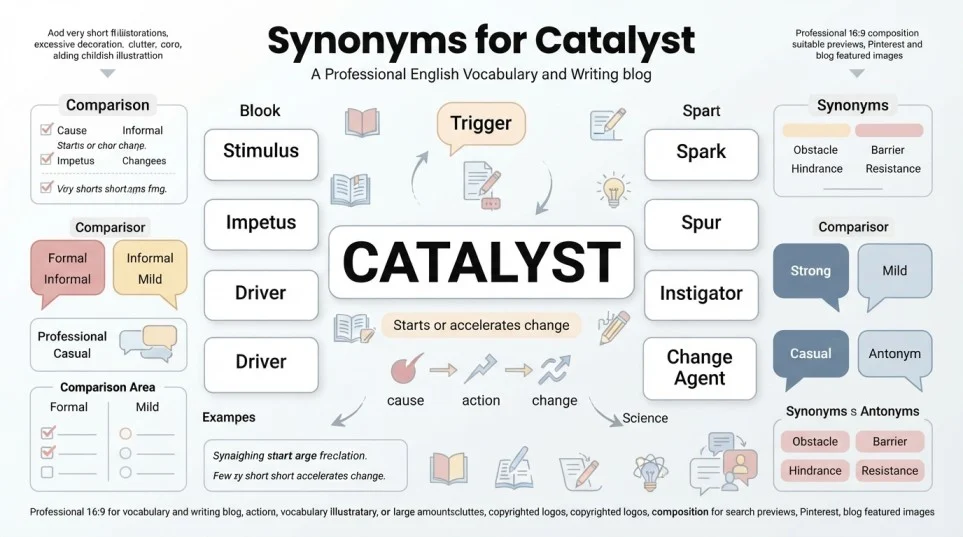
A catalyst is a person, event, action, or thing that causes or accelerates change. Depending on context, useful synonyms include stimulus, trigger, impetus, driver, spark, spur, instigator, motivator, and change agent.
Meaning, Tone and Context
Simple Definition
A catalyst is something that causes an important change or makes an existing process happen faster.
In chemistry, a catalyst is a substance that increases the rate of a chemical reaction without being consumed by the reaction itself.
In everyday English, the word is usually used figuratively. A person, decision, event, discovery, or problem can act as a catalyst for change.
Part of Speech
“Catalyst” is primarily a noun.
Example:
“The new policy became a catalyst for organizational change.”
The related adjective is “catalytic,” which describes something that causes or accelerates significant change.
Example:
“Her catalytic role helped transform the organization.”
Tone
Catalyst is generally neutral and can be positive or negative depending on the situation.
A new invention can be a positive catalyst for progress. A crisis can also become a catalyst for major reform.
Formality Level
Catalyst is moderately formal and widely accepted in academic, professional, business, journalistic, and everyday writing.
It is particularly useful when discussing change, development, transformation, reactions, innovation, or major events.
Common Use Cases
You can use catalyst when describing:
- Business transformation
- Social change
- Scientific developments
- Personal growth
- Political or historical events
- Technological innovation
- Academic arguments
- Workplace changes
- Emotional reactions
- Creative developments
Related Word Forms
The main noun is “catalyst.”
The adjective is “catalytic.”
Example:
“The investment had a catalytic effect on the local economy.”
The plural noun is “catalysts.”
Example:
“Several catalysts contributed to the company’s rapid growth.”
When and How to Use “Catalyst”
Use catalyst when you want to emphasize that something caused, encouraged, or accelerated a meaningful change.
It works especially well when the change is larger than the original event itself.
Professional Example
“The leadership change became a catalyst for a new company strategy.”
Personal Example
“Moving to a new city was a catalyst for personal growth.”
Academic Example
“The invention of the printing press served as a catalyst for widespread access to information.”
Creative Example
“Her unexpected conversation became the catalyst for the novel’s central conflict.”
The word works best when there is a clear connection between one factor and a subsequent change.
Another Word for “Catalyst”
The best single replacement depends on what you mean.
- For professional writing, “driver” or “change agent” often works well.
- For academic writing, “stimulus” or “impetus” can sound precise.
- For casual conversation, “spark” or “trigger” is often more natural.
- For emotional writing, “spark” can emphasize a sudden reaction.
- For creative writing, “spark,” “trigger,” or “instigator” can add energy to the sentence.
- For resumes and workplace writing, “driver,” “initiator,” or “change agent” can emphasize action and results.
- For social media captions, “spark” is concise and expressive.
- For a stronger meaning, “instigator” or “precipitant” may be appropriate depending on context.
- For a softer meaning, “influence,” “stimulus,” or “motivation” may fit better.
When Not to Use “Catalyst”
Catalyst can sound unnecessarily formal when you are simply talking about a small reason for doing something.
Instead of:
“Her text message was a catalyst for me to call her.”
A natural alternative is:
“Her text message prompted me to call her.”
Catalyst can also be too vague when you know exactly what caused an event.
Instead of:
“The meeting was a catalyst for change.”
You could write:
“The meeting prompted the team to revise its strategy.”
The second version tells readers more precisely what happened.
Words Commonly Confused With “Catalyst”
Catalyst vs. Cause
A cause directly produces an outcome. A catalyst often initiates or accelerates a change without being the only reason it happens.
Catalyst vs. Trigger
A trigger usually causes an immediate reaction or response. Catalyst often describes broader or more sustained change.
Catalyst vs. Stimulus
A stimulus encourages activity or response. Catalyst often suggests that the stimulus contributes to a meaningful transformation.
Catalyst vs. Impetus
Impetus is a force or reason that encourages action. Catalyst can refer to the person, event, or factor that sets change in motion.
Catalyst vs. Instigator
An instigator actively starts something, often with a negative or controversial implication. Catalyst is more neutral.
Catalyst vs. Driver
A driver is an important factor pushing something forward. Catalyst often emphasizes the event or factor that initiates change.
Best Synonym by Context for “Catalyst”
| Context | Best Synonym | Why It Works | Example |
|---|---|---|---|
| Formal writing | Impetus | Sounds precise and professional | The report provided an impetus for reform. |
| Academic writing | Stimulus | Fits analytical discussions of responses and change | The discovery became a stimulus for further research. |
| Professional or business use | Driver | Clearly identifies a factor moving progress forward | Innovation was a major driver of growth. |
| Resume | Change agent | Highlights a person’s role in creating change | Served as a change agent during the company transition. |
| Casual conversation | Spark | Natural and easy to understand | That conversation was the spark for my new idea. |
| Creative writing | Instigator | Gives a person or event an active role | The stranger became the instigator of the conflict. |
| Emotional tone | Spark | Suggests a sudden emotional reaction | Their meeting was the spark that changed everything. |
| Strong intensity | Trigger | Suggests a direct and noticeable reaction | The announcement triggered a wave of criticism. |
| Soft or moderate tone | Stimulus | Suggests encouragement without excessive force | The award provided a stimulus for continued effort. |
| Social media captions | Spark | Short, expressive, and memorable | One idea can be the spark for something bigger. |
| Scientific writing | Activator | Useful when something causes a process to become active | The compound acts as an activator in the reaction. |
| Historical writing | Precipitant | Formal word for something that directly brings about an event | The dispute became a precipitant of the crisis. |
| Workplace communication | Initiator | Emphasizes starting an action or process | She was the initiator of the new training program. |
| Motivational writing | Spur | Highlights encouragement to act | The criticism became a spur to improve. |
| Negative situations | Instigator | Can suggest someone who deliberately starts trouble | He was identified as the instigator of the dispute. |
| Business transformation | Change agent | Emphasizes intentional transformation | The consultant served as a change agent. |
| US usage | Catalyst | Common and natural in American English | The merger was a catalyst for expansion. |
| UK usage | Catalyst | Also standard and widely understood in British English | The decision acted as a catalyst for reform. |
Which Synonym Should You Choose?
Start by asking what role the catalyst plays in your sentence.
- If it encourages action, consider “stimulus,” “spur,” or “motivation.”
- If it starts a process, consider “initiator,” “trigger,” or “instigator.”
- If it pushes progress forward, consider “driver” or “impetus.”
- If it causes a sudden reaction, consider “trigger” or “spark.”
- If it creates broader transformation, consider “change agent” or “driver.”
Also consider tone. A business report may benefit from “driver,” while a personal story may sound more natural with “spark.”
Real Life Examples of “Catalyst” in Sentences
School
“The research project became a catalyst for her interest in environmental science.”
Workplace
“The new manager was a catalyst for improvements in team communication.”
Writing
“The author’s experience became a catalyst for the novel.”
Conversation
“That unexpected question was a catalyst for a much deeper discussion.”
Social Media
“Sometimes one small idea can become a catalyst for something much bigger.”
Resume
“Served as a catalyst for improved customer service processes.”
“The recent feedback can serve as a catalyst for improving our workflow.”
Storytelling
“The unexpected discovery became the catalyst that changed the direction of the story.”
18 Synonyms for “Catalyst”
| Synonym | Simple Meaning | Best Used For | Example Sentence |
|---|---|---|---|
| Stimulus | Something that encourages a response or activity | Academic and formal writing | The grant provided a stimulus for new research. |
| Trigger | Something that causes a reaction or event | Sudden reactions and events | The announcement triggered major changes. |
| Impetus | A force or reason that encourages action | Formal and professional writing | The crisis gave the organization an impetus to change. |
| Instigator | A person or thing that starts something | Conflict or active initiation | She was the instigator of the new campaign. |
| Driver | A factor that pushes progress or change | Business and professional writing | Technology is a major driver of economic growth. |
| Spur | Something that encourages action | Motivational and personal contexts | The criticism became a spur to improve. |
| Spark | Something that starts an idea, reaction, or change | Creative, emotional, and casual writing | Their conversation was the spark for a new project. |
| Motivator | Something that encourages someone to act | Personal and workplace contexts | Recognition was an important motivator for the team. |
| Incitement | Something that encourages a particular action | Formal and often negative contexts | The speech was described as incitement to further unrest. |
| Provocation | An action that causes a reaction | Emotional or conflict situations | His comment was a provocation that intensified the argument. |
| Precipitant | Something that directly brings about an event | Formal and academic writing | The economic dispute was a precipitant of the crisis. |
| Initiator | A person or thing that starts something | Projects and processes | She became the initiator of the community program. |
| Activator | Something that makes a process active | Science and technical contexts | The substance acts as an activator in the process. |
| Change agent | A person or factor that creates change | Business and organizational writing | The consultant became an effective change agent. |
| Influence | Something that affects development or behavior | General and moderate contexts | Her mentor was a strong influence on her career. |
| Force | Something that strongly affects an outcome | General, professional, and analytical writing | Education can be a powerful force for social change. |
| Precursor | Something that comes before and contributes to a later development | Historical and analytical writing | The early experiment was a precursor to later discoveries. |
| Impulse | A force or feeling that encourages action | Personal and emotional writing | Curiosity was the impulse behind his decision. |
Synonym Groups and Usage Differences
Professional vs. Personal Synonyms
Professional writing often benefits from “driver,” “impetus,” “change agent,” “initiator,” and “stimulus.”
These words can make business communication sound precise without being overly dramatic.
Personal writing can use “spark,” “spur,” “influence,” or “motivation.”
These alternatives often sound more natural when discussing relationships, decisions, experiences, or personal development.
Formal vs. Conversational Synonyms
Formal writing often favors “impetus,” “stimulus,” “precipitant,” and “change agent.”
Conversational writing usually sounds more natural with “spark,” “trigger,” or “influence.”
For example:
Formal:
“The policy provided an impetus for reform.”
Conversational:
“The policy sparked a lot of changes.”
Academic Synonyms
Academic writing requires careful distinctions.
“Stimulus” works when something encourages a response.
“Impetus” works when something encourages action or progress.
“Precipitant” works when identifying a factor that directly precedes or contributes to an event.
“Catalyst” itself remains useful when discussing a significant factor that accelerates or initiates broader change.
Professional and Business Synonyms
In workplace writing, “driver” is especially useful because it identifies a factor responsible for progress.
“Change agent” works well when referring to a person who actively helps an organization transform.
“Initiator” is useful when the emphasis is on starting a project or process.
Example:
“Customer feedback became a major driver of product improvements.”
Creative or Literary Synonyms
Creative writing often benefits from vivid words such as “spark,” “trigger,” “instigator,” and “impulse.”
“Spark” can make an idea or relationship feel energetic.
“Instigator” can introduce conflict.
“Impulse” can highlight an internal emotional force.
Example:
“Her sudden departure became the spark that set the entire story in motion.”
Slang or Modern Synonyms
There is no universally appropriate slang replacement for catalyst.
Words such as “spark” are informal enough for social media and casual conversation, but they remain standard English rather than true slang.
Avoid forcing trendy expressions into professional or academic writing simply to avoid repetition.
Strongest vs. Weaker Synonyms
A useful intensity scale is:
Mild: influence, stimulus, motivation
Moderate: impetus, spur, driver
Strong: catalyst, trigger, spark
Potentially forceful or negative: instigator, incitement, provocation
The strongest choice depends on the situation. A stronger word is not automatically a better word.
Emotional vs. Neutral Synonyms
“Influence,” “stimulus,” and “driver” can remain relatively neutral.
“Spark” can create excitement or emotional energy.
“Trigger” can suggest a sudden reaction.
“Instigator,” “incitement,” and “provocation” can carry negative associations.
Choose based on the emotional meaning you want readers to understand.
Antonyms of “Catalyst”
Catalyst does not have a single perfect opposite in every context. The following words function as contextual opposites when they describe something that prevents, slows, discourages, or blocks change.
| Antonym | Meaning | Example Sentence |
|---|---|---|
| Hindrance | Something that makes progress harder | The outdated system became a hindrance to growth. |
| Obstacle | Something that blocks progress | Lack of funding was an obstacle to expansion. |
| Impediment | Something that prevents or slows progress | Poor communication became an impediment to success. |
| Deterrent | Something that discourages an action | High costs can be a deterrent to investment. |
| Inhibitor | Something that slows or prevents activity | The chemical acts as an inhibitor in the reaction. |
| Restraint | Something that limits action or development | Strict rules placed a restraint on innovation. |
| Barrier | Something that prevents movement or progress | Limited access created a barrier to education. |
| Blockage | Something that stops movement or progress | The approval process created a blockage in development. |
| Stagnation | A state in which growth or progress stops | Economic stagnation affected the entire region. |
| Inaction | Failure to take action | Inaction allowed the problem to continue. |
| Passivity | Lack of active response | Passivity can prevent meaningful change. |
| Resistance | Opposition that prevents change | Employee resistance slowed the transition. |
| Disincentive | Something that reduces motivation to act | Additional fees became a disincentive to participation. |
| Suppressor | Something that reduces or prevents activity | The compound functions as a suppressor of the reaction. |
| Brake | Something that slows progress | Excessive bureaucracy became a brake on innovation. |
Comparison: “Catalyst” vs. Similar Words
Catalyst vs. Trigger
The main difference is scope. A trigger often produces a specific or immediate reaction, while a catalyst can contribute to broader change.
Trigger can sound stronger when an immediate response is involved.
Catalyst is often more suitable for long term transformation.
Example:
“The announcement triggered an angry response.”
“The announcement became a catalyst for organizational reform.”
Catalyst vs. Stimulus
A stimulus encourages a response or activity. Catalyst emphasizes change or acceleration.
Neither word is always stronger.
Stimulus is especially useful in academic and scientific discussions.
Example:
“The new program provided a stimulus for research.”
“The program became a catalyst for institutional change.”
Catalyst vs. Impetus
Impetus refers to a force or reason that encourages action.
Catalyst focuses more strongly on the factor that starts or accelerates change.
Impetus often sounds more formal.
Example:
“The report gave the team an impetus to act.”
“The report became a catalyst for reform.”
Catalyst vs. Instigator
An instigator actively starts something, especially an argument, conflict, or controversial event.
Instigator can have a negative tone.
Catalyst is more neutral.
Example:
“She was the instigator of the dispute.”
“She became a catalyst for positive change.”
Catalyst vs. Driver
A driver is a factor that pushes progress or determines development.
Catalyst often highlights the beginning of change, while driver can describe an ongoing force.
Driver is especially common in business writing.
Example:
“Innovation was a driver of growth.”
“The new technology became a catalyst for transformation.”
Catalyst vs. Spark
Spark is an informal and vivid alternative.
It often suggests that something suddenly starts an idea, reaction, movement, or emotional response.
Spark is more conversational and expressive than catalyst.
Example:
“The article sparked a debate.”
“The article became a catalyst for a broader public discussion.”
Common Phrases and Expressions with “Catalyst”
1. Catalyst for Change
Meaning:
Something that causes or accelerates meaningful change.
Example sentence:
“The new leadership became a catalyst for change.”
2. Catalyst for Growth
Meaning:
Something that helps development or expansion happen faster.
Example sentence:
“Investment in technology became a catalyst for growth.”
3. Catalyst for Innovation
Meaning:
Something that encourages new ideas, methods, or products.
Example sentence:
“The research project served as a catalyst for innovation.”
4. Catalyst for Reform
Meaning:
Something that encourages improvements to an existing system.
Example sentence:
“The investigation became a catalyst for reform.”
5. Major Catalyst
Meaning:
An important factor that contributes to significant change.
Example sentence:
“The discovery was a major catalyst for scientific progress.”
6. Powerful Catalyst
Meaning:
Something with a strong effect on change or development.
Example sentence:
“The experience became a powerful catalyst for personal growth.”
7. Act as a Catalyst
Meaning:
To cause or accelerate change.
Example sentence:
“New technology can act as a catalyst for better communication.”
Common Mistakes to Avoid
1. Using Catalyst When You Mean Simple Cause
Not every cause is a catalyst.
If something simply explains why an event happened, “cause” may be more accurate.
2. Confusing Catalyst With Trigger
A trigger often describes an immediate reaction, while catalyst can describe broader transformation.
Choose the word that reflects the actual relationship between events.
3. Using Casual Synonyms in Formal Writing
Words such as “spark” can be effective, but they may sound less formal in research papers or official reports.
Use “stimulus,” “impetus,” or “driver” when appropriate.
4. Using an Overly Dramatic Synonym
“Instigator” and “provocation” can imply conflict or deliberate action.
Do not use them for neutral situations unless that meaning is intended.
5. Repeating Catalyst Too Often
Repeating the same word can make writing feel predictable.
Replace it selectively with “driver,” “stimulus,” “impetus,” or “spark” when the meaning remains accurate.
6. Choosing the Wrong Emotional Tone
“Trigger” and “instigator” can carry stronger associations than “influence” or “stimulus.”
Always consider how the synonym will affect the reader’s interpretation.
FAQs
What is the best synonym for catalyst?
The best synonym depends on context. “Driver” works well professionally, “stimulus” academically, “spark” casually, and “impetus” in formal writing.
What is a formal synonym for catalyst?
“Impetus,” “stimulus,” “precipitant,” and “change agent” can work as formal alternatives, depending on the specific meaning of the sentence.
What is an informal synonym for catalyst?
“Spark” is one of the most natural informal alternatives. “Trigger” can also work when describing a sudden reaction or event.
What is another word for catalyst in professional writing?
“Driver” is often effective in professional writing, while “change agent” works particularly well when describing a person responsible for organizational transformation.
What is the difference between catalyst and trigger?
A trigger often causes a specific or immediate reaction, while a catalyst commonly describes something that initiates or accelerates broader change.
What is the opposite of catalyst?
Contextual opposites include hindrance, obstacle, impediment, inhibitor, barrier, resistance, deterrent, and stagnation because they prevent or slow change.
Conclusion
A catalyst is a person, event, factor, or substance that causes or accelerates change. The word works across academic, professional, scientific, personal, and creative contexts.
The best alternative depends on your exact meaning. Choose “driver” for business progress, “stimulus” for academic contexts, “impetus” for formal writing, and “spark” for casual or creative language.
The most useful vocabulary tip is to choose a synonym based on the relationship between the action and the result, not simply on whether the words appear similar in a dictionary.
When you understand that difference, your writing becomes more precise, natural, and effective.
Discover More Post:
- 25+ Synonyms for Access | Meanings, Examples, and Best …
- 25+ Synonyms for Acknowledge | Meanings, Examples, and …
- 25+ Synonyms for Attention | Meanings, Examples, and Best …