Have you ever written “had” several times in one paragraph and felt that your writing sounded repetitive? This small word appears everywhere, from emails and essays to conversations, captions, resumes, and stories.
The challenge is that “had” can mean different things. It can describe possession, experience, eating, receiving, completing an action, or something that happened earlier in the past.
That is why choosing another word for “had” requires attention to context. This guide explains the most useful alternatives, when they work, and when replacing “had” would actually change the meaning.
What Does “Had” Mean?
“Had” is the past tense of “have” and can show possession, experience, consumption, receipt, or a completed past action. Depending on context, alternatives include possessed, experienced, received, consumed, enjoyed, underwent, obtained, or completed.
Meaning, Tone and Context
Simple Definition
“Had” is the past tense of “have.” It is also the past participle used with other verbs to form the past perfect tense.
Its meaning depends heavily on the sentence.
For example:
“I had a car” describes possession.
“I had lunch” describes eating.
“I had a great experience” describes an experience.
“I had finished the report” shows that one past action happened before another past action.
Part of Speech
“Had” can function as a verb and as an auxiliary verb.
As a main verb, it can express possession, experience, relationships, events, or actions.
As an auxiliary verb, it helps form the past perfect tense.
Tone
“Had” is normally neutral. It is neither strongly positive nor negative.
Its tone changes according to the surrounding words.
“I had an excellent day” sounds positive.
“I had a difficult conversation” sounds negative or serious.
“I had three meetings” is mostly neutral.
Formality Level
“Had” is suitable for virtually every level of English. It works in casual conversation, academic writing, business communication, formal documents, and creative writing.
However, a more precise verb can sometimes make professional or academic writing clearer.
Instead of:
“The company had a significant increase in sales.”
You could write:
“The company recorded a significant increase in sales.”
Common Use Cases
“Had” commonly appears when describing:
- Possession
- Experiences
- Meals and drinks
- Events
- Problems
- Relationships
- Appointments
- Conversations
- Opportunities
- Past completed actions
- Obligations
- Conditions or situations
Important Word Forms
The main related forms are:
Have: present tense
Has: present tense for third person singular subjects
Had: past tense and past participle
Having: present participle
The opposite idea depends on context. For possession, “lack” or “be without” may work. For receiving, “give” may provide the opposite relationship. For experiencing something, “avoid” or “miss” can sometimes provide a contrasting meaning.
When and How to Use “Had”
Use “had” when you want to describe something that existed, happened, was experienced, or was completed in the past.
Professional Example
“We had a productive meeting with the client.”
Here, “had” means that the meeting took place.
Personal Example
“She had a wonderful weekend with her family.”
Here, “had” describes an experience.
Academic Example
“The researchers had several opportunities to examine the results.”
Here, “had” expresses possession or availability of opportunities.
Email Example
“I had a chance to review your proposal.”
Here, “had” means the opportunity was available to the writer.
Another Word for “Had”
There is no single replacement that works in every sentence. The best synonym depends on what “had” means.
Professional Writing
Use words such as possessed, received, recorded, experienced, obtained, or completed when they precisely describe the intended meaning.
Academic Writing
Words such as experienced, demonstrated, contained, involved, underwent, or possessed may provide greater precision.
Casual Conversation
“Got,” “enjoyed,” “experienced,” and “received” can sometimes replace “had,” depending on the sentence.
Emotional Writing
“Experienced,” “endured,” “enjoyed,” “suffered,” and “cherished” can communicate more specific emotional meaning.
Creative Writing
“Experienced,” “encountered,” “enjoyed,” “endured,” and “possessed” can create more vivid descriptions when appropriate.
Resume or Workplace Use
Professional writing often benefits from specific verbs.
Instead of:
“I had responsibility for customer accounts.”
Consider:
“I managed customer accounts.”
Instead of:
“I had experience with project management.”
Consider:
“I managed multiple projects.”
Social Media Captions
Casual alternatives such as “enjoyed,” “experienced,” “spent,” or “celebrated” can make captions more descriptive.
Instead of:
“Had an amazing weekend.”
You could write:
“Enjoyed an amazing weekend with friends.”
Stronger Meaning
Choose “endured,” “underwent,” “experienced,” or “possessed” when the context requires a stronger or more specific meaning.
Softer Meaning
Sometimes “experienced,” “enjoyed,” or “spent” creates a more natural and less blunt expression.
When Not to Use “Had”
You should not automatically replace “had” simply to avoid repetition.
“Had” is often the most natural word.
For example:
“She had two brothers.”
Replacing it with “possessed two brothers” would be unnatural.
Likewise:
“We had lunch at noon.”
“Consumed lunch at noon” sounds unnecessarily formal in ordinary conversation.
The goal is precision, not replacing every occurrence of “had.”
“Had” can also be essential as an auxiliary verb.
For example:
“She had finished the assignment before class.”
You cannot casually replace the auxiliary “had” with a simple synonym without changing the grammatical structure.
Words Commonly Confused With “Had”
Had vs. Have
“Have” normally refers to the present, while “had” normally refers to the past.
“I have a meeting today.”
“I had a meeting yesterday.”
Had vs. Has
“Has” is generally used with third person singular subjects in the present.
“She has a new job.”
“She had a new job last year.”
Had vs. Got
“Got” can sometimes mean received or obtained, but it is more conversational.
“I had a new laptop” describes possession.
“I got a new laptop” usually emphasizes receiving or obtaining it.
Had vs. Possessed
“Possessed” is more formal and specifically emphasizes ownership or control.
“He had valuable property.”
“He possessed valuable property.”
The second sentence sounds more formal.
Had vs. Experienced
“Experienced” focuses on something that happened to someone rather than simple possession.
“She had a difficult day.”
“She experienced a difficult day.”
The second version emphasizes the event as an experience.
Had vs. Underwent
“Underwent” is appropriate for a process, procedure, treatment, or difficult experience.
“She had surgery.”
“She underwent surgery.”
The second sentence is more formal and precise.
Best Synonym by Context for “Had”
| Context | Best Synonym | Why It Works | Example |
|---|---|---|---|
| Formal writing | Possessed | Clearly expresses ownership | The estate possessed considerable historical value. |
| Academic writing | Experienced | Clearly describes an event or condition | Participants experienced several changes during the study. |
| Professional or business use | Recorded | Works well for measurable results | The company recorded strong growth. |
| Resume | Managed | Replaces vague responsibility language | Managed a portfolio of client accounts. |
| Casual conversation | Got | Natural when receiving or obtaining something | She got a new phone last week. |
| Creative writing | Experienced | Adds emphasis to an event | He experienced a moment of unexpected clarity. |
| Emotional tone | Endured | Suggests difficulty or suffering | She endured a difficult period. |
| Strong intensity | Underwent | Emphasizes a significant process or event | He underwent extensive training. |
| Soft or moderate tone | Experienced | Neutral and flexible | They experienced a brief delay. |
| Social media captions | Enjoyed | Makes positive experiences more vivid | We enjoyed a beautiful evening downtown. |
| Possession | Owned | Clearly identifies ownership | She owned a small bookstore. |
| Receiving | Received | Emphasizes something being given | He received an invitation. |
| Food or drink | Consumed | More precise and formal | The participants consumed the meal. |
| Opportunity | Had access to | Clarifies availability | Students had access to the library. |
| Responsibility | Managed | Shows active professional involvement | She managed several important accounts. |
| Problem | Faced | Emphasizes dealing with difficulty | The team faced several challenges. |
| Event | Attended | Specifies participation in an event | We attended the conference. |
| UK and US usage | Had | Natural in both varieties | She had a meeting in the morning. |
Which Synonym Should You Choose?
Start by asking what “had” actually means in your sentence.
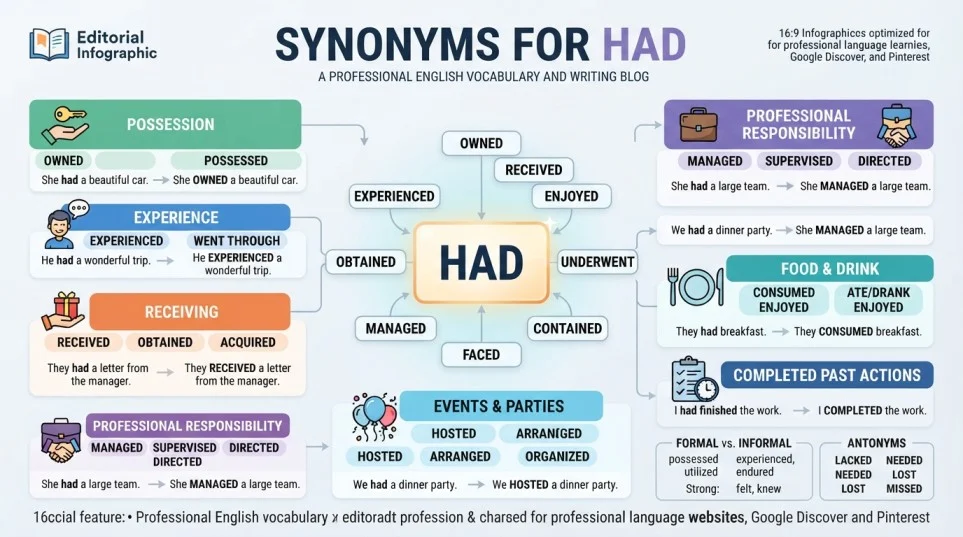
If it means ownership, consider owned or possessed.
If it means receiving something, consider received or got.
If it means experiencing something, consider experienced or underwent.
If it refers to food or drink, consider ate, drank, or consumed.
If it describes a professional responsibility, choose a specific action such as managed, led, handled, or oversaw.
If it describes a difficult situation, faced or endured may communicate more meaning.
For formal writing, prioritize precision. For casual writing, prioritize natural expression.
Real Life Examples of “Had” in Sentences
School
“I had a difficult assignment to complete before Friday.”
More precise:
“I faced a difficult assignment to complete before Friday.”
Workplace
“She had responsibility for the company’s largest account.”
More professional:
“She managed the company’s largest account.”
Writing
“The story had several unexpected twists.”
More descriptive:
“The story contained several unexpected twists.”
Conversation
“We had dinner at a small restaurant.”
Possible alternative:
“We enjoyed dinner at a small restaurant.”
Social Media
“Had an incredible time at the concert.”
More expressive:
“Enjoyed an incredible night at the concert.”
Resume
“I had experience working with international clients.”
Stronger:
“Worked with international clients.”
“I had a chance to review the document.”
More direct:
“I reviewed the document.”
Storytelling
“She had a strange feeling that something was wrong.”
More vivid:
“She sensed that something was wrong.”
18 Synonyms for “Had”
The following alternatives are context based replacements. They are not interchangeable with every grammatical use of “had.”
| Synonym | Simple Meaning | Best Used For | Example Sentence |
|---|---|---|---|
| Possessed | Owned or controlled | Formal ownership | The museum possessed several rare paintings. |
| Owned | Legally or personally had something | Property and possessions | She owned a small business. |
| Experienced | Went through something | Events and situations | He experienced a major career change. |
| Received | Was given something | Gifts, messages, documents, opportunities | We received your application yesterday. |
| Obtained | Successfully got something | Formal and professional writing | The researchers obtained useful results. |
| Got | Received or obtained | Casual conversation | I got a new laptop last month. |
| Enjoyed | Took pleasure in something | Positive experiences | They enjoyed a relaxing vacation. |
| Endured | Continued through something difficult | Emotional or difficult situations | She endured several challenging months. |
| Underwent | Went through a process or procedure | Medical, professional, or formal contexts | He underwent extensive training. |
| Faced | Encountered a problem or challenge | Difficult situations | The team faced unexpected obstacles. |
| Encountered | Came across or experienced | Problems, situations, or people | We encountered several technical issues. |
| Attended | Was present at an event | Meetings, classes, events | She attended the annual conference. |
| Consumed | Ate or drank something | Formal and factual writing | The participants consumed the provided meal. |
| Contained | Included something within something | Objects, documents, stories, collections | The report contained useful information. |
| Included | Had something as part of a whole | Lists, packages, plans, features | The package included free delivery. |
| Managed | Was responsible for something | Workplace and resume writing | He managed a team of ten employees. |
| Handled | Dealt with something | Business and practical situations | She handled customer complaints professionally. |
| Spent | Used time or money | Time, money, and experiences | We spent the afternoon exploring the city. |
Synonym Groups and Usage Differences
Professional vs. Personal Synonyms
Professional writing often benefits from verbs that identify an actual action.
Instead of saying:
“I had responsibility for the project.”
Say:
“I managed the project.”
Personal writing can remain more natural:
“I had a wonderful weekend.”
There is no need to make every personal sentence sound formal.
Formal vs. Conversational Synonyms
“Possessed,” “obtained,” “underwent,” and “consumed” generally sound more formal.
“Got,” “enjoyed,” and “spent” are more natural in everyday communication.
Compare:
“The company obtained approval.”
“We got approval.”
Both can be correct, but the first sounds more formal.
Academic Synonyms
Academic writing usually benefits from precise verbs.
Instead of:
“The participants had several problems.”
Consider:
“The participants experienced several difficulties.”
Instead of:
“The study had three major sections.”
Consider:
“The study contained three major sections.”
Precision makes academic writing easier to understand.
Professional and Business Synonyms
In business communication, avoid vague uses of “had” when a specific action is available.
Instead of:
“She had responsibility for the sales team.”
Use:
“She managed the sales team.”
Instead of:
“The company had a rise in revenue.”
Use:
“The company recorded an increase in revenue.”
Creative or Literary Synonyms
Creative writing can benefit from verbs that reveal experience and emotion.
“She had fear” is less natural than:
“She felt afraid.”
“He had a difficult journey” can become:
“He endured a difficult journey.”
The stronger verb creates a clearer image.
Slang or Modern Synonyms
“Got” is common in casual American English.
It works well in conversation and informal messages.
However, “got” can sound too casual for academic papers, formal reports, and some professional documents.
Strongest vs. Weaker Synonyms
A rough intensity scale can help:
Mild: had, experienced
Moderate: encountered, faced, underwent
Strong: endured, suffered
The correct choice depends on the situation. Do not use a strong word simply because it sounds more impressive.
Emotional vs. Neutral Synonyms
“Had” is usually neutral.
“Experienced” remains relatively neutral.
“Enjoyed” adds positive emotion.
“Endured” adds negative emotional weight.
“Suffered” is strongly negative.
Choose the emotional word only when the sentence genuinely supports that feeling.
Antonyms of “Had”
Because “had” has several meanings, it does not have one universal opposite. The following words and expressions provide contrasting meanings in specific contexts.
| Antonym | Meaning | Example Sentence |
|---|---|---|
| Lacked | Did not have something | The team lacked sufficient funding. |
| Lost | No longer possessed something | She lost her keys. |
| Gave | Transferred something to another person | He gave his friend the book. |
| Returned | Gave something back | She returned the equipment. |
| Surrendered | Gave up possession or control | The company surrendered the property. |
| Forfeited | Lost something because of an action or condition | He forfeited his deposit. |
| Rejected | Refused to accept something | She rejected the offer. |
| Refused | Chose not to accept or do something | He refused the invitation. |
| Avoided | Stayed away from an experience or situation | She avoided unnecessary conflict. |
| Missed | Failed to experience or attend something | He missed the meeting. |
| Declined | Politely refused something | They declined the opportunity. |
| Discarded | Threw something away | She discarded the damaged item. |
| Removed | Took something away | The technician removed the faulty component. |
| Abandoned | Gave up or left something | They abandoned the old plan. |
| Lived without | Managed without possessing something | He lived without a car for years. |
Comparison: “Had” vs. Similar Words
Had vs. Possessed
Main difference: “Had” is broad, while “possessed” specifically emphasizes ownership or control.
Which one is stronger: Possessed is more specific.
Which one is more formal: Possessed is more formal.
Examples:
“He had several valuable paintings.”
“He possessed several valuable paintings.”
Had vs. Experienced
Main difference: “Experienced” emphasizes going through an event or condition.
Which one is stronger: Experienced is often more specific.
Which one is more formal: Experienced can sound more polished in formal writing.
Examples:
“She had several difficulties.”
“She experienced several difficulties.”
Had vs. Got
Main difference: “Got” often emphasizes receiving or obtaining something.
Which one is stronger: Neither is inherently stronger.
Which one is more formal: “Had” is generally more neutral, while “got” is more conversational.
Examples:
“He had a new computer.”
“He got a new computer.”
Had vs. Received
Main difference: “Received” specifically indicates that something came to someone from another source.
Which one is stronger: Received is more precise.
Which one is more formal: Received is more formal in many contexts.
Examples:
“She had an invitation.”
“She received an invitation.”
Had vs. Underwent
Main difference: “Underwent” means someone went through a process, procedure, or experience.
Which one is stronger: Underwent is more specific.
Which one is more formal: Underwent is considerably more formal.
Examples:
“He had surgery.”
“He underwent surgery.”
Had vs. Owned
Main difference: “Owned” specifically indicates possession or legal ownership.
Which one is stronger: Owned is more precise for property.
Which one is more formal: Both are acceptable, but owned is more exact when ownership matters.
Examples:
“She had a house.”
“She owned a house.”
Common Phrases and Expressions with “Had”
1. Had a Chance
Meaning:
Had an opportunity to do something.
Example sentence:
“I had a chance to speak with the manager.”
2. Had a Good Time
Meaning:
Enjoyed an experience.
Example sentence:
“We had a good time at the festival.”
3. Had Enough
Meaning:
Reached the point where something is no longer acceptable or desirable.
Example sentence:
“She had enough of the constant interruptions.”
4. Had No Idea
Meaning:
Did not know or understand something.
Example sentence:
“I had no idea the store closed so early.”
5. Had an Impact
Meaning:
Affected someone or something.
Example sentence:
“The decision had a major impact on the community.”
6. Had a Problem
Meaning:
Experienced a difficulty.
Example sentence:
“We had a problem with the internet connection.”
7. Had to
Meaning:
Was required or needed to do something.
Example sentence:
“I had to leave early for work.”
8. Had Been
Meaning:
Used in the past perfect to describe an earlier state or situation.
Example sentence:
“She had been tired before the meeting began.”
Common Mistakes to Avoid
1. Replacing Every “Had”
Not every occurrence needs a synonym.
“Had” is often the most natural option, especially when it expresses simple possession or appears as an auxiliary verb.
2. Confusing “Had” With “Got”
“Got” often emphasizes receiving something, while “had” can simply describe possession.
“I had a car” and “I got a car” do not necessarily communicate the same idea.
3. Using Casual Language in Formal Writing
“Got” may sound natural in conversation but can be less appropriate in a formal report.
Choose “received” or “obtained” when those words accurately describe the action.
4. Choosing an Overly Dramatic Synonym
Do not replace “had a difficult day” with “endured a terrible ordeal” unless the situation genuinely deserves that intensity.
5. Repeating “Had” Too Often
If several sentences contain “had,” look for opportunities to use precise verbs.
However, avoid unnatural substitutions simply to eliminate repetition.
6. Choosing the Wrong Emotional Tone
“Enjoyed” is positive, while “endured” suggests difficulty.
Replacing neutral “had” with an emotional synonym can unintentionally change the meaning.
FAQs
What is the best synonym for “had”?
The best synonym depends on meaning. Use “owned” for possession, “experienced” for events, “received” for something given, and “managed” for workplace responsibilities.
What is a formal synonym for “had”?
Formal alternatives include “possessed,” “obtained,” “received,” “underwent,” “experienced,” and “contained,” depending on the sentence and intended meaning.
What is an informal synonym for “had”?
“Got” can replace “had” when the intended meaning is receiving or obtaining something. “Enjoyed” and “spent” also work in casual contexts.
What is another word for “had” in professional writing?
Professional alternatives include “managed,” “recorded,” “received,” “obtained,” “experienced,” “handled,” and “contained,” depending on what “had” means.
What is the difference between “had” and “experienced”?
“Had” is broad and can describe possession or experience. “Experienced” specifically emphasizes something that happened to or was encountered by someone.
What is the opposite of “had”?
There is no single opposite in every context. “Lacked,” “lost,” “gave,” “refused,” “missed,” and “lived without” can express contrasting meanings.
Conclusion
“Had” is a simple but extremely flexible English word. It can describe possession, experiences, events, food, opportunities, responsibilities, and completed past actions.
The best replacement depends on the exact meaning. Use “owned” for possession, “received” for something given, “experienced” for events, “managed” for professional responsibility, and “underwent” for formal processes or procedures.
Remember that good vocabulary is not about replacing common words with complicated ones. The best synonym is the word that expresses your intended meaning clearly, naturally, and appropriately for your reader.
Before publishing vocabulary content, verify definitions and usage with trusted dictionaries such as Cambridge, Oxford, Merriam Webster, Collins, or Britannica.
Discover More Post:
- 25+ Synonyms for Access | Meanings, Examples, and Best …
- 25+ Synonyms for Acknowledge | Meanings, Examples, and …
- 25+ Synonyms for Attention | Meanings, Examples, and Best …