Do you keep using the word “contrast” in essays, emails, captions, presentations, or everyday conversations? The word is useful, but repeating it can make your writing sound predictable.
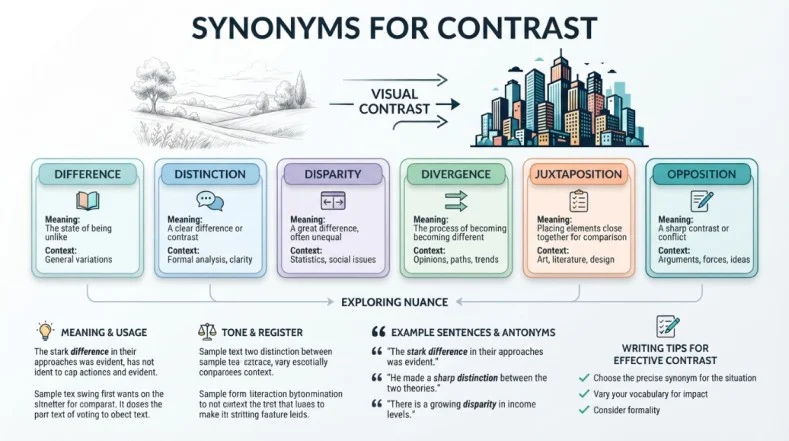
Learning synonyms for contrast helps you describe differences with greater precision. Depending on your sentence, you might need a formal word such as “distinction,” an academic choice such as “disparity,” or a creative term such as “juxtaposition.”
This guide explains the meaning, tone, strength, and practical use of each option so you can choose the right word instead of simply replacing one word with another.
What Does “Contrast” Mean?
Contrast means a clear difference between two or more people, things, ideas, qualities, or situations. Useful synonyms include distinction, difference, disparity, divergence, juxtaposition, opposition, comparison, and differentiation, depending on context.
Meaning, Tone and Context
Simple Definition
Contrast refers to a noticeable difference between two or more things. It can describe differences in appearance, qualities, ideas, opinions, behavior, or results.
As a verb, contrast means to compare things in order to show how different they are.
For example:
“The two designs contrast sharply.”
As a noun, contrast means the difference itself.
“There is a striking contrast between the two designs.”
Part of Speech
“Contrast” can function as both a noun and a verb.
As a noun:
“The contrast between the two approaches was obvious.”
As a verb:
“The report contrasts traditional methods with modern techniques.”
It can also appear in the phrase “in contrast,” which introduces an opposing or noticeably different idea.
Tone
Contrast is generally neutral. It does not automatically express approval or criticism.
The emotional effect depends on what is being compared. A contrast between two colors may be factual, while a contrast between poverty and wealth may create a serious emotional effect.
Formality Level
Contrast works comfortably in casual, academic, creative, and professional English.
It is especially common in essays, research writing, presentations, reviews, business reports, and analytical discussions.
Common Use Cases
You can use contrast when discussing:
- Differences between people
- Differences between ideas
- Visual differences
- Opposing opinions
- Business results
- Academic arguments
- Literary techniques
- Emotional differences
- Before and after situations
- Similarities and differences
Important Word Forms
Contrast: noun and verb
Contrasting: adjective or present participle
Contrasted: past form of the verb
In contrast: phrase used to introduce a difference
By contrast: phrase used to emphasize a difference
When and How to Use “Contrast”
“Contrast” is useful when the difference between two things is important to your message.
It works particularly well when you want readers to notice how two qualities, ideas, results, or situations differ.
1. Professional
“The report contrasts this quarter’s sales with the previous quarter.”
This is clear and appropriate for business communication.
2. Personal
“My quiet personality contrasts with my sister’s outgoing nature.”
Here, contrast describes a difference between two personalities.
3. Academic
“The study contrasts urban and rural approaches to public transportation.”
This use is analytical and works well in essays and research writing.
4. Emotional
“The warmth of the family gathering contrasted with the loneliness he felt earlier.”
The contrast creates an emotional difference between two experiences.
5. Creative
“The bright flowers contrasted beautifully with the dark walls.”
This creates a visual effect and adds descriptive depth.
6. Social Media
“Her simple outfit was a perfect contrast to the colorful city lights.”
The word works naturally in captions when describing visual differences.
7. Email
“The updated proposal contrasts with the version we reviewed last week.”
This is useful when discussing changes between documents.
Another Word for “Contrast”
The best single replacement depends on what you mean.
- If you mean a difference, use “difference” or “distinction.”
- If you mean a large or important difference, use “disparity” or “divergence.”
- If you mean placing two things together to emphasize differences, use “juxtaposition.”
- If you mean showing differences through comparison, use “differentiate,” “distinguish,” or “compare.”
Professional Writing
Use distinction, difference, divergence, or disparity.
Academic Writing
Use distinction, differentiation, divergence, or disparity when they accurately describe the relationship.
Casual Conversation
Use difference, opposition, or simply compare.
Emotional Writing
Use opposition, disparity, polarization, or counterpoint when the emotional context supports them.
Creative Writing
Use juxtaposition, counterpoint, antithesis, or polarity for more expressive writing.
Resume or Workplace Use
Use differentiate, distinguish, separate, or set apart when describing how your work or skills differ from alternatives.
Social Media Captions
Use difference, contrast, opposition, or juxtaposition, depending on the visual.
Stronger Meaning
Use disparity, polarization, opposition, or antithesis when the difference is pronounced.
Softer Meaning
Use variation, distinction, or difference when you want a more neutral expression.
When Not to Use “Contrast”
“Contrast” is not always the most precise choice.
If you simply mean that two things are not identical, “difference” may be easier.
For example:
Less precise:
“There is a contrast between the two plans.”
More direct:
“There is a difference between the two plans.”
If the difference is substantial, “disparity” may communicate the idea more clearly.
For example:
“The study found a significant disparity in access to resources.”
If two ideas are being actively compared, “comparison” may be more appropriate.
For example:
“The article provides a comparison of the two approaches.”
If the focus is on separating two concepts, “distinction” may be better.
For example:
“The professor explained the distinction between correlation and causation.”
Words Commonly Confused With “Contrast”
Contrast vs. Comparison
A comparison examines two or more things for similarities and differences.
Contrast focuses specifically on differences.
Contrast vs. Difference
A difference is any way in which things are not the same.
Contrast often emphasizes or highlights that difference.
Contrast vs. Distinction
A distinction is a meaningful difference between things that might otherwise seem similar.
Contrast can be broader and more visually or rhetorically noticeable.
Contrast vs. Opposition
Opposition suggests that two things are against each other.
Contrast only requires them to be different.
Contrast vs. Disparity
Disparity usually suggests a significant or unequal difference.
Contrast does not necessarily imply inequality.
Contrast vs. Juxtaposition
Juxtaposition means placing two things close together so their differences or similarities become noticeable.
Contrast describes the difference itself.
Best Synonym by Context for “Contrast”
| Context | Best Synonym | Why It Works | Example |
|---|---|---|---|
| Formal writing | Distinction | Precise and professional | The distinction between the policies is important. |
| Academic writing | Differentiation | Emphasizes analytical separation | The study requires differentiation between the two groups. |
| Professional or business use | Difference | Clear and direct | The difference in results was significant. |
| Resume | Differentiation | Highlights what sets something apart | Strong differentiation helped the product stand out. |
| Casual conversation | Difference | Natural and easy to understand | There is a big difference between them. |
| Creative writing | Juxtaposition | Creates a deliberate visual or thematic effect | The juxtaposition of light and darkness shaped the scene. |
| Emotional tone | Disparity | Can emphasize a meaningful gap | The disparity between expectation and reality was painful. |
| Strong intensity | Opposition | Suggests a pronounced difference | Their opinions were in direct opposition. |
| Soft or moderate tone | Variation | Suggests a less dramatic difference | There is some variation between the designs. |
| Social media captions | Difference | Simple and accessible | The difference between morning and evening is incredible. |
| Literary analysis | Antithesis | Describes deliberately opposing ideas | The poem uses antithesis to emphasize the central conflict. |
| Research writing | Divergence | Describes movement or development in different directions | The results show a divergence in the two groups. |
| Visual design | Distinction | Helps describe noticeable visual separation | The color distinction improves readability. |
| Workplace communication | Differentiate | Useful when explaining how things differ | We need to differentiate the two services. |
| Presentations | Comparison | Helpful when showing differences side by side | This comparison highlights the major differences. |
Which Synonym Should You Choose?
Start by asking what kind of difference you want to express.
- If you need a simple, neutral word, choose difference.
- If you need a precise distinction between related concepts, choose distinction.
- If you are describing a significant gap, consider disparity.
- If two things move in different directions, divergence may be more accurate.
- If you deliberately place two things together to emphasize their differences, choose juxtaposition.
- If you are explaining how something stands apart from another option, use differentiate or differentiation.
For creative writing, antithesis, counterpoint, and juxtaposition can add depth, but they should only be used when their specific meanings fit.
Real Life Examples of “Contrast” in Sentences
School
“The essay uses contrast to explain the differences between traditional and modern education.”
Workplace
“The presentation contrasts our current strategy with the proposed approach.”
Writing
“The author creates a strong contrast between freedom and responsibility.”
Conversation
“The two restaurants are completely different, so the contrast is obvious.”
Social Media
“The contrast between the snowy mountains and blue sky makes this photo stand out.”
Resume
“I used data analysis to differentiate customer segments and improve campaign performance.”
“The updated proposal contrasts with the original version in several important areas.”
Storytelling
“The peaceful opening creates a powerful contrast with the conflict that follows.”
25 Synonyms for “Contrast”
| Synonym | Simple Meaning | Best Used For | Example Sentence |
|---|---|---|---|
| Difference | The way things are not alike | General writing and conversation | The difference between the two plans is easy to see. |
| Distinction | A meaningful difference | Formal and academic writing | The distinction between the two concepts is important. |
| Disparity | A significant or unequal difference | Social, economic, and analytical contexts | The report examined the disparity in access to education. |
| Divergence | Movement or development in different directions | Academic and professional writing | The results showed a divergence between the two groups. |
| Dissimilarity | Lack of similarity | Formal and descriptive writing | The dissimilarity between the designs was striking. |
| Variation | A difference or change within a group | Research and general description | There is considerable variation in customer preferences. |
| Variance | A difference from an expected or established value | Technical and analytical writing | The analyst investigated the variance between the estimates. |
| Discrepancy | A difference between information that should agree | Reports and professional contexts | The accountant noticed a discrepancy in the figures. |
| Opposition | A state of being strongly different or against | Political, social, and argumentative contexts | The proposal faced strong opposition from several members. |
| Antithesis | A direct or striking opposite | Literary and formal writing | The speech presents hope as the antithesis of despair. |
| Polarity | A relationship between two strongly opposing sides | Academic and social analysis | The debate revealed a growing polarity between the groups. |
| Juxtaposition | Placing things together to emphasize differences | Creative and literary writing | The artist used juxtaposition to place beauty beside decay. |
| Counterpoint | A contrasting element that creates balance or emphasis | Creative, musical, and analytical writing | Her optimism provides a counterpoint to his pessimism. |
| Differentiation | The process of showing how things differ | Business, education, and academic writing | Product differentiation can influence customer choices. |
| Separation | The act or state of keeping things distinct | General and practical contexts | The separation of the two sections improves clarity. |
| Comparison | Examination of similarities and differences | Academic and explanatory writing | The comparison reveals several important differences. |
| Compare | To examine things in relation to each other | Everyday and academic writing | The teacher asked students to compare the two theories. |
| Differentiate | To recognize or show differences | Professional and academic contexts | The analysis helps differentiate the two approaches. |
| Distinguish | To recognize one thing as different from another | Formal and everyday writing | The test helps distinguish reliable sources from weak ones. |
| Juxtapose | To place different things together for effect | Creative and literary writing | The photographer chose to juxtapose old buildings with modern towers. |
| Oppose | To place against or act against something | Arguments and conflicting positions | The article opposes traditional assumptions with new evidence. |
| Set apart | To make something noticeably different | Workplace and casual communication | Her attention to detail sets her apart from other candidates. |
| Set against | To place one thing in relation to another | Analysis and creative writing | The bright background is set against a dark foreground. |
| Highlight differences | To make differences especially noticeable | Explanatory and professional writing | The chart highlights differences between the two regions. |
| Accentuate differences | To make differences more prominent | Formal and descriptive writing | The lighting accentuates differences in texture. |
Synonym Groups and Usage Differences
Professional vs. Personal Synonyms
Professional communication usually benefits from clear and neutral choices such as difference, distinction, differentiation, and discrepancy.
Personal communication can be more flexible. Words such as difference, opposition, and contrast usually sound natural without becoming overly formal.
Formal vs. Conversational Synonyms
Formal writing may use distinction, disparity, dissimilarity, divergence, or differentiation.
Conversational English usually favors difference, compare, differentiate, and set apart.
A simple word is often better than a sophisticated word when the audience does not need technical precision.
Academic Synonyms
Academic writing requires careful distinctions.
Divergence works when ideas, results, or developments move in different directions.
Disparity works when the difference involves a meaningful gap.
Differentiation works when categories or concepts are being separated.
Distinction works when two related concepts need to be clearly separated.
Professional and Business Synonyms
In business writing, clarity matters more than complexity.
- Use difference when you simply need to identify a change.
- Use discrepancy for conflicting numbers or information.
- Use differentiation when discussing what makes a product, service, or company distinct.
- Use distinction when explaining meaningful differences between options.
Creative or Literary Synonyms
Creative writing gives you more freedom.
Juxtaposition can create a visual or thematic effect.
Antithesis can emphasize opposing ideas.
Counterpoint can introduce a contrasting element.
Polarity can express strong opposing forces.
Choose these words only when their specific meanings fit the scene.
Slang or Modern Synonyms
There are no widely accepted slang synonyms for contrast that consistently work across US English.
Casual phrases such as “worlds apart” can express a strong difference, but they are better suited to conversation, captions, and informal writing.
Avoid them in academic essays and formal reports unless the context specifically calls for conversational language.
Strongest vs. Weaker Synonyms
A useful intensity scale is:
Mild: variation, difference
Moderate: distinction, dissimilarity, differentiation
Strong: disparity, divergence, opposition
Very strong or deliberately oppositional: polarity, antithesis
Intensity depends on context. A word such as “disparity” may sound much stronger than “difference” because it often suggests a substantial gap.
Emotional vs. Neutral Synonyms
For neutral writing, choose difference, distinction, variation, or differentiation.
For emotional writing, disparity, opposition, antithesis, and polarity can create stronger effects.
Use emotional vocabulary carefully. A dramatic word can make an otherwise simple observation sound exaggerated.
Antonyms of “Contrast”
The opposite of contrast is generally an idea of similarity, agreement, sameness, or correspondence. The best antonym depends on the specific meaning of contrast in your sentence.
| Antonym | Meaning | Example Sentence |
|---|---|---|
| Similarity | A quality of being alike | The similarity between the two designs is obvious. |
| Resemblance | The quality of looking or being alike | There is a strong resemblance between the two buildings. |
| Likeness | Similarity in appearance or qualities | The likeness between the paintings surprised the visitors. |
| Sameness | A lack of meaningful difference | The sameness of the designs made the collection feel repetitive. |
| Agreement | A state of sharing the same view | The committee reached agreement on the proposal. |
| Harmony | A pleasing state of agreement | The colors work together in harmony. |
| Conformity | Similarity to an established standard | The product meets the required conformity standards. |
| Uniformity | Consistency without significant variation | The company values uniformity across its locations. |
| Correspondence | A close match between things | There is a clear correspondence between the two records. |
| Equivalence | A state of being equal in value or meaning | The two expressions have practical equivalence. |
| Alignment | A state of agreement or matching direction | The teams reached alignment on the project goals. |
| Compatibility | The ability to exist or work well together | The two systems have strong compatibility. |
| Concurrence | Agreement or shared judgment | The experts expressed concurrence on the main finding. |
| Consistency | Similarity or steadiness across situations | The results showed consistency across the sample. |
| Affinity | A natural similarity or connection | The two artists share an affinity for simple forms. |
Comparison: “Contrast” vs. Similar Words
Contrast vs. Difference
Main difference: Difference is the broadest and simplest term. Contrast often emphasizes the noticeable quality of the difference.
Which one is stronger: Contrast can sound more emphatic.
Which one is more formal: Both work in formal writing, but “difference” is more universally accessible.
Contrast: “The contrast between the two paintings is striking.”
Difference: “There is a clear difference between the two paintings.”
Contrast vs. Comparison
Main difference: Comparison considers similarities and differences. Contrast focuses mainly on differences.
Which one is stronger: Contrast usually places more emphasis on differences.
Which one is more formal: Both are appropriate for academic writing.
Contrast: “The essay contrasts two theories.”
Comparison: “The essay compares two theories.”
Contrast vs. Distinction
Main difference: Distinction highlights a meaningful difference between related things.
Which one is stronger: Contrast can create a more noticeable difference, while distinction can be more precise.
Which one is more formal: Distinction often sounds slightly more formal.
Contrast: “The contrast between the approaches is obvious.”
Distinction: “The distinction between the approaches is important.”
Contrast vs. Disparity
Main difference: Disparity usually suggests a substantial or unequal difference.
Which one is stronger: Disparity generally carries stronger implications.
Which one is more formal: Disparity is common in formal, academic, and professional writing.
Contrast: “The report highlights the contrast between the two regions.”
Disparity: “The report highlights the disparity in access to resources.”
Contrast vs. Opposition
Main difference: Opposition suggests that two things actively conflict or stand against each other.
Which one is stronger: Opposition usually carries a stronger sense of conflict.
Which one is more formal: Both are formal enough for professional and academic writing.
Contrast: “The contrast between their opinions was clear.”
Opposition: “Their opinions were in direct opposition.”
Contrast vs. Juxtaposition
Main difference: Juxtaposition describes placing things together so their relationship becomes noticeable.
Which one is stronger: Juxtaposition can create a strong artistic effect, but it does not automatically mean the things are opposites.
Which one is more formal: Juxtaposition is more specialized.
Contrast: “The contrast between light and darkness creates tension.”
Juxtaposition: “The juxtaposition of light and darkness creates tension.”
Common Phrases and Expressions with “Contrast”
1. In contrast
Meaning:
Used to introduce something noticeably different.
Example sentence:
“The first plan focuses on speed. In contrast, the second focuses on long term stability.”
2. By contrast
Meaning:
Used to emphasize a difference between two situations or ideas.
Example sentence:
“Sales increased in the city. By contrast, rural sales remained stable.”
3. In stark contrast
Meaning:
Used when the difference is especially obvious or dramatic.
Example sentence:
“The modern office stands in stark contrast to the historic building next door.”
4. In sharp contrast
Meaning:
Used when two things differ very noticeably.
Example sentence:
“Her calm response was in sharp contrast to his angry reaction.”
5. Contrast with
Meaning:
Used to directly identify a difference between two things.
Example sentence:
“The new model contrasts with the previous version in several ways.”
6. Contrast between
Meaning:
Used to describe a noticeable difference involving two or more things.
Example sentence:
“The contrast between the colors makes the design more readable.”
7. Contrast sharply
Meaning:
Used when differences are especially clear.
Example sentence:
“The two candidates contrast sharply in their communication styles.”
Common Mistakes to Avoid
1. Using “Contrast” When “Difference” Is More Natural
Not every difference needs the stronger idea of contrast.
Instead of forcing “contrast” into a simple sentence, use “difference” when you only need to state that things are not alike.
2. Confusing Contrast With Comparison
A comparison can discuss both similarities and differences.
Contrast is more specifically concerned with differences.
3. Using a Casual Synonym in Formal Writing
Phrases such as “worlds apart” can sound too conversational in an academic essay.
Choose “disparity,” “distinction,” or “difference” when the formal context requires precision.
4. Using an Overly Dramatic Synonym
Words such as “antithesis” and “polarity” can sound excessive when describing a minor difference.
Use the simplest accurate word.
5. Repeating “Contrast” Too Often
Repeating the same word can make an essay or article feel mechanical.
Rotate between accurate choices such as “difference,” “distinction,” “divergence,” and “juxtaposition” when their meanings genuinely fit.
6. Choosing the Wrong Emotional Tone
“Disparity” can suggest a meaningful gap, while “variation” sounds relatively mild.
Choose according to the emotional and factual weight of your message.
7. Using Specialized Vocabulary Without Need
A sophisticated word does not automatically make writing better.
If “difference” communicates your meaning clearly, it may be the strongest choice because readers understand it immediately.
FAQs
What is the best synonym for “contrast”?
“Difference” is the best general synonym, while “distinction,” “disparity,” “divergence,” and “juxtaposition” are better when the context requires greater precision.
What is a formal synonym for “contrast”?
“Distinction,” “disparity,” “differentiation,” “divergence,” and “dissimilarity” can serve as formal alternatives, depending on the intended meaning.
What is an informal synonym for “contrast”?
“Difference” is the most natural informal alternative. In very casual language, phrases such as “worlds apart” can also express strong differences.
What is another word for “contrast” in professional writing?
“Difference,” “distinction,” “discrepancy,” and “differentiation” are useful professional alternatives. The best choice depends on the type of difference.
What is the difference between “contrast” and “comparison”?
Comparison considers similarities and differences, while contrast focuses primarily on differences between people, objects, ideas, qualities, or situations.
What is the opposite of “contrast”?
Common contextual opposites include similarity, resemblance, likeness, sameness, agreement, harmony, uniformity, correspondence, and alignment.
Conclusion
Contrast describes a noticeable difference between people, ideas, objects, qualities, or situations. It can function as both a noun and a verb and works naturally in academic, professional, creative, and everyday English.
The best synonym depends on your exact meaning. Choose “difference” for simple communication, “distinction” for precision, “disparity” for a significant gap, “divergence” for different directions, and “juxtaposition” for deliberate placement of contrasting elements.
For professional and academic writing, accuracy matters more than using impressive vocabulary. The best synonym for contrast is the one that communicates your intended meaning clearly and naturally.
Before publishing a vocabulary article, verify definitions and usage with trusted references such as Cambridge, Oxford, Merriam Webster, Collins, or Britannica.
The practical takeaway is simple: do not replace “contrast” automatically. First identify the type, strength, and purpose of the difference, then choose the word that fits your sentence.
Discover More Post:
- 25+ Synonyms for Frustrated | Meanings, Examples, and Best …
- 25+ Synonyms for Shadow | Meanings, Examples, and Best …
- 25+ Synonyms for Values | Meanings, Examples, and Best …