You may use the word “relevant” often when writing an email, essay, resume, report, caption, or professional message. The word is useful, but repeating it can make your writing feel predictable.
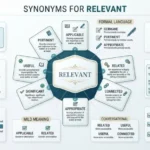
Knowing the right synonyms for relevant helps you describe ideas more precisely. Depending on your situation, you might choose words such as pertinent, applicable, appropriate, related, significant, or germane.
The best replacement depends on what you mean. A word can be technically similar to “relevant” while creating a different tone or suggesting a more specific relationship.
This guide explains the meaning of relevant, shows practical alternatives, compares commonly confused words, and helps you choose the right synonym for school, work, conversation, creative writing, social media, and everyday communication.
What Does “Relevant” Mean?
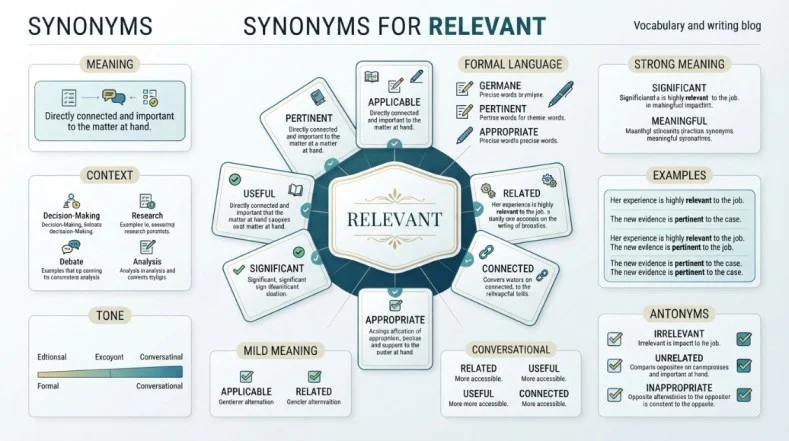
“Relevant” means directly connected to a particular subject, situation, purpose, or question. Common alternatives include pertinent and germane for formal writing, applicable for practical use, related for general conversation, and significant when importance matters.
Meaning, Tone and Context
1. Simple Definition
Relevant describes something that is connected to the matter being discussed or considered.
If information helps answer a question, explain a situation, solve a problem, or support a particular purpose, it may be relevant.
For example:
“Please include only relevant information in your application.”
Here, relevant means information that directly matters to the application.
2. Part of Speech
“Relevant” is an adjective.
It describes a person, fact, detail, idea, example, experience, question, topic, or piece of information.
Common forms and related words include:
| Word | Type | Meaning |
|---|---|---|
| Relevant | Adjective | Connected to the subject or situation |
| Relevance | Noun | The quality of being connected or useful to a subject |
| Relevant to | Adjective phrase | Connected to a particular matter |
| Irrelevant | Adjective | Not connected to the subject or situation |
3. Tone
“Relevant” is generally neutral.
It does not automatically express approval, criticism, excitement, or emotion. It simply indicates that something has a meaningful connection to the subject.
For example:
“The researcher included several relevant studies.”
This statement is factual and neutral.
4. Formality Level
“Relevant” works well in both formal and informal English.
It is especially common in:
- Academic writing
- Business communication
- Professional reports
- Resumes
- Essays
- Presentations
- Everyday conversation
- Emails
- Research
- Online content
5. Common Use Cases
You can use “relevant” when discussing:
- Information
- Experience
- Skills
- Evidence
- Examples
- Questions
- Research
- Topics
- Details
- Documents
- Experience for a job
- Ideas connected to a discussion
6. Important Word Forms
The noun form is “relevance.”
Example:
“The relevance of this research is clear.”
The negative adjective is “irrelevant.”
Example:
“That detail is irrelevant to the current discussion.”
The phrase “relevant to” is especially common.
Example:
“Her experience is relevant to the position.”
When and How to Use “Relevant”
“Relevant” is useful when you want to show that something belongs directly to the subject, purpose, or situation.
The following examples show how its meaning stays consistent while the context changes.
Professional
“Please provide any relevant information before the meeting.”
The word identifies information that directly matters to the meeting.
Personal
“She shared a relevant experience from her childhood.”
Here, relevant means the experience was connected to what they were discussing.
Academic
“The essay should include relevant evidence to support the main argument.”
In academic writing, relevant information should clearly support the topic or claim.
Emotional
“His comments were relevant to the concerns she had expressed.”
The word remains neutral even though the surrounding situation is emotional.
Creative
“The author added several relevant details to make the story feel realistic.”
Here, relevant describes details that support the story’s situation or subject.
Social Media
“These are some relevant tips for anyone starting a new business.”
The word tells readers that the tips connect directly to the topic.
“I have attached the relevant documents for your review.”
This is a common professional use because it clearly identifies documents connected to the matter at hand.
Another Word for “Relevant”
The best single replacement depends on the exact meaning you want to communicate.
- For professional writing, “pertinent” is often a polished alternative.
- For academic writing, “pertinent” or “germane” can work when the information is directly connected to the topic.
- For casual conversation, “related” is usually more natural.
- For emotional writing, “meaningful” may work when you want to emphasize personal importance rather than simple connection.
- For creative writing, “fitting” or “appropriate” can work when the idea suits the scene.
- For resumes and workplace writing, “applicable” is useful when discussing skills, experience, or knowledge that can be applied to a particular role.
- For social media captions, “related” or “timely” may sound more natural depending on the intended meaning.
- For a stronger meaning, “pertinent” can emphasize direct connection and importance.
- For a softer meaning, “related” simply indicates a connection without suggesting that the information is especially important.
Quick Context Guide
| Situation | Useful Alternative |
|---|---|
| Professional writing | Pertinent |
| Academic writing | Germane |
| Casual conversation | Related |
| Emotional writing | Meaningful |
| Creative writing | Fitting |
| Resume | Applicable |
| Workplace communication | Applicable |
| Social media | Related |
| Stronger sense of direct connection | Pertinent |
| Softer sense of connection | Related |
When Not to Use “Relevant”
“Relevant” is a flexible word, but it is not always the most precise choice.
When You Mean “Important”
If you mean something has major importance rather than simply having a connection, “significant” may be better.
Less precise:
“Her discovery was relevant to the field.”
More specific:
“Her discovery was significant to the field.”
When You Mean “Useful”
If the main idea is practical value, “useful” may communicate your meaning more clearly.
Less precise:
“This information is relevant to new employees.”
More specific:
“This information is useful to new employees.”
When You Mean “Suitable”
If you mean something is appropriate for a particular purpose, “suitable” may be stronger.
Less precise:
“That example is relevant for beginners.”
More specific:
“That example is suitable for beginners.”
When You Mean “Connected”
If you simply want to describe a connection, “related” is often easier and more conversational.
“Your question is related to the topic we discussed.”
When You Mean “Applicable”
If an idea, skill, rule, or experience can actually be used in a situation, “applicable” is often more exact.
“Her previous experience is applicable to this role.”
Words Commonly Confused With “Relevant”
Several words overlap with relevant but do not mean exactly the same thing.
Relevant vs. Related
“Related” means connected in some way.
“Relevant” usually suggests that the connection matters to the particular topic, question, or purpose.
Example:
“These two subjects are related.”
“That example is relevant to our discussion.”
Relevant vs. Pertinent
“Pertinent” usually means directly connected to the matter being considered.
It is often more formal than relevant.
Example:
“Please provide any pertinent information.”
Relevant vs. Applicable
“Applicable” means capable of being applied to a particular situation.
Example:
“The policy is applicable to all employees.”
“Relevant” is broader.
“The policy contains relevant information for employees.”
Relevant vs. Significant
“Significant” focuses on importance, effect, or meaning.
“Relevant” focuses primarily on connection.
Something can be relevant without being especially important.
Relevant vs. Appropriate
“Appropriate” means suitable or acceptable for a particular purpose, situation, or audience.
A detail can be relevant but inappropriate to mention in a particular setting.
Relevant vs. Useful
“Useful” focuses on practical value.
“Relevant” focuses on connection to the matter.
An interesting fact may be relevant but not particularly useful.
Best Synonym by Context for “Relevant”
| Context | Best Synonym | Why It Works | Example |
|---|---|---|---|
| Formal writing | Pertinent | Sounds precise and professional | Please include all pertinent information. |
| Academic writing | Germane | Clearly connects an idea to the topic | The evidence is germane to the argument. |
| Professional use | Applicable | Works well for skills, rules, and experience | Her training is applicable to the role. |
| Resume | Applicable | Highlights practical connection to a position | I have applicable experience in customer service. |
| Business communication | Pertinent | Clearly identifies information that matters | We reviewed the pertinent details. |
| Casual conversation | Related | Sounds natural and conversational | That story is related to what we discussed. |
| Creative writing | Fitting | Suggests that something suits the situation | The description was fitting for the scene. |
| Emotional writing | Meaningful | Adds a sense of personal importance | Her advice was meaningful to me. |
| Strong meaning | Pertinent | Suggests a direct and important connection | The witness provided pertinent details. |
| Mild meaning | Related | Indicates connection without extra emphasis | The question is related to our topic. |
| Social media | Timely | Works when relevance comes from current interest | This advice is timely for new creators. |
| Practical instructions | Applicable | Emphasizes usefulness in a particular situation | The rule is applicable to every applicant. |
| Research | Pertinent | Highlights information directly connected to the study | The researchers examined pertinent evidence. |
| Workplace email | Relevant | Clear and familiar in professional communication | I attached the relevant documents. |
| Speech or presentation | Pertinent | Sounds polished while remaining understandable | Let us focus on the pertinent points. |
| News discussion | Timely | Emphasizes current connection | The issue is especially timely today. |
| Storytelling | Fitting | Describes something that suits the story | The detail was fitting for the character. |
| Everyday explanation | Related | Simple and easy to understand | That example is related to the question. |
| Technical writing | Applicable | Useful for rules, methods, and procedures | This standard is applicable to the system. |
Which Synonym Should You Choose?
Start by asking what kind of connection you want to describe.
- If something is directly connected to the subject, use “pertinent” or “germane.”
- If a rule, skill, method, or experience can be used in a situation, consider “applicable.”
- If you simply mean that two ideas have a connection, choose “related.”
- If you want to emphasize importance, consider “significant” or “meaningful.”
- If you want to show that something suits a particular situation, “appropriate” or “fitting” may be better.
For professional writing, favor precise words rather than choosing an unusual synonym simply to avoid repetition.
For casual communication, simple words such as “related” often sound more natural than formal alternatives such as “germane.”
Real Life Examples of “Relevant” in Sentences
School
“Use relevant examples to explain your main argument.”
Workplace
“Please send me any relevant information before the presentation.”
Writing
“Removing irrelevant details made the article easier to read.”
Conversation
“That question is relevant to what we are discussing.”
Social Media
“Here are five relevant tips for people learning to write better captions.”
Resume
“Highlight relevant experience that matches the requirements of the position.”
“I have included the relevant files in this message.”
Storytelling
“The writer included relevant details that helped explain the character’s decision.”
25 Synonyms for “Relevant”
| Synonym | Simple Meaning | Best Used For | Example Sentence |
|---|---|---|---|
| Pertinent | Directly connected to the matter | Formal and professional writing | Please provide any pertinent details before the interview. |
| Germane | Closely connected to the subject | Academic and formal writing | The evidence is germane to the central argument. |
| Applicable | Able to be used in a particular situation | Rules, skills, experience, and methods | Her technical training is applicable to the position. |
| Related | Connected in meaning or subject | Casual and general communication | The article discusses several related topics. |
| Connected | Having a clear relationship | Everyday and professional writing | These issues are closely connected. |
| Associated | Linked with something else | Professional, academic, and analytical contexts | The study examined factors associated with higher productivity. |
| Appropriate | Suitable for a particular situation | Professional, academic, and social contexts | Choose an appropriate example for your audience. |
| Suitable | Right for a particular purpose | General and practical writing | We need a suitable example for younger students. |
| Fitting | Well suited to a situation | Creative and conversational writing | The ending was fitting for the story. |
| Material | Important or directly significant to a matter | Legal, business, and formal contexts | The report omitted several material facts. |
| Significant | Important or meaningful | Academic and professional contexts | The research revealed a significant change. |
| Meaningful | Having importance or value | Personal, emotional, and reflective writing | Her advice was meaningful to me. |
| Useful | Helpful for a purpose | Practical and everyday communication | The guide contains useful information for beginners. |
| Valuable | Helpful or important | Professional, educational, and business contexts | Your feedback provided valuable insight. |
| Informative | Providing useful information | Educational and content writing | The presentation was informative and easy to follow. |
| Topical | Connected to a current or discussed subject | Media, publishing, and current discussions | The article covers several topical issues. |
| Timely | Relevant at a particular moment | News, business, and social media | The report offers timely advice for new businesses. |
| Apropos | Especially suitable or directly connected | Formal and literary writing | Her comment was apropos to the discussion. |
| Corresponding | Matching or connected with another thing | Technical and formal contexts | The figures were listed beside their corresponding categories. |
| Pertaining | Relating directly to a subject | Formal and technical writing | The document contains information pertaining to employee benefits. |
| Concerning | Relating to a particular subject | Formal communication | We received several questions concerning the new policy. |
| Relational | Showing a relationship between things | Academic and technical contexts | The study takes a relational approach to the issue. |
| Contextual | Connected to a particular context | Academic and analytical writing | The meaning becomes clearer with contextual information. |
| Substantive | Having meaningful importance or content | Formal, academic, and professional writing | The committee discussed substantive concerns about the proposal. |
| On point | Directly addressing the subject | Conversation and informal professional communication | Her answer was concise and completely on point. |
Some of these words overlap with “relevant” only in specific contexts. A good synonym should preserve the intended meaning rather than simply resemble the original word.
For example, “significant” emphasizes importance, while “related” emphasizes connection. “Applicable” emphasizes practical use, while “pertinent” emphasizes direct connection.
Synonym Groups and Usage Differences
Professional vs. Personal Synonyms
Professional writing often benefits from words such as “pertinent,” “applicable,” “pertaining,” and “significant.”
Personal writing can sound more natural with “related,” “meaningful,” “connected,” or “fitting.”
For example:
Professional:
“Please provide any pertinent information about the project.”
Personal:
“That experience is meaningful to me.”
Both sentences communicate a connection, but the vocabulary matches the situation.
Formal vs. Conversational Synonyms
Formal choices include “pertinent,” “germane,” “applicable,” “pertaining,” and “apropos.”
Conversational choices include “related,” “connected,” “useful,” and “on point.”
A formal synonym is not automatically better. The goal is to match the audience and situation.
Academic Synonyms
Academic writing requires precision.
“Pertinent,” “germane,” “applicable,” “significant,” “contextual,” and “associated” can be useful when they accurately describe the relationship between ideas.
For example:
“The findings are pertinent to current discussions about education.”
This sounds more precise than repeatedly using “relevant” throughout a research paper.
Professional and Business Synonyms
Business writing often uses “relevant,” “pertinent,” “applicable,” “significant,” “valuable,” and “timely.”
For example:
“Please review the pertinent information before making a decision.”
“Applicable” is especially useful for policies, qualifications, procedures, and experience.
“Timely” works when the importance comes from the current moment.
Creative or Literary Synonyms
Creative writing gives you more freedom.
“Fitting,” “meaningful,” “significant,” “connected,” and “apropos” can add different shades of meaning.
For example:
“The final scene felt fitting after everything the character had experienced.”
Here, “fitting” suggests that the ending suits the emotional and narrative situation.
Slang or Modern Synonyms
“On point” is a modern conversational expression that can mean accurate, appropriate, or directly connected to the subject.
Example:
“Her explanation was completely on point.”
It can work in casual conversation and some informal online writing.
It is usually better to avoid it in formal academic writing, legal writing, and highly professional documents.
Strongest vs. Weaker Synonyms
There is no universal intensity scale for synonyms of “relevant” because different words emphasize different qualities.
A useful practical scale is:
Mild connection: Related
Clear connection: Connected
Direct connection: Pertinent
Very close connection to a specific subject: Germane
Practical connection: Applicable
Important connection: Significant
Strong personal importance: Meaningful
The strongest choice depends on the meaning you want to emphasize.
Emotional vs. Neutral Synonyms
“Relevant” is neutral.
“Related” and “connected” are also generally neutral.
“Meaningful” adds emotional or personal importance.
“Significant” can suggest importance without necessarily being emotional.
“Pertinent” remains formal and factual.
Choose a word based on the meaning you need, not simply the word that sounds more sophisticated.
Antonyms of “Relevant”
| Antonym | Meaning | Example Sentence |
|---|---|---|
| Irrelevant | Not connected to the subject | That detail is irrelevant to the question. |
| Unrelated | Having no meaningful connection | The two issues are unrelated. |
| Inapplicable | Not suitable for use in a situation | The old rule is inapplicable to this case. |
| Inappropriate | Not suitable for the situation | That example is inappropriate for this audience. |
| Immaterial | Not important to the matter being considered | The difference was immaterial to the final decision. |
| Extraneous | Not necessary or directly connected | Remove extraneous information from the report. |
| Off topic | Not connected to the current discussion | His comment was completely off topic. |
| Unconnected | Not linked to the subject | The incident appears unconnected to the investigation. |
| Unsuitable | Not appropriate for the purpose | That example is unsuitable for beginners. |
| Incongruous | Not fitting naturally with the situation | The humorous remark seemed incongruous during the serious meeting. |
| Remote | Only distantly connected | The possibility has only a remote connection to the issue. |
| Peripheral | Related only indirectly | The discussion moved toward peripheral concerns. |
| Incidental | Occurring as a secondary or minor matter | The cost was incidental to the main issue. |
| Unimportant | Lacking importance | The minor detail was unimportant to the conclusion. |
| Misplaced | Used or presented in an unsuitable context | The criticism seemed misplaced during the celebration. |
Antonyms can vary by context. For example, “irrelevant” directly describes a lack of connection, while “unimportant” describes a lack of significance.
Comparison: “Relevant” vs. Similar Words
Relevant vs. Related
Main difference: “Relevant” means connected in a way that matters to the current subject. “Related” simply indicates a connection.
Which one is stronger: Relevant usually provides a more specific connection.
Which one is more formal: Both work in formal writing, but “relevant” is often more precise.
Examples:
“Please provide relevant information.”
“The article covers several related subjects.”
Relevant vs. Pertinent
Main difference: Both indicate connection, but “pertinent” often emphasizes a direct and immediate connection.
Which one is stronger: Pertinent can sound more specific.
Which one is more formal: Pertinent is generally more formal.
Examples:
“The information is relevant to the discussion.”
“The witness provided pertinent information.”
Relevant vs. Applicable
Main difference: Relevant means connected to a matter. Applicable means capable of being applied to a particular situation.
Which one is stronger: Neither is universally stronger because they describe different relationships.
Which one is more formal: Both are suitable for professional writing.
Examples:
“Her experience is relevant to the job.”
“Her training is applicable to the job.”
Relevant vs. Significant
Main difference: Relevant focuses on connection. Significant focuses on importance or effect.
Which one is stronger: Significant generally places more emphasis on importance.
Which one is more formal: Both work well in academic and professional writing.
Examples:
“The statistic is relevant to the study.”
“The statistic is significant to the study.”
Relevant vs. Appropriate
Main difference: Relevant means connected. Appropriate means suitable or acceptable.
Which one is stronger: Neither is inherently stronger.
Which one is more formal: Both are widely accepted in formal writing.
Examples:
“The example is relevant to the topic.”
“The example is appropriate for the audience.”
Relevant vs. Useful
Main difference: Relevant means connected to the subject. Useful means helpful for achieving a purpose.
Which one is stronger: Useful emphasizes practical benefit.
Which one is more formal: Both are common, but “relevant” is especially frequent in academic and professional writing.
Examples:
“The information is relevant to the question.”
“The information is useful for solving the problem.”
Common Phrases and Expressions with “Relevant”
1. Relevant Information
Meaning:
Information that directly connects to a particular topic, question, or situation.
Example sentence:
“Please include all relevant information in your application.”
2. Relevant Experience
Meaning:
Experience that connects directly to a job, role, activity, or purpose.
Example sentence:
“Her relevant experience helped her demonstrate that she understood the position.”
3. Relevant Skills
Meaning:
Skills that match the requirements of a particular role or activity.
Example sentence:
“Your resume should highlight relevant skills rather than every skill you have.”
4. Relevant Evidence
Meaning:
Evidence that directly supports or addresses an argument, claim, or investigation.
Example sentence:
“The student used relevant evidence to support the central argument.”
5. Relevant Details
Meaning:
Specific pieces of information that help explain the matter being discussed.
Example sentence:
“The manager asked the team to provide the relevant details.”
6. Relevant Questions
Meaning:
Questions that directly relate to the subject under discussion.
Example sentence:
“The interviewer asked several relevant questions about the applicant’s experience.”
7. Relevant Documents
Meaning:
Documents connected to a particular task, application, case, or project.
Example sentence:
“Please attach the relevant documents to your email.”
8. Relevant to the Discussion
Meaning:
Directly connected to the current conversation or subject.
Example sentence:
“Her comment was relevant to the discussion and helped clarify the issue.”
Common Mistakes to Avoid
1. Using “Relevant” When a More Precise Word Is Better
“Relevant” is broad.
If you mean useful, important, suitable, or applicable, choose the more precise word.
Instead of:
“This guide is relevant to beginners.”
Consider:
“This guide is useful for beginners.”
2. Confusing “Relevant” With “Related”
Something can be related without being relevant.
Two subjects may share a connection, but only one may directly matter to the current discussion.
3. Using a Casual Synonym in Formal Writing
Expressions such as “on point” can sound natural in conversation but may be too informal for an academic paper.
Choose “pertinent” or “relevant” when the context requires a formal tone.
4. Using an Overly Dramatic Synonym
Do not replace “relevant” with “significant” unless you actually mean important.
A detail can be relevant without having major significance.
5. Repeating “Relevant” Too Often
Repeated vocabulary can make an essay or article feel monotonous.
Instead of forcing a synonym into every sentence, restructure some sentences or use precise alternatives such as “pertinent,” “applicable,” “related,” or “significant.”
6. Choosing the Wrong Emotional Tone
“Relevant” is neutral, while “meaningful” can sound personal or emotional.
Use “meaningful” when emotional importance is actually part of your message.
7. Using Slang in Academic or Professional Writing
“On point” can be effective in a casual conversation, but it may not suit a formal report or academic essay.
Always consider your audience before selecting an alternative.
FAQs
What is the best synonym for relevant?
“Pertinent” is an excellent formal synonym, while “related” works naturally in casual conversation. The best choice depends on the exact meaning and context.
What is a formal synonym for relevant?
“Pertinent” and “germane” are strong formal alternatives. “Applicable” also works when discussing rules, skills, experience, or practical use.
What is an informal synonym for relevant?
“Related” and “connected” are natural informal alternatives. “On point” can also work in casual conversation when the meaning fits.
What is another word for relevant in professional writing?
“Pertinent” works well for information, while “applicable” is useful for skills, experience, policies, and procedures connected to a professional situation.
What is the difference between relevant and related?
“Related” means connected in some way, while “relevant” usually means connected in a way that matters to the current topic, question, or purpose.
What is the opposite of relevant?
The most direct opposite is “irrelevant.” Other context based opposites include unrelated, inapplicable, immaterial, extraneous, inappropriate, and off topic.
Conclusion
“Relevant” means connected to the subject, situation, purpose, or question being considered. It is a useful neutral word that works in academic, professional, personal, and everyday communication.
The best synonym depends on the relationship you want to emphasize. Choose “pertinent” for a direct formal connection, “germane” for academic precision, “applicable” for practical use, and “related” for simple everyday communication.
Use “significant” when importance matters, “meaningful” when emotional value matters, and “fitting” when something suits a creative situation.
The most useful vocabulary habit is simple: do not choose a synonym just because it sounds more advanced. Choose the word that communicates your exact meaning, tone, and purpose.
Discover More Post:
- 25+ Synonyms for Frustrated | Meanings, Examples, and Best …
- 25+ Synonyms for Shadow | Meanings, Examples, and Best …
- 25+ Synonyms for Values | Meanings, Examples, and Best …