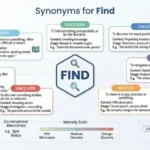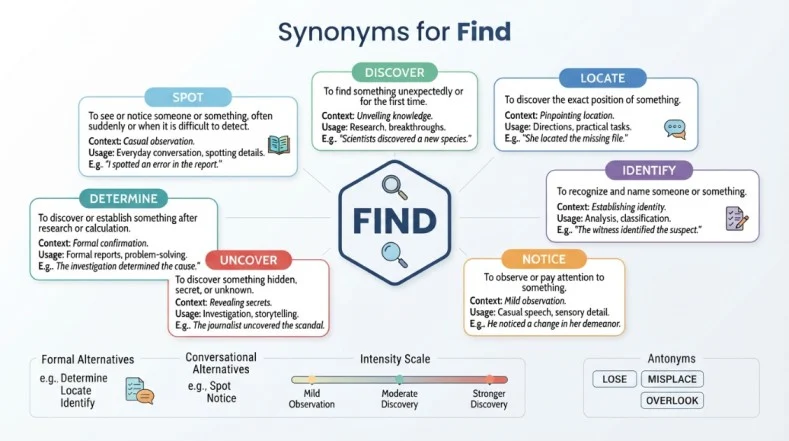
Do you keep using the word “find” in emails, essays, captions, conversations, or professional writing? The word is useful, but repeating it can make your writing feel predictable.
The good news is that you have many alternatives. Depending on your meaning, you can use words such as discover, locate, identify, detect, encounter, uncover, determine, or obtain.
The right synonym depends on what you actually mean. Finding a lost object is different from finding information, finding a solution, finding a person, or finding something emotionally meaningful.
This guide explains the most useful synonyms for find, including their meanings, tone, formality, examples, and best contexts. It also shows which alternatives work well in academic writing, professional communication, resumes, conversations, creative writing, and social media.
What Does “Find” Mean?
“Find” means to discover, locate, notice, identify, obtain, or reach something after looking for it or becoming aware of it. Formal choices include determine and ascertain, while casual choices include spot, notice, and come across.
Meaning, Tone and Context
Simple Definition
The verb “find” generally means to discover or locate something, especially after looking for it.
For example:
“I found my keys under the sofa.”
It can also mean discovering information, reaching a conclusion, experiencing something, or judging something in a particular way.
For example:
“We found the results encouraging.”
Part of Speech
“Find” is primarily a verb.
Its common forms are:
Find: present tense
Found: past tense
Found: past participle
Finding: present participle
The noun “finding” is also common, especially in academic, medical, scientific, and professional contexts.
Example:
“The researchers reported an important finding.”
Tone
“Find” is usually neutral.
It does not automatically sound positive or negative. Its emotional effect depends on the surrounding sentence.
“I found an interesting book.”
This sounds positive or curious.
“I found evidence of an error.”
This sounds neutral but may introduce a negative situation.
“I found the experience deeply moving.”
This carries an emotional tone.
Formality Level
“Find” works in almost every level of English.
It is appropriate in casual conversations, school assignments, emails, business communication, reports, and professional writing.
However, more precise alternatives can improve formal writing when the exact meaning is important.
For example:
“Researchers found a pattern.”
More precise:
“Researchers identified a pattern.”
Common Use Cases
You may use “find” when you:
- Locate a person or object
- Discover information
- Notice something
- Identify a problem
- Reach a conclusion
- Obtain something
- Encounter someone or something
- Decide that something has a particular quality
- Discover a solution
- Recover something that was lost
When and How to Use “Find”
“Find” is useful when you want a simple, flexible verb that communicates discovery, location, recognition, or judgment.
Professional Example
“We found several issues in the original report.”
Here, “identified” may sound more precise in a formal business report.
Personal Example
“I finally found my old photo album.”
This is a natural everyday use of “find.”
Academic Example
“The study found a strong relationship between the two variables.”
In academic writing, “identified” or “observed” may sometimes provide greater precision.
Emotional Example
“I found the conversation surprisingly comforting.”
Here, “found” describes a personal reaction or judgment.
Creative Example
“She found a quiet path through the forest.”
The word creates a simple sense of discovery.
Social Media Example
“Found the perfect coffee shop today.”
This is a natural informal caption.
Email Example
“I found the document you requested.”
This sounds clear and professional.
Resume Example
“I found opportunities to improve customer response times.”
For a resume, a stronger verb such as “identified” or “uncovered” may communicate the action more specifically.
Another Word for “Find”
There is no single best replacement for “find” in every situation. The best synonym depends on what you are trying to communicate.
Professional Writing
Use “identify,” “determine,” “locate,” or “uncover” when you want greater precision.
Academic Writing
Use “identify,” “observe,” “determine,” “establish,” or “ascertain” when the context supports those meanings.
Casual Conversation
Use “spot,” “notice,” “come across,” or simply “find.”
Emotional Writing
Use “discover,” “encounter,” “realize,” or “come across” when the emotional context supports them.
Creative Writing
Use “discover,” “encounter,” “uncover,” “stumble upon,” or “come across.”
Resume or Workplace Use
Use “identified,” “uncovered,” “determined,” “located,” or “secured” when these accurately describe your achievement.
Social Media Captions
Use “found,” “discovered,” “spotted,” or “came across.”
Stronger Meaning
“Uncover,” “detect,” and “track down” can sound stronger because they suggest effort, investigation, or successful discovery.
Softer Meaning
“Notice,” “come across,” and “encounter” can sound more observational and less forceful.
When Not to Use “Find”
“Find” is rarely wrong, but it can sometimes be too broad.
When the Discovery Required Investigation
Instead of:
“We found the cause of the problem.”
Consider:
“We identified the cause of the problem.”
“Identified” emphasizes recognition and analysis.
When You Want to Emphasize Investigation
Instead of:
“The journalist found new evidence.”
Consider:
“The journalist uncovered new evidence.”
“Uncovered” suggests that the evidence was not immediately obvious.
When You Mean Physical Location
“Locate” can be more precise than “find.”
Instead of:
“Can you find the file?”
You might write:
“Can you locate the file?”
When You Mean a Formal Conclusion
Instead of:
“The researchers found that the treatment was effective.”
Depending on the context, you might use:
“The researchers determined that the treatment was effective.”
When You Mean Obtaining Something
“Find” may be too vague when you actually mean obtaining or securing something.
Instead of:
“She found a new client.”
Consider:
“She secured a new client.”
Words Commonly Confused With “Find”
Find vs. Discover
“Find” is broader. “Discover” emphasizes learning about something previously unknown.
“I found the report.”
“I discovered a new pattern in the report.”
Find vs. Locate
“Locate” specifically emphasizes determining where something or someone is.
“I found my phone.”
“I located the missing equipment.”
Find vs. Identify
“Identify” means recognizing or establishing what something is.
“We found the problem.”
“We identified the source of the problem.”
Find vs. Notice
“Notice” means becoming aware of something through observation.
“I found a mistake in the document.”
“I noticed a mistake in the document.”
Find vs. Determine
“Determine” emphasizes reaching a conclusion after analysis, investigation, or reasoning.
“We found the cause.”
“We determined the cause.”
Find vs. Encounter
“Encounter” means coming into contact with someone or something, often unexpectedly.
“I found an old friend at the event.”
“I encountered an old friend at the event.”
Best Synonym by Context for “Find”
| Context | Best Synonym | Why It Works | Example |
|---|---|---|---|
| Formal writing | Determine | Emphasizes reaching a conclusion | The committee determined the main cause. |
| Academic writing | Identify | Suggests recognizing a specific factor | Researchers identified three major patterns. |
| Professional use | Locate | Clearly describes finding a physical or digital item | Please locate the original contract. |
| Resume | Uncovered | Shows discovery and initiative | Uncovered reporting errors that affected monthly totals. |
| Business use | Secure | Works when finding means successfully obtaining something | The team secured a new partnership. |
| Casual conversation | Spot | Sounds natural and conversational | I spotted your car outside. |
| Creative writing | Discover | Adds a sense of exploration | She discovered a hidden garden. |
| Emotional writing | Encounter | Can suggest an unexpected personal experience | He encountered an old memory in the photograph. |
| Strong discovery | Uncover | Suggests revealing something hidden | The investigation uncovered new evidence. |
| Mild observation | Notice | Sounds factual and less dramatic | I noticed a small error. |
| Social media | Spot | Short, natural, and conversational | Spotted this beautiful view today. |
| Physical location | Locate | Focuses directly on position | We located the missing package. |
| Research | Establish | Works when evidence supports a conclusion | The study established a clear relationship. |
| Unexpected discovery | Come across | Suggests finding something by chance | I came across an interesting article. |
| Investigation | Track down | Suggests effort to find someone or something | We tracked down the missing records. |
| US usage | Find | Common and versatile in American English | I found the information online. |
| UK usage | Find | Equally standard and natural | I found the information online. |
Which Synonym Should You Choose?
Start by asking what “find” means in your sentence.
- If you mean locating something, choose “locate.”
- If you mean recognizing something, choose “identify.”
- If you mean learning something new, choose “discover.”
- If you mean noticing something, choose “notice.”
- If you mean reaching a conclusion, choose “determine” or “establish.”
- If you mean revealing something hidden, choose “uncover.”
- If you mean finding something unexpectedly, choose “encounter” or “come across.”
- If you mean obtaining an opportunity, customer, agreement, or resource, “secure” may be more accurate.
The best synonym is not necessarily the most sophisticated word. It is the word that expresses your intended meaning most accurately.
Real Life Examples of “Find” in Sentences
School
“I found three useful sources for my research paper.”
A more academic alternative could be:
“I identified three useful sources for my research paper.”
Workplace
“We found an error in the monthly report.”
A more precise version is:
“We identified an error in the monthly report.”
Writing
“The writer found a creative way to explain the concept.”
You could also say:
“The writer discovered a creative way to explain the concept.”
Conversation
“Did you find your keys?”
This is the most natural choice in everyday speech.
Social Media
“Found a beautiful little bookstore downtown.”
The casual wording works well for a social post.
Resume
“I found opportunities to reduce unnecessary expenses.”
A stronger professional version could be:
“I identified opportunities to reduce unnecessary expenses.”
“I found the file and attached it to this email.”
This is clear and natural professional communication.
Storytelling
“She found an old letter hidden inside the wooden box.”
“Discovered” could create a stronger sense of mystery.
25 Synonyms for “Find”
| Synonym | Simple Meaning | Best Used For | Example Sentence |
|---|---|---|---|
| Discover | Learn about or encounter something previously unknown | New information and experiences | She discovered a useful resource during her research. |
| Locate | Determine where something is | Physical or digital objects | We located the missing document. |
| Identify | Recognize or establish what something is | Research, analysis, and problems | The team identified the main source of the error. |
| Uncover | Reveal something hidden or unknown | Investigation and research | The investigation uncovered important evidence. |
| Detect | Notice or discover something that may be difficult to see | Problems, signals, and changes | The system detected an unusual pattern. |
| Notice | Become aware of something | Everyday observation | I noticed a small spelling mistake. |
| Spot | See or recognize something quickly | Casual speech and observation | She spotted her friend across the room. |
| Encounter | Come into contact with someone or something | Unexpected experiences | We encountered several challenges during the project. |
| Determine | Reach a conclusion through reasoning or investigation | Formal and academic writing | The researchers determined the likely cause. |
| Establish | Show or prove something with evidence | Research and formal writing | The study established a connection between the factors. |
| Ascertain | Discover something with careful investigation | Very formal writing | The auditor sought to ascertain the source of the discrepancy. |
| Learn | Gain information or knowledge | Information and personal discovery | I learned the answer during the meeting. |
| Realize | Become aware of a fact or situation | Thoughts and personal understanding | She realized that she had made an incorrect assumption. |
| Retrieve | Get something back after searching for it | Files, objects, and information | He retrieved the document from the archive. |
| Recover | Get something back after it was lost | Lost objects, data, and information | The technician recovered the deleted files. |
| Obtain | Get or acquire something | Formal and professional contexts | The researcher obtained additional data. |
| Secure | Successfully obtain or arrange something | Business, jobs, contracts, and opportunities | The company secured a major client. |
| Encounter | Come upon something unexpectedly | Experiences and situations | I encountered an interesting idea while reading. |
| Come across | Find or discover something by chance | Casual conversation and writing | I came across an excellent article yesterday. |
| Track down | Find something or someone after effort | Investigation and searches | The reporter tracked down the original source. |
| Seek out | Deliberately look for something or someone | Intentional searching | She sought out expert advice before making a decision. |
| Stumble upon | Discover something unexpectedly | Casual and creative writing | We stumbled upon a quiet café while exploring the city. |
| Uncover | Bring hidden information to light | Investigative contexts | The review uncovered several inconsistencies. |
| Observe | Notice something through careful attention | Academic and professional settings | The researchers observed a significant change. |
| Deem | Judge or consider something to have a particular quality | Formal evaluation | The committee deemed the proposal acceptable. |
Note: Some alternatives overlap with only one specific meaning of “find.” Always choose according to the intended sense rather than replacing the word mechanically.
Synonym Groups and Usage Differences
Professional vs. Personal Synonyms
Personal communication often favors simple words such as “find,” “notice,” “spot,” and “come across.”
Professional writing benefits from greater precision. Words such as “identify,” “determine,” “locate,” “uncover,” and “establish” can make the action clearer when they accurately describe what happened.
Formal vs. Conversational Synonyms
“Find,” “spot,” “notice,” and “come across” are comfortable in ordinary conversation.
“Determine,” “ascertain,” “establish,” and “identify” are more suitable when the writing requires precision or a formal tone.
For example:
Casual:
“I found an interesting article.”
Formal:
“I identified a relevant source for the report.”
Academic Synonyms
Academic writing often benefits from words that show exactly how information was obtained.
Useful choices include:
“Identify”
“Determine”
“Establish”
“Observe”
“Detect”
“Ascertain”
However, a sophisticated word is not automatically better. The word should accurately describe the research process.
Professional and Business Synonyms
In business writing, “find” can often be replaced with a more specific action verb.
- Use “identify” for problems or opportunities.
- Use “locate” for documents and resources.
- Use “determine” for conclusions.
- Use “secure” for clients, contracts, partnerships, or opportunities.
- Use “uncover” for hidden issues or information.
Creative or Literary Synonyms
Creative writing can use “discover,” “encounter,” “stumble upon,” “come across,” and “uncover” to add atmosphere.
“She found a door.”
“She discovered a door behind the ivy.”
The second sentence creates a stronger sense of mystery without changing the basic idea.
Slang or Modern Synonyms
There are no major slang replacements for “find” that work across all situations.
Informal expressions such as “spot,” “come across,” and “stumble upon” are more useful than forced slang.
Avoid slang when writing academic papers, resumes, formal reports, or important professional emails.
Strongest vs. Weaker Synonyms
A useful intensity scale is:
Mild observation: notice
Neutral discovery: find
Quick recognition: spot
Unexpected discovery: encounter
Intentional discovery: discover
Difficult discovery: track down
Hidden discovery: uncover
Careful determination: ascertain
The strongest choice depends on the situation. “Uncover” may sound stronger than “find” because it suggests something was hidden.
Emotional vs. Neutral Synonyms
Neutral:
“I found an interesting article.”
More personal:
“I discovered an inspiring article.”
More unexpected:
“I stumbled upon an inspiring article.”
More investigative:
“I uncovered important information.”
The surrounding context determines the emotional effect.
Antonyms of “Find”
“Find” has several meanings, so there is no single universal opposite. The following words can function as context dependent opposites when “find” means locate, discover, notice, obtain, or identify.
| Antonym | Meaning | Example Sentence |
|---|---|---|
| Lose | No longer have or cannot locate something | I lost my keys this morning. |
| Misplace | Put something somewhere and cannot remember where | I misplaced the document. |
| Overlook | Fail to notice something | We overlooked an important detail. |
| Miss | Fail to see, notice, or encounter something | I missed the sign near the entrance. |
| Ignore | Choose not to pay attention to something | Do not ignore the warning. |
| Hide | Put something where it cannot easily be found | She hid the gift in the closet. |
| Conceal | Keep something from being discovered | The report concealed important details. |
| Obscure | Make something difficult to see or understand | The wording obscured the main point. |
| Suppress | Prevent information from becoming known | The organization suppressed the findings. |
| Withhold | Keep information or something from someone | They withheld the relevant records. |
| Discard | Get rid of something rather than retain it | He discarded the old files. |
| Abandon | Leave something behind | They abandoned the search. |
| Reject | Refuse to accept or recognize something | The committee rejected the proposed solution. |
| Avoid | Stay away from someone or something | She avoided the area during the investigation. |
| Forget | Fail to remember something | I forgot where I placed the receipt. |
Comparison: “Find” vs. Similar Words
Find vs. Discover
The main difference is that “find” is broader, while “discover” often emphasizes learning about something previously unknown.
“Discover” can sound stronger and more exploratory.
“Find” is more general and conversational.
Example:
“I found an old photograph.”
“I discovered an old photograph inside a forgotten box.”
Find vs. Locate
“Locate” specifically focuses on determining where something or someone is.
“Locate” is more formal than “find.”
Example:
“I found the file.”
“I located the file in the archive.”
Find vs. Identify
“Identify” means recognizing, naming, or determining what something is.
“Identify” is often more precise and formal.
Example:
“We found the cause of the problem.”
“We identified the cause of the problem.”
Find vs. Notice
“Notice” means becoming aware of something.
Neither word is always stronger. The intended action determines the best choice.
Example:
“I found a mistake in the report.”
“I noticed a mistake in the report.”
Find vs. Determine
“Determine” means reaching a conclusion through investigation, evidence, or reasoning.
“Determine” is more formal.
Example:
“We found the cause.”
“We determined the cause.”
Find vs. Encounter
“Encounter” means coming into contact with someone or something.
It often suggests an unexpected experience.
Example:
“I found an old friend at the conference.”
“I encountered an old friend at the conference.”
Common Phrases and Expressions with “Find”
1. Find out
Meaning:
To discover information or learn a fact.
Example sentence:
“I need to find out when the meeting begins.”
2. Find a way
Meaning:
To discover a method or solution.
Example sentence:
“We will find a way to solve the problem.”
3. Find fault with
Meaning:
To identify or criticize problems in something or someone.
Example sentence:
“He always finds fault with minor details.”
4. Find your way
Meaning:
To discover how to reach a destination or manage a situation.
Example sentence:
“She found her way through the crowded station.”
5. Find yourself
Meaning:
To discover something about your own feelings, interests, or situation.
Example sentence:
“He found himself enjoying the new role.”
6. Find common ground
Meaning:
To discover shared beliefs, interests, or goals.
Example sentence:
“The two teams found common ground during the discussion.”
7. Find it difficult
Meaning:
To experience difficulty doing something.
Example sentence:
“Many students find it difficult to write concise essays.”
8. Find a solution
Meaning:
To discover or develop an answer to a problem.
Example sentence:
“The engineers found a practical solution.”
Common Mistakes to Avoid
1. Using “Find” When a More Precise Synonym Is Better
“Find” is correct, but it may not explain what actually happened.
Instead of:
“We found the cause.”
Consider:
“We identified the cause.”
2. Confusing “Find” With “Discover”
“Discover” usually emphasizes something previously unknown.
Do not automatically use “discover” for every instance of “find.”
3. Using a Casual Synonym in Formal Writing
“Spot” is natural in conversation but may sound too casual in a formal research report.
Use “identify” or “detect” when appropriate.
4. Using an Overly Dramatic Synonym
“Uncover” can suggest that something was hidden.
If you simply noticed a typo, “notice” is usually more accurate.
5. Repeating “Find” Too Often
Repeated use can make writing feel flat.
Look at the exact meaning and replace some instances with accurate alternatives such as “identify,” “locate,” “discover,” or “determine.”
6. Choosing the Wrong Emotional Tone
“Stumble upon” suggests an unexpected discovery.
“Track down” suggests effort.
“Identify” sounds analytical.
Choose according to the feeling and purpose of the sentence.
7. Using Slang in Academic or Professional Writing
Informal expressions can make formal writing sound less polished.
Use clear, standard vocabulary in resumes, academic papers, reports, and important workplace communication.
FAQs
What is the best synonym for “find”?
The best synonym depends on context. Use “locate” for position, “discover” for new information, “identify” for recognition, and “determine” for conclusions.
What is a formal synonym for “find”?
“Determine,” “ascertain,” “identify,” “establish,” and “locate” can serve as formal alternatives when their meanings accurately match the sentence.
What is an informal synonym for “find”?
“Spot,” “notice,” “come across,” and “stumble upon” are useful informal alternatives, especially in conversations and casual writing.
What is another word for “find” in professional writing?
Professional alternatives include “identify,” “locate,” “determine,” “uncover,” “establish,” and “secure,” depending on the intended meaning.
What is the difference between “find” and “discover”?
“Find” is a broad word for locating or becoming aware of something. “Discover” more strongly suggests learning about something previously unknown.
What is the opposite of “find”?
Depending on the meaning, possible opposites include “lose,” “misplace,” “overlook,” “miss,” “hide,” “conceal,” and “ignore.”
Conclusion
The word “find” is flexible, natural, and useful, but it does not always communicate the exact meaning you want.
Use “locate” when you mean finding a position, “identify” when you recognize something, “discover” when you learn something new, and “determine” when you reach a conclusion.
For professional writing, precise vocabulary can make your message clearer. For casual communication, simple words such as “find,” “spot,” and “notice” often sound more natural.
The best synonym for find is not the most complicated word. It is the word that accurately communicates your meaning, tone, and situation.
A practical vocabulary tip is to ask yourself one question before replacing “find”: What exactly happened? Did you locate, notice, discover, identify, obtain, or determine something? Your answer will usually reveal the strongest word choice.
Discover More Post:
- 25+ Synonyms for Frustrated | Meanings, Examples, and Best …
- 25+ Synonyms for Shadow | Meanings, Examples, and Best …
- 25+ Synonyms for Values | Meanings, Examples, and Best …