The word grace can describe elegant movement, kindness toward others, forgiveness, divine favor, or even extra time given to someone. That range makes it beautiful, but also easy to overuse.
If you keep writing grace in essays, emails, captions, stories, or professional communication, the right synonym can make your meaning much clearer.
This guide explains synonyms for grace by meaning, tone, formality, and situation. You will learn which alternatives work best in academic writing, professional communication, personal messages, creative writing, and everyday conversation.
The key is not simply finding another word for grace. It is choosing a word that preserves the exact meaning you want.
What Does “Grace” Mean?
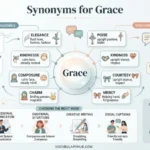
Grace can mean elegance, kindness, courtesy, forgiveness, divine favor, or a period of extra time. Formal choices include graciousness and decorum, while casual choices include charm and kindness. Creative writing may favor elegance, poise, or beauty.
Meaning, Tone and Context
1. Simple Definition
Grace has several important meanings.
It can describe smooth, controlled, and attractive movement or behavior.
For example:
“She moved across the stage with grace.”
It can also describe kindness, courtesy, or a willingness to forgive.
For example:
“She accepted the criticism with grace.”
In religious contexts, grace can refer to divine favor or unearned spiritual blessing.
For example:
“Many people view grace as a gift from God.”
Grace can also refer to extra time or special permission.
For example:
“The professor gave the students a three day grace period.”
2. Part of Speech
Grace is primarily a noun.
Examples include:
“Her grace impressed everyone.”
“He accepted the decision with grace.”
The related adjective is gracious.
Example:
“She was gracious to her guests.”
The adverb is graciously.
Example:
“He graciously accepted the invitation.”
The verb form is less common in ordinary modern English, although grace can appear as a verb in expressions such as “to grace the occasion.”
3. Tone
Grace is generally positive or respectful.
- When it describes behavior, it often suggests dignity, kindness, self control, or generosity.
- When it describes movement or appearance, it suggests elegance and refinement.
- When used in religious writing, it can have a spiritual meaning connected with divine favor or blessing.
4. Formality Level
Grace is suitable for casual, professional, academic, literary, and formal communication.
Its meaning changes according to context, so replacing it with a synonym requires attention to the intended sense.
For example, elegance may describe appearance, while mercy may describe compassionate treatment.
5. Common Use Cases
Grace commonly appears in discussions about:
- Physical movement
- Personal character
- Social behavior
- Beauty and elegance
- Forgiveness
- Religious belief
- Courtesy
- Difficult situations
- Professional conduct
- Extra time or special permission
When and How to Use “Grace”
Grace works best when you want to describe a quality that combines elegance, dignity, kindness, or generous behavior.
Professional
“Maria handled the difficult client with remarkable grace.”
Here, grace means calm, respectful, and controlled behavior.
Personal
“Thank you for treating my mistake with grace.”
The word suggests patience, kindness, and understanding.
Academic
“The author examines how grace functions as a symbol of forgiveness.”
Here, grace has a more conceptual and literary meaning.
Emotional
“She accepted the disappointing news with grace.”
The word suggests dignity and emotional control.
Creative
“The dancer crossed the stage with extraordinary grace.”
In this sentence, grace refers to beautiful and controlled movement.
Social Media
“Growing older with grace means appreciating every stage of life.”
Here, grace suggests dignity, acceptance, and positive character.
“Thank you for giving me the grace to correct the error.”
This use is understandable, although “additional time” or “opportunity” may sound more natural in many professional emails.
Another Word for “Grace”
The best single replacement depends heavily on what grace means in your sentence.
| Context | Recommended Alternative |
|---|---|
| Professional writing | graciousness |
| Academic writing | elegance |
| Casual conversation | charm |
| Emotional writing | dignity |
| Creative writing | poise |
| Resume or workplace use | composure |
| Social media captions | elegance |
| Stronger meaning | dignity |
| Softer meaning | kindness |
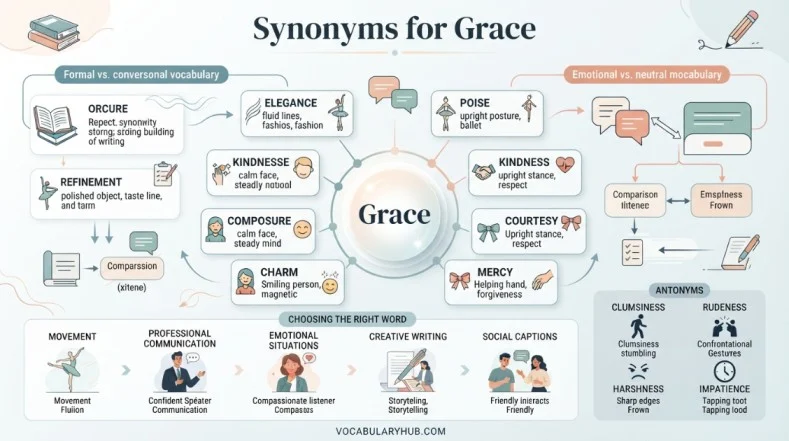
- If grace describes movement, elegance or poise may work best.
- If it describes treatment of another person, kindness, courtesy, or mercy may be more accurate.
- If it refers to religious favor, blessing is often a closer choice.
- If it refers to forgiveness, pardon or mercy may communicate the meaning more precisely.
When Not to Use “Grace”
Grace is a broad word, so it can become vague when the sentence requires a more specific idea.
For example:
“She showed grace after the mistake.”
This could mean she was forgiving, calm, polite, or dignified.
A more precise version would be:
“She showed mercy after the mistake.”
Or:
“She responded with patience after the mistake.”
Grace can also sound overly literary in simple workplace communication.
Instead of:
“We appreciate your grace regarding the delayed payment.”
You could write:
“We appreciate your patience regarding the delayed payment.”
The second sentence communicates the intended idea more directly.
Words Commonly Confused With “Grace”
Grace vs. Graciousness
Grace can refer to elegance, kindness, forgiveness, or divine favor.
Graciousness specifically emphasizes polite, kind, generous, and welcoming behavior.
Grace vs. Elegance
Elegance usually describes beauty, style, simplicity, or refined movement.
Grace can include elegance, but it also has meanings connected with kindness, forgiveness, and spirituality.
Grace vs. Mercy
Mercy means choosing not to punish or harm someone when punishment may be expected.
Grace can include mercy, but it has a broader range of meanings.
Grace vs. Courtesy
Courtesy means polite and considerate behavior toward other people.
Grace can suggest courtesy, but it often adds dignity, generosity, or emotional composure.
Grace vs. Poise
Poise means calm confidence and self control, especially under pressure.
Grace can include poise, but grace may also refer to physical elegance or kindness.
Grace vs. Charm
Charm refers to an appealing quality that attracts or delights people.
Grace is often more associated with dignity, elegance, kindness, or refined behavior.
Best Synonym by Context for “Grace”
| Context | Best Synonym | Why It Works | Example |
|---|---|---|---|
| Formal writing | graciousness | Sounds polished and respectful | Her graciousness impressed the committee. |
| Academic writing | elegance | Works well for style and refined expression | The essay has an unusual elegance. |
| Professional or business use | composure | Highlights calm behavior | She maintained composure during the meeting. |
| Resume | poise | Shows confidence and self control | Demonstrated poise during high pressure presentations. |
| Casual conversation | charm | Sounds natural and approachable | His charm made everyone feel welcome. |
| Creative writing | beauty | Adds descriptive and emotional depth | The scene captured the beauty of the morning. |
| Emotional tone | dignity | Highlights respectful self control | She faced the setback with dignity. |
| Strong intensity | mercy | Clearly communicates compassionate treatment | The judge showed mercy. |
| Soft or moderate tone | kindness | Sounds warm and approachable | Her kindness made the situation easier. |
| Social media captions | elegance | Concise and visually appealing | Choosing elegance over attention. |
| Religious context | blessing | Reflects spiritual favor | They considered the opportunity a blessing. |
| Social behavior | courtesy | Clearly communicates politeness | He treated everyone with courtesy. |
| Movement | poise | Describes controlled and confident movement | The performer moved with poise. |
| Style | refinement | Suggests polished quality | The room has a sense of refinement. |
| Difficult situations | composure | Emphasizes calm control | She responded with composure. |
Which Synonym Should You Choose?
Start by identifying what grace means in your sentence.
- If you mean beautiful movement, choose elegance or poise.
- If you mean polite treatment, choose courtesy or graciousness.
- If you mean compassionate treatment, consider mercy or kindness.
- If you mean calm behavior under pressure, choose composure or dignity.
- If you mean spiritual favor, blessing may be more precise.
- If you mean attractive personality, charm may sound more natural.
The best synonym is the one that preserves the original meaning while matching the tone of the sentence.
Real Life Examples of “Grace” in Sentences
School
“The student accepted the teacher’s correction with grace.”
A stronger alternative might be “The student accepted the correction with humility.”
Workplace
“She handled the difficult conversation with grace.”
For a resume, “She handled difficult conversations with composure” may sound more specific.
Writing
“The novelist describes the character’s final moments with grace.”
Here, grace suggests beauty, dignity, and emotional restraint.
Conversation
“Thanks for giving me some grace while I figure this out.”
In casual speech, grace can communicate patience and understanding.
Social Media
“Real confidence is carrying yourself with grace.”
Here, elegance, dignity, and self respect are all suggested.
Resume
“Maintained composure and professionalism during challenging customer interactions.”
This is more precise than simply saying “showed grace.”
“Thank you for your patience and understanding regarding the delay.”
This is generally clearer than using grace in a professional email.
Storytelling
“She left the room with quiet dignity, refusing to let the criticism define her.”
Here, dignity provides a more specific alternative to grace.
25 Synonyms for “Grace”
| Synonym | Simple Meaning | Best Used For | Example Sentence |
|---|---|---|---|
| Elegance | Attractive and refined quality | Style and movement | The pianist performed with remarkable elegance. |
| Poise | Calm confidence and control | Pressure and movement | She answered the difficult question with poise. |
| Graciousness | Kind and polite behavior | Social and professional situations | His graciousness made the guests feel welcome. |
| Courtesy | Polite and considerate behavior | Professional and social communication | She treated every customer with courtesy. |
| Kindness | Friendly and caring behavior | Personal situations | His kindness helped me through a difficult day. |
| Charm | An appealing personal quality | Personality and social situations | Her natural charm made conversation easy. |
| Dignity | Self respect and composed behavior | Difficult emotional situations | He accepted the criticism with dignity. |
| Composure | Calm self control | Stressful situations | She maintained her composure during the interview. |
| Refinement | Polished and sophisticated quality | Style and manners | The restaurant is known for its refinement. |
| Finesse | Skillful and delicate handling | Professional and creative situations | He solved the problem with considerable finesse. |
| Gentility | Polished and courteous manner | Formal social settings | Her gentility was noticeable at the formal dinner. |
| Decorum | Proper and respectful behavior | Formal environments | The discussion was conducted with decorum. |
| Mercy | Compassion shown toward someone | Punishment and forgiveness | The ruler showed mercy to the defeated soldiers. |
| Clemency | Reduced punishment or forgiveness | Legal and formal contexts | The prisoner requested clemency from the governor. |
| Leniency | Less severe treatment than expected | Rules and punishment | The manager showed leniency after the first mistake. |
| Pardon | Forgiveness for an offense | Personal and legal contexts | She asked for a pardon after realizing her mistake. |
| Forgiveness | Letting go of resentment or blame | Emotional situations | His forgiveness allowed the family to move forward. |
| Blessing | A beneficial gift or divine favor | Religious and spiritual contexts | They regarded the opportunity as a blessing. |
| Favor | Helpful treatment or approval | General and religious contexts | The project received favor from senior leadership. |
| Goodwill | Friendly and positive feeling | Business and relationships | The company built goodwill through honest communication. |
| Benevolence | Desire to help others | Formal and charitable contexts | The foundation is known for its benevolence. |
| Tact | Skill in handling sensitive matters | Communication | She used tact when discussing the employee’s mistake. |
| Beauty | Quality that creates pleasure or admiration | Creative and descriptive writing | The garden revealed its beauty at sunrise. |
| Polish | Refined quality or finish | Skills and professional presentation | His presentation showed impressive polish. |
| Patience | Ability to remain calm while waiting or dealing with difficulty | Personal and professional situations | Thank you for your patience while we resolved the issue. |
Synonym Groups and Usage Differences
Professional vs. Personal Synonyms
Professional writing often benefits from precise words such as composure, tact, courtesy, and graciousness.
Personal writing can use warmer choices such as kindness, charm, patience, and forgiveness.
For example, “She demonstrated composure during the negotiation” sounds professional.
“She treated my mistake with kindness” sounds more personal.
Formal vs. Conversational Synonyms
Formal writing may favor graciousness, decorum, benevolence, clemency, and dignity.
Conversational English usually favors kindness, patience, charm, or simply grace itself.
The more specialized a word sounds, the more carefully you should consider whether your audience will find it natural.
Academic Synonyms
Academic writing should prioritize precision.
Elegance works when discussing style or structure. Dignity may describe conduct. Mercy may be appropriate when analyzing ethical or social issues.
Avoid replacing grace with an elaborate word merely to sound academic. Precision matters more than complexity.
Professional and Business Synonyms
For emails, presentations, resumes, and workplace communication, composure, tact, courtesy, patience, and professionalism are often more precise.
For example:
“She showed grace during the meeting.”
can become:
“She maintained composure during the difficult meeting.”
The second sentence tells the reader exactly what quality was demonstrated.
Creative or Literary Synonyms
Creative writing allows more expressive choices.
Elegance, beauty, poise, charm, dignity, refinement, and finesse can create different emotional effects.
A writer might use elegance for movement, dignity for emotional strength, and beauty for visual description.
Slang or Modern Synonyms
Grace does not have a single slang equivalent that works across its major meanings.
In casual modern speech, words such as charm, kindness, patience, or class may sometimes communicate a related idea.
However, “class” has additional meanings and should not automatically replace grace.
Strongest vs. Weaker Synonyms
There is no universal intensity scale because grace has several meanings.
For compassionate treatment, a rough progression can be:
Kindness, mercy, leniency, clemency.
For refined behavior, a useful progression can be:
Courtesy, composure, poise, elegance.
These are not interchangeable scales. The correct choice depends on what aspect of grace you are describing.
Emotional vs. Neutral Synonyms
Emotional alternatives include forgiveness, mercy, kindness, dignity, and blessing.
More neutral alternatives include courtesy, composure, refinement, and tact.
Choose emotional vocabulary when you want readers to feel the human significance of the situation.
Choose neutral vocabulary when accuracy and professional clarity are more important.
Antonyms of “Grace”
Because grace has several meanings, its antonyms depend on the intended sense. The following words contrast with one or more common meanings of grace.
| Antonym | Meaning | Example Sentence |
|---|---|---|
| Clumsiness | Lack of physical coordination | His clumsiness made the movement difficult. |
| Awkwardness | Lack of ease or social confidence | Her awkwardness was noticeable during the introduction. |
| Rudeness | Lack of politeness | His rudeness upset the guests. |
| Discourtesy | Impolite behavior | The customer’s discourtesy created tension. |
| Harshness | Severe or unkind treatment | The harshness of the response surprised everyone. |
| Cruelty | Deliberate lack of compassion | The story focuses on the cruelty of the ruler. |
| Hostility | Unfriendly or antagonistic behavior | His hostility ended the discussion quickly. |
| Impatience | Lack of willingness to wait calmly | Her impatience became obvious during the delay. |
| Impoliteness | Failure to observe social courtesy | His impoliteness offended the audience. |
| Indifference | Lack of concern or interest | Her indifference made the problem worse. |
| Severity | Extreme strictness or harshness | The severity of the punishment caused concern. |
| Pettiness | Excessive concern with minor issues | His pettiness damaged the relationship. |
| Insensitivity | Failure to recognize another person’s feelings | The comment showed considerable insensitivity. |
| Aggression | Forceful or hostile behavior | The team’s aggression changed the tone of the meeting. |
| Condemnation | Strong expression of disapproval | The decision received public condemnation. |
Comparison: “Grace” vs. Similar Words
Grace vs. Elegance
The main difference is range.
Elegance usually focuses on beauty, refinement, style, or movement. Grace can describe those qualities but can also mean kindness, forgiveness, or divine favor.
Elegance is more specific for style. Grace is broader.
Example:
“The dancer moved with elegance.”
“She responded to the criticism with grace.”
Grace vs. Poise
Poise emphasizes calm confidence and self control.
Grace can describe calm behavior, but it also includes kindness and physical elegance.
Poise is more specific for pressure.
Example:
“She answered the interview questions with poise.”
“She accepted the difficult decision with grace.”
Grace vs. Courtesy
Courtesy means polite and considerate behavior.
Grace can include courtesy but usually suggests something broader or more refined.
Courtesy is more precise when discussing basic politeness.
Example:
“Please show courtesy to other passengers.”
“She accepted the criticism with grace.”
Grace vs. Mercy
Mercy concerns compassion toward someone who could otherwise receive punishment or harm.
Grace has a wider meaning and does not always involve punishment.
Mercy is stronger when forgiveness or reduced punishment is the central idea.
Example:
“The judge showed mercy.”
“She handled the criticism with grace.”
Grace vs. Charm
Charm refers to an appealing quality that attracts people.
Grace suggests elegance, dignity, kindness, or refinement.
Charm is more closely connected with personal appeal.
Example:
“Her charm made everyone smile.”
“Her grace became especially visible during the difficult moment.”
Grace vs. Dignity
Dignity emphasizes self respect and a composed sense of worth.
Grace can communicate dignity, but it may also describe physical elegance or generosity.
Dignity is more precise for maintaining self respect.
Example:
“He faced the loss with dignity.”
“She accepted the result with grace.”
Common Phrases and Expressions with “Grace”
1. With Grace
Meaning:
To behave calmly, elegantly, or respectfully, especially during a difficult situation.
Example sentence:
“She accepted the criticism with grace.”
2. Grace Period
Meaning:
An additional period of time allowed before a deadline, payment, or requirement takes effect.
Example sentence:
“The company offers a ten day grace period for late payments.”
3. State of Grace
Meaning:
A condition of spiritual favor or moral acceptance, especially in religious contexts.
Example sentence:
“The concept of a state of grace appears in several religious traditions.”
4. Fall From Grace
Meaning:
To lose respect, approval, status, or a previously favorable position.
Example sentence:
“The public figure experienced a dramatic fall from grace.”
5. Grace Under Pressure
Meaning:
The ability to remain calm and dignified during a stressful situation.
Example sentence:
“She demonstrated grace under pressure during the crisis.”
6. Saving Grace
Meaning:
A quality or feature that makes an otherwise difficult or disappointing situation better.
Example sentence:
“The friendly staff were the hotel’s saving grace.”
7. Say Grace
Meaning:
To pray before a meal, particularly in a religious context.
Example sentence:
“The family paused to say grace before dinner.”
8. By the Grace of God
Meaning:
An expression referring to divine help, protection, or favor.
Example sentence:
“By the grace of God, everyone arrived safely.”
Common Mistakes to Avoid
1. Using Grace When a More Precise Synonym Is Better
Grace is broad.
If you specifically mean patience, write patience. If you mean calm behavior, consider composure.
2. Confusing Grace With Elegance
Elegance is mainly about beauty, style, refinement, or movement.
Grace can describe those qualities, but it also covers kindness and forgiveness.
3. Using a Casual Synonym in Formal Writing
Words such as charm or class can sound less precise in academic or professional contexts.
Choose words such as courtesy, composure, dignity, or graciousness when appropriate.
4. Using an Overly Dramatic Synonym
Words such as mercy and clemency can sound too serious when you simply mean politeness.
Always match the synonym to the actual situation.
5. Repeating Grace Too Often
Repeated use can make an essay, story, or caption sound predictable.
Replace it with an accurate alternative when the meaning remains clear.
6. Choosing the Wrong Emotional Tone
Kindness, mercy, dignity, elegance, and charm create different emotional impressions.
Do not choose a synonym simply because it sounds sophisticated.
7. Using Specialized Vocabulary Without a Reason
Words such as benevolence, gentility, and clemency have specific uses.
Simple words are often stronger when they communicate the idea more directly.
FAQs
What is the best synonym for grace?
The best synonym depends on meaning. Elegance works for beauty and movement, while kindness, dignity, courtesy, mercy, or composure work for other contexts.
What is a formal synonym for grace?
Graciousness, dignity, decorum, refinement, benevolence, and courtesy can serve as formal alternatives, depending on the intended meaning.
What is an informal synonym for grace?
In casual conversation, kindness, charm, patience, or poise may replace grace when they match the specific meaning.
What is another word for grace in professional writing?
Composure, courtesy, tact, graciousness, patience, and dignity can work well in professional writing because they communicate specific workplace qualities.
What is the difference between grace and elegance?
Elegance mainly describes beauty, refinement, or style. Grace is broader and can also describe kindness, forgiveness, dignity, or divine favor.
What is the opposite of grace?
There is no single opposite because grace has several meanings. Depending on context, opposites include clumsiness, rudeness, cruelty, harshness, impatience, and hostility.
Conclusion
Grace is a versatile word that can describe elegance, dignity, kindness, forgiveness, courtesy, spiritual favor, or extra time.
The best synonym depends on the exact meaning. Choose elegance for refined beauty, poise for controlled confidence, courtesy for politeness, mercy for compassionate treatment, dignity for self respect, and composure for calm behavior.
When choosing synonyms for grace, focus on meaning before style. A simple, precise word is usually more effective than an impressive word that changes the original idea.
A useful vocabulary habit is to ask yourself one question before replacing grace: “What quality am I actually trying to describe?” That answer will usually lead you to the strongest word choice.
Before publishing definitions or usage claims, verify them with trusted dictionaries such as Cambridge, Oxford, Merriam Webster, Collins, or Britannica.
Discover More Post:
- 25+ Synonyms for Frustrated | Meanings, Examples, and Best …
- 25+ Synonyms for Shadow | Meanings, Examples, and Best …
- 25+ Synonyms for Values | Meanings, Examples, and Best …