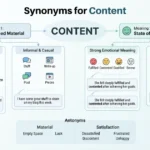
You may notice yourself using the word content again and again in blog posts, emails, essays, social media captions, and workplace communication. Sometimes you mean an article or information, while other times you mean feeling satisfied with a situation.
That is why choosing the right alternative matters. This guide to synonyms for content explains the meaning, tone, and context of each option, helping you choose clearer words such as material, information, copy, satisfied, pleased, or fulfilled.
What Does “Content” Mean?
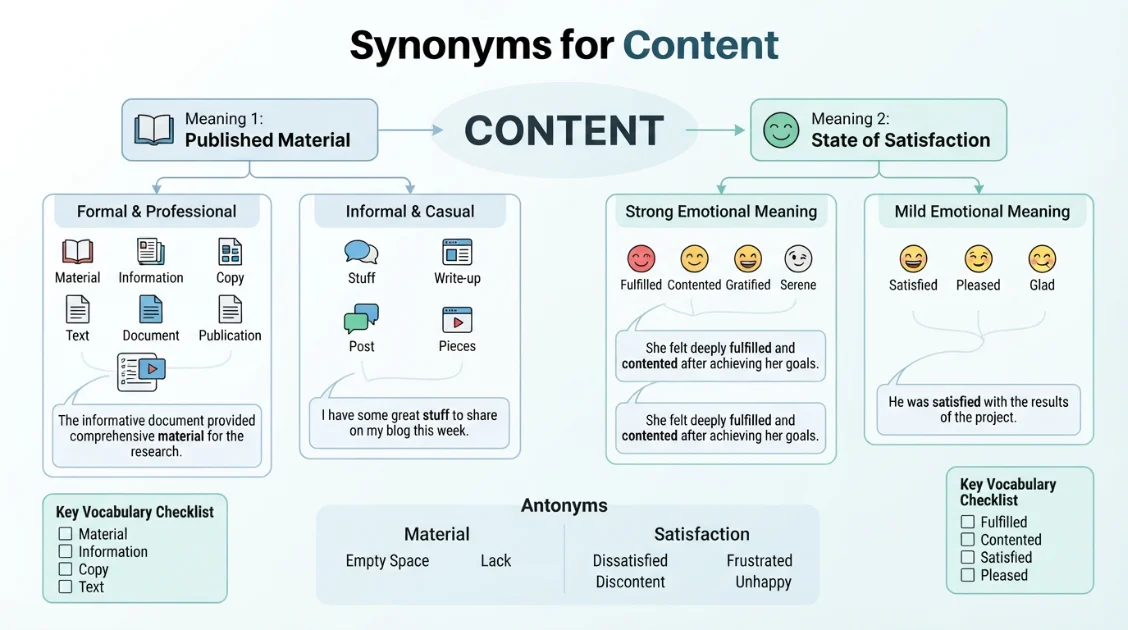
Content usually means the information, ideas, writing, images, videos, or other material presented through a website or communication channel. As an adjective, it means satisfied or at peace. Useful alternatives include material, information, text, satisfied, pleased, fulfilled, and at ease.
Meaning, Tone and Context
The word content has two especially common meanings.
1. Content as a noun
As a noun, content refers to the information, material, ideas, or creative work contained in something or shared with an audience.
For example:
The website publishes educational content for college students.
In this sentence, content means the material published by the website.
It can include articles, videos, images, podcasts, guides, social media posts, research, and other forms of communication.
2. Content as an adjective
As an adjective, content means satisfied, comfortable, or peacefully accepting a situation.
For example:
She was content with her decision.
Here, content does not mean information. It describes an emotional state.
Tone and Formality
As a noun, content is generally neutral and extremely common in professional, academic, digital, and everyday communication.
As an adjective, content is also neutral to positive. It often suggests quiet satisfaction rather than intense excitement.
Common Use Cases
You may see content used in:
- Blog writing
- Marketing
- Journalism
- Social media
- Education
- Business communication
- Academic writing
- Entertainment
- Personal conversations
- Emotional descriptions
Important Word Forms
Content: material or information, or satisfied.
Contented: satisfied and comfortable.
Contentment: a state of satisfaction or peaceful happiness.
Contentedly: in a satisfied or peaceful manner.
Content oneself: to accept or satisfy oneself with something, although this expression is less common in everyday American English.
When and How to Use “Content”
Use content when you need a broad term for information, communication, or published material.
It is particularly useful when the exact format is not important.
Professional Example
Our team is developing new content for the company website.
Here, content refers broadly to material intended for the website.
Personal Example
He felt content with the simple life he had built.
Here, content means satisfied.
Academic Example
The course content covers modern American literature.
In this context, content means the subjects and material included in the course.
Emotional Example
After finishing the project, Maya felt content with the result.
The adjective describes satisfaction.
Creative Example
The writer creates thoughtful content about family and identity.
Here, content refers to creative material.
Social Media Example
The brand posts educational content three times a week.
This is a common digital marketing use.
Email Example
Please review the content of the presentation before the meeting.
Here, content means the information contained in the presentation.
Another Word for “Content”
- The best replacement depends on which meaning of content you intend.
- For professional writing, material, information, or copy may be more precise when discussing published work.
- For academic writing, material, subject matter, or information often provides greater clarity.
- For casual conversation, stuff, material, or information may work depending on the sentence.
- For emotional writing, satisfied, pleased, fulfilled, or at ease can replace content when describing a person’s state.
- For creative writing, writing, prose, narrative, or material may provide more detail.
- For resumes and workplace communication, copy, material, documentation, or information may be better when describing a specific responsibility.
- For social media captions, post, media, material, or message can be more specific.
- For a stronger emotional meaning, fulfilled or deeply satisfied can communicate more than content.
- For a softer emotional meaning, at ease or comfortable can sound more understated.
When Not to Use “Content”
Content is convenient, but it can sometimes be too broad.
If you know exactly what you mean, a more precise word often improves the sentence.
Instead of:
Please update the website content.
You could write:
Please update the website copy.
Copy is more specific when you mean written marketing material.
Instead of:
The course has useful content.
You could write:
The course includes useful learning material.
Material makes the educational context clearer.
Instead of:
She was content with her life.
You could write:
She was fulfilled by her life.
This creates a stronger emotional meaning.
Avoid using content when the reader needs to know whether you mean an article, video, data, message, text, or another specific format.
Words Commonly Confused With “Content”
Content vs. Context
Content means what something contains.
Context means the surrounding circumstances or information that helps explain something.
Example:
The content of the article was useful.
The historical context helped readers understand the article.
Content vs. Material
Content is broad and common in digital communication. Material often refers to resources, documents, or information used for a particular purpose.
Example:
The website contains educational content.
The teacher provided additional study material.
Content vs. Information
Information specifically refers to facts, knowledge, or details.
Example:
The article contains useful information.
Content can include information, but it can also include entertainment, opinions, images, and creative work.
Content vs. Copy
Copy usually means written material created for advertising, marketing, websites, or other communication.
Example:
The marketing team reviewed the website copy.
Content is broader because it can include written, visual, and audio material.
Content vs. Subject Matter
Subject matter refers to the topic or area being discussed.
Example:
The subject matter of the book is difficult.
Content can refer to the entire material inside the book, not simply its topic.
Content vs. Substance
Substance can refer to the meaningful ideas or depth within something.
Example:
The article has plenty of content.
The article has little substance.
The first sentence discusses quantity or material. The second discusses meaningful depth.
Best Synonym by Context for “Content”
| Context | Best Synonym | Why It Works | Example |
|---|---|---|---|
| Formal writing | Material | Broad and professional | The report contains valuable material. |
| Academic writing | Subject matter | Clearly identifies the topic | The subject matter requires careful analysis. |
| Professional use | Information | Precise for facts and knowledge | Please review the information before the meeting. |
| Business use | Copy | Useful for written marketing material | The team approved the new website copy. |
| Resume | Documentation | Specific for records and supporting materials | Prepared documentation for client presentations. |
| Casual conversation | Stuff | Natural but informal | I saved some interesting stuff for later. |
| Creative writing | Prose | Specific to written literary expression | Her prose creates a vivid atmosphere. |
| Emotional tone | Satisfied | Direct replacement for adjective content | He felt satisfied with the outcome. |
| Strong emotional tone | Fulfilled | Suggests deeper personal satisfaction | She felt fulfilled by her career. |
| Soft emotional tone | At ease | Suggests calm comfort | He felt at ease in his new home. |
| Social media | Post | Specific to individual published material | Her latest post received thousands of views. |
| Digital marketing | Media | Useful for broader digital assets | The campaign uses several forms of media. |
| Educational use | Learning material | Clearly identifies study resources | Students received additional learning material. |
| Journalism | Coverage | Refers to reporting about a subject | The newspaper provided extensive coverage. |
| Creative project | Work | Broad term for a creative production | The artist displayed her latest work. |
| US usage | Content | Common and versatile | The company creates educational content. |
| UK usage | Content | Equally standard | The publisher produces digital content. |
Which Synonym Should You Choose?
Start by identifying what content means in your sentence.
- If you mean published information, consider material, information, copy, text, media, or documentation.
- If you mean the topic being discussed, subject matter may be more precise.
- If you mean meaningful depth, substance may be the better choice.
- If you mean a specific social media item, use post.
- If content describes someone’s emotional state, consider satisfied, pleased, fulfilled, or at ease.
Think about your audience too. A professional report may benefit from information or documentation, while a casual conversation may naturally use stuff.
Real Life Examples of “Content” in Sentences
School
The teacher added new content to the online course.
Workplace
Our marketing team creates content for several business channels.
Writing
The article contains useful content for new writers.
Conversation
I found some interesting content while researching the topic.
Social Media
The creator publishes educational content every week.
Resume
Developed written content for company newsletters and customer communications.
Please check the content of the attached proposal before sending it.
Storytelling
The emotional content of the story makes the ending memorable.
Emotional Use
After years of searching, she finally felt content with her life.
25 Synonyms for “Content”
Because content has more than one meaning, these are context based synonyms and close replacements. Some describe published material, while others describe the emotional meaning of content.
| Synonym | Simple Meaning | Best Used For | Example Sentence |
|---|---|---|---|
| Material | Information or resources | General professional use | The course provides useful material for beginners. |
| Information | Facts or knowledge | Academic and professional writing | The report contains important information. |
| Text | Written words | Articles, books, websites | The editor revised the text for clarity. |
| Copy | Written promotional material | Marketing and business | The agency created fresh copy for the campaign. |
| Media | Communication formats and materials | Digital and social platforms | The company produces educational media. |
| Subject matter | The topic being discussed | Academic and formal writing | The subject matter requires careful research. |
| Substance | Meaningful or important ideas | Analytical and critical writing | The article has real substance. |
| Writing | Written creative or informational work | Books, articles, essays | Her writing appeals to a wide audience. |
| Documentation | Organized written records | Business and technical settings | The documentation explains the new procedure. |
| Details | Specific pieces of information | Reports and explanations | The email includes all the necessary details. |
| Data | Collected facts or figures | Research and business | The dashboard displays current data. |
| Knowledge | Understanding or learned information | Educational contexts | The course gives students useful knowledge. |
| Message | Main idea or communication | Emails, campaigns, social media | The campaign has a clear message. |
| Narrative | A structured account or story | Creative and journalistic writing | The documentary presents a compelling narrative. |
| Prose | Ordinary written language | Literary and creative writing | The author’s prose is clear and elegant. |
| Publication | Material formally made available | Publishing and journalism | The publication includes several expert interviews. |
| Coverage | Reporting or treatment of a topic | Journalism and media | The newspaper provided detailed coverage. |
| Post | An individual online publication | Social media | Her latest post generated many comments. |
| Work | A creative or professional production | Art and writing | The gallery displayed his latest work. |
| Output | Material produced by a person or team | Business and professional settings | The team’s output increased this quarter. |
| Resource | Material used for learning or work | Education and professional development | The guide is a useful resource for students. |
| Contribution | Material added to a larger project | Collaborative work | Her contribution strengthened the final report. |
| Entertainment | Material intended to amuse or engage | Media and leisure | The platform offers entertainment for families. |
| Satisfied | Feeling pleased with a result or situation | Emotional meaning | She was satisfied with her decision. |
| Fulfilled | Experiencing deeper personal satisfaction | Emotional and personal writing | He felt fulfilled by his volunteer work. |
Synonym Groups and Usage Differences
Professional vs. Personal Synonyms
Professional writing usually benefits from precise words such as information, material, documentation, copy, and data.
Personal writing can use broader or more expressive choices such as writing, work, message, or stuff, depending on the situation.
For emotional uses, satisfied, pleased, and fulfilled are more useful than material related synonyms.
Formal vs. Conversational Synonyms
Formal writing often favors subject matter, documentation, material, information, and substance.
Conversational English may use stuff, writing, post, work, or material.
The most natural choice depends on what you are describing. Avoid replacing content with a more sophisticated word if the simpler word is already precise.
Academic Synonyms
Academic writing often benefits from information, subject matter, data, material, substance, and knowledge.
For example:
The study provides useful information about student behavior.
This is more precise than:
The study provides useful content about student behavior.
Professional and Business Synonyms
Business communication often requires specific vocabulary.
Use copy for marketing text, documentation for records, data for numerical information, information for facts, and material for broader resources.
For example:
The marketing team revised the website copy.
This is more precise than:
The marketing team revised the website content.
Creative or Literary Synonyms
Creative writing may benefit from words such as prose, narrative, writing, work, and message.
These words help readers understand what kind of content is being discussed.
Slang or Modern Synonyms
Stuff can replace content in casual speech when precision is not important.
For example:
I have a lot of stuff to read tonight.
However, stuff is too vague for academic papers, professional reports, resumes, and many business documents.
Strongest vs. Weaker Synonyms
For the emotional meaning of content, intensity can roughly move from calm to deeper satisfaction:
At ease → comfortable → content → pleased → satisfied → fulfilled
These words are not exact equivalents in every sentence, but the scale helps explain their typical emotional effect.
At ease suggests calmness.
Content suggests peaceful satisfaction.
Satisfied often suggests that a need, expectation, or goal has been met.
Fulfilled can suggest deeper personal meaning or emotional satisfaction.
Emotional vs. Neutral Synonyms
Neutral alternatives include information, material, text, data, and documentation.
More emotional alternatives include fulfilled, pleased, satisfied, and at ease.
Choosing between them depends on whether you want to communicate facts or feelings.
Antonyms of “Content”
The noun content, meaning published or contained material, does not have a simple set of direct antonyms.
The following table therefore focuses on content as an adjective meaning satisfied. These words describe opposite or contrasting emotional states.
| Antonym | Meaning | Example Sentence |
|---|---|---|
| Dissatisfied | Not satisfied | The customer was dissatisfied with the service. |
| Discontented | Unhappy with a situation | He felt discontented with his routine. |
| Unhappy | Experiencing sadness or dissatisfaction | She was unhappy with the decision. |
| Restless | Unable to feel calm or settled | He became restless during the long wait. |
| Unfulfilled | Lacking a sense of satisfaction or purpose | She felt unfulfilled in her old career. |
| Frustrated | Annoyed because something is not working as hoped | The student felt frustrated by the difficult assignment. |
| Displeased | Not pleased with something | The manager was displeased with the result. |
| Unsatisfied | Not having needs or expectations met | The client remained unsatisfied with the response. |
| Disgruntled | Annoyed or dissatisfied | Several employees became disgruntled after the change. |
| Unsettled | Not calm or emotionally secure | He felt unsettled after hearing the news. |
| Troubled | Experiencing worry or distress | She looked troubled after the conversation. |
| Agitated | Emotionally disturbed or upset | The passenger became agitated during the delay. |
| Anxious | Worried or uneasy | He felt anxious before the interview. |
| Concerned | Worried about a person or situation | She was concerned about the unexpected change. |
| Miserable | Extremely unhappy | He felt miserable after losing the opportunity. |
Comparison: “Content” vs. Similar Words
Content vs. Satisfied
Main difference: Content suggests peaceful acceptance, while satisfied often suggests that a specific need or expectation has been met.
Stronger: Satisfied can sound stronger when referring to a completed need or expectation.
More formal: Both are standard, but satisfied is especially common in professional feedback.
Content:
She was content with her quiet lifestyle.
Satisfied:
The customer was satisfied with the service.
Content vs. Happy
Main difference: Happy is a broad emotional word, while content suggests calm satisfaction.
Stronger: Happy can express more obvious positive emotion.
More formal: Content can sound more measured and restrained.
Content:
He was content with his current position.
Happy:
He was happy about his promotion.
Content vs. Fulfilled
Main difference: Content suggests satisfaction, while fulfilled often suggests deeper meaning or personal purpose.
Stronger: Fulfilled generally suggests deeper emotional satisfaction.
More formal: Both are appropriate in formal writing, but fulfilled can sound more reflective.
Content:
She felt content with her daily routine.
Fulfilled:
She felt fulfilled by helping other people.
Content vs. Information
Main difference: Content is a broad term for material, while information specifically refers to facts or knowledge.
Stronger: Neither is inherently stronger.
More formal: Information is often more precise in academic and professional writing.
Content:
The website contains educational content.
Information:
The website provides information about financial planning.
Content vs. Material
Main difference: Material usually refers to resources or material used for a purpose, while content is broader in digital communication.
Stronger: Neither is inherently stronger.
More formal: Material can sound slightly more formal in educational contexts.
Content:
The platform offers video content.
Material:
The instructor provided study material.
Content vs. Copy
Main difference: Copy usually refers specifically to written promotional or marketing text.
Stronger: Neither is inherently stronger.
More formal: Copy is standard professional terminology in marketing.
Content:
The company produces content for its website.
Copy:
The writer created copy for the landing page.
Content vs. Context
Main difference: Content is what something contains. Context is the surrounding information that helps explain it.
Stronger: Neither is stronger.
More formal: Both are common in formal writing.
Content:
The content of the article was useful.
Context:
The historical context changed how readers understood the article.
Common Phrases and Expressions with “Content”
1. Content creation
Meaning: The process of producing articles, videos, images, posts, or other communication material.
Example sentence:
Content creation has become an important part of digital marketing.
2. Content marketing
Meaning: A marketing approach that uses useful or engaging material to attract and retain an audience.
Example sentence:
The company uses content marketing to educate potential customers.
3. Content creator
Meaning: A person who produces material for digital or media platforms.
Example sentence:
The content creator shares practical writing advice online.
4. Content strategy
Meaning: A planned approach to producing, managing, and distributing useful material.
Example sentence:
The team developed a content strategy for the next quarter.
5. Content management
Meaning: The organization, editing, publishing, and maintenance of material.
Example sentence:
The company improved its content management process.
6. Content quality
Meaning: The usefulness, accuracy, clarity, and overall standard of published material.
Example sentence:
Improving content quality can make a website more helpful to readers.
7. Content calendar
Meaning: A schedule showing what material will be published and when.
Example sentence:
The marketing team updated its content calendar for September.
8. Content library
Meaning: An organized collection of existing material.
Example sentence:
The company built a content library for its sales team.
Common Mistakes to Avoid
1. Using Content When a Precise Word Is Better
Content can be vague.
Instead of saying:
Please update the content.
Say:
Please update the article text.
The second sentence tells the reader exactly what needs to change.
2. Confusing Content With Context
These words are related but different.
Content refers to what something contains. Context refers to the circumstances surrounding it.
3. Using a Casual Synonym in Formal Writing
Words such as stuff can sound too informal in academic or professional writing.
Use material, information, or another precise term instead.
4. Using an Overly Dramatic Emotional Synonym
Replacing content with fulfilled, ecstatic, or delighted can change the emotional intensity.
Use the stronger word only when the situation supports it.
5. Repeating Content Too Often
Digital writing frequently uses the word content several times in a paragraph.
Where appropriate, replace repeated uses with specific terms such as article, copy, information, video, post, material, or documentation.
6. Choosing the Wrong Emotional Tone
Content suggests calm satisfaction. It does not always mean excited, thrilled, or delighted.
Choose the synonym according to the emotion you actually want to communicate.
7. Using Slang in Academic or Professional Writing
Terms such as stuff may work in conversation but usually reduce precision in essays, reports, resumes, and formal emails.
FAQs
What is the best synonym for content?
The best synonym depends on meaning. Use material or information for published material, and satisfied or pleased when content describes a person’s emotional state.
What is a formal synonym for content?
Formal alternatives include material, information, subject matter, documentation, substance, and satisfied. The correct choice depends on the intended meaning.
What is an informal synonym for content?
In casual conversation, stuff can sometimes replace content when discussing general material. For emotional meaning, happy or pleased may work naturally.
What is another word for content in professional writing?
Professional alternatives include information, material, copy, documentation, data, and subject matter. Choose the word that identifies the exact type of material.
What is the difference between content and context?
Content means what something contains, while context means the surrounding information or circumstances that help readers understand its meaning.
What is the opposite of content?
When content means satisfied, common opposites include dissatisfied, discontented, unhappy, frustrated, unsettled, and unfulfilled. The exact choice depends on the situation.
Conclusion
The word content is useful because it covers several ideas, but its broad meaning can sometimes make writing less precise.
When discussing published material, consider information, material, copy, text, media, documentation, or subject matter.
When content describes an emotional state, words such as satisfied, pleased, comfortable, at ease, and fulfilled can communicate more specific shades of meaning.
The best synonym is not necessarily the most sophisticated word. It is the word that communicates your intended meaning, tone, and level of formality most clearly.
Before publishing vocabulary based content, verify definitions and subtle usage differences with trusted dictionaries such as Cambridge, Oxford, Merriam Webster, Collins, or Britannica.
A practical tip is simple: before replacing content, ask yourself you mean material, information, a specific type of media, or a feeling of satisfaction. That one distinction will usually lead you to a much better word.
Discover More Post:
- 25+ Synonyms for Frustrated | Meanings, Examples, and Best …
- 25+ Synonyms for Shadow | Meanings, Examples, and Best …
- 25+ Synonyms for Values | Meanings, Examples, and Best …