When you describe a person, product, idea, place, or organization, repeating the word “characteristics” can make your writing feel predictable. The right alternative can make a resume more precise, an essay more academic, or a description more engaging.
Understanding synonyms for characteristics is not simply about replacing one word with another. Each choice can change the level of formality, emphasis, emotional tone, or meaning.
This guide explains practical alternatives to “characteristics,” including which words work best in professional writing, academic essays, everyday conversation, creative descriptions, resumes, and social media.
What Does “Characteristics” Mean?
Characteristics are qualities, features, traits, or attributes that describe what makes a person, object, group, or idea recognizable or distinctive. Common alternatives include traits for people, features for things, attributes for formal writing, and qualities for general descriptions.
Meaning, Tone and Context
Simple Definition
Characteristics are the qualities, features, or traits that describe a person, thing, group, situation, or idea.
For example:
Patience and curiosity are important characteristics of an effective teacher.
Here, “characteristics” refers to qualities that help describe the teacher.
Part of Speech
“Characteristics” is a plural noun.
The singular form is characteristic.
Example:
Honesty is an important characteristic.
Plural:
Honesty and patience are valuable characteristics.
Tone
The word “characteristics” is generally neutral. It can describe positive, negative, or neutral qualities depending on the context.
Positive:
Leadership and empathy are valuable characteristics.
Negative:
Impulsiveness can be a difficult characteristic in stressful situations.
Neutral:
The report lists the main characteristics of the species.
Formality Level
“Characteristics” is moderately formal and works well in academic, professional, scientific, and general writing.
In casual conversation, people often use simpler alternatives such as “traits,” “qualities,” or “features.”
Common Use Cases
You can use “characteristics” when describing:
- Personality
- Behavior
- Products
- Animals
- Plants
- Organizations
- Writing styles
- Academic subjects
- Professional skills
- Physical appearance
- Geographic features
- Social groups
Important Word Forms
Characteristic: A quality or feature that describes something.
Characteristics: More than one quality or feature.
Characterize: To describe the distinctive qualities of something.
Characteristically: In a way that is typical of a particular person or thing.
Example:
The artist is characteristically bold in her use of color.
When and How to Use “Characteristics”
“Characteristics” is useful when you want to identify several qualities or features that describe something clearly.
Professional Example
The report identifies the key characteristics of successful project teams.
Personal Example
Kindness and patience are two of her strongest characteristics.
Academic Example
Researchers examined the physical characteristics of the species.
Emotional Example
Trust and compassion are important characteristics of a lasting friendship.
Creative Example
The old house had several distinctive characteristics, including tall windows and narrow hallways.
Social Media Example
These are some of the characteristics that make this travel destination unforgettable.
Resume Example
Strong communication and adaptability are characteristics I bring to collaborative projects.
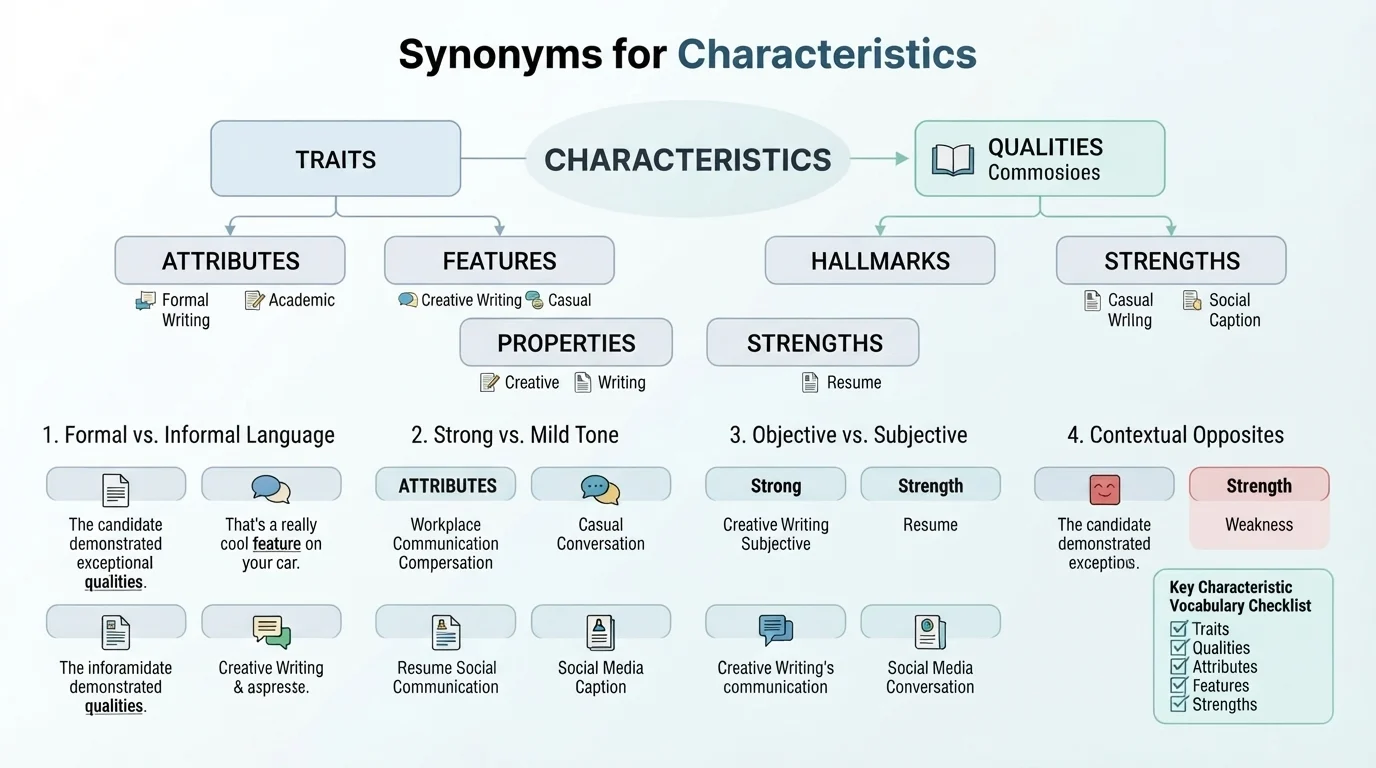
Another Word for “Characteristics”
The best single replacement depends on what you are describing.
- For professional writing, “attributes” or “qualities” often sound polished.
- For academic writing, “features,” “attributes,” or “properties” can provide greater precision.
- For casual conversation, “traits” or “qualities” usually sound natural.
- For emotional writing, “qualities” often works better because it can suggest personal value.
- For creative writing, “traits,” “features,” “details,” or “facets” can add descriptive depth.
- For resume or workplace use, “attributes,” “strengths,” or “qualities” may be more persuasive when discussing people.
- For social media captions, “features,” “traits,” or “qualities” are usually easier to read.
- For a stronger meaning, “hallmarks” can emphasize qualities that are especially distinctive.
- For a softer meaning, “features” or “aspects” can sound less evaluative.
When Not to Use “Characteristics”
“Characteristics” can sometimes be too broad. If your sentence identifies one specific quality, a more precise word may communicate the idea better.
Instead of:
Communication is one of the characteristics of a successful manager.
Consider:
Communication is an important skill for a successful manager.
- If you are describing a product, “features” may be clearer.
The phone has several useful features.
- If you are describing personality, “traits” may sound more natural.
Patience is one of his strongest traits.
- If you are describing a measurable scientific quality, “properties” may be more accurate.
The material has unique properties that make it resistant to heat.
The goal is not to avoid “characteristics.” The goal is to choose the word that communicates your exact meaning.
Words Commonly Confused With “Characteristics”
Characteristics vs. Traits
“Traits” usually refers to recognizable qualities of a person, personality, animal, or living thing.
“Characteristics” has a broader range and can describe people, objects, systems, and concepts.
Characteristics vs. Features
“Features” usually refers to noticeable parts or qualities of an object, product, place, or system.
“Characteristics” can be broader and more abstract.
Characteristics vs. Qualities
“Qualities” often suggests attributes that have value or meaning, especially when describing people.
“Characteristics” is more neutral.
Characteristics vs. Attributes
“Attributes” is a formal alternative that often appears in professional, technical, academic, and analytical writing.
Characteristics vs. Properties
“Properties” is especially useful for materials, substances, mathematics, science, and technical subjects.
Characteristics vs. Aspects
“Aspects” refers to particular parts or dimensions of something rather than qualities that define it.
Best Synonym by Context for “Characteristics”
| Context | Best Synonym | Why It Works | Example |
|---|---|---|---|
| Formal writing | Attributes | Polished and precise | The study identifies several important attributes. |
| Academic writing | Features | Clear and broadly applicable | The article examines the key features of the theory. |
| Professional use | Qualities | Natural when discussing people | Leadership is one of her strongest qualities. |
| Business use | Attributes | Suitable for analytical descriptions | The product has several valuable attributes. |
| Resume | Strengths | Focuses on useful personal abilities | Adaptability is one of my key strengths. |
| Casual conversation | Traits | Natural for people and personality | Patience is one of his best traits. |
| Creative writing | Details | Adds descriptive depth | Small details gave the room its unique identity. |
| Emotional tone | Qualities | Highlights personal value | Her kindness is one of her finest qualities. |
| Strong intensity | Hallmarks | Suggests defining qualities | Innovation is a hallmark of the company. |
| Mild or moderate tone | Aspects | Less evaluative and more neutral | Cost is one aspect of the decision. |
| Social media captions | Features | Easy to understand and concise | These features make the app especially useful. |
| Scientific use | Properties | Appropriate for measurable qualities | The material has unusual thermal properties. |
| Personality description | Traits | Common and natural | Curiosity is a valuable trait. |
| Product description | Features | Refers to useful or visible elements | The camera offers several advanced features. |
| Literary description | Facets | Suggests different sides of something | The novel explores many facets of identity. |
| Workplace evaluation | Attributes | Professional and analytical | Reliability is a valuable attribute. |
| Technical writing | Properties | Precise for measurable qualities | The chemical has distinctive properties. |
| Historical writing | Features | Works for identifiable elements | The architecture has several classical features. |
| Neutral analysis | Aspects | Focuses on individual dimensions | The report examines several aspects of the issue. |
| Describing behavior | Tendencies | Focuses on repeated behavioral patterns | His leadership tendencies became clear over time. |
Which Synonym Should You Choose?
Start by asking what exactly you are describing.
- If you are describing personality, choose “traits,” “qualities,” or “attributes.”
- If you are describing a product, choose “features.”
- If you are discussing science or materials, choose “properties.”
- If you are writing a resume, “strengths,” “qualities,” and “attributes” may be more useful.
- If you are writing an academic paper, consider “features,” “attributes,” “properties,” or “aspects,” depending on the subject.
- If you want a strong and distinctive expression, “hallmarks” can emphasize defining qualities.
- If you want a neutral expression, “aspects” is often a safe choice.
Always check whether your synonym preserves the original meaning. A word can be related to “characteristics” without being interchangeable in every sentence.
Real Life Examples of “Characteristics” in Sentences
School
The assignment asks students to identify the main characteristics of persuasive writing.
Workplace
Reliability and clear communication are important characteristics of an effective team member.
Writing
The author uses several characteristics of modern fiction in the novel.
Conversation
What characteristics do you value most in a friend?
Social Media
One of the best characteristics of this destination is its peaceful atmosphere.
Resume
The position requires characteristics such as adaptability, organization, and attention to detail.
I have attached a summary of the main characteristics discussed during the meeting.
Storytelling
Her quiet confidence was one of the characteristics that made her memorable.
25 Synonyms for “Characteristics”
| Synonym | Simple Meaning | Best Used For | Example Sentence |
|---|---|---|---|
| Traits | Personal or behavioral qualities | People and personality | Curiosity and patience are valuable traits. |
| Qualities | Descriptive attributes, often valued | People and general descriptions | Her strongest qualities are honesty and empathy. |
| Attributes | Identifying qualities or features | Professional and formal writing | Adaptability is an important attribute in this role. |
| Features | Noticeable or functional parts | Products, places, systems | The new phone includes several useful features. |
| Properties | Qualities belonging to a material or subject | Science and technical writing | The material has excellent insulating properties. |
| Aspects | Particular parts or dimensions | Analysis and general writing | Cost is an important aspect of the decision. |
| Elements | Individual parts that contribute to a whole | Academic and general writing | Several elements define the style of the building. |
| Markers | Signs that identify a quality or condition | Academic and analytical writing | Certain markers can indicate changes in behavior. |
| Indicators | Signs that point toward a condition or quality | Reports and analysis | Attendance can be an indicator of student engagement. |
| Hallmarks | Especially distinctive qualities | Strong descriptions | Creativity is a hallmark of her work. |
| Distinctions | Qualities that make something different | Comparison and analysis | The distinctions between the two methods are significant. |
| Peculiarities | Unusual or distinctive qualities | Detailed and descriptive writing | The region has several linguistic peculiarities. |
| Particulars | Specific details or qualities | Formal and detailed writing | The report explains the particulars of the proposal. |
| Details | Small pieces of descriptive information | General and creative writing | The details of the room created a welcoming atmosphere. |
| Facets | Different sides or dimensions | Abstract and creative subjects | The book explores several facets of human identity. |
| Dimensions | Different areas or sides of a subject | Academic and analytical writing | The research examines social and economic dimensions. |
| Tendencies | Patterns of behavior or inclination | People and behavior | His leadership tendencies became noticeable during the project. |
| Behaviors | Observable ways of acting | People, animals, and psychology | Certain behaviors are common among young children. |
| Habits | Repeated patterns of behavior | Personal behavior | Reading before bed is one of her daily habits. |
| Mannerisms | Distinctive ways of behaving or moving | Personality and storytelling | His unusual mannerisms made the character memorable. |
| Descriptors | Words used to describe something | Writing and analysis | The author uses vivid descriptors for the landscape. |
| Specifications | Detailed requirements or measurable details | Products and technical subjects | The product meets all required specifications. |
| Strengths | Positive abilities or qualities | Resumes and professional writing | Organization is one of her greatest strengths. |
| Distinguishing features | Qualities that make something recognizable | Identification and description | The building has several distinguishing features. |
| Defining qualities | Qualities that strongly establish identity | Formal, creative, and analytical writing | Persistence is one of his defining qualities. |
Synonym Groups and Usage Differences
Professional vs. Personal Synonyms
Professional writing often benefits from words such as “attributes,” “qualities,” “strengths,” and “features.”
For personal descriptions, “traits,” “qualities,” “habits,” and “mannerisms” tend to sound more natural.
Compare:
Adaptability is an important professional attribute.
Patience is one of her best personal traits.
Both sentences work, but the vocabulary matches the context.
Formal vs. Conversational Synonyms
Formal writing often favors “attributes,” “properties,” “aspects,” “dimensions,” and “elements.”
Conversational English commonly uses “traits,” “qualities,” “features,” and “details.”
For an academic essay:
The study examines several important attributes of effective leadership.
For casual conversation:
What traits do you look for in a good friend?
Academic Synonyms
Academic writing requires precision rather than unnecessary complexity.
Useful choices include “features,” “attributes,” “properties,” “aspects,” “elements,” “dimensions,” and “indicators.”
- Choose “properties” when discussing measurable qualities of a substance or object.
- Choose “aspects” when discussing different parts of a broad topic.
- Choose “indicators” when a quality functions as evidence of another condition.
Professional and Business Synonyms
In workplace communication, “attributes,” “qualities,” “strengths,” “features,” and “specifications” can be useful.
- For people:
Communication is one of the candidate’s strongest attributes.
- For products:
The software includes several features designed to improve efficiency.
- For technical requirements:
The device meets the required specifications.
Creative or Literary Synonyms
Creative writing benefits from words that add texture and perspective.
“Traits,” “facets,” “details,” “mannerisms,” “peculiarities,” and “hallmarks” can create more specific descriptions.
For example:
Her nervous mannerisms revealed more than her words did.
This is more vivid than simply saying:
Her characteristics revealed more than her words did.
Slang or Modern Synonyms
There is no single slang replacement that works naturally for “characteristics” in every context.
Informal expressions such as “traits,” “features,” “things that stand out,” or “what makes it unique” are generally more natural than forcing slang into the sentence.
Academic and professional writing should usually avoid trendy expressions when a precise standard word is available.
Strongest vs. Weaker Synonyms
A useful intensity guide is:
Mild: aspects, details, elements
Moderate: features, qualities, attributes, traits
More distinctive: distinguishing features, defining qualities, hallmarks
The strongest option depends on the sentence. “Hallmark” is particularly useful when a quality strongly identifies a person, style, product, or organization.
Emotional vs. Neutral Synonyms
Neutral choices include “characteristics,” “features,” “aspects,” “elements,” and “attributes.”
More personal choices include “qualities,” “traits,” “strengths,” and “mannerisms.”
More distinctive choices include “peculiarities,” “hallmarks,” and “defining qualities.”
Choose neutral vocabulary when you want objective description. Choose emotionally meaningful words when your purpose is to praise, criticize, or create a stronger impression.
Antonyms of “Characteristics”
There is no single exact opposite of “characteristics” because the word refers to qualities or features rather than a simple state with one direct opposite.
The following are contextual opposites, not universal dictionary antonyms. They describe situations involving sameness, lack of distinction, or absence of identifiable qualities.
| Antonym | Meaning | Example Sentence |
|---|---|---|
| Sameness | Lack of meaningful difference | The two designs have a noticeable sameness. |
| Uniformity | Consistency without significant variation | The system was designed for uniformity. |
| Homogeneity | Similarity within a group | The sample showed considerable homogeneity. |
| Indistinguishability | Inability to tell things apart | The copies were nearly indistinguishable. |
| Featurelessness | Lack of noticeable features | The plain surface appeared almost featureless. |
| Anonymity | Lack of identifying characteristics | The design preserved the anonymity of the participants. |
| Genericness | Lack of distinctive identity | The genericness of the product made it less memorable. |
| Blandness | Lack of distinctive or interesting qualities | The writing suffered from blandness. |
| Typicality | Strong resemblance to what is usual | The example showed a high degree of typicality. |
| Normality | Conformity with what is expected | The results were within the expected range of normality. |
| Commonality | State of being common rather than distinctive | The commonality of the design reduced its uniqueness. |
| Standardization | Use of the same standard or form | Standardization reduced variation across the products. |
| Consistency | Lack of variation across instances | The process emphasizes consistency. |
| Simplicity | Absence of unnecessary complexity or detail | The simplicity of the design was intentional. |
| Lack of distinction | Absence of qualities that separate one thing from another | The lack of distinction made the two versions difficult to compare. |
Comparison: “Characteristics” vs. Similar Words
Characteristics vs. Traits
The main difference is scope. “Characteristics” can describe almost any identifiable quality, while “traits” commonly refers to personality, behavior, or inherited qualities.
“Traits” is more specific for people. “Characteristics” is broader.
Example:
Patience is an important characteristic of a teacher.
Patience is an important trait in a teacher.
Characteristics vs. Qualities
“Qualities” often carries a slightly more positive or evaluative tone.
“Characteristics” is more neutral.
Example:
The characteristics of the material were measured.
Her best qualities include patience and honesty.
Characteristics vs. Features
“Features” is especially useful for visible, functional, or noticeable parts of something.
“Characteristics” can refer to more abstract qualities.
Example:
The phone has several advanced features.
The material has several unusual characteristics.
Characteristics vs. Attributes
“Attributes” is a close formal synonym and works well in professional, academic, and analytical writing.
It can sound more deliberate and technical than “characteristics.”
Example:
Reliability is an important characteristic of the system.
Reliability is an important attribute of the system.
Characteristics vs. Properties
“Properties” is more specialized.
It is particularly appropriate when discussing scientific, physical, chemical, mathematical, or technical qualities.
Example:
The material has unusual characteristics.
The material has unusual thermal properties.
Characteristics vs. Aspects
“Aspects” means particular parts or dimensions of something.
A characteristic describes a quality, while an aspect identifies one area of consideration.
Example:
Durability is an important characteristic of the product.
Cost is an important aspect of the purchasing decision.
Common Phrases and Expressions with “Characteristics”
1. Key characteristics
Meaning: The most important qualities or features of something.
Example sentence: The report identifies the key characteristics of effective leadership.
2. Distinctive characteristics
Meaning: Qualities that make something noticeably different from others.
Example sentence: The bird has several distinctive characteristics that make identification easier.
3. Common characteristics
Meaning: Qualities shared by several people or things.
Example sentence: The two approaches have several common characteristics.
4. Physical characteristics
Meaning: Visible or measurable qualities related to appearance or structure.
Example sentence: The researcher recorded the physical characteristics of each specimen.
5. Personal characteristics
Meaning: Qualities associated with an individual’s personality or behavior.
Example sentence: Patience and honesty are valuable personal characteristics.
6. Defining characteristics
Meaning: Qualities that strongly identify something.
Example sentence: Curiosity is one of the defining characteristics of an effective researcher.
7. Main characteristics
Meaning: The primary qualities or features of something.
Example sentence: The article explains the main characteristics of the new system.
8. Unique characteristics
Meaning: Qualities that are unusual or not widely shared.
Example sentence: The region is known for its unique characteristics and traditions.
Common Mistakes to Avoid
1. Using “Characteristics” When a More Precise Word Is Better
A broad word can hide the exact meaning.
Instead of saying:
The product has many characteristics.
Try:
The product has several useful features.
2. Confusing Characteristics With Traits
“Traits” is especially natural for personality and behavior.
Use “properties” for scientific qualities and “features” for product functions.
3. Using a Casual Synonym in Formal Writing
Words that sound natural in conversation may not fit an academic report.
For formal writing, consider “attributes,” “features,” “properties,” or “aspects.”
4. Using an Overly Dramatic Synonym
“Hallmarks” suggests a defining or especially recognizable quality.
Do not use it for every ordinary feature.
5. Repeating “Characteristics” Too Often
Repeated use can make an article or essay feel monotonous.
Replace it with an accurate alternative when the context genuinely changes.
6. Choosing the Wrong Emotional Tone
“Qualities” can sound more positive than “characteristics.”
If you are writing objectively, “characteristics,” “features,” or “attributes” may be safer.
7. Using Informal Language in Academic Writing
Phrases such as “what makes it cool” may work in casual content but usually do not belong in formal academic analysis.
Choose precise vocabulary instead.
FAQs
What is the best synonym for characteristics?
The best synonym depends on context. Use “traits” for people, “features” for products, “attributes” for formal writing, and “properties” for scientific subjects.
What is a formal synonym for characteristics?
“Attributes” is one of the most useful formal synonyms for characteristics. “Properties,” “features,” and “aspects” can also work depending on the subject.
What is an informal synonym for characteristics?
“Traits” and “qualities” are natural informal alternatives when describing people. “Features” works well when discussing objects, products, or places.
What is another word for characteristics in professional writing?
“Attributes” is a strong professional alternative. “Qualities,” “features,” “strengths,” and “properties” may be more precise in specific workplace contexts.
What is the difference between characteristics and traits?
“Characteristics” has a broad meaning and can describe people, objects, systems, and ideas. “Traits” more commonly describes personality or behavioral qualities.
What is the opposite of characteristics?
There is no single exact opposite. Contextual opposites include sameness, uniformity, homogeneity, featurelessness, and lack of distinction.
Conclusion
“Characteristics” refers to qualities, traits, features, or other identifying aspects of a person, object, group, or idea. The best replacement depends on what you are describing and how precise your sentence needs to be.
Use traits for personality, features for products, attributes for professional writing, properties for scientific subjects, and qualities when discussing valued personal attributes.
The most useful vocabulary tip is simple: do not choose a synonym merely because it sounds different. Choose the word that preserves your meaning while matching the formality, tone, and context of your sentence.
If you are looking for synonyms for characteristics, focus on precision first and variety second. That approach makes your writing clearer, more natural, and more effective.
Read More Related Articles:
- 25+ Synonyms for Frustrated | Meanings, Examples, and Best …
- 25+ Synonyms for Framework | Meanings, Examples, and Best …