Have you ever written, “I felt happy,” “I felt nervous,” or “I felt that this was wrong” several times in the same paragraph? The word felt is useful, but repeating it can make writing sound flat.
Learning the right synonyms for felt helps you describe emotions, physical sensations, opinions, discoveries, and personal experiences with greater precision.
The best replacement depends on what you mean. A professional email may need experienced or perceived, while creative writing may benefit from sensed, endured, or experienced.
This guide explains the meaning of felt, its tone, common uses, similar words, contextual alternatives, and practical examples so you can choose vocabulary naturally.
What Does “Felt” Mean?
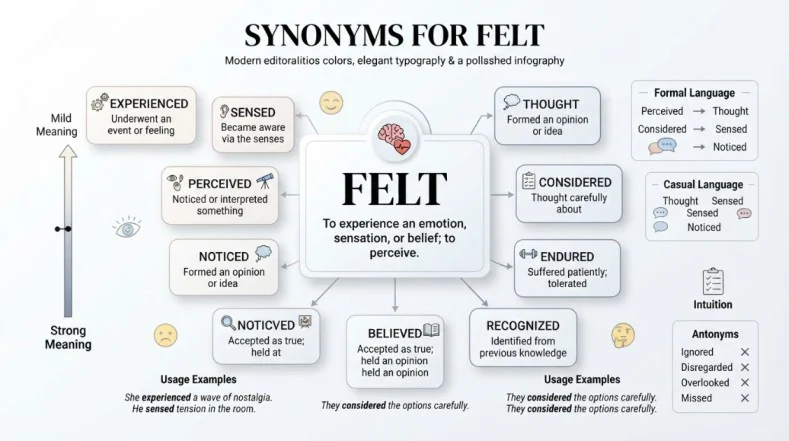
Felt is the past tense and past participle of feel. It can describe experiencing an emotion, noticing a physical sensation, sensing something, believing something, or having an opinion. Useful alternatives include experienced, sensed, perceived, believed, noticed, endured, and considered.
Meaning, Tone and Context
1. Simple Definition
Felt means experienced, sensed, noticed, or believed something in the past, depending on the sentence.
For example:
“I felt nervous before the interview.”
Here, felt means experienced an emotion.
“I felt a sharp pain in my shoulder.”
Here, felt refers to a physical sensation.
“She felt that the decision was unfair.”
Here, felt means believed or considered.
2. Part of Speech
Felt is primarily the past tense and past participle form of the verb feel.
Examples include:
- “I feel confident.”
- “I felt confident yesterday.”
- “I have felt confident since the training.”
The word can describe emotional, physical, mental, intuitive, or evaluative experiences.
3. Tone
Felt is generally neutral.
Its emotional effect depends on the surrounding words. “I felt relieved” sounds positive, while “I felt disappointed” expresses a negative experience.
The word can also sound personal because it often describes an individual’s internal experience.
4. Formality Level
Felt works in casual conversation, academic writing, professional communication, personal essays, emails, storytelling, and social media.
However, more precise alternatives can improve formal writing when you need to explain exactly what happened.
For example:
“I felt that the proposal was unclear.”
can become:
“I considered the proposal unclear.”
The second version sounds more analytical and direct.
5. Common Use Cases
Felt commonly describes:
- Emotions
- Physical sensations
- Personal opinions
- Intuition
- Awareness
- Experiences
- Pain or discomfort
- Reactions to events
- Perceptions
- Personal judgments
6. Related Word Forms
The main forms include:
Feel: present tense
Felt: past tense and past participle
Feeling: present participle and noun
Feelings: plural noun
For example:
“I feel confident today.”
“I felt confident yesterday.”
“Feeling confident helped me speak clearly.”
“Her feelings were understandable.”
When and How to Use “Felt”
Use felt when you are describing an experience that happened in the past.
It is especially useful when the experience involves emotion, sensation, intuition, or personal judgment.
1. Personal Context
“I felt relieved after receiving the good news.”
This clearly describes an emotional response.
2. Professional Context
“I felt that the meeting would benefit from a clearer agenda.”
Here, felt expresses a personal professional judgment.
3. Academic Context
“Students felt more confident after completing the practice exercises.”
This describes a reported experience.
4. Physical Context
“I felt a sudden pressure in my chest.”
Here, felt refers to a physical sensation rather than an opinion.
5. Emotional Context
“She felt disappointed when the event was canceled.”
Felt naturally introduces an emotional reaction.
6. Creative Context
“As the sun disappeared, he felt a strange sense of loneliness.”
The word works well when a writer wants to reveal an internal experience.
7. Casual Context
“I felt like staying home tonight.”
This is common conversational English.
Another Word for “Felt”
There is no single replacement that works in every sentence because felt has several meanings.
- For professional writing, experienced, perceived, or considered may work well.
- For academic writing, experienced, perceived, or reported can provide greater precision.
- For casual conversation, thought, sensed, or experienced may sound natural.
- For emotional writing, experienced, sensed, endured, or suffered may add useful detail.
- For creative writing, sensed, experienced, noticed, or endured can create more specific imagery.
- For resumes and workplace writing, experienced often communicates professional experience more clearly.
- For social media captions, experienced, enjoyed, loved, or sensed may work depending on the intended emotion.
- For a stronger meaning, endured, suffered, or experienced deeply may be appropriate.
- For a softer meaning, noticed, sensed, or perceived can be more restrained.
When Not to Use “Felt”
Felt is sometimes too general.
Compare:
“I felt something strange.”
with:
“I sensed something unusual.”
The second sentence gives the reader a clearer impression that the person detected something without necessarily knowing exactly what it was.
Felt can also be too vague in professional writing.
“I felt the presentation was weak.”
could become:
“I considered the presentation unclear and incomplete.”
The revised version identifies the specific judgment.
Avoid replacing felt with an overly dramatic word when the situation is ordinary.
“I suffered disappointment when my package arrived late.”
sounds much stronger than:
“I felt disappointed when my package arrived late.”
The second version is more natural.
Words Commonly Confused With “Felt”
Felt vs. Thought
Felt can describe an emotional or intuitive response. Thought usually describes a mental opinion, idea, or belief.
“I felt uncomfortable during the meeting.”
“I thought the meeting was too long.”
Felt vs. Sensed
Felt is broad, while sensed usually suggests detecting something through intuition or physical awareness.
“I felt nervous.”
“I sensed tension in the room.”
Felt vs. Experienced
Experienced emphasizes going through an event, condition, or situation.
“I felt sadness.”
“I experienced a difficult period.”
Experienced often sounds more formal.
Felt vs. Perceived
Perceived means became aware of or interpreted something through observation or judgment.
“I felt that the policy was unfair.”
“I perceived the policy as unfair.”
Perceived is more formal and analytical.
Felt vs. Noticed
Noticed emphasizes becoming aware of something.
“I felt a change in the room.”
“I noticed a change in the room.”
Noticed is usually more observational.
Felt vs. Believed
Believed focuses on accepting something as true.
“I felt that she was honest.”
“I believed that she was honest.”
Believed makes the statement sound more directly connected to a belief.
Best Synonym by Context for “Felt”
| Context | Best Synonym | Why It Works | Example |
|---|---|---|---|
| Formal writing | Perceived | Sounds precise and analytical | The change was perceived as beneficial. |
| Academic writing | Experienced | Clearly describes an individual’s experience | Participants experienced increased confidence. |
| Professional use | Considered | Expresses an evaluation clearly | The manager considered the proposal practical. |
| Resume | Experienced | Shows direct involvement with something | Experienced significant growth in customer engagement. |
| Casual conversation | Thought | Natural for everyday opinions | I thought the movie was great. |
| Creative writing | Sensed | Adds intuitive or atmospheric meaning | She sensed danger nearby. |
| Emotional writing | Experienced | Describes an emotion without exaggeration | He experienced deep disappointment. |
| Strong intensity | Endured | Suggests difficulty or prolonged hardship | She endured months of uncertainty. |
| Soft intensity | Noticed | Keeps the observation restrained | He noticed a slight change in tone. |
| Social media captions | Enjoyed | Works naturally for positive experiences | We enjoyed every moment of the trip. |
| Physical sensation | Detected | Focuses on recognizing a sensation or change | She detected a slight vibration. |
| Opinion | Believed | Clearly communicates personal conviction | I believed the decision was reasonable. |
Which Synonym Should You Choose?
Start by asking what felt means in your sentence.
- If it describes an emotion, consider experienced.
- If it describes physical awareness, consider sensed, noticed, or detected.
- If it describes an opinion, consider thought, believed, or considered.
- If it describes intuition, sensed is often more precise.
- If it describes hardship, endured or suffered may communicate stronger intensity.
For professional or academic writing, choose the synonym that explains the exact action rather than simply replacing felt with another broad word.
Real Life Examples of “Felt” in Sentences
School
“The student felt more prepared after reviewing the material.”
A more precise alternative could be:
“The student experienced greater confidence after reviewing the material.”
Workplace
“I felt that the team needed more time.”
A more professional alternative is:
“I considered the team in need of additional time.”
Writing
“The author felt the character needed more depth.”
A more analytical version is:
“The author considered the character underdeveloped.”
Conversation
“I felt tired after the long drive.”
This casual sentence sounds natural.
Social Media
“I felt so grateful for everyone who came to the celebration.”
A more expressive option is:
“I appreciated everyone who came to the celebration.”
Resume
“I felt confident leading the project.”
A resume usually benefits from a stronger action focused construction:
“I successfully led the project with confidence.”
“I felt that your suggestion could improve the process.”
A more direct professional version is:
“I believe your suggestion could improve the process.”
Storytelling
“She felt a sudden chill as she entered the empty house.”
A more atmospheric alternative is:
“She sensed a sudden chill as she entered the empty house.”
25 Synonyms for “Felt”
| Synonym | Simple Meaning | Best Used For | Example Sentence |
|---|---|---|---|
| Experienced | Went through something personally | Emotions, events, conditions | She experienced a strong sense of relief. |
| Sensed | Detected something through feeling or intuition | Intuition, atmosphere, physical awareness | He sensed tension in the room. |
| Perceived | Became aware of or interpreted something | Formal and academic writing | The participants perceived the change positively. |
| Thought | Had an opinion or idea | Casual and conversational writing | I thought the plan was reasonable. |
| Believed | Accepted something as true | Opinions and convictions | She believed the decision was fair. |
| Considered | Formed an opinion after reflection | Professional and formal writing | The committee considered the proposal practical. |
| Noticed | Became aware of something | Observation and everyday writing | He noticed a difference in her voice. |
| Detected | Discovered or recognized something | Technical and precise contexts | The device detected a small change. |
| Understood | Recognized the meaning or significance of something | Mental understanding | She understood the concern immediately. |
| Recognized | Identified or acknowledged something | Awareness and formal writing | He recognized the importance of preparation. |
| Endured | Went through something difficult | Pain, hardship, difficulty | They endured a challenging winter. |
| Suffered | Experienced pain, loss, or difficulty | Strong negative experiences | She suffered considerable disappointment. |
| Enjoyed | Experienced pleasure from something | Positive experiences | We enjoyed the evening together. |
| Appreciated | Recognized the value or importance of something | Gratitude and professional communication | I appreciated your thoughtful response. |
| Discovered | Came to know something through experience or observation | Learning and realization | He discovered a new sense of confidence. |
| Encountered | Came across or experienced something | Professional and formal contexts | The team encountered several technical problems. |
| Underwent | Went through a process or experience | Formal and professional contexts | The company underwent significant changes. |
| Experienced firsthand | Personally went through something | Professional and explanatory writing | She experienced the process firsthand. |
| Perceived | Interpreted something in a particular way | Academic and analytical contexts | The audience perceived the message differently. |
| Detected | Became aware of a physical or measurable change | Technical contexts | The sensor detected movement. |
| Registered | Became aware of or responded to something | Formal and technical contexts | The system registered a sudden increase. |
| Realized | Became aware of a fact or truth | Discovery and personal insight | He realized that he had made a mistake. |
| Knew | Had awareness or certainty | Simple conversational contexts | She knew something was wrong. |
| Feared | Experienced fear about something | Emotional writing | He feared that the opportunity would disappear. |
| Regarded | Considered something in a particular way | Formal writing | The researchers regarded the result as significant. |
Note: Several of these words overlap with only one meaning of felt. They should be selected according to the sentence rather than treated as interchangeable in every situation.
Synonym Groups and Usage Differences
Professional vs. Personal Synonyms
Personal writing often uses felt, thought, sensed, and experienced because these words communicate individual reactions naturally.
Professional writing often benefits from considered, perceived, experienced, recognized, or regarded because these choices can make the underlying judgment more explicit.
Formal vs. Conversational Synonyms
For formal writing, consider:
Perceived
Considered
Regarded
Experienced
Underwent
For conversation, these are usually more natural:
Thought
Felt
Knew
Noticed
Sensed
The most natural choice depends on the sentence, not simply on whether the situation is formal.
Academic Synonyms
Academic writing often requires precision.
Instead of:
“Participants felt more confident.”
you might write:
“Participants experienced greater confidence.”
If the study is specifically reporting participant perceptions, perceived or reported may be more accurate.
Choose the word that reflects what the evidence actually establishes.
Professional and Business Synonyms
Business communication often benefits from direct wording.
Instead of:
“I felt the report was unclear.”
consider:
“I considered the report unclear.”
Instead of:
“We felt that the process needed improvement.”
consider:
“We identified areas where the process could be improved.”
The second construction can sound more objective because it explains the basis of the statement.
Creative or Literary Synonyms
Creative writing often benefits from words that reveal atmosphere or emotion.
Sensed can create tension.
Endured can emphasize hardship.
Experienced can create emotional distance.
Suffered can communicate pain.
Noticed can keep the description subtle.
For example:
“She felt something behind her.”
is less specific than:
“She sensed someone standing behind her.”
Slang or Modern Synonyms
There is no single slang replacement for felt that works across all meanings.
Words such as vibed with can sometimes express a positive emotional reaction or connection in casual modern speech.
For example:
“I really vibed with the atmosphere.”
This is informal and should generally be avoided in academic papers, formal business documents, and professional resumes.
Strongest vs. Weaker Synonyms
A useful intensity scale is:
Noticed
Mild awareness.
Sensed
Moderate intuitive awareness.
Experienced
Neutral personal experience.
Endured
Strong experience involving difficulty.
Suffered
Very strong negative experience involving pain, loss, or hardship.
Intensity should match the situation. Using suffered for a minor inconvenience can sound exaggerated.
Emotional vs. Neutral Synonyms
Emotional choices include:
Suffered
Feared
Enjoyed
Appreciated
Endured
More neutral choices include:
Experienced
Perceived
Noticed
Considered
Recognized
Neutral words are often better when you want the sentence to sound factual rather than emotionally charged.
Antonyms of “Felt”
Because felt has several meanings, it does not have one universal opposite. The following are contextual opposites that can work depending on whether felt means experienced, sensed, believed, or noticed.
| Antonym | Meaning | Example Sentence |
|---|---|---|
| Ignored | Chose not to notice or respond | He ignored the warning. |
| Overlooked | Failed to notice something | She overlooked the small error. |
| Missed | Failed to detect or experience something | He missed the subtle change. |
| Dismissed | Rejected something as unimportant | The manager dismissed the concern. |
| Denied | Refused to accept something | She denied that there was a problem. |
| Doubted | Lacked confidence in a belief | He doubted the explanation. |
| Rejected | Refused to accept an idea or judgment | The committee rejected the proposal. |
| Disliked | Had a negative opinion instead of a positive response | She disliked the new design. |
| Remained indifferent | Did not experience a strong emotional response | He remained indifferent to the criticism. |
| Was unaware | Did not know or notice something | She was unaware of the change. |
| Misunderstood | Failed to understand correctly | He misunderstood the instructions. |
| Forgot | Failed to retain or recall something | She forgot the details of the conversation. |
| Neglected | Failed to give proper attention | The team neglected an important warning. |
| Disregarded | Chose not to consider something | He disregarded the advice. |
| Refrained | Chose not to experience or express a response in a given context | She refrained from expressing her opinion. |
These are contextual opposites rather than exact dictionary antonyms for every meaning of felt.
Comparison: “Felt” vs. Similar Words
Felt vs. Thought
The main difference is that felt often describes emotion, sensation, or intuition, while thought usually describes an opinion or mental judgment.
Thought is more precise when you are clearly expressing an opinion.
Example:
“I felt uncomfortable during the interview.”
“I thought the interview was too long.”
Felt vs. Sensed
Sensed is more specific when someone detects something through intuition or subtle awareness.
Sensed can sound slightly more descriptive and literary.
Example:
“She felt nervous.”
“She sensed tension in the room.”
Felt vs. Experienced
Experienced emphasizes personally going through an event or condition.
It is often more formal than felt.
Example:
“I felt disappointment.”
“I experienced disappointment.”
Felt vs. Perceived
Perceived emphasizes interpretation or awareness.
It is more formal and analytical.
Example:
“The change felt significant.”
“The participants perceived the change as significant.”
Felt vs. Noticed
Noticed focuses on becoming aware of something.
It usually sounds more observational than felt.
Example:
“I felt a change in temperature.”
“I noticed a change in temperature.”
Felt vs. Believed
Believed focuses on accepting something as true.
It is more direct when the sentence concerns conviction rather than emotion.
Example:
“I felt that he was honest.”
“I believed that he was honest.”
Common Phrases and Expressions with “Felt”
1. Felt like
Meaning:
Used to describe an inclination, impression, or experience.
Example sentence:
“I felt like taking a walk after dinner.”
2. Felt better
Meaning:
Describes an improvement in physical or emotional condition.
Example sentence:
“She felt better after getting some rest.”
3. Felt worse
Meaning:
Describes a decline in physical or emotional condition.
Example sentence:
“He felt worse after skipping lunch.”
4. Felt relieved
Meaning:
Describes the emotion that follows the removal of worry or pressure.
Example sentence:
“I felt relieved when the results arrived.”
5. Felt confident
Meaning:
Describes having a strong sense of self assurance.
Example sentence:
“She felt confident before giving her presentation.”
6. Felt uncomfortable
Meaning:
Describes physical or emotional uneasiness.
Example sentence:
“He felt uncomfortable discussing the issue in front of everyone.”
7. Felt strongly
Meaning:
Describes having a powerful opinion or emotional reaction.
Example sentence:
“Many employees felt strongly about the proposed change.”
8. Felt at home
Meaning:
Describes feeling comfortable and accepted in a place.
Example sentence:
“We immediately felt at home in the new neighborhood.”
Common Mistakes to Avoid
1. Using Felt When a More Precise Word Is Better
“I felt the temperature change.”
This is acceptable, but noticed or detected may be more precise when the focus is awareness.
2. Confusing Felt With Thought
“I felt the answer was correct.”
This can work, but thought or believed may be clearer when the sentence is specifically about an opinion.
3. Using a Casual Synonym in Formal Writing
“I really vibed with the presentation.”
This is conversational.
For professional writing, use:
“I responded positively to the presentation.”
4. Using an Overly Dramatic Synonym
“I suffered because my appointment was delayed.”
This may exaggerate an ordinary inconvenience.
“I felt frustrated because my appointment was delayed.”
is more natural.
5. Repeating Felt Too Often
A paragraph containing several instances of felt can sound repetitive.
Replace some instances with precise alternatives such as experienced, sensed, noticed, considered, or believed when the meaning supports them.
6. Choosing the Wrong Emotional Tone
Do not use suffered when you simply mean experienced.
Suffered communicates significant difficulty, pain, loss, or distress.
7. Using Slang in Academic or Professional Writing
Modern expressions can be useful in casual communication but may reduce the formality of an essay, report, resume, or business document.
Always match the vocabulary to the audience.
FAQs
1. What is the best synonym for felt?
The best synonym depends on meaning. Experienced is broadly useful, while sensed, perceived, thought, considered, and noticed work better for specific contexts.
2. What is a formal synonym for felt?
Perceived, considered, regarded, and experienced can work as formal alternatives when their meanings accurately match the original sentence.
3. What is an informal synonym for felt?
In casual conversation, thought, sensed, noticed, or simply experienced can replace felt depending on what you are describing.
4. What is another word for felt in professional writing?
Considered, perceived, experienced, recognized, or regarded can work in professional writing when they accurately express the intended meaning.
5. What is the difference between felt and sensed?
Felt is broader and can describe emotions, opinions, and physical sensations. Sensed specifically emphasizes detecting something through awareness or intuition.
6. What is the opposite of felt?
There is no single opposite for every meaning of felt. Contextual opposites include ignored, overlooked, missed, dismissed, doubted, and remained indifferent.
Conclusion
Felt is a flexible word that can describe emotions, physical sensations, opinions, intuition, awareness, and personal experiences. Its meaning changes significantly according to context.
For a more precise alternative, choose experienced for personal experiences, sensed for intuition, noticed for awareness, perceived for interpretation, thought for opinions, and considered for formal judgments.
The best synonym for felt is not necessarily the most sophisticated word. It is the word that communicates your exact meaning, tone, and level of intensity.
A simple vocabulary tip is to ask yourself one question before replacing felt: Am I describing an emotion, sensation, opinion, observation, or experience? Once you know that, the right synonym becomes much easier to choose.
Discover More Post:
- 25+ Synonyms for Dream | Meanings, Examples, and Best …
- 25+ Synonyms for Even Though | Meanings, Examples, and …
- 25+ Synonyms for Yelled | Meanings, Examples, and Best …