The word teach appears everywhere, from school assignments and professional emails to social media captions and workplace conversations. However, repeating the same word can make your writing feel predictable, especially when describing training, mentoring, explaining, or helping someone develop a skill.
Choosing the right synonym for teach makes your message more precise. A teacher might instruct students, a manager might train new employees, and an experienced professional might mentor a junior colleague. Although these words share a connection with teaching, each communicates a slightly different purpose.
This guide to synonyms for teach explains their meanings, differences, tone, and practical uses so you can choose natural alternatives for academic writing, business communication, creative work, and everyday conversation.
What Does “Teach” Mean?
To teach means to help someone gain knowledge, understand an idea, or develop a skill. Common synonyms include instruct, educate, train, tutor, guide, coach, mentor, and explain. The best alternative depends on whether you are sharing information, building practical skills, or supporting someone’s development.
Meaning, Tone and Context
What does teach mean?
Teach means to help another person learn something through explanation, demonstration, practice, guidance, or structured instruction. It can refer to sharing facts, developing abilities, or helping someone understand a concept.
For example, a science teacher teaches students about the solar system, while an experienced cook teaches a friend how to prepare a new recipe.
Part of speech
Teach is primarily a verb. It describes the action of helping someone learn.
- Present tense: teach
- Third person singular: teaches
- Past tense: taught
- Present participle: teaching
- Noun form: teaching, teacher
- Related adjective: teachable
Is teach positive, negative, or neutral?
Teach is generally a neutral or positive word. Its emotional effect depends on the context.
Teaching a child to read usually suggests a helpful activity. Teaching someone to deceive others, however, gives the same verb a negative context.
Formality level
Teach is appropriate in formal, informal, academic, and professional communication. It is clear and natural in most situations, although a more specific verb can communicate greater expertise or purpose.
Common uses of teach
- Education: teaching students mathematics.
- Professional development: teaching employees a new procedure.
- Personal guidance: teaching a child responsibility.
- Practical skills: teaching someone to drive.
- Communication: teaching an audience about a complex subject.
- Life experience: teaching someone a valuable lesson.
When and How to Use “Teach”
Use teach when you want to emphasize helping another person learn, whether through direct instruction, demonstration, experience, or ongoing guidance.
Here are seven examples from different contexts.
- Academic: Professor Lewis teaches introductory psychology at the university.
- Professional: Our supervisor will teach the team how to use the new software.
- Personal: My grandfather taught me how to repair a bicycle.
- Email: Could you teach me the correct procedure before the meeting?
- Creative writing: The difficult journey taught her the value of patience.
- Social media: Good mentors teach you to believe in your potential.
- Casual conversation: Can you teach me how to make your favorite pasta dish?
Notice that the sixth and seventh examples can also use show, guide, or coach, depending on the intended meaning.
Another Word for “Teach”
The best single replacement for teach is usually instruct when you mean giving organized directions or information. However, educate, train, mentor, and explain can be better choices when the purpose of learning differs.
| Context | Best alternative | Why it works |
|---|---|---|
| Professional writing | Instruct | Emphasizes clear direction and organized teaching |
| Academic writing | Educate | Highlights the development of knowledge and understanding |
| Casual conversation | Show | Sounds natural when demonstrating how to do something |
| Emotional writing | Guide | Suggests patient, supportive assistance |
| Creative writing | Enlighten | Emphasizes a new understanding or realization |
| Resume or workplace | Train | Highlights practical skills and job readiness |
| Social media captions | Inspire | Emphasizes motivation and positive influence |
| Stronger instructional meaning | Drill | Suggests repeated practice to build proficiency |
| Softer meaning | Help | Focuses on assistance without implying formal instruction |
Which alternative should you choose?
- Use instruct for organized directions or formal teaching.
- Use educate when developing knowledge and awareness.
- Use train when building practical or professional skills.
- Use mentor when offering long term career or personal guidance.
- Use coach when improving performance through feedback and practice.
- Use explain when making a concept easier to understand.
- Use guide when helping someone progress without doing everything for them.
When Not to Use “Teach”
Although teach is versatile, it can sound too general when the sentence requires a specific action.
Example 1: Professional communication
General: I teach new employees how to use the system.
More precise: I train new employees to use the system efficiently.
The second sentence highlights practical skill development.
Example 2: Academic writing
General: The article teaches readers about climate change.
More precise: The article educates readers about the causes and effects of climate change.
Educates emphasizes broader knowledge and awareness.
Example 3: Career development
General: She teaches junior employees.
More precise: She mentors junior employees throughout their professional development.
Mentors communicates ongoing guidance rather than simply delivering lessons.
Example 4: Everyday conversation
General: Can you teach me how to open this file?
More natural in many situations: Can you show me how to open this file?
Show is often the simplest choice when someone needs a quick demonstration.
Example 5: Creative writing
General: The experience taught him something important.
More expressive: The experience enlightened him about the importance of honesty.
Enlightened emphasizes a meaningful change in understanding, although it sounds more formal and elevated.
Words Commonly Confused With “Teach”
Several words connected with teaching overlap in meaning, but they are not always interchangeable.
| Word | Main difference | When to use it |
|---|---|---|
| Educate | Develops knowledge and understanding | Broad learning and awareness |
| Train | Builds practical ability through instruction and practice | Jobs, equipment, and procedures |
| Instruct | Gives organized directions or lessons | Formal settings and specific tasks |
| Tutor | Provides focused or individual academic support | Subjects, exams, and assignments |
| Mentor | Supports long term growth and development | Career guidance and personal development |
| Explain | Makes information or ideas understandable | Clarifying concepts or instructions |
For example, a tutor helps a student understand algebra, while a mentor may help that same student plan a career. Both support learning, but their responsibilities differ.
Best Synonym by Context for “Teach”
The right word depends on your audience, purpose, and intended tone. These recommendations cover common writing and speaking situations.
| Context | Best synonym | Why it works | Example |
|---|---|---|---|
| Formal writing | Instruct | Sounds organized and professional | The director instructed staff on the new procedure. |
| Academic writing | Educate | Emphasizes knowledge development | The program educates students about environmental issues. |
| Business communication | Train | Focuses on workplace skills | We train employees to handle customer inquiries. |
| Resume | Mentor | Shows professional support | Mentored junior colleagues during project development. |
| Casual conversation | Show | Feels friendly and natural | Show me how to fix this setting. |
| Creative writing | Enlighten | Suggests a meaningful realization | Her travels enlightened her about different cultures. |
| Emotional writing | Guide | Communicates care and support | Her mother guided her through difficult decisions. |
| Strong instructional emphasis | Drill | Highlights repeated practice | The instructor drilled the class on essential safety procedures. |
| Gentle assistance | Help | Avoids sounding overly formal | Can you help me understand this question? |
| Social media captions | Inspire | Emphasizes encouragement and influence | Great leaders inspire others to keep learning. |
| One to one education | Tutor | Highlights focused instruction | He tutors children in reading and writing. |
| Performance improvement | Coach | Emphasizes feedback and development | She coaches new speakers before presentations. |
| Technical demonstration | Demonstrate | Shows how something works | The technician demonstrated the equipment. |
| Sharing facts | Inform | Focuses on communicating information | The workshop informs residents about local services. |
| Career development | Mentor | Emphasizes ongoing guidance | Experienced managers mentor emerging leaders. |
| Practical preparation | Prepare | Focuses on readiness for a task | The course prepares students for professional exams. |
These are context based recommendations rather than strict rules. For example, instruct works in academic settings too, while educate can be appropriate in professional writing.
Which Synonym Should You Choose?
Before replacing teach, consider five factors.
- Meaning: Decide whether you are explaining information, developing a skill, giving advice, or supporting long term growth.
- Formality: Choose instruct or educate for formal contexts, and show or help for many everyday conversations.
- Emotional intensity: Use guide for supportive assistance and enlighten for a stronger sense of discovery.
- Professional value: Use train, coach, or mentor when describing employee development, leadership, and workplace achievements.
- Sentence context: Check whether the replacement fits the action and its grammatical structure.
For example, “I taught five employees the new process” can become “I trained five employees in the new process.” The second version is especially useful when describing practical workplace instruction.
Real Life Examples of “Teach” in Sentences
The following examples show how synonyms for teach can improve clarity in everyday and professional situations.
| Situation | Example sentence |
|---|---|
| School | The instructor explained the formula before assigning practice problems. |
| Workplace | The company trained new hires to use its customer service platform. |
| Writing | This guide educates readers about effective communication. |
| Conversation | Can you show me how to change the settings? |
| Social media | A great mentor inspires you to become a better version of yourself. |
| Resume | Coached a team of eight employees on presentation skills. |
| Could you instruct the new team members on the reporting process? | |
| Storytelling | Her grandmother taught her to remain hopeful during difficult times. |
| Technical training | The engineer demonstrated the correct equipment setup. |
| Career development | My supervisor mentored me through my first major project. |
The strongest replacement is not always the most sophisticated one. A familiar word that communicates the exact action is often more effective than a formal word chosen merely to sound impressive.
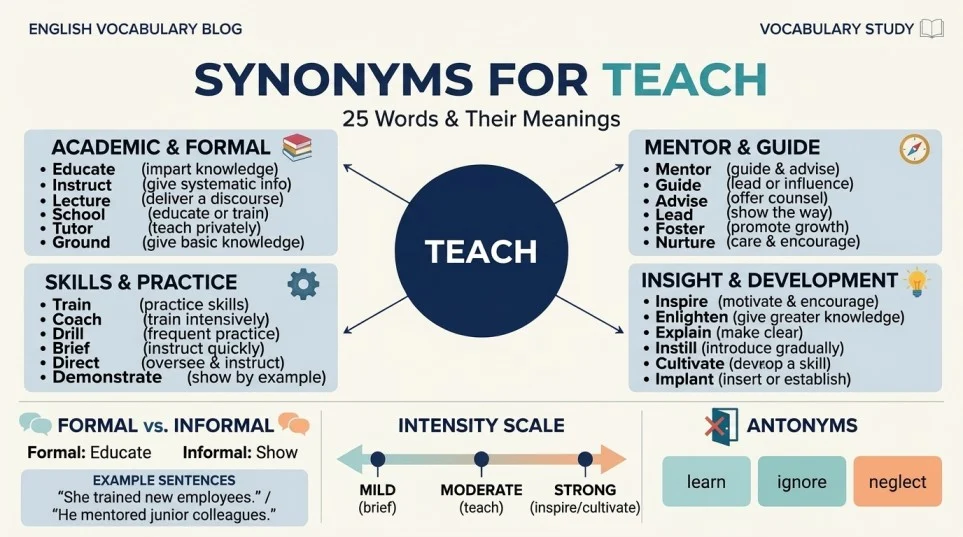
25 Synonyms for “Teach”
The following list includes 25 useful alternatives. Some describe direct instruction, while others refer to related activities such as demonstrating, mentoring, or preparing learners.
| Synonym | Simple meaning | Best used for | Example sentence |
|---|---|---|---|
| 1. Instruct | Give directions or lessons | Formal instruction | The trainer instructed staff on emergency procedures. |
| 2. Educate | Develop knowledge and understanding | Schools and public awareness | The campaign educates families about recycling. |
| 3. Train | Develop practical skills | Workplace and technical learning | We train new employees every month. |
| 4. Tutor | Provide focused academic help | Individual lessons | She tutors students in chemistry. |
| 5. Coach | Improve performance through practice | Sports and professional development | He coaches young athletes after school. |
| 6. Mentor | Offer ongoing guidance | Career and personal growth | She mentors recent graduates in her industry. |
| 7. Guide | Help someone learn or progress | Supportive instruction | The librarian guided us through the research process. |
| 8. Explain | Make something understandable | Concepts and information | Please explain the final step again. |
| 9. Demonstrate | Show how something works | Practical learning | The chef demonstrated the cutting technique. |
| 10. Show | Let someone observe how to do something | Everyday conversation | My brother showed me how to edit the video. |
| 11. Enlighten | Help someone gain deeper understanding | Reflective or formal writing | The discussion enlightened us about the issue. |
| 12. Inform | Give facts or information | Presentations and public communication | The session informs parents about school policies. |
| 13. Prepare | Make someone ready for a task | Exams and professional responsibilities | The course prepares nurses for clinical practice. |
| 14. School | Teach or train someone, sometimes strictly | Formal or figurative contexts | Her experience schooled her in the realities of business. |
| 15. Drill | Practice something repeatedly | Memorization and skill building | The instructor drilled students on multiplication facts. |
| 16. Brief | Give essential information or instructions | Meetings and workplace tasks | The manager briefed the team before the launch. |
| 17. Lecture | Give a structured talk or lesson | Classrooms and formal talks | The professor lectured on modern history. |
| 18. Counsel | Offer thoughtful advice or guidance | Personal or professional decisions | The adviser counseled students about their options. |
| 19. Advise | Recommend a course of action | Decisions and problem solving | My supervisor advised me on preparing the report. |
| 20. Orient | Introduce someone to a role or environment | New employees and students | The coordinator oriented new volunteers on their first day. |
| 21. Facilitate | Make learning or progress easier | Workshops and group learning | The instructor facilitated a discussion about teamwork. |
| 22. Impart | Pass knowledge or wisdom to others | Formal or literary writing | The elder imparted valuable lessons about patience. |
| 23. Cultivate | Develop a quality or ability over time | Critical thinking and creativity | Good teachers cultivate curiosity in their students. |
| 24. Nurture | Encourage gradual development | Confidence and potential | Her teacher nurtured her interest in science. |
| 25. Indoctrinate | Teach beliefs in a way that discourages independent questioning | Critical or negative contexts | The documentary examined how extremist groups indoctrinate recruits. |
Important distinction: These words are not perfect substitutes in every sentence. Indoctrinate usually has a negative implication, while cultivate and nurture describe the development of abilities or qualities rather than ordinary lesson delivery.
Synonym Groups and Usage Differences
Professional vs. Personal Synonyms
Professional teaching often involves measurable skills, organized procedures, or workplace expectations. Train, instruct, coach, and mentor are especially useful when describing employee development.
Personal teaching may involve values, habits, practical knowledge, or emotional growth. Guide, show, advise, and nurture can sound warmer and more appropriate in these situations.
Compare these examples:
- Professional: The supervisor trained the team to operate the equipment safely.
- Personal: My aunt taught me to treat people with kindness.
- Career focused: An experienced colleague mentored me during my first year.
Formal vs. Conversational Synonyms
Formal alternatives work well when the audience expects precise or structured language. Conversational alternatives usually sound more natural in everyday interactions.
| Formal synonym | Conversational alternative | Example |
|---|---|---|
| Instruct | Show | The technician showed me how to restart the device. |
| Educate | Teach | The program teaches children about healthy habits. |
| Demonstrate | Show | Could you show me the correct technique? |
| Advise | Tell or suggest | She suggested a better way to organize my notes. |
| Impart | Share | He shared his knowledge with the group. |
Use formal language when it adds precision. Do not replace a familiar word with a complicated one simply to make a sentence sound more professional.
Academic Synonyms
Academic writing benefits from verbs that explain the exact learning activity.
- Educate: Develop understanding of a broad subject.
- Instruct: Deliver organized lessons or directions.
- Explain: Clarify a theory, process, or concept.
- Demonstrate: Provide evidence or show a method.
- Cultivate: Encourage the gradual development of a skill or intellectual quality.
- Facilitate: Make a learning process or discussion easier.
For example, “The instructor facilitated peer discussion” describes creating conditions for students to learn together. It does not necessarily mean the instructor directly taught every concept.
Professional and Business Synonyms
In the workplace, the best word often depends on what you actually did.
| Workplace task | Recommended word | Example |
|---|---|---|
| Helping employees learn a system | Train | Trained staff to use the scheduling platform. |
| Giving formal directions | Instruct | Instructed team members on compliance procedures. |
| Improving employee performance | Coach | Coached colleagues on customer communication. |
| Supporting career growth | Mentor | Mentored two junior analysts. |
| Explaining a process | Explain | Explained the new approval workflow. |
| Introducing employees to a role | Orient | Oriented new hires to company procedures. |
For resumes, use specific verbs that accurately represent your contribution. If you designed a training program, say so. If you helped one colleague learn a task, trained or guided may be more accurate than led professional development.
Creative or Literary Synonyms
Creative writing sometimes benefits from words that convey emotional depth or gradual change.
- Enlighten: Suggests gaining a meaningful insight.
- Impart: Gives a formal or literary feeling to sharing wisdom.
- Nurture: Emphasizes patient support and growth.
- Cultivate: Suggests developing a quality over time.
- Guide: Highlights direction during a journey or challenge.
- School: Can describe learning through difficult experiences.
Example: “The years of hardship schooled him in patience” suggests that experience taught him through challenges rather than formal lessons.
Slang or Modern Synonyms
There is no single modern slang word that replaces teach in every situation. Informal expressions depend on the activity and audience.
- Show someone the ropes: Help a beginner understand how something works.
- Walk someone through something: Explain a process step by step.
- Give someone a crash course: Teach the essentials in a short period.
- Break it down: Explain something in simpler terms.
- Put someone on to something: Informally introduce someone to an idea, resource, or interest.
These expressions suit casual conversations, informal messages, and some social media captions. In academic papers, formal reports, and official business documents, use a direct verb such as explain, instruct, or train instead.
Strongest vs. Weaker Synonyms
Teaching words do not have one universal intensity scale. Some describe greater structure, others greater support, and some simply describe a different method.
The following scale shows increasing emphasis on organized or intensive instruction, not necessarily better teaching.
Mild assistance
Help, guide, show
Supports learning without implying a formal lesson.
Clear explanation
Explain, inform, demonstrate
Communicates information or makes a process understandable.
Structured instruction
Educate, instruct, train
Suggests an organized approach to knowledge or skill development.
Intensive practice
Drill
Emphasizes repeated exercises, often to improve accuracy or speed.
Emotional vs. Neutral Synonyms
Neutral words describe the learning activity without adding much emotional meaning. Instruct, explain, demonstrate, and inform are useful examples.
More expressive words suggest a relationship or emotional effect. Mentor, nurture, inspire, and enlighten can communicate personal growth, encouragement, or a meaningful change in understanding.
Choose the emotional word only when the context supports it. Calling a short software demonstration an enlightening experience may sound exaggerated unless it genuinely changed someone’s understanding.
Antonyms of “Teach”
Teach has no single direct opposite that fits every context. The following 15 words describe contrasting actions, such as preventing learning, withholding information, or giving someone incorrect information. They are contextual antonyms rather than interchangeable opposites.
| Antonym | Meaning | Example sentence |
|---|---|---|
| 1. Mislead | Cause someone to believe something incorrect | The guide misled readers about the process. |
| 2. Confuse | Make something difficult to understand | The unclear instructions confused the students. |
| 3. Obscure | Make information harder to understand | The report obscured the main point with unnecessary details. |
| 4. Conceal | Keep information hidden | The employee concealed the relevant facts. |
| 5. Withhold | Refuse to provide information | The instructor withheld important details from the class. |
| 6. Deceive | Make someone believe something false | The dishonest seller deceived the new buyer. |
| 7. Misinform | Give someone incorrect information | The website misinformed readers about the policy. |
| 8. Discourage | Reduce someone’s willingness to learn or act | Harsh criticism discouraged the student from asking questions. |
| 9. Hinder | Make progress more difficult | Poor resources hindered the learning process. |
| 10. Obstruct | Block progress or access | The locked classroom obstructed access to the lesson. |
| 11. Distract | Divert attention away from learning | Loud conversations distracted the class. |
| 12. Neglect | Fail to provide necessary attention or support | The coach neglected the beginners who needed help. |
| 13. Suppress | Prevent information or ideas from being expressed | The authority suppressed discussion of alternative theories. |
| 14. Ignore | Pay no attention to someone or something | The instructor ignored the student’s request for clarification. |
| 15. Unteach | Attempt to remove or reverse previously learned ideas or habits | The program helped participants unteach harmful assumptions. |
The most suitable opposite depends on your intended meaning. Use misinform when the problem is false information, withhold when knowledge is deliberately kept back, and hinder when learning is made more difficult.
Comparison: Teach vs. Similar Words
Teach vs. Educate
Main difference: Teach often refers to helping someone learn a particular subject or skill. Educate can suggest broader intellectual development or increased awareness.
Which is stronger? Educate often sounds broader, but it is not necessarily stronger.
Which is more formal? Educate can sound more formal in public communication, although both are standard in academic writing.
Examples:
- Teach: She teaches students how to write essays.
- Educate: The initiative educates communities about water conservation.
Teach vs. Train
Main difference: Teach can cover almost any kind of learning. Train focuses more on building practical ability through instruction and practice.
Which is stronger? Train often suggests more structured practice toward a specific skill.
Which is more formal? Both are appropriate professionally.
Examples:
- Teach: He teaches students about computer networks.
- Train: He trains technicians to install network equipment.
Teach vs. Instruct
Main difference: Teach emphasizes learning, while instruct often emphasizes organized directions or formal lessons.
Which is stronger? Instruct can sound more directive.
Which is more formal? Instruct generally has a more formal tone.
Examples:
- Teach: She teaches children to play chess.
- Instruct: She instructed the players on the tournament rules.
Teach vs. Tutor
Main difference: Teach is broad, while tutor usually means providing focused instruction to an individual or small group, often in an academic subject.
Which is stronger? Neither is inherently stronger. Tutor is more specific.
Which is more formal? Both are appropriate in educational settings.
Examples:
- Teach: Mr. Davis teaches English at a high school.
- Tutor: Mr. Davis tutors students preparing for English exams.
Teach vs. Mentor
Main difference: Teach often involves delivering knowledge or developing skills. Mentor suggests continued guidance based on experience.
Which is stronger? Mentor emphasizes the relationship and long term development, not instructional intensity.
Which is more formal? Both work in professional settings. Mentor is especially common in career development.
Examples:
- Teach: The manager teaches employees how to prepare reports.
- Mentor: The manager mentors employees as they advance in their careers.
Teach vs. Explain
Main difference: Teach may involve a complete learning process. Explain focuses on making a particular idea, fact, or procedure understandable.
Which is stronger? Teach is broader. Explain describes a narrower action.
Which is more formal? Both are suitable for formal and informal communication.
Examples:
- Teach: The professor teaches students about economics.
- Explain: The professor explains how inflation affects prices.
Common Phrases and Expressions with “Teach”
These expressions are useful in everyday conversations, educational writing, and professional communication.
1. Teach someone a lesson
Meaning: Help someone understand a consequence, sometimes through an unpleasant experience.
Example sentence: Losing the competition taught him a lesson about preparation.
2. Teach by example
Meaning: Help others learn by demonstrating the behavior you want them to follow.
Example sentence: Effective managers teach by example rather than relying on instructions alone.
3. Teach someone the ropes
Meaning: Help a beginner understand the basics of a job or activity.
Example sentence: My colleague taught me the ropes during my first week at work.
4. Teach from experience
Meaning: Share knowledge gained through personal experience.
Example sentence: The speaker taught from experience, making the advice especially practical.
5. Teach the basics
Meaning: Introduce the fundamental ideas or skills of a subject.
Example sentence: This online course teaches the basics of digital marketing.
6. Teach someone how to fish
Meaning: Help someone develop the ability to solve future problems independently rather than simply providing an immediate solution.
Example sentence: Instead of fixing every problem for her, he taught her how to fish by explaining the troubleshooting process.
7. Teach and learn
Meaning: Describe the exchange of knowledge between people.
Example sentence: Great teams create opportunities to teach and learn from one another.
8. Teach through practice
Meaning: Help someone develop knowledge or ability by performing an activity.
Example sentence: The instructor teaches through practice so students can apply each new concept.
Common Mistakes to Avoid
1. Using teach when a more precise verb is available
Teach is correct in many situations, but it can hide the specific action.
Less precise: She teaches employees.
More precise: She trains employees to use the inventory system.
2. Confusing teaching with mentoring
Teaching often focuses on knowledge or skills. Mentoring usually involves ongoing guidance and development.
Use mentor when you mean helping someone navigate professional challenges over time.
3. Choosing a casual expression for formal writing
Expressions such as “show someone the ropes” can sound friendly but informal.
In a formal report, consider “provide introductory training” or “instruct new employees.”
4. Using an overly dramatic synonym
Enlighten may sound exaggerated when you simply mean explain.
Choose words that match the importance and complexity of the situation.
5. Repeating teach too frequently
Repeated wording can make an article or report feel monotonous.
Instead of writing “The program teaches students, and the instructor teaches them new skills,” try “The program educates students, while the instructor develops their practical skills.”
6. Choosing the wrong emotional tone
Nurture suggests supportive development, while drill emphasizes repeated practice. Neither is automatically suitable for every teaching situation.
Match the word to the actual relationship and learning method.
7. Using slang in academic or professional writing
Expressions such as “break it down” are useful in casual speech, but explain, clarify, or demonstrate may be more appropriate in formal documents.
FAQs About Synonyms for Teach
1. What is the best synonym for teach?
The best synonym is usually instruct for organized teaching, educate for broader knowledge, train for practical skills, and mentor for long term personal or professional development.
2. What is a formal synonym for teach?
Instruct is a strong formal synonym for teach when describing organized lessons or directions. Educate and impart are also useful in appropriate academic and professional contexts.
3. What is an informal synonym for teach?
Show is a natural informal alternative when demonstrating a task. Help and walk someone through something also work well in everyday conversations.
4. What is another word for teach in professional writing?
Train is ideal for workplace skills, instruct for formal procedures, coach for performance improvement, and mentor for ongoing professional development.
5. What is the difference between teach and educate?
Teach often describes helping someone learn a particular subject or skill. Educate can emphasize broader knowledge, understanding, and awareness across a topic.
6. What is the opposite of teach?
There is no single opposite in every context. Mislead, misinform, confuse, and hinder can describe actions that interfere with learning or understanding.
Conclusion
The word teach describes helping someone gain knowledge, understand information, or develop a skill. Its best synonyms include instruct, educate, train, tutor, coach, mentor, guide, and explain.
Choose a word according to the purpose of the sentence. Use train for practical skills, mentor for ongoing guidance, instruct for structured lessons, and explain when your main goal is clarity.
The most useful vocabulary tip is simple: choose the word that describes exactly what the person is doing, rather than choosing a synonym just because it sounds sophisticated. This approach makes your writing clearer, more natural, and more effective.
Discover More Post:
- 50+ Synonyms for Investigate | Meanings, Examples, and Best …
- 50+ Synonyms for Opinion | Meanings, Examples, and Best …
- 50+ Synonyms for Greedy | From Selfish to Insatiable, Find the …