Have you ever described someone as arrogant in an essay, email, conversation, or social media caption, only to realize that the word does not fully express what you mean? Sometimes, you want to describe a person who acts superior. Other times, you need a word for someone who ignores advice, brags about achievements, or treats others as less important.
Understanding synonyms for arrogant helps you communicate these differences clearly. The right word can make your writing more accurate, natural, and engaging. Whether you are an English learner, student, writer, or professional, this guide explains useful alternatives with simple definitions and realistic examples. You will learn which words work best in formal writing, everyday conversations, workplace feedback, and creative descriptions.
What Does Arrogant Mean?
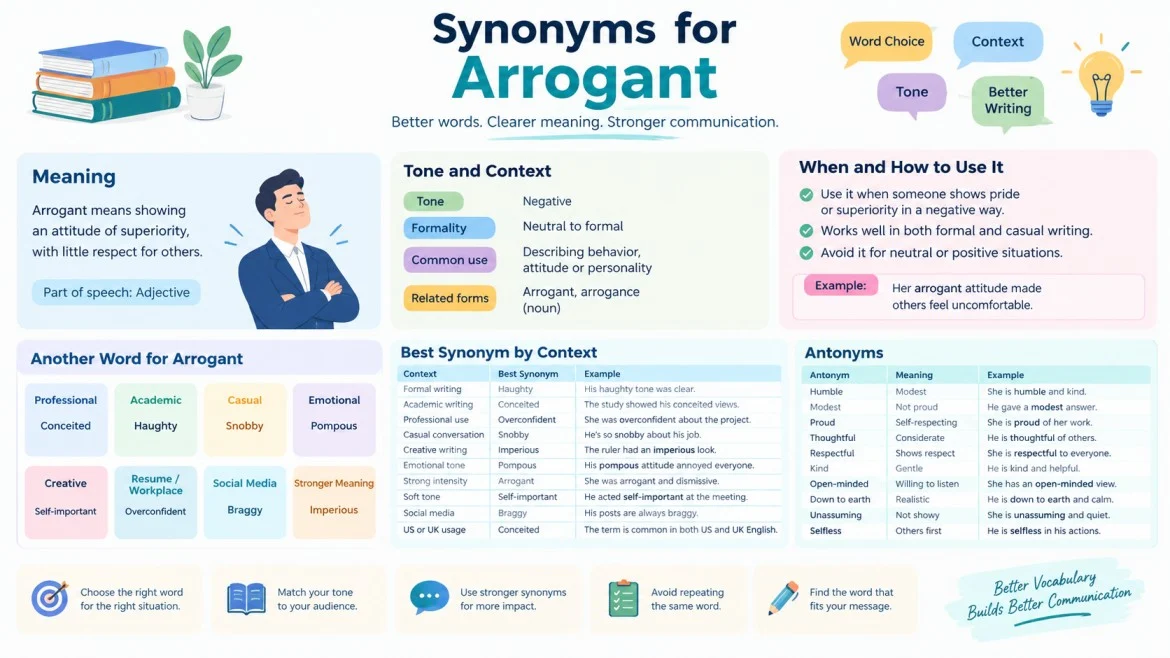
Arrogant means behaving as if you are more important, intelligent, or capable than other people. Common synonyms include conceited, haughty, overbearing, pompous, and self important. For professional writing, use condescending or dismissive when appropriate. For casual conversation, stuck up or full of yourself may sound more natural.
Meaning, Tone and Context
What Does Arrogant Mean?
Arrogant describes someone who believes they are better than other people and shows that belief through their words, actions, or attitude. An arrogant person may dismiss advice, brag about achievements, or treat others disrespectfully.
For example, a manager who interrupts every employee because they believe nobody else has valuable ideas may be described as arrogant.
Part of Speech
Arrogant is an adjective. It describes a person’s attitude, behavior, or manner.
Examples:
- The arrogant speaker refused to consider other opinions.
- His arrogant attitude made teamwork difficult.
- She sounded arrogant when she dismissed the suggestion.
Tone and Formality
Arrogant has a negative tone. It usually criticizes someone’s behavior or attitude rather than praising their confidence.
The word is suitable for everyday conversation, essays, reviews, stories, and professional discussions when the behavior supports the description. In sensitive workplace situations, a more specific phrase may communicate the concern without sounding unnecessarily personal.
Common Use Cases
Arrogant is often used to describe someone who:
- Acts superior to others.
- Rejects advice without considering it.
- Brags about personal achievements.
- Treats people as less intelligent or important.
- Assumes they are always right.
Related Word Forms
| Word | Part of Speech | Meaning | Example |
|---|---|---|---|
| Arrogant | Adjective | Acting superior to others | His arrogant response upset the team. |
| Arrogance | Noun | An attitude of superiority | Her arrogance damaged the relationship. |
| Arrogantly | Adverb | In a superior or dismissive manner | He arrogantly rejected the offer. |
| Arrogant behavior | Phrase | Actions showing superiority | His arrogant behavior discouraged questions. |
When and How to Use Arrogant
Use arrogant when someone’s behavior suggests that they consider themselves better than other people. Focus on observable actions rather than making assumptions about someone’s personality.
Professional context: The supervisor appeared arrogant when he dismissed the team’s concerns without discussion.
Personal context: My friend sounded arrogant when she claimed that everyone else was wrong.
Academic context: The novel presents an arrogant character whose pride eventually damages his relationships.
Social media context: Confidence is attractive, but an arrogant attitude can push people away.
The word is most effective when the situation clearly shows superiority, disrespect, or an unwillingness to consider others.
Another Word for Arrogant
The best single replacement depends on the behavior you want to describe. Conceited works when someone thinks too highly of themselves. Condescending describes someone who treats others as inferior. Overbearing emphasizes controlling or forceful behavior.
Here are useful alternatives by situation.
| Situation | Best Alternative | Why It Works |
|---|---|---|
| Professional writing | Condescending | Highlights disrespectful treatment of others |
| Academic writing | Haughty | Describes a proud, superior attitude |
| Casual conversation | Stuck up | Sounds natural in informal speech |
| Emotional writing | Egotistical | Emphasizes excessive focus on oneself |
| Creative writing | Supercilious | Adds a literary sense of superiority |
| Resume or workplace feedback | Dismissive | Identifies a specific communication problem |
| Social media captions | Full of yourself | Expresses criticism in conversational language |
| Stronger meaning | Supercilious | Suggests open disdain for others |
| Softer meaning | Self important | Suggests an inflated sense of personal importance |
For workplace documents, describe the action whenever possible. For example, saying that someone repeatedly dismisses feedback is more useful than simply labeling that person arrogant.
When Not to Use Arrogant
Arrogant is not the best choice for every person who appears confident, ambitious, or outspoken. Choosing a more precise word prevents misunderstandings.
- When someone is confident: Use confident if the person believes in their abilities without treating others as inferior.
When someone talks about achievements: Use boastful if they repeatedly praise their own success.
- When someone controls conversations: Use domineering if they try to control other people or decisions.
- When someone ignores suggestions: Use dismissive if they show little interest in other people’s ideas.
- When someone seems proud of their appearance or abilities: Use conceited if they have an exaggerated opinion of themselves.
Consider this example:
Less precise: The manager was arrogant.
More precise: The manager dismissed three employee suggestions without explaining why.
The second sentence explains the actual behavior and gives readers a clearer understanding of the problem.
Words Commonly Confused With Arrogant
Several similar words describe different forms of pride, superiority, or disrespect.
| Word | Main Difference | When to Use It |
|---|---|---|
| Confident | Believes in their abilities | When someone shows healthy self belief |
| Conceited | Thinks too highly of themselves | When someone overvalues their qualities |
| Proud | Feels satisfaction in achievements | When pride is justified or positive |
| Boastful | Talks excessively about achievements | When someone frequently brags |
| Condescending | Treats others as inferior | When someone speaks down to people |
| Haughty | Displays a proud, superior manner | When someone’s attitude seems cold or disdainful |
The most important distinction is that arrogance involves a sense of superiority. Confidence does not necessarily include disrespect, while boastfulness specifically involves talking too much about personal achievements.
Best Synonym by Context for Arrogant
The following table helps you choose an alternative based on tone, purpose, and audience.
| Context | Best Synonym | Why It Works | Example |
|---|---|---|---|
| Formal writing | Haughty | Expresses a proud, superior manner | His haughty response ended the discussion. |
| Academic writing | Supercilious | Describes visible disdain | The character’s supercilious attitude reveals his pride. |
| Professional communication | Dismissive | Identifies a specific behavior | Her dismissive reply discouraged further questions. |
| Resume or performance review | Unreceptive | Focuses on resistance to feedback | The employee was unreceptive to constructive advice. |
| Casual conversation | Stuck up | Sounds natural in informal speech | He acts stuck up around new people. |
| Creative writing | Pompous | Suggests exaggerated importance | The pompous official delivered another long speech. |
| Emotional writing | Egotistical | Emphasizes excessive self focus | His egotistical behavior hurt his closest friends. |
| Strong intensity | Supercilious | Suggests superiority and disdain | She gave him a supercilious glance. |
| Softer criticism | Self important | Suggests an inflated view of importance | He sounded self important during the meeting. |
| Social media captions | Full of yourself | Communicates criticism casually | Being talented does not mean being full of yourself. |
| Leadership feedback | Overbearing | Highlights forceful or controlling behavior | The overbearing manager controlled every discussion. |
| Storytelling | Haughty | Creates a clear impression of pride | The haughty prince refused to greet the villagers. |
There is no single best synonym for every situation. The most accurate option identifies the particular behavior rather than merely repeating the negative meaning of arrogant.
Which Synonym Should You Choose?
Use these practical rules when selecting another word for arrogant.
1. Identify the Main Behavior
Ask what the person actually does.
If they brag, choose boastful. look down on others, choose condescending. If they try to control everyone, choose domineering or overbearing.
2. Consider Formality
Use haughty, conceited, or supercilious in suitable essays, reports, and descriptive writing. Choose stuck up or full of yourself for informal conversations.
3. Match the Emotional Intensity
Use self important for relatively mild criticism. Choose contemptuous when someone openly shows strong disrespect toward others. Do not use an extremely harsh word for a minor disagreement.
4. Focus on Professional Value
In business communication, specific descriptions are often more constructive than personal labels.
Instead of writing that a colleague is arrogant, explain that they interrupt others, reject feedback, or fail to consider alternative ideas.
5. Read the Whole Sentence
A synonym should fit the sentence naturally.
For example, conceited describes a person’s opinion of themselves, while dismissive describes how they respond to something. Both may relate to arrogance, but they are not interchangeable in every sentence.
Real Life Examples of Arrogant in Sentences
These examples show how to use arrogant and its alternatives in everyday situations.
School: The arrogant student refused to work with classmates because he believed he was the smartest person in the room.
Workplace: Her dismissive response made the team reluctant to share new ideas.
Writing: The author portrays a conceited character who believes that success makes him superior to everyone else.
Conversation: Nobody enjoyed talking with him because he always acted like he knew everything.
Social media: Real confidence does not require putting other people down.
Resume and professional development: Demonstrated openness to feedback and respect for diverse perspectives are stronger professional qualities than an attitude of superiority.
Email: Instead of calling a colleague arrogant, explain that their response did not address the concerns raised by the team.
Storytelling: The haughty king ignored the villagers until their suffering threatened his kingdom.
These examples show why specific word choices make writing more convincing and useful.
18 Synonyms for Arrogant
Here are 18 useful alternatives, each with a distinct meaning and example.
| Synonym | Simple Meaning | Best Used For | Example Sentence |
|---|---|---|---|
| 1. Conceited | Having an overly high opinion of oneself | Personal descriptions | He is too conceited to admit a mistake. |
| 2. Haughty | Proud in a way that seems superior | Formal writing | She gave the guests a haughty look. |
| 3. Pompous | Acting more important than one really is | Speeches and behavior | His pompous introduction annoyed the audience. |
| 4. Condescending | Treating others as less capable | Workplace communication | The instructor’s condescending tone embarrassed the student. |
| 5. Egotistical | Excessively focused on oneself | Personality descriptions | His egotistical nature made cooperation difficult. |
| 6. Overbearing | Trying to control others | Relationships and leadership | An overbearing supervisor leaves little room for discussion. |
| 7. Supercilious | Showing disdain or superiority | Literary and formal writing | He offered a supercilious smile. |
| 8. Self important | Believing one’s importance is unusually great | Everyday descriptions | The self important guest expected special treatment. |
| 9. Boastful | Frequently talking about one’s achievements | Casual descriptions | Her boastful stories soon became tiring. |
| 10. Snobbish | Treating people as inferior because of status or taste | Social behavior | His snobbish attitude made newcomers uncomfortable. |
| 11. Presumptuous | Acting as if one has a right without permission | Social and professional situations | It was presumptuous of him to make that decision alone. |
| 12. Domineering | Trying to dominate others | Leadership and relationships | The domineering coach refused to hear objections. |
| 13. Disdainful | Showing strong disrespect or contempt | Emotional and literary writing | She gave the proposal a disdainful glance. |
| 14. Contemptuous | Showing that someone is considered unworthy of respect | Strong criticism | His contemptuous reply ended the conversation. |
| 15. Smug | Too pleased with oneself, often irritatingly | Casual conversation | He looked smug after proving his point. |
| 16. Patronizing | Acting kindly or helpfully in a way that suggests superiority | Conversation and feedback | Her patronizing explanation offended the experienced staff. |
| 17. Stuck up | Informally acting as if one is better than others | Casual speech | They thought the new student was stuck up. |
| 18. Arrogant | Acting as though one is superior | General descriptions | His arrogant behavior damaged the friendship. |
Note that these words overlap but do not have identical meanings. Choose the word that accurately describes the behavior in your sentence.
Synonym Groups and Usage Differences
Professional vs. Personal Synonyms
Personal descriptions often focus on someone’s personality, while professional descriptions benefit from identifying specific behavior.
For personal writing, conceited, egotistical, and stuck up can describe how someone presents themselves.
For workplace feedback, dismissive, overbearing, and unreceptive are often more useful because they identify actions that can change.
Example:
Personal: He is conceited and always praises himself.
Professional: He frequently dismisses colleagues’ suggestions without considering their value.
Formal vs. Conversational Synonyms
Formal alternatives work well in essays, literary analysis, and detailed descriptions. Conversational alternatives sound more natural in everyday speech.
| Formal or Literary | Conversational | Example |
|---|---|---|
| Haughty | Stuck up | He acted stuck up at the party. |
| Supercilious | Full of yourself | You sound full of yourself when you brag. |
| Pompous | Big headed | His big headed attitude irritated his friends. |
| Condescending | Talking down to people | Stop talking down to your classmates. |
Big headed is an informal expression. Use it in conversation rather than formal academic writing.
Academic Synonyms
Academic writing benefits from precise vocabulary that explains a character’s behavior or the evidence in a text.
Useful choices include haughty, conceited, condescending, and supercilious.
Example: The protagonist’s haughty attitude reflects his belief that social status makes him more deserving than others.
In an analytical essay, explain how the behavior supports your interpretation. A precise example is more convincing than a string of negative adjectives.
Professional and Business Synonyms
Professional communication should explain the impact of a person’s behavior. Labels can make feedback sound personal, while specific descriptions help readers understand the problem.
Consider these options:
- Dismissive, when someone ignores suggestions or concerns.
- Overbearing, when someone controls discussions or decisions excessively.
- Unreceptive, when someone refuses to consider feedback.
- Condescending, when someone treats colleagues as less capable.
- Presumptuous, when someone makes decisions or assumptions without proper authority.
For performance reviews, explain what happened, how it affected the team, and what behavior would improve the situation.
Creative or Literary Synonyms
Creative writing often needs words that reveal personality, mood, and relationships.
Haughty can make a character seem distant and proud. Pompous suggests exaggerated self importance. Supercilious adds a sense of disdain, while smug conveys satisfaction with oneself.
Example: The pompous merchant boasted about his fortune while ignoring the hungry people outside his shop.
The strongest description often combines one accurate adjective with a concrete action.
Slang or Modern Synonyms
Informal expressions can make conversations, captions, and dialogue sound natural.
Stuck up: Acting as if you are better than others.
Big headed: Having an exaggerated opinion of your abilities.
Full of yourself: Being excessively impressed with yourself.
Know it all: Someone who acts as if they know everything.
These expressions are suitable for casual speech and character dialogue. Avoid them in formal research papers, business reports, and professional evaluations unless you are quoting or analyzing informal language.
Strongest vs. Weaker Synonyms
The following scale is approximate. Actual intensity depends on the sentence and situation.
| Intensity | Word | Meaning |
|---|---|---|
| Mild | Self important | Thinks too highly of personal importance |
| Mild to moderate | Smug | Appears overly pleased with oneself |
| Moderate | Conceited | Has an inflated view of oneself |
| Moderate | Pompous | Displays exaggerated importance |
| Strong | Haughty | Shows proud superiority |
| Strong | Condescending | Treats others as inferior |
| Very strong | Contemptuous | Shows deep disrespect |
| Very strong | Supercilious | Displays disdainful superiority |
Use the scale as a guide, not an absolute ranking. A contemptuous remark may be more hurtful than a haughty expression, depending on the context.
Emotional vs. Neutral Synonyms
Some alternatives carry stronger emotional judgments than others.
More emotionally charged: Contemptuous, snobbish, supercilious, and conceited.
Focused on specific behavior: Dismissive, unreceptive, overbearing, and presumptuous.
More conversational: Stuck up, big headed, and full of yourself.
When you want to describe what happened without making a broad judgment about someone’s personality, choose a behavior focused word.
Antonyms of Arrogant
Antonyms describe the opposite of arrogance, including humility, respect, openness, and a willingness to learn.
| Antonym | Meaning | Example Sentence |
|---|---|---|
| 1. Humble | Not thinking you are better than others | She remained humble after winning the award. |
| 2. Modest | Not boasting about achievements | He was modest about his success. |
| 3. Humble minded | Having a humble attitude | The humble minded leader welcomed advice. |
| 4. Unassuming | Not seeking attention or importance | His unassuming manner made everyone comfortable. |
| 5. Respectful | Showing consideration for others | She remained respectful during the disagreement. |
| 6. Courteous | Polite and considerate | The courteous manager listened patiently. |
| 7. Polite | Showing good manners | He was polite to every guest. |
| 8. Considerate | Thinking about other people’s needs | A considerate colleague makes room for different opinions. |
| 9. Approachable | Easy to talk to | The approachable director welcomed questions. |
| 10. Open minded | Willing to consider other views | An open minded student learns from feedback. |
| 11. Receptive | Willing to listen to ideas | She was receptive to suggestions. |
| 12. Unpretentious | Not trying to appear more important than you are | His unpretentious style impressed the audience. |
| 13. Self effacing | Avoiding attention or praise for oneself | She was self effacing when discussing her achievement. |
| 14. Deferential | Showing respect toward another person’s position or authority | The assistant was deferential to the visiting judge. |
| 15. Down to earth | Practical, friendly, and unpretentious | Despite his fame, he remained down to earth. |
These antonyms are not interchangeable. Humble and modest describe attitudes toward personal importance, while respectful and courteous focus on how someone treats others.
Comparison: Arrogant vs. Similar Words
Arrogant vs. Confident
Main difference: Arrogant suggests superiority, while confident means believing in your own abilities.
Which is stronger: Arrogant carries a negative judgment.
Which is more formal: Both are appropriate in formal writing.
Examples:
Arrogant: He assumed nobody else could complete the task correctly.
Confident: He trusted his skills and completed the task successfully.
Arrogant vs. Conceited
Main difference: Arrogant emphasizes superior behavior, while conceited emphasizes an inflated opinion of oneself.
Which is stronger: Arrogant can sound more confrontational, depending on the situation.
Which is more formal: Both work in formal and informal writing.
Examples:
Arrogant: She refused to listen to anyone else’s advice.
Conceited: He believed his talent was greater than everyone else’s.
Arrogant vs. Haughty
Main difference: Both suggest superiority, but haughty often describes a proud, distant manner.
Which is stronger: Haughty can sound especially cold or disdainful.
Which is more formal: Haughty is more literary in everyday usage.
Examples:
Arrogant: The manager believed his judgment was always correct.
Haughty: The nobleman greeted the visitors with a haughty expression.
Arrogant vs. Condescending
Main difference: Arrogant describes an attitude of superiority, while condescending describes treating others as inferior.
Which is stronger: Condescending can feel especially insulting during direct conversation.
Which is more formal: Both are suitable for professional and academic writing.
Examples:
Arrogant: He believed his experience made him better than the rest of the team.
Condescending: He explained a simple task as if his experienced colleagues were children.
Arrogant vs. Pompous
Main difference: Arrogant suggests superiority, while pompous emphasizes exaggerated importance in behavior or speech.
Which is stronger: Neither is always stronger. Pompous often sounds more mocking.
Which is more formal: Both work in formal descriptions, though pompous is often used critically.
Examples:
Arrogant: She dismissed the opinions of her coworkers.
Pompous: He gave a pompous speech about his minor achievement.
Arrogant vs. Boastful
Main difference: Arrogant involves a sense of superiority, while boastful specifically means talking too much about achievements or qualities.
Which is stronger: Arrogant may imply a broader negative attitude.
Which is more formal: Both are suitable for general writing.
Examples:
Arrogant: He acted as though other people were beneath him.
Boastful: He spent the entire evening talking about his awards.
Common Phrases and Expressions with Arrogant
1. Arrogant Attitude
Meaning: A way of behaving that suggests superiority over others.
Example sentence: His arrogant attitude made it difficult for new employees to approach him.
2. Arrogant Behavior
Meaning: Actions that show an inflated sense of importance.
Example sentence: The coach addressed the player’s arrogant behavior after practice.
3. Arrogant Person
Meaning: Someone who behaves as if they are better than others.
Example sentence: An arrogant person may struggle to accept constructive criticism.
4. Arrogant Tone
Meaning: A way of speaking that sounds superior or disrespectful.
Example sentence: Her arrogant tone turned a simple question into an argument.
5. Arrogant Remark
Meaning: A comment that suggests superiority or disrespect.
Example sentence: His arrogant remark offended several people in the room.
6. Arrogant Assumption
Meaning: An unsupported belief that reflects an exaggerated sense of importance or ability.
Example sentence: It was an arrogant assumption that nobody else could lead the project.
7. Come Across as Arrogant
Meaning: To create an impression of superiority, whether intended or not.
Example sentence: Speaking without listening can make even a knowledgeable person come across as arrogant.
8. Arrogant Sense of Superiority
Meaning: A strong belief that one is better than other people.
Example sentence: The story explores how an arrogant sense of superiority can destroy friendships.
Common Mistakes to Avoid
1. Confusing Arrogance With Confidence
Confidence is not automatically negative. A person can believe in their abilities while respecting other people’s skills and opinions.
Incorrect: She is arrogant because she speaks confidently.
Better: She is confident and explains her ideas clearly.
Use arrogant only when the behavior suggests superiority or disrespect.
2. Using Arrogant When Boastful Is More Accurate
Someone who talks repeatedly about achievements may be boastful without necessarily treating other people as inferior.
Better: He was boastful about his promotion and kept mentioning his new title.
3. Using Casual Synonyms in Formal Writing
Expressions such as stuck up and full of yourself can sound too informal in academic or professional documents.
Better: The character displays a conceited attitude toward his classmates.
4. Choosing an Overly Dramatic Word
Contemptuous and supercilious can sound stronger or more literary than necessary.
If someone simply ignores a suggestion, dismissive may be more accurate than contemptuous.
5. Repeating the Same Word Too Often
Using arrogant in every paragraph makes writing less varied and may hide important differences.
Instead, choose among conceited, dismissive, haughty, and overbearing according to the behavior being described.
6. Judging Personality Instead of Describing Behavior
Calling a coworker arrogant may sound personal and unhelpful.
Better: He interrupted several colleagues and rejected their suggestions without discussion.
Specific details make criticism easier to understand and address.
FAQs About Synonyms for Arrogant
1. What Is the Best Synonym for Arrogant?
Conceited is a useful general synonym when someone thinks too highly of themselves. Condescending works better when they treat others as inferior, while haughty emphasizes a proud, superior manner.
2. What Is a Formal Synonym for Arrogant?
Haughty, supercilious, and conceited are suitable formal alternatives. Haughty describes a proud manner, while supercilious emphasizes disdain. Choose the word that best matches the person’s behavior.
3. What Is an Informal Synonym for Arrogant?
Stuck up, big headed, and full of yourself are common informal alternatives. They work well in conversations, personal writing, and dialogue but are usually unsuitable for formal reports.
4. What Is Another Word for Arrogant in Professional Writing?
Dismissive, condescending, and overbearing can work in professional writing. Dismissive describes ignoring concerns, condescending describes talking down to colleagues, and overbearing highlights excessive control.
5. What Is the Difference Between Arrogant and Confident?
Confident means trusting your abilities, while arrogant means acting as though you are superior to others. Confidence can be positive, but arrogance generally carries a negative meaning.
6. What Is the Opposite of Arrogant?
Humble is one of the clearest antonyms of arrogant. Other useful opposites include modest, respectful, unassuming, and open minded, depending on whether you mean attitude, behavior, or willingness to listen.
Conclusion
Arrogant describes someone who acts as if they are better than other people. Useful alternatives include conceited, haughty, pompous, condescending, and overbearing, but each word highlights a different quality.
For formal writing, haughty and supercilious can add precision. In casual conversation, stuck up and full of yourself sound more natural. In professional communication, dismissive and unreceptive can identify specific behaviors without making a broad personal judgment.
The best way to improve your vocabulary is to focus on what a person actually says or does before choosing a synonym. This small habit makes your writing clearer, more natural, and more accurate.
Discover More Post:
- 50+ Synonyms for Investigate | Meanings, Examples, and Best …
- 50+ Synonyms for Opinion | Meanings, Examples, and Best …
- 50+ Synonyms for Greedy | From Selfish to Insatiable, Find the …