Have you ever described someone as trapped and then struggled to find a more precise word? Whether you are writing an essay, a professional email, a social media caption, or a story, choosing the right synonym can make your message clearer and more engaging.
The word trapped can describe physical confinement, emotional pressure, limited choices, or a situation that seems impossible to escape. Understanding these differences helps you choose words that communicate the exact meaning and tone you want.
This guide explores 25 synonyms for trapped, with practical definitions, natural examples, antonyms, and recommendations for different writing situations.
What Does “Trapped” Mean?
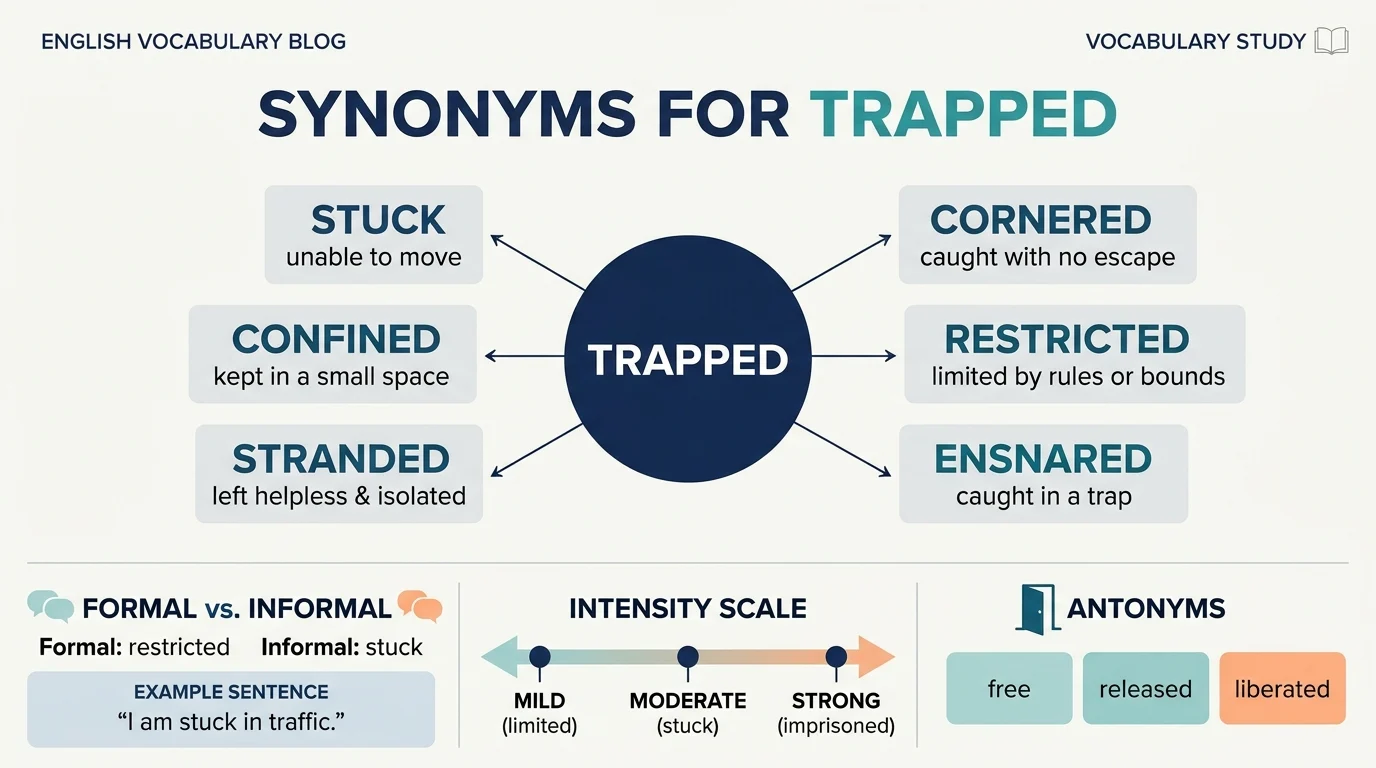
Trapped means unable to escape from a place, situation, or difficult circumstance. Common synonyms include confined, stuck, stranded, cornered, imprisoned, restricted, and ensnared. Use confined in formal writing, stuck in casual conversation, and ensnared for figurative or creative descriptions.
Meaning, Tone and Context
What does trapped mean?
Trapped describes a person, animal, or thing that cannot get out of a place or situation. It can also describe someone who feels unable to change their circumstances.
For example, a person trapped in an elevator faces physical confinement, while someone trapped in an unhappy job may feel professionally restricted.
Part of speech
- Trapped is commonly used as:
- Verb form: The firefighters trapped the spreading flames inside the damaged structure.
- Adjective: The trapped passengers waited for help.
- Past participle: She felt trapped by her financial responsibilities.
The base verb is trap, and its related forms include traps, trapping, and trapped.
Tone and formality
The word trapped is neutral in many factual situations, but it can convey fear, helplessness, frustration, or desperation when describing a person’s experience.
| Feature | Explanation |
|---|---|
| Meaning | Unable to escape or change a situation |
| Tone | Neutral, negative, or emotionally intense |
| Formality | Suitable for casual, academic, and professional contexts |
| Common uses | Accidents, difficult relationships, work problems, stories, and emotional experiences |
| Related noun | Trap |
| Opposite ideas | Free, released, liberated, unrestricted |
When is trapped commonly used?
Use trapped when escape or freedom is the central idea. The word works particularly well when someone has limited options, faces an obstacle, or cannot leave a difficult situation.
For example, stuck often sounds conversational, confined emphasizes restricted movement, and imprisoned suggests detention or a powerful sense of lost freedom.
When and How to Use “Trapped”
The most appropriate synonym depends on what prevents someone from escaping. Consider these realistic examples.
1. Professional: “I feel trapped in a role that offers no opportunities for advancement.” The word communicates career frustration.
2. Personal: “We were trapped inside the house during the severe storm.” The emphasis is on physical confinement.
3. Academic: “The researchers examined how families became trapped in cycles of poverty.” The word describes persistent social and economic barriers.
4. Emotional: “She felt trapped by guilt and unrealistic expectations.” It communicates psychological pressure.
5. Creative writing: “The explorer was trapped beneath the ancient ruins.” The word builds suspense and urgency.
6. Social media: “Feeling trapped in the same routine every single day.” This informal expression communicates frustration with repetitive experiences.
7. Email: “Our team is stuck waiting for approval before proceeding with the project.” Here, stuck provides a natural, professional description of a delay.
Another Word for “Trapped”
The best single replacement for trapped is usually stuck in everyday conversation. However, confined works better for physical restrictions, cornered for situations with few options, and ensnared for complex problems or deceptive circumstances.
Choose the word that explains why escape is difficult rather than simply replacing trapped with the first similar word you find.
| Context | Best alternative | Example |
|---|---|---|
| Professional writing | Restricted | The team was restricted by outdated procedures. |
| Academic writing | Confined | The participants were confined to a controlled environment. |
| Casual conversation | Stuck | I am stuck in traffic. |
| Emotional writing | Powerless | He felt powerless to change his circumstances. |
| Creative writing | Ensnared | The traveler became ensnared in a dangerous scheme. |
| Resume or workplace | Limited | My previous role offered limited opportunities for growth. |
| Social media captions | Stuck | Stuck in my thoughts again. |
| Stronger meaning | Imprisoned | She felt imprisoned by her circumstances. |
| Softer meaning | Restricted | Our options were restricted by the deadline. |
Choosing a stronger or softer alternative
For a stronger expression, use imprisoned, entangled, or ensnared when the context supports the intensity. These words can suggest serious confinement, complicated involvement, or an inescapable problem.
For a softer expression, choose limited, restricted, or stuck. These alternatives can communicate an obstacle without making an ordinary inconvenience sound like a crisis.
When Not to Use “Trapped”
Although trapped is versatile, it is not always the most accurate choice.
- the problem is temporary: Instead of “I am trapped in traffic,” you might say “I am delayed in traffic” if the main concern is arriving late.
- When movement is restricted by rules: Use restricted when someone has limited access rather than being unable to escape.
- When someone is waiting for a decision: Use stalled or held up to describe a process that cannot move forward.
- Dlegal detention: Use detained when someone is officially held by an authority.
- When describing a difficult choice: Use cornered when pressure leaves someone with few reasonable options.
- When describing a complicated relationship: Use entangled if the emphasis is on involvement in a difficult or complicated situation.
Precision matters because these alternatives describe different reasons a person might lack freedom or progress.
Words Commonly Confused With “Trapped”
Several related words overlap with trapped, but their meanings are not identical.
| Word | Main difference | Best situation |
|---|---|---|
| Stuck | Unable to move forward or get free | Traffic, problems, routines |
| Confined | Kept within a limited space or boundary | Rooms, facilities, restricted areas |
| Stranded | Left somewhere without a practical way to leave | Travel disruptions, remote locations |
| Cornered | Facing pressure with few ways out | Arguments, negotiations, confrontations |
| Imprisoned | Held in prison or figuratively deprived of freedom | Legal detention, severe emotional limitations |
| Restricted | Limited by rules, conditions, or circumstances | Access, choices, workplace procedures |
- The main distinction is the reason freedom is limited. A stranded traveler may be unable to leave because transportation is unavailable, while a confined person may be physically restricted to a particular area.
Best Synonym by Context for “Trapped”
The following table matches common situations with alternatives that communicate the intended meaning more precisely.
| Context | Best Synonym | Why It Works | Example |
|---|---|---|---|
| Formal writing | Confined | Emphasizes restricted space or movement | The workers were confined to the designated area. |
| Academic writing | Restricted | Describes limitations imposed by conditions | Access to the facility was restricted. |
| Business communication | Stalled | Shows that progress has stopped | The project stalled while the team awaited approval. |
| Resume writing | Limited | Describes a lack of opportunities without sounding overly negative | Growth was limited by the department’s structure. |
| Casual conversation | Stuck | Sounds natural and familiar | I am stuck at the airport. |
| Creative writing | Ensnared | Suggests being caught in a difficult situation | The detective became ensnared in a dangerous plot. |
| Emotional writing | Powerless | Highlights a lack of control | She felt powerless to change the outcome. |
| Strong intensity | Imprisoned | Conveys severe restriction or lost freedom | He felt imprisoned by his obligations. |
| Mild intensity | Restricted | Communicates a limitation without exaggeration | Our choices were restricted by the budget. |
| Social media captions | Stuck | Short, direct, and relatable | Stuck in a loop of unfinished plans. |
| Physical danger | Pinned | Suggests being held down or unable to move | The fallen beam pinned him to the ground. |
| Travel disruption | Stranded | Emphasizes being unable to continue a journey | The passengers were stranded overnight. |
| Difficult decision | Cornered | Suggests limited options under pressure | The manager felt cornered by the sudden demand. |
| Complex relationship | Entangled | Describes involvement in a complicated situation | She became entangled in a family dispute. |
| Legal context | Detained | Indicates being held by an authority | The suspect was detained for questioning. |
These words are not interchangeable in every sentence. Choose pinned for physical pressure, detained for official custody, and stalled when the main problem is a lack of progress.
Which Synonym Should You Choose?
Use this practical decision guide to find the best alternative to trapped.
1. Identify the meaning. Is someone physically unable to escape, emotionally overwhelmed, or prevented from making progress? Choose confined, powerless, or stalled accordingly.
2. Consider formality. Use stuck in everyday speech, restricted in workplace communication, and confined in formal descriptions of physical limitations.
3. Check emotional intensity. Limited sounds relatively mild, cornered communicates pressure, and imprisoned creates a stronger impression of lost freedom.
4. Think about professional impact. In a resume or interview, describe the actual limitation rather than saying you felt trapped. For example, “I sought a role with greater opportunities for advancement” sounds constructive.
5. Read the whole sentence. A synonym should preserve the original meaning and fit naturally with the surrounding words.
A useful rule is to choose the most specific word that accurately describes the obstacle. Stronger language is not automatically better language.
Real Life Examples of “Trapped” in Sentences
Here are examples showing how the word and its alternatives work in everyday situations.
| Situation | Example sentence |
|---|---|
| School | The student felt stuck on the final question of the exam. |
| Workplace | The outdated approval process left the project stalled. |
| Essay writing | Families can become trapped in cycles of financial hardship. |
| Conversation | I am stuck in traffic, so I will arrive a little late. |
| Social media | Sometimes, we feel trapped by our own expectations. |
| Resume | I pursued professional development because advancement was limited in my previous role. |
| Our progress is restricted until the client approves the revised proposal. | |
| Storytelling | The explorer was stranded in the wilderness after losing his map. |
| Relationships | She felt entangled in a conflict she had not started. |
| Personal reflection | He felt powerless to change a situation that affected his entire family. |
Notice how the alternatives clarify what is happening. Stalled describes a project, stranded describes an isolated traveler, and entangled describes complicated involvement.
25 Synonyms for “Trapped”
These 25 alternatives cover physical confinement, emotional difficulty, restricted choices, and figurative situations. Some are close synonyms, while others work only in particular contexts.
| Synonym | Simple Meaning | Best Used For | Example Sentence |
|---|---|---|---|
| 1. Stuck | Unable to move or progress | Everyday problems | I am stuck on the last step of the assignment. |
| 2. Confined | Kept within a limited space | Physical restrictions | The animals were confined to a secure enclosure. |
| 3. Imprisoned | Held in prison or deprived of freedom | Severe confinement or metaphorical restriction | He felt imprisoned by his mounting responsibilities. |
| 4. Captive | Held and prevented from leaving | Hostage situations or captivity | The captive waited for an opportunity to escape. |
| 5. Stranded | Left somewhere without a practical way to leave | Travel and isolation | We were stranded at the station after the final train departed. |
| 6. Cornered | Forced into a position with few options | Conflict and pressure | The witness felt cornered by the difficult questions. |
| 7. Ensnared | Caught in a difficult or deceptive situation | Literary and figurative writing | She was ensnared in a web of lies. |
| 8. Entangled | Involved in something complicated | Relationships and disputes | He became entangled in a lengthy legal battle. |
| 9. Restricted | Limited by rules or circumstances | Formal and professional writing | Employees were restricted from entering the damaged building. |
| 10. Confounded | Confused or frustrated by a difficulty | Complex problems | The team was confounded by the unexpected results. |
| 11. Helpless | Unable to take effective action | Emotional situations | She felt helpless as the storm damaged her home. |
| 12. Powerless | Lacking control or authority | Personal and professional challenges | He felt powerless to change the policy. |
| 13. Pinned | Held down or prevented from moving | Physical obstacles | The injured climber was pinned beneath a fallen branch. |
| 14. Wedged | Firmly jammed into a narrow space | Physical confinement | The suitcase was wedged between two seats. |
| 15. Hemmed in | Surrounded or restricted on several sides | Physical or figurative limitations | The small business felt hemmed in by rising costs. |
| 16. Bottled up | Unable to express feelings freely | Emotional writing | She had bottled up her frustration for months. |
| 17. Detained | Kept in custody or prevented from leaving | Legal and official situations | The passenger was detained for additional questioning. |
| 18. Held | Kept in a place or under someone’s control | General or physical restraint | The gate held the animals inside the enclosure. |
| 19. Immobilized | Unable to move | Medical or physical situations | The damaged vehicle was immobilized on the highway. |
| 20. Halted | Brought to a stop | Processes and activities | Construction was halted because of unsafe conditions. |
| 21. Stalled | Unable to make further progress | Projects and negotiations | Negotiations stalled after the initial meeting. |
| 22. Snared | Caught in a trap or difficult situation | Hunting, physical danger, and figurative writing | The fox was snared in a wire trap. |
| 23. Enclosed | Surrounded or contained within boundaries | Spaces and structures | The garden was enclosed by a tall fence. |
| 24. Obligated | Bound by a duty or commitment | Responsibilities and figurative limitations | She felt obligated to stay until the work was finished. |
| 25. Burdened | Weighed down by responsibilities or problems | Emotional and professional writing | He felt burdened by debts he could not repay. |
Important usage note: Words such as confounded, obligated, and burdened are context dependent alternatives, not direct replacements in every sentence. Verify the intended meaning before substituting them.
Synonym Groups and Usage Differences
Professional vs. Personal Synonyms
Professional writing benefits from specific, measured language. Restricted, limited, stalled, and confined can describe obstacles without adding unnecessary emotion.
Personal writing allows more emotional expression. Powerless, cornered, burdened, and imprisoned can convey frustration or a feeling of lost control.
Compare these examples:
Professional: “The project was stalled by unresolved technical issues.”
Personal: “I felt trapped in a routine that no longer made me happy.”
Formal vs. Conversational Synonyms
Formal language usually identifies the precise nature of a limitation. Conversational language favors words that are immediately understood.
| Writing style | Recommended words | Example |
|---|---|---|
| Reports | Restricted, confined | Movement was restricted to authorized personnel. |
| Essays | Entrapped, confined, restricted | The character remained entrapped by social expectations. |
| Speeches | Cornered, powerless | Communities can feel powerless when their concerns are ignored. |
| Casual writing | Stuck, held up | I am stuck waiting for a delivery. |
| Text messages | Stuck, stranded | We are stranded at the airport. |
| Emails | Delayed, stalled, restricted | The rollout has stalled pending final approval. |
Use entrapped sparingly. It is a valid word, but trapped or ensnared may sound more natural in many modern contexts.
Academic Synonyms
Academic writing should prioritize accuracy over complexity. Use confined when describing a physical boundary, restricted for limitations, and constrained when choices or actions are limited by conditions.
For example:
- Less precise: “The community was trapped by economic problems.”
- More specific: “The community faced economic constraints that limited access to employment.”
The second version identifies the mechanism behind the limitation instead of relying on a broad metaphor.
Professional and Business Synonyms
In workplace communication, trapped can sound emotionally charged when a neutral explanation would be more useful.
Consider these alternatives:
- Stalled: The project cannot progress.
- Limited: Opportunities or resources are insufficient.
- Restricted: Rules or conditions prevent certain actions.
- Delayed: Something is taking longer than expected.
- Constrained: Available choices or resources are limited.
For a resume, focus on your response to the challenge rather than describing yourself as trapped. For example, “Developed new skills to pursue broader career opportunities” emphasizes initiative.
Creative or Literary Synonyms
Creative writing can use more vivid words to create atmosphere and emotional depth.
Ensnared suggests being caught in a complicated situation. Cornered creates tension. Imprisoned emphasizes a severe loss of freedom, while hemmed in can evoke the image of narrowing space.
Example: “As the walls of the tunnel narrowed, the explorer felt hemmed in by darkness.”
The strongest choice depends on the scene, not simply on which word sounds most dramatic.
Slang or Modern Synonyms
Stuck is the most natural informal alternative in many everyday situations. Expressions such as boxed in and stuck in a rut are also common.
- “I feel boxed in by everyone’s expectations.”
- “I am stuck in a rut at work.”
- “We got stuck waiting for the bus.”
These expressions work well in conversation, personal blogs, and social media captions. For academic papers and formal reports, use a more precise description.
Strongest vs. Weaker Synonyms
The intensity of a synonym depends on context. This scale provides a general guide rather than a universal ranking.
Mild
Limited, delayed, restricted
A practical obstacle or reduced choice.
Moderate
Stuck, cornered, hemmed in
A noticeable barrier or pressure.
Strong
Imprisoned, ensnared, captive
Severe confinement, capture, or a powerful figurative limitation.
This is a practical writing scale, not an absolute linguistic rule. For example, captive is especially strong in a literal hostage situation, while ensnared may be more appropriate for a complicated scheme.
Emotional vs. Neutral Synonyms
Neutral words describe the situation with limited emotional judgment. Emotional words communicate how the situation affects someone.
| Neutral wording | Emotional wording |
|---|---|
| Restricted by regulations | Cornered by expectations |
| Delayed by circumstances | Powerless to change the situation |
| Confined to a room | Imprisoned by fear |
| Limited by available resources | Burdened by responsibility |
Use neutral terms when reporting facts. Choose emotional language when the person’s feelings are central to the message.
Antonyms of “Trapped”
Antonyms describe freedom, movement, escape, or the ability to make choices. The best opposite depends on the original meaning of trapped.
| Antonym | Meaning | Example Sentence |
|---|---|---|
| 1. Free | Not restricted or controlled | The rescued hikers were finally free to leave. |
| 2. Released | Allowed to leave confinement | The animal was released into the wild. |
| 3. Liberated | Freed from control or oppression | She felt liberated after leaving the unhealthy workplace. |
| 4. Unconfined | Not limited to a particular space | The birds were unconfined in the open sanctuary. |
| 5. Unrestricted | Not subject to the same limitations | The researchers received unrestricted access to the archive. |
| 6. Independent | Able to act without relying on control from others | He became financially independent after finding a stable job. |
| 7. Unrestrained | Not held back or controlled | Her laughter was unrestrained. |
| 8. Escaped | Got away from confinement or danger | The prisoner escaped through an unlocked gate. |
| 9. Rescued | Saved from danger or confinement | The firefighters rescued the passengers from the vehicle. |
| 10. Unlocked | Opened so entry or exit is possible | The caretaker unlocked the emergency exit. |
| 11. Unbound | Released from a restraint or obligation | The agreement left both parties unbound by further commitments. |
| 12. Unhindered | Able to proceed without obstacles | The team continued its work unhindered. |
| 13. Empowered | Given the ability or confidence to act | The training empowered employees to make decisions. |
| 14. Mobile | Able to move freely | The patient became mobile after recovering from the injury. |
| 15. Unencumbered | Free from burdens or hindrances | She pursued her new goals unencumbered by old commitments. |
Some antonyms describe direct physical freedom, while others describe independence or the removal of obstacles. For example, released is a closer opposite to confined, whereas empowered better contrasts with feeling powerless.
Comparison: Trapped vs. Similar Words
Trapped vs. Stuck
Main difference: Trapped often implies that escape is difficult or impossible. Stuck is broader and can describe a temporary obstacle.
Which is stronger? Trapped usually sounds more serious.
Which is more formal? Both are widely understood, but trapped can suit formal reporting when accurate.
- Trapped: “The passengers were trapped inside the damaged train.”
- Stuck: “I am stuck on the final paragraph of my essay.”
Trapped vs. Confined
Main difference: Trapped emphasizes difficulty escaping. Confined emphasizes being kept within boundaries or limits.
Which is stronger? Trapped may suggest greater urgency, depending on the situation.
Which is more formal? Confined is often more precise in formal descriptions of physical boundaries.
- Trapped: “The hikers were trapped by the rising floodwater.”
- Confined: “The patients were confined to their rooms during the outbreak.”
Trapped vs. Stranded
Main difference: Stranded usually means left somewhere without practical transportation or a way to continue. Trapped can describe any situation that prevents escape.
Which is stronger? Neither is always stronger. Stranded emphasizes isolation, while trapped emphasizes inability to get out.
Which is more formal? Both work in formal and informal contexts.
- Trapped: “The workers were trapped inside the collapsed building.”
- Stranded: “The travelers were stranded when the airport closed.”
Trapped vs. Cornered
Main difference: Cornered means pushed into a position with few options, often by pressure or confrontation. Trapped is broader.
Which is stronger? Cornered can sound more confrontational, while trapped can suggest more complete confinement.
Which is more formal? Both are acceptable, although placed under pressure may be more neutral in business writing.
- Trapped: “She felt trapped in a difficult financial situation.”
- Cornered: “The spokesperson felt cornered by the reporters’ questions.”
Trapped vs. Imprisoned
Main difference: Imprisoned literally refers to imprisonment or figuratively suggests severe restrictions on freedom. Trapped does not necessarily imply imprisonment.
Which is stronger? Imprisoned often carries a more intense meaning.
Which is more formal? Both are appropriate in formal writing when their meanings fit.
- Trapped: “He was trapped in the elevator.”
- Imprisoned: “The character felt imprisoned by fear and regret.”
Trapped vs. Restricted
Main difference: Restricted means limited by rules, conditions, or boundaries. Trapped suggests difficulty escaping a place or circumstance.
Which is stronger? Trapped often sounds more urgent or emotional.
Which is more formal? Restricted is particularly useful in policies, reports, and business communication.
- Trapped: “The hikers were trapped by a landslide.”
- Restricted: “Access to the construction site was restricted.”
Common Phrases and Expressions with “Trapped”
1. Trapped in a cycle
Meaning: Repeatedly experiencing the same difficult pattern.
Example sentence: She felt trapped in a cycle of overspending and debt.
2. Trapped in traffic
Meaning: Unable to move freely because of congestion.
Example sentence: We were trapped in traffic for nearly an hour.
3. Feel trapped
Meaning: Experience a sense of having few choices or little freedom.
Example sentence: He began to feel trapped by expectations he could not meet.
4. Trapped in a situation
Meaning: Unable to find an easy way out of difficult circumstances.
Example sentence: The family felt trapped in a situation with no obvious solution.
5. Trapped between two choices
Meaning: Forced to choose between two difficult alternatives.
Example sentence: She felt trapped between accepting the promotion and staying close to her family.
6. Trapped in a rut
Meaning: Stuck in a repetitive routine with little progress or excitement.
Example sentence: After years of doing the same work, he felt trapped in a rut.
7. Trapped by circumstances
Meaning: Prevented from acting freely because of events or conditions beyond one’s control.
Example sentence: They were trapped by circumstances that made relocating impossible.
8. Trapped in one’s own thoughts
Meaning: Unable to stop dwelling on worries, memories, or negative thinking.
Example sentence: She felt trapped in her own thoughts after the difficult conversation.
Common Mistakes to Avoid
1. Using trapped when a more precise word is available
Not every obstacle means someone is trapped. If a project cannot progress, stalled may be more accurate.
Less precise: “The project was trapped.”
Better: “The project stalled while the team waited for funding.”
2. Confusing trapped with stranded
A person can be stranded without being physically confined. A traveler whose flight is canceled may be stranded at the airport, not trapped inside it.
Choose the word that identifies the actual obstacle.
3. Using casual language in formal writing
Stuck works naturally in conversation, but formal reports may benefit from restricted, confined, or unable to proceed.
Match the wording to your audience and purpose.
4. Making a minor problem sound dramatic
Saying “I am imprisoned by my homework” may be humorous, but it sounds exaggerated in a serious academic discussion.
Use stuck on an assignment when you simply need help completing it.
5. Repeating trapped too often
Repeated use can make a paragraph feel monotonous. Replace the word only when another term preserves the intended meaning.
For example, a story might use trapped, cornered, and unable to escape at different points to emphasize different aspects of the danger.
6. Choosing the wrong emotional tone
Powerless describes a lack of control, while confined describes a limitation on movement or space. Neither automatically replaces the other.
Ask whether the sentence focuses on physical freedom, emotional experience, or practical choices.
7. Using slang in academic or professional writing
Expressions such as boxed in or stuck in a rut may be too informal for a research paper or official report.
Use constrained, restricted, or limited when a more objective tone is needed.
FAQs
1. What is the best synonym for trapped?
The best synonym for trapped is usually stuck in everyday conversation. For physical confinement, use confined, while ensnared suits figurative descriptions of complicated situations.
2. What is a formal synonym for trapped?
Confined is a useful formal synonym when someone cannot leave a particular space. Restricted works better when rules or circumstances limit freedom or available choices.
3. What is an informal synonym for trapped?
Stuck is the most natural informal alternative in many situations. For example, “I am stuck in traffic” sounds conversational and communicates the problem clearly.
4. What is another word for trapped in professional writing?
Use restricted, limited, constrained, or stalled, depending on the situation. These words can describe workplace obstacles without introducing unnecessary emotional intensity.
5. What is the difference between trapped and stuck?
Trapped often suggests being unable to escape a place or situation, while stuck can describe a temporary delay, a difficult task, or an inability to make progress.
6. What is the opposite of trapped?
Common opposites include free, released, liberated, and unrestricted. Use released for physical confinement and liberated for freedom from control or oppression.
Conclusion
Choosing the right synonym for trapped depends on the situation, the intended meaning, and the emotional tone. Stuck works well in everyday conversation, confined describes physical limitations, restricted suits professional writing, and ensnared adds depth to creative descriptions.
When exploring synonyms for trapped, focus on what prevents freedom or progress. A precise word helps readers understand whether the problem involves physical confinement, emotional pressure, limited choices, or a temporary obstacle.
The practical takeaway is simple: choose the word that explains the specific difficulty, not just one that sounds more sophisticated.
Discover More Post:
- 50+ Synonyms for Before | Meanings, Examples, and Best …
- 50+ Synonyms for Other | Meanings, Examples, and Best …
- 50+ Synonyms for Other | Meanings, Examples, and Best …