Have you ever used the word joyful repeatedly in a story, social media caption, school essay, or professional message? Although it expresses happiness beautifully, choosing a more specific word can make your writing more expressive and memorable.
The best synonyms for joyful depend on the emotion you want to communicate. Words such as delighted, cheerful, elated, and ecstatic describe different shades of happiness, from quiet satisfaction to overwhelming excitement.
This guide explores the meaning of joyful, its most useful alternatives, natural examples, antonyms, and practical ways to select the right word for academic, personal, creative, and professional writing.
What Does “Joyful” Mean?
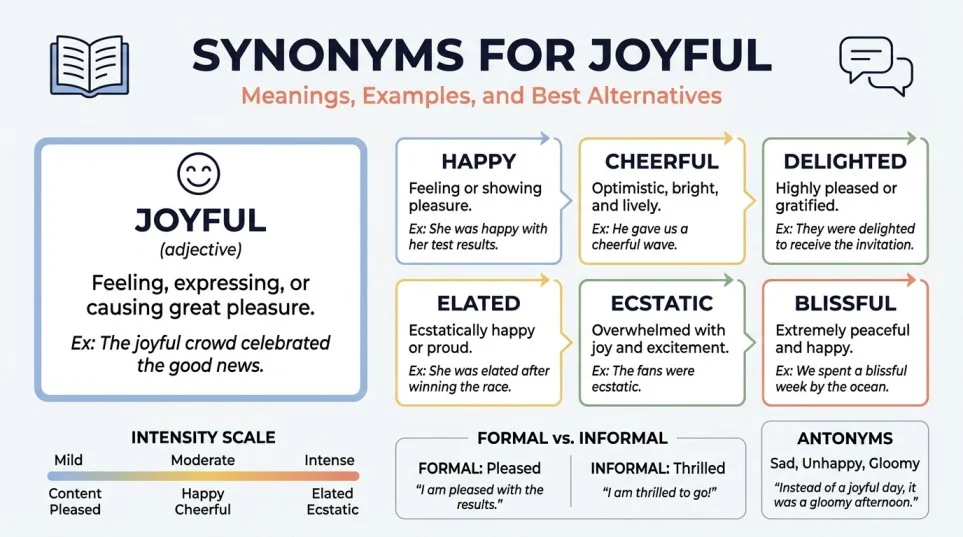
Joyful means feeling, expressing, or bringing great happiness and pleasure. Common synonyms include happy, cheerful, delighted, pleased, elated, and ecstatic. Choose cheerful for a positive mood, delighted for pleasure, and elated or ecstatic for intense happiness.
Meaning, Tone and Context
What Does Joyful Mean?
The word joyful describes a feeling of happiness, delight, or deep emotional satisfaction. It can refer to a person’s feelings, their behavior, an event, or an atmosphere that creates happiness.
For example, a joyful reunion suggests that people feel genuine happiness about seeing one another again.
Part of Speech
Joyful is an adjective. It describes a noun or pronoun by communicating happiness, delight, or a positive emotional quality.
- Adjective: The children looked joyful.
- Noun form: Joy.
- Adverb form: Joyfully.
- Related noun: Joyfulness.
- Opposite adjective: Sad or sorrowful.
Tone and Formality
Joyful has a positive, warm, and expressive tone. It works in personal conversations, creative writing, speeches, greetings, essays, and descriptions of meaningful experiences.
Although the word is suitable for professional writing, a more precise alternative can sometimes communicate the situation better. For instance, pleased may sound more measured in a business email, while delighted can express sincere appreciation.
Common Uses of Joyful
Joyful commonly describes:
- People experiencing happiness or excitement.
- Celebrations, reunions, and special occasions.
- Music, stories, and creative experiences.
- Positive memories and meaningful achievements.
- Warm relationships and shared experiences.
- Celebrations, holidays, and uplifting moments.
When and How to Use “Joyful”
Use joyful when you want to describe genuine happiness with warmth and positivity. It is especially useful when the feeling matters more than the specific event that caused it.
Here are seven realistic examples.
1. Personal: She felt joyful when her family surprised her on her birthday.
2. Professional: The team celebrated a joyful milestone after completing a challenging project.
3. Academic: The novel presents a joyful childhood memory that contrasts with the protagonist’s later struggles.
4. Emotional: Reuniting with his childhood friend was a joyful experience.
5. Creative writing: A joyful melody drifted through the open windows of the village café.
6. Social media: A joyful afternoon filled with sunshine, laughter, and unforgettable memories.
7. Email: I am joyful to share the news that the community fundraiser exceeded its goal.
In the final example, pleased or delighted would sound more natural in most professional emails. Understanding these subtle differences helps you choose language that fits the situation.
Another Word for “Joyful”
The best single replacement for joyful in many everyday situations is happy. However, other synonyms may express your intended meaning more precisely.
| Context | Best alternative | Example |
|---|---|---|
| Professional writing | Delighted | We are delighted with the results. |
| Academic writing | Positive | The findings suggest a positive outlook. |
| Casual conversation | Happy | I am happy to see you. |
| Emotional writing | Overjoyed | She was overjoyed by the reunion. |
| Creative writing | Jubilant | Jubilant voices filled the square. |
| Resume or workplace | Accomplished | She felt accomplished after leading the project. |
| Social media captions | Cheerful | A cheerful start to the weekend. |
| Stronger meaning | Ecstatic | He was ecstatic about his acceptance. |
| Softer meaning | Pleased | I am pleased with the outcome. |
A note about professional language: accomplished describes a sense of achievement rather than happiness itself. Use it when success is the main idea, not as a direct substitute in every sentence.
When Not to Use “Joyful”
Although joyful is versatile, it is not always the most accurate word.
1. When you mean extreme happiness
Joyful can describe happiness without communicating its intensity. If someone has just received life changing news, ecstatic or overjoyed may convey the emotion more clearly.
Example:
General: She was joyful about winning the competition.
More precise: She was ecstatic about winning the national competition.
2. When you mean simple satisfaction
For an ordinary positive response, joyful may sound more emotional than necessary.
General: I am joyful with the updated schedule.
Better: I am pleased with the updated schedule.
3. When describing an energetic personality
Joyful emphasizes happiness, while cheerful can suggest an upbeat disposition.
General: He is a joyful person who greets everyone warmly.
Alternative: He is a cheerful person who greets everyone warmly.
Both work, but cheerful is especially natural when describing someone’s usual manner.
4. When writing a formal business message
Joyful may sound too personal or expressive for routine business communication.
General: We are joyful to confirm your appointment.
Better: We are pleased to confirm your appointment.
5. When describing calm contentment
Joyful may imply a stronger emotional feeling than quiet satisfaction.
Example: After a peaceful morning, she felt content rather than intensely excited.
Choose the word that reflects the actual emotion instead of automatically replacing joyful with a more dramatic alternative.
Words Commonly Confused With “Joyful”
Several words overlap with joyful, but each carries a slightly different meaning.
| Word | Main difference | Best use |
|---|---|---|
| Happy | Broad, everyday happiness | General positive feelings |
| Cheerful | An upbeat mood or manner | Personality and behavior |
| Delighted | Strong pleasure or satisfaction | Good news and pleasant surprises |
| Excited | Eagerness or anticipation | Looking forward to an event |
| Content | Peaceful satisfaction | Feeling comfortable with a situation |
| Elated | Intense happiness after success or good news | Major achievements |
For example, a student might feel excited before an exam result, elated after receiving an excellent score, and content after finishing the semester successfully.
These words describe different emotional experiences rather than interchangeable versions of the same feeling.
Best Synonym by Context for “Joyful”
The most effective synonym depends on your audience, intended meaning, and desired emotional intensity.
| Context | Best synonym | Why it works | Example |
|---|---|---|---|
| Formal writing | Delighted | Polished and expressive | We were delighted by the invitation. |
| Academic writing | Positive | Measured and analytical | The study reported positive experiences. |
| Professional communication | Pleased | Courteous and restrained | I am pleased with the progress. |
| Resume | Fulfilled | Expresses meaningful satisfaction | She felt fulfilled by mentoring new employees. |
| Casual conversation | Happy | Natural and familiar | I am happy you came. |
| Creative writing | Jubilant | Adds vivid celebration | Jubilant crowds cheered in the streets. |
| Emotional writing | Overjoyed | Communicates profound happiness | He was overjoyed to meet his daughter. |
| Strong intensity | Ecstatic | Expresses overwhelming excitement | They were ecstatic about the victory. |
| Soft or moderate tone | Pleased | Shows moderate satisfaction | She was pleased with her work. |
| Social media captions | Cheerful | Bright and approachable | A cheerful little weekend escape. |
| Romantic writing | Blissful | Suggests deep, peaceful happiness | They shared a blissful afternoon. |
| Celebrations | Festive | Emphasizes a celebratory atmosphere | The room had a festive atmosphere. |
| Gratitude | Grateful | Connects happiness with appreciation | I am grateful for your support. |
| Achievement | Triumphant | Highlights success and victory | The team made a triumphant return. |
| US and UK usage | Happy | Widely understood in both varieties | We are happy to welcome you. |
There is no major US versus UK difference in the everyday meaning of joyful. Most of its common synonyms are also widely understood in both varieties of English.
Which Synonym Should You Choose?
Choosing a synonym is easier when you identify what you actually want to express.
1. Identify the main emotion
Ask whether you mean happiness, pleasure, excitement, calm satisfaction, or gratitude.
- Happiness: happy
- Pleasure: delighted
- Excitement: thrilled
- Calm satisfaction: content
- Appreciation: grateful
2. Consider the level of formality
Use pleased in professional messages, delighted in polished announcements, and happy in everyday conversations.
For essays and reports, prioritize precision over emotional intensity.
3. Match the emotional intensity
Use a word that matches the situation.
- Mild: pleased
- Moderate: cheerful
- Strong: delighted
- Very strong: overjoyed
- Extremely intense: ecstatic
This is a practical guide rather than a strict ranking. Context can change how intense a word feels.
4. Consider your audience
A casual social media caption can use expressive words such as thrilled or over the moon. A workplace report usually benefits from more measured language.
5. Read the whole sentence
A synonym should fit naturally with the surrounding words.
For example, ecstatic about the result sounds natural, while content about winning the championship may understate the emotion if the person is celebrating an extraordinary victory.
Real Life Examples of “Joyful” in Sentences
These examples demonstrate how alternatives to joyful can make everyday writing more specific.
| Situation | Example sentence |
|---|---|
| School | The student was thrilled when she earned a scholarship. |
| Workplace | We were pleased with the client’s feedback. |
| Writing | The author describes a blissful summer by the lake. |
| Conversation | I am so happy you could join us. |
| Social media | Feeling cheerful and grateful for the little things. |
| Resume | He found his mentoring work deeply fulfilling. |
| I am delighted to invite you to our annual event. | |
| Storytelling | The village erupted in jubilant celebration after the victory. |
| Family | She was overjoyed to see her grandchildren. |
| Personal reflection | He felt content knowing he had done his best. |
Notice that the strongest word is not always the best word. A precise alternative improves the sentence when it reflects the situation more accurately.
25 Synonyms for “Joyful”
The following 25 alternatives cover everyday happiness, strong excitement, peaceful satisfaction, celebration, and expressive writing. Some are close synonyms, while others describe specific aspects of joy.
| Synonym | Simple meaning | Best used for | Example sentence |
|---|---|---|---|
| 1. Happy | Feeling pleasure or satisfaction | Everyday communication | I am happy with my decision. |
| 2. Cheerful | Showing an upbeat mood | Personality and behavior | Her cheerful greeting brightened the morning. |
| 3. Delighted | Feeling great pleasure | Good news and surprises | We were delighted by the thoughtful gift. |
| 4. Pleased | Feeling satisfied or approving | Professional and formal writing | The manager was pleased with the results. |
| 5. Elated | Extremely happy | Achievements and exciting news | She felt elated after passing her final exam. |
| 6. Ecstatic | Overwhelmingly happy | Major celebrations | He was ecstatic about winning the award. |
| 7. Overjoyed | Filled with great happiness | Emotional experiences | They were overjoyed when their baby arrived. |
| 8. Jubilant | Expressing triumphant happiness | Victories and celebrations | Jubilant fans filled the stadium. |
| 9. Blissful | Deeply happy and peaceful | Romance and relaxation | They enjoyed a blissful evening together. |
| 10. Gleeful | Showing lively delight | Playful or mischievous situations | The children exchanged gleeful smiles. |
| 11. Merry | Cheerful and festive | Holidays and celebrations | A merry crowd gathered around the tree. |
| 12. Joyous | Full of happiness | Meaningful events and celebrations | It was a joyous occasion for the family. |
| 13. Exuberant | Energetic and enthusiastic | Lively personalities | Her exuberant welcome made everyone smile. |
| 14. Buoyant | Optimistic and positive | Attitudes and outlooks | He remained buoyant despite the setback. |
| 15. Thrilled | Extremely pleased or excited | Anticipation and achievements | I was thrilled to receive the invitation. |
| 16. Content | Peacefully satisfied | Everyday fulfillment | She felt content with her simple routine. |
| 17. Satisfied | Pleased with an outcome | Work and personal goals | He was satisfied with his progress. |
| 18. Gratified | Pleased because something was worthwhile | Effort and achievement | She felt gratified by the students’ success. |
| 19. Fulfilling | Providing satisfaction or purpose | Work and life experiences | Teaching became a fulfilling career. |
| 20. Festive | Cheerful and celebratory | Events and surroundings | Colorful decorations created a festive mood. |
| 21. Radiant | Showing happiness through appearance | Faces and expressions | She looked radiant on her wedding day. |
| 22. Sunny | Bright and cheerful in mood | Informal descriptions | His sunny disposition lifted everyone’s spirits. |
| 23. Upbeat | Positive and optimistic | Conversations and attitudes | The speaker delivered an upbeat message. |
| 24. Triumphant | Happy because of victory or success | Accomplishments | The triumphant team raised its trophy. |
| 25. Rapturous | Expressing overwhelming delight | Highly emotional or literary writing | The performer received a rapturous welcome. |
Usage tip: Words such as festive, radiant, fulfilling, and triumphant are context dependent rather than exact substitutes for joyful. They work best when the sentence emphasizes celebration, appearance, purpose, or achievement.
Synonym Groups and Usage Differences
Professional vs. Personal Synonyms
Professional communication usually benefits from words that sound measured and courteous. Pleased, delighted, and satisfied can communicate positive feelings without sounding overly emotional.
Personal writing allows more expressive choices. Overjoyed, blissful, and ecstatic are useful when describing meaningful relationships, special occasions, or major life events.
Formal vs. Conversational Synonyms
Formal language works well in reports, speeches, business emails, and academic assignments. Consider pleased, delighted, and gratified.
Conversational language tends to favor happy, thrilled, and glad. These words sound natural in texts, friendly emails, and everyday speech.
For example:
Formal: We are pleased to announce the successful completion of the project.
Conversational: We are thrilled that the project is finally finished.
Academic Synonyms
Academic writing requires clear descriptions rather than dramatic expressions of emotion.
Use positive when describing an outcome or attitude, satisfied when reporting an evaluation, and gratified when emphasizing a sense of reward from an accomplishment.
Example: Participants reported positive experiences during the learning program.
Avoid using ecstatic in a research report unless the word accurately reflects a participant’s reported experience.
Professional and Business Synonyms
In business communication, the right synonym depends on the purpose of the message.
- Pleased: Appropriate for progress updates and routine communication.
- Delighted: Useful for welcoming clients or announcing positive news.
- Satisfied: Suitable for evaluating performance or results.
- Gratified: Useful when acknowledging meaningful outcomes or contributions.
For resumes, avoid simply stating that you are joyful. Instead, describe achievements, professional interests, or meaningful contributions.
Example: Found the greatest fulfillment in helping customers resolve complex problems.
This describes a source of professional satisfaction rather than merely claiming a positive emotion.
Creative or Literary Synonyms
Creative writing benefits from words that help readers imagine an emotion rather than simply naming it.
- Radiant suggests happiness visible in someone’s face.
- Blissful conveys peaceful and deep enjoyment.
- Jubilant evokes celebration and triumph.
- Gleeful adds playful delight.
- Rapturous communicates intense, almost overwhelming enthusiasm.
Example: Her radiant smile welcomed the travelers into the warm kitchen.
This description provides a visual detail that the general word joyful might not convey on its own.
Slang or Modern Synonyms
There is no single modern slang word that replaces joyful in every situation. However, casual expressions can communicate similar feelings.
- Pumped: Very excited about something upcoming.
- Over the moon: Extremely happy about good news.
- On cloud nine: Feeling exceptionally happy.
- Stoked: Informal expression of excitement or enthusiasm.
Examples:
I am pumped for the concert tonight.
She was over the moon when she got the job.
These expressions suit casual conversations, texts, and informal captions. Avoid them in academic essays or formal business reports unless the context specifically calls for conversational language.
Strongest vs. Weaker Synonyms
The following scale provides a rough guide to emotional intensity. Actual intensity depends on context and personal interpretation.
Mild
Pleased, content, satisfied
Quiet happiness or moderate approval.
Moderate
Happy, cheerful, glad
Everyday positive feelings and mood.
Strong
Delighted, thrilled, elated
Noticeable excitement or great pleasure.
Very strong
Ecstatic, overjoyed, rapturous
Intense happiness or overwhelming delight.
Jubilant belongs in a more specific category because it often connects happiness with victory, achievement, or public celebration.
Emotional vs. Neutral Synonyms
Emotional synonyms communicate the strength or character of a feeling. Words such as ecstatic, blissful, and overjoyed make the emotion prominent.
More neutral choices, including pleased, satisfied, and positive, can fit routine communication and objective descriptions.
Compare these sentences:
Emotional: The entire family was overjoyed by the unexpected reunion.
Neutral: The family was pleased with the arrangements for the reunion.
The first emphasizes emotion. The second focuses on a favorable response.
Antonyms of “Joyful”
Antonyms describe sadness, unhappiness, disappointment, or a lack of positive emotion. Some indicate a direct opposite, while others emphasize a particular negative feeling.
| Antonym | Meaning | Example sentence |
|---|---|---|
| 1. Sad | Feeling unhappiness | She felt sad when her friend moved away. |
| 2. Unhappy | Not feeling happy | He was unhappy with the decision. |
| 3. Miserable | Extremely unhappy | The long delay left everyone miserable. |
| 4. Gloomy | Dark or lacking cheerfulness | A gloomy mood settled over the room. |
| 5. Sorrowful | Filled with sadness | She gave a sorrowful farewell. |
| 6. Melancholy | Thoughtfully or quietly sad | The music created a melancholy atmosphere. |
| 7. Depressed | Feeling very low or discouraged | He felt depressed after the disappointing news. |
| 8. Dejected | Low in spirits after a setback | The dejected player left the field. |
| 9. Disheartened | Losing confidence or hope | She felt disheartened by the rejection. |
| 10. Disappointed | Unhappy because expectations were unmet | They were disappointed by the cancellation. |
| 11. Cheerless | Lacking warmth or happiness | The empty hall looked cheerless. |
| 12. Woeful | Showing deep sorrow or distress | He wore a woeful expression. |
| 13. Morose | Gloomy and withdrawn | His morose response ended the conversation. |
| 14. Forlorn | Lonely, abandoned, or hopeless | The forlorn child waited by the window. |
| 15. Dismal | Gloomy or depressing | The dismal forecast dampened their plans. |
These words are not interchangeable in every context. Disappointed is especially suitable when expectations are unmet, while forlorn often suggests loneliness or abandonment.
Comparison: Joyful vs. Similar Words
Joyful vs. Happy
Main difference: Happy is a broad everyday term for positive feelings, while joyful often emphasizes a deeper or more expressive kind of happiness.
Which is stronger? Joyful can sound more emotionally expressive, although context matters.
Which is more formal? Both work in formal and informal contexts.
Examples:
Happy: I am happy with my new apartment.
Joyful: The family shared a joyful celebration in their new home.
Joyful vs. Cheerful
Main difference: Joyful often describes a feeling or meaningful experience. Cheerful commonly describes an upbeat mood, personality, or manner.
Which is stronger? Joyful can suggest deeper happiness, while cheerful emphasizes a bright disposition.
Which is more formal? Both are appropriate in standard written English.
Examples:
Joyful: She felt joyful after reuniting with her family.
Cheerful: She remained cheerful throughout the difficult day.
Joyful vs. Delighted
Main difference: Joyful describes happiness broadly, while delighted emphasizes pleasure caused by something specific.
Which is stronger? Both can be strong, but delighted often communicates a clear response to good news or a pleasant surprise.
Which is more formal? Delighted is especially useful in polished professional communication.
Examples:
Joyful: It was a joyful day for the community.
Delighted: We were delighted to receive your invitation.
Joyful vs. Excited
Main difference: Joyful emphasizes happiness, while excited often includes anticipation, energy, or eagerness.
Which is stronger? Either can feel stronger depending on the situation. Excited is particularly appropriate when someone looks forward to something.
Which is more formal? Both are widely used, although excited is more direct about anticipation.
Examples:
Joyful: She felt joyful after the ceremony.
Excited: She was excited about the upcoming ceremony.
Joyful vs. Elated
Main difference: Joyful describes happiness generally, while elated communicates especially intense happiness, often following success.
Which is stronger? Elated usually suggests greater emotional intensity.
Which is more formal? Both can appear in polished writing, but elated is more specific and less common in casual conversation.
Examples:
Joyful: The reunion was a joyful occasion.
Elated: He was elated after receiving his acceptance letter.
Joyful vs. Content
Main difference: Joyful suggests active or expressive happiness, while content describes peaceful satisfaction with one’s circumstances.
Which is stronger? Joyful often sounds more emotionally intense.
Which is more formal? Both are suitable for formal and informal writing.
Examples:
Joyful: She was joyful when her family arrived.
Content: She felt content sitting quietly in the garden.
Common Phrases and Expressions with “Joyful”
1. Joyful occasion
Meaning: An event marked by happiness and celebration.
Example sentence: Their graduation became a joyful occasion for the entire family.
2. Joyful experience
Meaning: An activity or event that brings happiness.
Example sentence: Volunteering at the local shelter was a joyful experience.
3. Joyful heart
Meaning: A figurative expression for feeling happy or grateful.
Example sentence: She returned home with a joyful heart after visiting her grandparents.
4. Joyful celebration
Meaning: A lively event filled with happiness.
Example sentence: The neighborhood organized a joyful celebration after the team won.
5. Joyful memories
Meaning: Memories associated with happiness and pleasant experiences.
Example sentence: The old photographs brought back joyful memories of childhood.
6. Joyful atmosphere
Meaning: An environment that feels cheerful and uplifting.
Example sentence: Music and colorful decorations created a joyful atmosphere at the festival.
7. Joyful reunion
Meaning: A happy meeting after a period of separation.
Example sentence: Their joyful reunion brought tears to everyone’s eyes.
8. Joyful anticipation
Meaning: Happiness and excitement about something expected to happen.
Example sentence: The children waited in joyful anticipation for the holiday morning.
Common Mistakes to Avoid
1. Using joyful when a precise emotion is needed
Joyful is broad enough for many situations, but it may not identify the exact feeling.
Less precise: He was joyful about his promotion.
More precise: He was thrilled about his promotion.
2. Confusing happiness with excitement
Excitement often involves anticipation, while joy can describe happiness without expecting anything new.
Use excited before an upcoming trip and joyful to describe a meaningful family reunion.
3. Choosing a casual synonym for formal writing
Expressions such as stoked and over the moon may sound too conversational in business reports.
Use pleased, delighted, or satisfied when a more polished tone is appropriate.
4. Making a simple situation sound dramatic
Ecstatic and rapturous communicate powerful emotions. Using them for ordinary satisfaction can make writing seem exaggerated.
If you simply approve of a schedule, pleased is usually more natural than ecstatic.
5. Repeating joyful too often
Repeating one adjective can make an article or story less engaging.
Instead of writing, “It was a joyful day with joyful people and joyful memories,” try “It was a cheerful day filled with laughter and unforgettable memories.”
6. Choosing the wrong emotional tone
A word may communicate more than happiness. Triumphant suggests victory, while content emphasizes satisfaction.
Choose the word that reflects the actual circumstances.
7. Treating every synonym as an exact replacement
Words such as festive, radiant, and fulfilling describe different qualities associated with happiness.
Check the entire sentence before replacing joyful. A related word is useful only when its meaning fits the intended message.
FAQs
1. What is the best synonym for joyful?
Happy is the most versatile synonym for joyful. Delighted, cheerful, elated, and ecstatic are better choices when you need a more specific emotional meaning.
2. What is a formal synonym for joyful?
Delighted, pleased, and gratified are useful formal alternatives. Pleased works well for routine professional messages, while delighted expresses stronger positive feelings.
3. What is an informal synonym for joyful?
Happy, glad, thrilled, and stoked can work in casual communication. Stoked is slang, so reserve it for informal conversations, texts, and relaxed captions.
4. What is another word for joyful in professional writing?
Pleased is an excellent choice for professional writing. Delighted is suitable for positive announcements, while satisfied works well when evaluating outcomes or performance.
5. What is the difference between joyful and cheerful?
Joyful often describes a feeling of happiness or a meaningful experience. Cheerful usually emphasizes an upbeat mood, positive personality, or bright manner.
6. What is the opposite of joyful?
Sad is a common opposite of joyful. Other antonyms include unhappy, miserable, sorrowful, gloomy, and dejected, depending on the specific emotion being described.
Conclusion
Joyful describes happiness, delight, and positive emotional experiences. Its best synonyms include happy for everyday communication, delighted for pleasure, cheerful for an upbeat mood, elated for intense happiness, and pleased for professional writing.
The most effective word depends on emotional intensity, audience, formality, and context. A carefully selected synonym makes writing clearer, more natural, and more engaging.
A practical vocabulary tip: Before replacing joyful, ask yourself what makes the person happy. Is it success, love, relief, gratitude, or simple satisfaction? Identifying the reason for the emotion will help you choose a word that communicates your meaning more accurately.
Discover More Post:
- 50+ Synonyms for Before | Meanings, Examples, and Best …
- 50+ Synonyms for Other | Meanings, Examples, and Best …
- 50+ Synonyms for Other | Meanings, Examples, and Best …