Finding another word for teacher can make your writing more precise, engaging, and professional. Whether you are writing a school essay, updating a resume, preparing an email, or creating an educational caption, the right alternative helps you communicate exactly what someone does.
Although teacher is a familiar and widely understood word, terms such as educator, instructor, tutor, and mentor have different meanings. Choosing between them depends on the person’s role, teaching style, subject, and relationship with learners.
This guide explores 25 synonyms for teacher, explains their meanings and differences, and shows you which alternatives work best in academic, professional, casual, and creative writing.
What Does “Teacher” Mean?
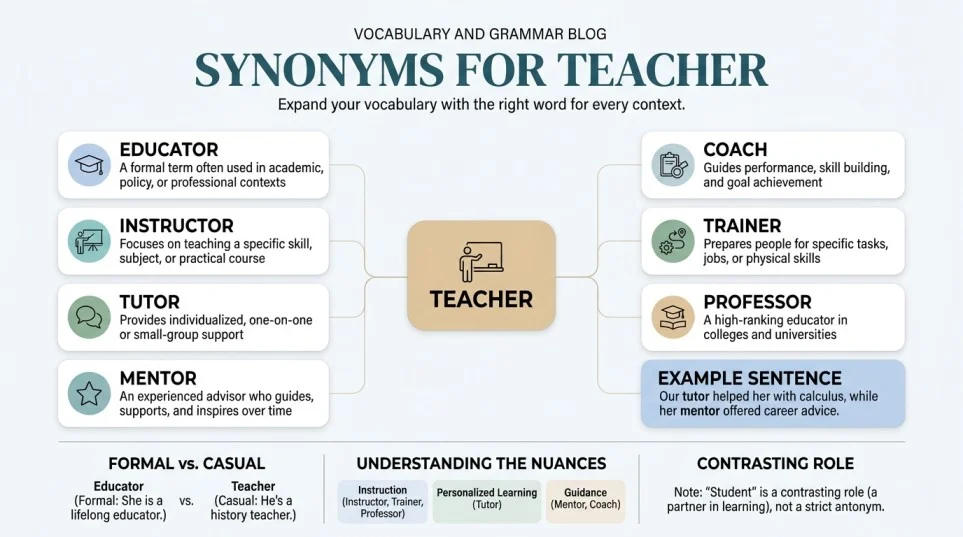
A teacher is someone who helps others learn knowledge, skills, or subjects. Common synonyms include educator, instructor, tutor, mentor, professor, and trainer. Educator works well formally, tutor suits individual instruction, and mentor emphasizes guidance and personal development.
Meaning, Tone and Context
A teacher is a person who helps students or other learners understand information, develop abilities, and gain knowledge through instruction, explanation, demonstration, and practice.
Simple definition
A teacher explains concepts, supports learning, answers questions, and helps learners improve their understanding or skills. Teachers may work in schools, colleges, training centers, workplaces, or private educational settings.
Part of speech
Teacher is a countable noun.
- Singular: The teacher explained the lesson.
- Plural: The teachers prepared their classrooms.
- Related verb: Teach.
- Related noun: Teaching.
- Related adjective: Teaching, as in teaching methods.
Tone and formality
The word teacher has a neutral, respectful tone. It is appropriate for everyday conversation, school assignments, professional communication, and most educational contexts.
Educator often sounds more formal and emphasizes a person’s broader role in education. Instructor highlights the act of teaching a subject or skill, while mentor emphasizes guidance and development.
Common use cases
Use teacher when referring to someone who teaches students, delivers lessons, explains academic concepts, or supports learning.
For more precise writing, choose a related term when the person’s responsibilities are more specific. For example, a driving instructor teaches driving, a private tutor provides individualized academic help, and a mentor offers advice based on experience.
When and How to Use “Teacher”
The word teacher works in many situations because it is familiar, direct, and easy to understand. The following examples show how it fits different contexts.
1. Academic: My teacher explained the difference between renewable and nonrenewable energy.
2. Professional: The teacher attended a workshop on classroom management and student engagement.
3. Personal: My first teacher encouraged me to believe in my abilities.
4. Email: Dear Teacher, I am writing to ask about the upcoming assignment. In a real email, use the person’s name or preferred title when known.
5. Resume: Experienced elementary school teacher with a background in lesson planning and student assessment.
6. Social media: Every great teacher can make a difficult subject feel easier.
7. Creative writing: The village teacher filled the small classroom with stories, questions, and curiosity.
These examples demonstrate that teacher remains effective in both formal and informal writing. A synonym is useful when it adds information rather than simply making a sentence sound different.
Another Word for “Teacher”
The best replacement for teacher depends on the person’s responsibilities and the tone of your sentence.
| Context | Best alternative | Why it works |
|---|---|---|
| Professional writing | Educator | Emphasizes a role in education |
| Academic writing | Instructor | Focuses on teaching a subject |
| Casual conversation | Teacher | Familiar and natural |
| Emotional writing | Mentor | Suggests encouragement and guidance |
| Creative writing | Guide | Highlights helping others discover or learn |
| Resume | Educator or instructor | Describes teaching experience professionally |
| Social media captions | Mentor or educator | Offers a more specific message |
| Teaching practical skills | Trainer | Emphasizes skill development |
| Individual academic support | Tutor | Indicates personalized instruction |
| College teaching | Professor | Appropriate for certain academic appointments |
Best choices by situation
- Professional: Educator is a versatile alternative for education related writing.
- Academic: Instructor is useful when describing someone who delivers lessons or teaches a course.
- Casual: Teacher is usually the clearest and most natural choice.
- Emotional: Mentor works when the person provides lasting guidance and encouragement.
- Creative: Guide can add a sense of discovery, wisdom, or direction.
- Resume or workplace: Use educator, instructor, trainer, or a specific job title that accurately reflects your duties.
- Social media: Mentor, educator, or coach may communicate your intended message more clearly.
- Stronger or more specialized meaning: Master teacher can describe an experienced, highly skilled teacher in some educational systems, while professor identifies a particular academic role.
- Softer meaning: Learning guide may suit an informal or supportive description, although it is not a standard replacement for every teaching position.
Remember that synonyms are not always interchangeable. A professor is not simply another name for every teacher, and a mentor may guide someone without delivering formal lessons.
When Not to Use “Teacher”
Although teacher is useful in many situations, it can be too general when the person’s actual role matters.
Choose a more precise word in these situations:
- When describing a university appointment: Use professor if that is the person’s actual academic title.
- When describing private lessons: Use tutor when someone provides individualized instruction.
- When describing workplace training: Use trainer when the main responsibility is developing practical skills.
- When describing personal guidance: Use mentor when someone shares experience, advice, and professional or personal support.
- When describing sports instruction: Use coach when the role involves developing performance, strategy, or athletic skills.
For example, “She is a teacher at a software company” sounds less specific than “She is a corporate trainer who teaches employees to use new software.”
The more precise sentence tells readers what she actually does.
Words Commonly Confused With “Teacher”
Several similar words describe people who help others learn, but each emphasizes a different responsibility.
| Word | Main difference | When to use it |
|---|---|---|
| Educator | Broad role in education | Schools, educational programs, and professional writing |
| Instructor | Teaching a subject or skill | Courses, workshops, and practical lessons |
| Tutor | Individualized or small group instruction | Academic support and exam preparation |
| Mentor | Guidance based on experience | Career development and personal growth |
| Coach | Improvement through practice and feedback | Sports, performance, and professional development |
| Professor | A specific academic rank or title in many institutions | Higher education when the title is accurate |
These terms overlap, but they describe different aspects of learning. A person can be a teacher and a mentor at the same time, for example, but not every teacher holds the title of professor.
Best Synonym by Context for “Teacher”
| Context | Best synonym | Why it works | Example |
|---|---|---|---|
| Formal writing | Educator | Professional and broad | The educator developed a new learning program. |
| Academic writing | Instructor | Focuses on teaching | The instructor reviewed the course objectives. |
| Business communication | Trainer | Highlights workplace skills | The trainer introduced the new software. |
| Resume | Teacher or educator | Clearly describes teaching experience | Experienced educator with strong classroom management skills. |
| Casual conversation | Teacher | Natural and familiar | My teacher helped me understand algebra. |
| Creative writing | Guide | Adds a sense of direction | The guide opened the door to a world of knowledge. |
| Emotional writing | Mentor | Highlights personal influence | Her mentor helped her regain confidence. |
| Specialized expertise | Subject specialist | Emphasizes subject knowledge | The subject specialist prepared advanced science lessons. |
| Individual instruction | Tutor | Signals personalized learning | The tutor helped him prepare for the exam. |
| Skill development | Trainer | Emphasizes practical ability | The trainer demonstrated each step. |
| Sports | Coach | Focuses on performance | The coach taught the team new techniques. |
| College or university | Professor | Identifies an appropriate academic title | The professor published a study on learning. |
| Early childhood | Preschool teacher | Specifies the age group | The preschool teacher introduced basic counting. |
| Religious education | Religious instructor | Specifies the subject area | The religious instructor explained the lesson. |
| Social media caption | Educator | Broad and professional | Great educators inspire lifelong curiosity. |
| Career development | Mentor | Suggests long term guidance | My mentor helped me set career goals. |
| Practical workshop | Instructor | Suitable for demonstrations | The instructor showed us how to use the equipment. |
| Online learning | Online instructor | Specifies the teaching format | The online instructor provided recorded lessons. |
| Informal skill sharing | Guide | Suggests helpful direction | My friend became my guide to photography. |
| Advanced subject learning | Subject expert | Highlights expertise, not necessarily a teaching job | A subject expert explained the complex theory. |
US and UK usage
In both American and British English, teacher, educator, instructor, and tutor are widely understood.
In the United States, professor commonly refers to faculty members at colleges and universities, but titles and ranks vary. The United Kingdom, lecturer is a common university job title, although it is not an exact substitute for every professor or teacher.
Choose the term that matches the person’s actual position and the audience’s expectations.
Which Synonym Should You Choose?
Use these five questions to find the best synonym for teacher.
- What does the person do? Choose teacher for general instruction, trainer for practical skills, and tutor for personalized academic support.
- How formal is the writing? Choose educator for professional discussions and teacher for ordinary conversation.
- What relationship does the person have with learners? Choose mentor for guidance and coach for performance improvement.
- Does the title matter? Use professor, lecturer, or another specific job title only when accurate.
- What should readers understand immediately? Prefer a clear, familiar word over an unusual alternative that adds no useful meaning.
A simple rule is to choose the most accurate word, not the most impressive sounding one.
Real Life Examples of “Teacher” in Sentences
Here are practical ways to use teacher synonyms in everyday communication.
School: The educator introduced a hands on science activity to help students understand gravity.
Workplace: The corporate trainer prepared employees for the company’s new customer service system.
Writing: Instead of repeating teacher in every paragraph, the writer used instructor when discussing the course and mentor when describing career guidance.
Conversation: My tutor helped me solve the algebra problems I had struggled with all week.
Social media: A great educator does more than explain lessons. They inspire curiosity and independent thinking.
Resume: Dedicated elementary school teacher with experience in lesson planning, classroom leadership, and student assessment.
Email: Hello, Professor Smith. Could you please clarify the reading requirements for next week’s class?
Storytelling: The village mentor shared stories that helped young people make wiser decisions.
Each alternative adds a different shade of meaning. Use it only when that difference fits the situation.
25 Synonyms for “Teacher”
The following table includes 25 useful alternatives, with their meanings, best uses, and examples. Some are close synonyms, while others describe specialized teaching roles or related forms of educational guidance.
| Synonym | Simple meaning | Best used for | Example sentence |
|---|---|---|---|
| 1. Educator | A person involved in teaching or education | Professional and educational writing | The educator created an inclusive classroom. |
| 2. Instructor | Someone who teaches a subject or skill | Courses and lessons | The instructor explained the assignment clearly. |
| 3. Tutor | Someone who provides personalized instruction | Academic support | Her tutor helped her prepare for the exam. |
| 4. Professor | An academic with a relevant university title | Higher education | The professor discussed the latest research. |
| 5. Lecturer | Someone who delivers lectures or holds a relevant academic position | College and university contexts | The lecturer introduced a new economic theory. |
| 6. Mentor | An experienced person who offers guidance | Career and personal development | My mentor encouraged me to apply for the position. |
| 7. Coach | Someone who helps others improve performance | Sports and professional development | The coach helped the team improve its communication. |
| 8. Trainer | Someone who develops practical skills | Workplace and technical training | The trainer demonstrated the safety procedures. |
| 9. Guide | Someone who helps others understand or navigate something | Informal and creative writing | She became a guide for new students. |
| 10. Facilitator | Someone who helps a group learn or work together | Workshops and group learning | The facilitator encouraged everyone to participate. |
| 11. Teaching assistant | Someone who supports a teacher or professor | Schools and universities | The teaching assistant reviewed the students’ exercises. |
| 12. Private instructor | Someone who teaches individuals outside a standard class | Individual lessons | A private instructor helped him improve his piano technique. |
| 13. Schoolteacher | A teacher who works in a school | General school contexts | The schoolteacher organized a reading activity. |
| 14. Preschool teacher | Someone who teaches young children before kindergarten or elementary school | Early childhood education | The preschool teacher taught the children to recognize shapes. |
| 15. Elementary educator | A teacher working with elementary school learners | Primary education | The elementary educator planned a weekly reading schedule. |
| 16. Subject specialist | Someone with specialized knowledge in a subject | Specialized education | The subject specialist explained the advanced mathematics topic. |
| 17. Teaching professional | Someone whose profession involves teaching | Formal professional descriptions | The teaching professional attended a development seminar. |
| 18. Pedagogue | A person concerned with teaching or the practice of education | Educational theory and formal writing | The pedagogue studied different approaches to learning. |
| 19. Academic instructor | Someone who teaches academic subjects | Formal educational settings | The academic instructor revised the course materials. |
| 20. Demonstrator | Someone who teaches by showing how something works | Practical or laboratory instruction | The demonstrator showed students how to operate the equipment. |
| 21. Religious instructor | Someone who teaches religious knowledge | Religious education | The religious instructor explained the historical text. |
| 22. Language instructor | Someone who teaches a language | Language learning | The language instructor helped learners practice pronunciation. |
| 23. Driving instructor | Someone who teaches people to drive | Driver education | Her driving instructor taught her how to park safely. |
| 24. Music teacher | Someone who teaches music | Music education | The music teacher introduced the class to rhythm. |
| 25. Learning guide | Someone who supports another person’s learning | Informal or descriptive writing | The learning guide helped participants explore the topic independently. |
Important distinction: These terms are not all interchangeable. Pedagogue is relatively formal, professor and lecturer can refer to specific academic roles, and compound terms such as driving instructor describe particular kinds of teaching.
For everyday writing, educator, instructor, tutor, and mentor are among the most useful alternatives when their meanings fit.
Synonym Groups and Usage Differences
Professional vs. Personal Synonyms
Professional synonyms describe someone’s role or expertise. Personal synonyms describe the support or influence that person provides.
- Professional: Educator, instructor, trainer, academic instructor.
- Personal: Mentor, guide, coach.
Example: “The instructor explained the course material” describes a teaching responsibility. “My mentor helped me become more confident” describes personal guidance.
Formal vs. Conversational Synonyms
Formal alternatives can make professional writing more precise, but ordinary words are often easier to understand.
| Style | Suitable word | Example |
|---|---|---|
| Formal | Educator | The educator implemented new instructional methods. |
| Academic | Instructor | The instructor evaluated student progress. |
| Conversational | Teacher | My teacher gave us extra practice. |
| Informal and supportive | Mentor | She has been a great mentor to me. |
| Practical training | Trainer | The trainer showed us the process. |
For emails and reports, use educator or instructor when appropriate. For texts and everyday conversation, teacher usually sounds more natural.
Academic Synonyms
Academic writing benefits from precise titles and role descriptions.
- Instructor: Someone who teaches a course or subject.
- Professor: Someone holding the relevant academic title.
- Lecturer: Someone who delivers lectures or holds a corresponding academic position.
- Pedagogue: Someone associated with teaching practice or educational theory.
- Teaching assistant: Someone who supports instruction under another educator’s supervision.
For example, “The instructor collected the assignments” is a clear statement about teaching. “The professor published a study” is suitable when the person holds that academic role.
Do not replace teacher with professor simply to make an essay sound more sophisticated.
Professional and Business Synonyms
In workplaces, the best term depends on the activity being performed.
- Trainer: Develops job related skills.
- Facilitator: Helps a group participate, discuss, and learn.
- Mentor: Provides advice and professional development.
- Instructor: Delivers structured lessons or training.
- Educator: Offers a broad professional description of teaching work.
For a resume, a precise title is usually stronger than a general synonym. “Corporate trainer with experience in employee onboarding” communicates a more specific role than “professional teacher.”
Creative or Literary Synonyms
Creative writing may use words that emphasize a teacher’s influence rather than their official position.
Guide suggests direction and discovery. Mentor conveys wisdom and encouragement. Master can describe an expert in a specific skill, but it is not a general replacement for teacher. Sage describes a wise person, not necessarily someone who teaches professionally.
Example: “The old mentor taught the young artist to see beauty in ordinary things.”
This sentence conveys more personality than simply saying, “The teacher taught the artist.”
Slang or Modern Synonyms
There is no single modern slang term that accurately replaces teacher in every situation. Informal expressions depend on the community and context.
- Coach: Common in sports and increasingly used for professional development.
- Teach: Sometimes used as a verb in expressions such as “She taught us how to do it,” but it is not a noun synonym for teacher.
- Prof: An informal shortening of professor, generally suitable when the person actually holds that title.
Avoid using slang in academic assignments, formal reports, or professional resumes unless the context specifically calls for it.
Strongest vs. Weaker Synonyms
Teacher synonyms do not form a universal scale of strength because they describe different roles. However, they can be grouped by the kind of influence or responsibility they suggest.
| Level of emphasis | Word | Meaning |
|---|---|---|
| Basic | Teacher | General instruction |
| Specialized | Instructor | Teaching a particular subject or skill |
| Practical | Trainer | Developing specific abilities |
| Supportive | Guide | Helping someone learn or progress |
| Developmental | Mentor | Offering continuing advice and guidance |
| Expertise focused | Subject expert | Demonstrating advanced knowledge |
| Academic | Professor | Holding a recognized academic title |
A professor is not necessarily a better teacher than an instructor. These words describe roles, not a ranking of teaching ability.
Emotional vs. Neutral Synonyms
Neutral words describe what someone does, while more personal words highlight their influence.
| Neutral or role focused | More personal or expressive |
|---|---|
| Teacher | Mentor |
| Instructor | Guide |
| Educator | Inspiration |
| Trainer | Coach |
Inspiration is not a direct synonym for teacher. It describes someone or something that motivates others. Use it when discussing influence rather than a formal teaching position.
Antonyms of “Teacher”
There is no exact, universally accepted antonym for teacher. A teacher is a person who teaches, and English does not have a single opposite word that directly reverses that role.
Words such as student, learner, and pupil describe people who receive instruction. They are role contrasts rather than true antonyms.
The following table provides useful contrasting terms without incorrectly presenting them as dictionary antonyms.
| Contrasting term | Meaning | Example sentence |
|---|---|---|
| 1. Student | Someone who studies | The student asked a question. |
| 2. Learner | Someone acquiring knowledge or skills | The learner practiced every day. |
| 3. Pupil | A person receiving instruction, especially in school contexts | The pupil completed the exercise. |
| 4. Trainee | Someone learning to perform a job or skill | The trainee followed the safety instructions. |
| 5. Apprentice | Someone learning a trade through practical experience | The apprentice learned carpentry from an experienced craftsperson. |
| 6. Novice | Someone new to an activity | The novice needed help with the first lesson. |
| 7. Beginner | Someone starting to learn something | The beginner practiced basic guitar chords. |
| 8. Student teacher | Someone training to become a teacher | The student teacher prepared a lesson plan. |
| 9. Intern | Someone gaining practical work experience | The intern attended the training session. |
| 10. Participant | Someone taking part in a learning activity | Each participant completed the workshop task. |
| 11. Attendee | Someone attending a class or event | The attendee took notes during the seminar. |
| 12. Recipient | Someone who receives something | The recipient received the educational materials. |
| 13. Observer | Someone watching rather than leading an activity | The observer recorded the classroom interaction. |
| 14. Listener | Someone who listens to information | The listener asked for clarification. |
| 15. Mentee | Someone receiving guidance from a mentor | The mentee discussed career goals with a mentor. |
For a vocabulary exercise, student, learner, and pupil are often the most useful contrasts to teacher. Remember that the relationship is based on roles, not strict opposites.
Comparison: Teacher vs. Similar Words
Teacher vs. Educator
Main difference: Teacher usually refers to someone who teaches lessons. Educator can describe a broader professional role in teaching and learning.
Stronger: Neither is inherently stronger. Educator sounds broader, while teacher is more direct.
More formal: Educator often sounds more professional.
Examples:
- Teacher: The teacher explained the homework.
- Educator: The educator developed a new literacy program.
Teacher vs. Instructor
Main difference: Teacher is a general term, while instructor often emphasizes teaching a particular course, subject, or skill.
Stronger: Instructor is more specific in many training contexts.
More formal: Both are appropriate professionally.
Examples:
- Teacher: My teacher helped me improve my writing.
- Instructor: The instructor demonstrated the laboratory procedure.
Teacher vs. Tutor
Main difference: A teacher often teaches a class, while a tutor typically provides more individualized academic support.
Stronger: Neither is inherently stronger.
More formal: Teacher is more general, while tutor is precise for personalized instruction.
Examples:
- Teacher: The teacher introduced fractions to the class.
- Tutor: The tutor helped me practice fractions after school.
Teacher vs. Mentor
Main difference: A teacher focuses on instruction. A mentor offers advice, encouragement, and guidance based on experience.
Stronger: Mentor emphasizes the personal relationship rather than teaching authority.
More formal: Both can be used professionally.
Examples:
- Teacher: The teacher explained the research method.
- Mentor: My mentor helped me choose a career path.
Teacher vs. Professor
Main difference: Teacher is a broad term. Professor is an academic title or rank whose exact use varies by institution and country.
Stronger: Professor is more specific to higher education when the title is accurate.
More formal: Professor can be more title specific.
Examples:
- Teacher: The teacher assigned a reading exercise.
- Professor: The professor presented findings from a recent study.
Teacher vs. Coach
Main difference: A teacher often explains knowledge or concepts, while a coach typically helps people improve performance through practice, feedback, and strategy.
Stronger: Coach emphasizes performance development.
More formal: Both work in professional contexts.
Examples:
- Teacher: The teacher explained the grammar rule.
- Coach: The coach helped the speaker improve presentation skills.
Common Phrases and Expressions with “Teacher”
1. Experienced teacher
Meaning: Someone who has substantial teaching experience.
Example sentence: The school hired an experienced teacher to lead its literacy program.
2. Classroom teacher
Meaning: A teacher who works directly with students in a classroom.
Example sentence: The classroom teacher adjusted the lesson to support different learning needs.
3. Student teacher
Meaning: A person completing supervised practical training to become a teacher.
Example sentence: The student teacher observed the class before delivering her first lesson.
4. Private teacher
Meaning: Someone who teaches an individual or a small group privately.
Example sentence: He hired a private teacher to improve his piano skills.
5. Substitute teacher
Meaning: Someone who temporarily teaches a class when the regular teacher is absent.
Example sentence: The substitute teacher continued the lesson according to the class plan.
6. Teacher training
Meaning: Education and practical preparation for people entering or improving their teaching careers.
Example sentence: The district introduced a teacher training program on classroom technology.
7. Teacher’s assistant
Meaning: Someone who helps a teacher with classroom activities and student support.
Example sentence: The teacher’s assistant helped students complete their reading exercises.
8. Teacher of record
Meaning: A person officially assigned responsibility for a class or course, depending on the educational system.
Example sentence: The teacher of record submitted the final grades.
Common Mistakes to Avoid
1. Using a general word when a specific one is better. Calling a private tutor a professor may misrepresent the person’s role. Use the correct title.
2. Confusing a teacher with a mentor. A mentor may provide advice without teaching formal lessons. Choose the term that reflects the relationship.
3. Using overly formal vocabulary. Replacing every instance of teacher with educator or pedagogue can make ordinary writing sound unnatural.
4. Using dramatic words inaccurately. Calling someone a sage or master may suggest wisdom or exceptional expertise beyond what the context supports.
5. Repeating the same word too often. Use a precise alternative when appropriate, but do not change the word if doing so creates confusion.
6. Using slang in formal writing. Expressions such as prof may be acceptable in casual conversation but are not always appropriate in a formal email or academic paper.
7. Treating every related term as an exact synonym. An instructor, coach, tutor, and professor may all teach, but their duties and qualifications can differ.
FAQs About Synonyms for Teacher
1. What is the best synonym for teacher?
Educator is one of the best general alternatives for teacher in professional writing. Instructor, tutor, mentor, and professor are useful when their specific meanings fit.
2. What is a formal synonym for teacher?
Educator is a formal, broadly applicable alternative. Instructor is also suitable for courses, workshops, and structured training, depending on the person’s responsibilities.
3. What is an informal synonym for teacher?
Teacher remains the most natural everyday term. Prof is an informal alternative for professor, while coach may suit someone who helps others improve particular skills.
4. What is another word for teacher in professional writing?
Educator, instructor, and trainer are useful professional alternatives. Choose educator for a broad educational role, instructor for teaching, and trainer for practical workplace skills.
5. What is the difference between a teacher and a mentor?
A teacher primarily helps people learn knowledge or skills through instruction. A mentor provides guidance, advice, and encouragement, often drawing on personal or professional experience.
6. What is the opposite of teacher?
Teacher has no exact antonym. Student, learner, and pupil describe people receiving instruction, making them useful role contrasts rather than strict dictionary opposites.
Conclusion
The best synonyms for teacher depend on the person’s role, the audience, and the purpose of your writing. Educator is a versatile professional alternative, instructor emphasizes teaching, tutor suggests personalized support, and mentor highlights guidance and development.
When choosing another word for teacher, focus on accuracy rather than variety alone. A precise synonym makes your message clearer, more natural, and more useful to readers.
Your practical takeaway: before replacing teacher, ask whether you are describing instruction, specialized expertise, skill development, or personal guidance. That simple distinction will help you choose the right word every time.
Discover More Post:
- 50+ Synonyms for Before | Meanings, Examples, and Best …
- 50+ Synonyms for Other | Meanings, Examples, and Best …
- 50+ Synonyms for Other | Meanings, Examples, and Best …