The word sometimes is useful in everyday English, but repeating it in essays, emails, captions, or professional writing can make your sentences sound predictable. Choosing a more precise alternative helps you communicate how often something happens and whether it is occasional, irregular, or dependent on certain circumstances.
This guide explores 25 synonyms for sometimes, with clear meanings, natural examples, and practical advice for choosing the right expression. You will learn which alternatives fit academic writing, workplace communication, casual conversation, and creative storytelling.
What Does “Sometimes” Mean?
Sometimes means on certain occasions, but not always. Common synonyms include occasionally, now and then, at times, from time to time, and every so often. Formal alternatives depend on context, while expressions such as once in a while suit casual conversations.
Meaning, Tone and Context
What does sometimes mean?
Sometimes means that something happens on some occasions but not on every occasion. It describes an occurrence that is neither constant nor necessarily regular.
For example: “I sometimes work from home” means that working from home happens on certain occasions, but it is not an everyday arrangement.
- Part of speech: Adverb.
- Tone: Neutral. It does not automatically suggest something positive or negative.
- Formality: Suitable for casual conversations, academic essays, business emails, and professional reports.
- Common uses: Describing habits, changing circumstances, occasional feelings, irregular events, and exceptions to usual behavior.
Important related words
| Word | Meaning | Example |
|---|---|---|
| Sometimes | On certain occasions | I sometimes walk to work. |
| Sometime | At an unspecified time | Let’s meet sometime next week. |
| Some time | A period of time | It took some time to finish. |
| Occasional | Happening from time to time | We have occasional meetings. |
| Occasionally | Happening on some occasions | She occasionally visits us. |
Remember that sometimes describes frequency, while sometime generally refers to an unspecified point in time. They are not interchangeable in every sentence.
When and How to Use “Sometimes”
Use sometimes when you want to describe an occasional habit, an experience that does not always occur, or a situation that varies.
Here are realistic examples across different contexts.
1. Professional: Sometimes, a short meeting can resolve a problem more efficiently than a long email exchange.
2. Personal: I sometimes call my grandparents after dinner.
3. Academic: Students sometimes understand a concept more clearly after reviewing practical examples.
4. Emotional: Sometimes, taking a quiet walk helps me process difficult feelings.
5. Creative writing: Sometimes, the smallest moments become the most memorable parts of a story.
6. Social media: Sometimes, a simple photo says more than a long caption.
7. Email: Sometimes, project deadlines change because of unexpected client feedback.
In each example, sometimes communicates occasional occurrence without specifying an exact schedule. If the frequency matters, a more precise expression can make the sentence stronger.
Another Word for “Sometimes”
The best single replacement for sometimes is usually occasionally. It preserves the original meaning and works well in both professional and everyday English.
However, the ideal alternative depends on the sentence.
| Context | Recommended alternative | Example |
|---|---|---|
| Professional writing | Occasionally | We occasionally review the process. |
| Academic writing | In some cases | In some cases, the results differ. |
| Casual conversation | Every so often | I visit that café every so often. |
| Emotional writing | At times | At times, the transition feels overwhelming. |
| Creative writing | Now and then | Now and then, a distant bell rang. |
| Resume or workplace use | Periodically | Periodically reviewed project outcomes. |
| Social media captions | Once in a while | Once in a while, take the scenic route. |
| Stronger emphasis on irregularity | Sporadically | The connection works sporadically. |
| Softer, conversational meaning | From time to time | We chat from time to time. |
Practical tip: Use occasionally as a versatile substitute, periodically for recurring activities, sporadically for irregular occurrences, and at times when emphasizing particular experiences or feelings.
When Not to Use “Sometimes”
Although sometimes is versatile, it can sound vague when readers need exact information about frequency or timing.
1. When a precise frequency matters
Instead of saying, “I sometimes exercise,” specify how often you exercise if that information is important.
Better: “I exercise twice a week.”
2. When describing regular schedules
Sometimes is not the best choice for activities that follow a defined schedule.
Vague: “We sometimes review sales figures.”
More precise: “We review sales figures monthly.”
3. When irregularity is important
If something happens unpredictably, sporadically may communicate the situation more accurately.
Vague: “The internet sometimes disconnects.”
More precise: “The internet disconnects sporadically.”
4. When discussing research findings
Academic writing often benefits from specifying the conditions under which a result occurs.
General: “Sometimes, the treatment produces better results.”
More precise: “In some cases, the treatment produces better results.”
5. When the sentence needs emotional emphasis
The phrase at times can sound more reflective when describing difficult experiences.
General: “Sometimes, change feels uncomfortable.”
More expressive: “At times, change feels overwhelming.”
The goal is not to replace every occurrence of sometimes. Keep it whenever it expresses your meaning clearly.
Words Commonly Confused With “Sometimes”
These related expressions can overlap in meaning, but each communicates something slightly different.
| Word or phrase | Main difference | Example |
|---|---|---|
| Sometime | Refers to an unspecified time | We should meet sometime next month. |
| Occasionally | Emphasizes limited frequency | She occasionally works late. |
| Frequently | Means often, with greater frequency | He frequently travels for work. |
| Rarely | Means not often | They rarely miss a deadline. |
| Periodically | Suggests repeated occurrences, often at intervals | The system is periodically inspected. |
| Sporadically | Suggests irregular or scattered occurrences | The service operated sporadically. |
A useful distinction is that occasionally and sometimes are often interchangeable, whereas frequently, rarely, and sporadically give readers a more specific sense of frequency or pattern.
Best Synonym by Context for “Sometimes”
The best synonym for sometimes depends on what you want readers to understand. Use this table to select an alternative that fits your audience, tone, and purpose.
| Context | Best synonym | Why it works | Example |
|---|---|---|---|
| Formal writing | Occasionally | Professional and neutral | The committee occasionally revises its guidelines. |
| Academic writing | In some cases | Highlights specific circumstances | In some cases, the evidence supports the theory. |
| Business communication | Periodically | Suggests recurring reviews | We periodically assess our performance. |
| Resume | Regularly, when accurate | Shows an established habit | Regularly reviewed customer feedback. |
| Casual conversation | Every so often | Sounds relaxed and natural | I order takeout every so often. |
| Creative writing | Now and then | Creates a conversational narrative | Now and then, she glanced at the window. |
| Emotional writing | At times | Adds a reflective tone | At times, loneliness can feel overwhelming. |
| Irregular occurrence | Sporadically | Emphasizes an uneven pattern | The signal appeared sporadically. |
| Mild or occasional frequency | Once in a while | Suggests something happens infrequently | We eat out once in a while. |
| Social media captions | Every now and then | Feels friendly and expressive | Every now and then, choose adventure. |
| Scientific reporting | In certain instances | Limits the statement to particular cases | In certain instances, the reaction slows. |
| Everyday habits | Occasionally | Communicates an occasional action | I occasionally read before bed. |
| Conditional situations | Under certain circumstances | Identifies conditions rather than frequency | Under certain circumstances, refunds are available. |
| Personal reflection | Sometimes, at times | Preserves a natural reflective voice | At times, progress feels slow. |
| US and UK English | Occasionally | Widely understood in both varieties | The shop occasionally closes early. |
One important distinction: expressions such as under certain circumstances and in some cases are context based alternatives, not exact synonyms in every sentence.
Which Synonym Should You Choose?
Use these five questions to find the most suitable alternative.
1. What do you mean? Choose occasionally for occasional events, periodically for recurring reviews, and sporadically for irregular occurrences.
2. How formal is your writing? Use occasionally in professional documents, in some cases in analytical writing, and every so often in casual conversation.
3. How frequent is the event? Use a measurable expression such as twice a month when exact frequency matters. Choose rarely when something happens infrequently.
4. What tone do you want? Choose at times for reflection, now and then for storytelling, and occasionally for neutral communication.
5. What does the sentence need? Read the entire sentence before replacing the word. A synonym should preserve the original meaning, not simply make the vocabulary sound more advanced.
The strongest vocabulary choice is the one that makes your meaning clearer, not necessarily the longest or most formal expression.
Real Life Examples of “Sometimes” in Sentences
The following examples show how different alternatives work in everyday situations.
School
Original: Sometimes, students struggle to understand complex instructions.
Improved: Students occasionally struggle to understand complex instructions.
The revised sentence sounds natural in a school report without changing the meaning.
Workplace
Original: Sometimes, our team reviews customer feedback.
Improved: Our team periodically reviews customer feedback.
Use periodically when the reviews happen repeatedly, even if the exact schedule is not stated.
Writing
Original: Sometimes, a simple explanation is more effective.
Improved: In some cases, a simple explanation is more effective.
The alternative works well when the statement applies to particular situations rather than universally.
Conversation
Original: I sometimes go to the gym after work.
Improved: I go to the gym every so often after work.
The revised version sounds conversational, although it is less precise about frequency.
Social media
Original: Sometimes, you just need a break.
Improved: Every now and then, you just need a break.
This version creates a relaxed tone suitable for a personal caption.
Resume
Original: Sometimes, I checked project reports.
Improved: Periodically reviewed project reports.
Use the improved version only if reviewing reports was genuinely part of the role. For a resume, measurable accomplishments and accurate descriptions are stronger than vague frequency claims.
Original: Sometimes, the delivery schedule changes.
Improved: Occasionally, the delivery schedule changes.
The alternative maintains a polite, neutral tone appropriate for workplace correspondence.
Storytelling
Original: Sometimes, an old memory returns unexpectedly.
Improved: Now and then, an old memory returns unexpectedly.
The revised sentence feels more personal and narrative in style.
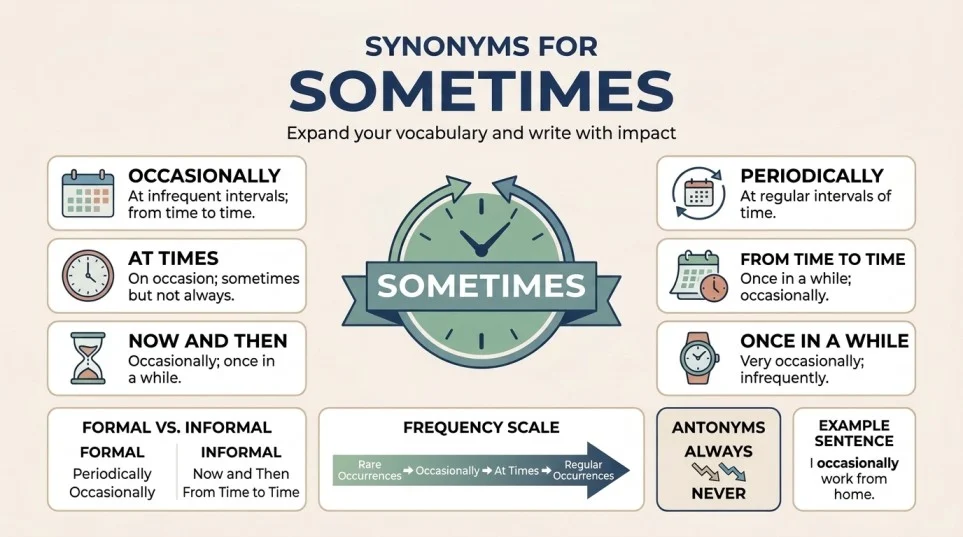
25 Synonyms for “Sometimes”
The table below includes single words and established phrases that can replace sometimes in suitable contexts. Some are close synonyms, while others express a more specific frequency or condition.
| Synonym | Simple meaning | Best used for | Example sentence |
|---|---|---|---|
| 1. Occasionally | On some occasions | General and professional writing | We occasionally meet after work. |
| 2. At times | On particular occasions | Reflection and emotional writing | At times, the process feels difficult. |
| 3. Sometimes | On certain occasions | Neutral everyday language | Sometimes, a break helps. |
| 4. Now and then | Every so often | Casual conversation | Now and then, I revisit that book. |
| 5. From time to time | On some occasions | Emails and general prose | We check the figures from time to time. |
| 6. Every so often | At occasional intervals | Informal writing | Every so often, she calls her old friends. |
| 7. Once in a while | Occasionally, not regularly | Casual conversation | Once in a while, we cook together. |
| 8. Every now and then | Occasionally | Captions and storytelling | Every now and then, take a different route. |
| 9. Periodically | Repeatedly at intervals | Business and technical writing | The equipment is periodically inspected. |
| 10. Sporadically | Irregularly, in scattered instances | Unpredictable events | Rain fell sporadically throughout the afternoon. |
| 11. Intermittently | Starting and stopping at intervals | Technical and descriptive writing | The machine operated intermittently. |
| 12. Infrequently | Not often | Formal or factual statements | The room is infrequently used. |
| 13. Rarely | Not often, with low frequency | Emphasizing uncommon events | He rarely misses practice. |
| 14. Occasionally enough | On some occasions, to a limited degree | Context dependent conversational phrasing | It happens occasionally enough to warrant attention. |
| 15. In some cases | In certain situations | Academic and analytical writing | In some cases, the method saves time. |
| 16. In certain instances | In particular situations | Formal reports | In certain instances, additional approval is required. |
| 17. Under certain circumstances | When specific conditions apply | Policy and professional writing | Under certain circumstances, the deadline may change. |
| 18. On occasion | On particular occasions | Formal prose and speeches | On occasion, the director joins the discussion. |
| 19. On some occasions | During some events or situations | Explanatory writing | On some occasions, the results vary. |
| 20. At intervals | At separated points in time | Technical and descriptive writing | The alarm sounded at intervals. |
| 21. At irregular intervals | Without a fixed pattern | Scientific and factual descriptions | The sensor sends updates at irregular intervals. |
| 22. From one time to another | At different points or occasions | Explanatory prose | Preferences can change from one time to another. |
| 23. Now and again | Occasionally | Conversational and literary writing | Now and again, he visits the coast. |
| 24. Infrequently enough | With sufficiently low frequency | Specialized context dependent phrasing | The fault occurs infrequently enough to escape routine detection. |
| 25. In isolated instances | In a small number of separate cases | Formal reporting | In isolated instances, the software may freeze. |
Accuracy note: Entries 14 and 24 are context dependent phrases rather than direct replacements for sometimes in every sentence. For everyday writing, prioritize occasionally, at times, now and then, from time to time, and once in a while.
Synonym Groups and Usage Differences
Professional vs. Personal Synonyms
Professional writing usually benefits from neutral expressions that communicate frequency clearly. Personal writing can use more conversational alternatives without sounding less correct.
| Professional choice | Personal choice |
|---|---|
| Occasionally | Once in a while |
| Periodically | Every so often |
| In certain instances | Now and then |
| At irregular intervals | From time to time |
For example, “We periodically evaluate our procedures” suits a workplace report. “We check in with each other every so often” feels more natural in a personal message.
Formal vs. Conversational Synonyms
Formal alternatives work well in reports, essays, presentations, and business emails. Conversational alternatives are better suited to texts, informal blogs, and everyday dialogue.
| Formal | Conversational |
|---|---|
| Occasionally | Now and then |
| On occasion | Every now and then |
| In certain instances | Once in a while |
| At irregular intervals | From time to time |
The word occasionally works in both settings, which makes it a reliable choice when you want to maintain a neutral tone.
Academic Synonyms
Academic writing should prioritize precision over complicated vocabulary. The right alternative depends on whether you are describing frequency, conditions, or an exception.
- Occasionally: Suitable for a general observation about frequency.
- In some cases: Useful when a finding applies to only certain cases.
- In certain instances: Appropriate for discussing specific examples or exceptions.
- Under certain circumstances: Useful when a result depends on particular conditions.
- At irregular intervals: Appropriate when occurrences do not follow a consistent schedule.
Example: “In some cases, students perform better when instructions include visual examples.”
This sentence identifies a limited set of circumstances rather than suggesting that the result applies to everyone.
Professional and Business Synonyms
Workplace communication should make frequency easy to understand. The best word depends on the task being described.
| Workplace purpose | Recommended expression | Example |
|---|---|---|
| Reviewing reports | Periodically | We periodically review department reports. |
| Occasional client contact | Occasionally | We occasionally contact former clients. |
| Unpredictable technical faults | Sporadically | The system fails sporadically. |
| Policy exceptions | In certain instances | In certain instances, manager approval is required. |
| Routine but unspecified checks | Regularly, if accurate | The team regularly checks inventory. |
For resumes, avoid vague descriptions whenever you can provide a truthful frequency, measurable result, or concrete accomplishment.
Creative or Literary Synonyms
Creative writing often benefits from phrases that sound natural and establish a particular rhythm.
- Now and then: Creates a conversational storytelling voice.
- At times: Adds a reflective or emotional quality.
- Now and again: Gives narration a slightly literary feel.
- Every so often: Suggests a relaxed, recurring event.
- On occasion: Works well in polished narration.
Example: “Now and again, a warm breeze carried the scent of rain through the open window.”
The phrase contributes to the sentence’s rhythm without changing the basic idea of occasional occurrence.
Slang or Modern Synonyms
There is no widely accepted slang word that replaces sometimes in every context. Modern conversational English usually relies on familiar expressions instead.
| Expression | Tone | Appropriate setting |
|---|---|---|
| Every now and then | Relaxed | Social posts and conversations |
| Once in a while | Friendly | Text messages and captions |
| Now and again | Casual or literary | Personal blogs and storytelling |
These expressions are not inherently slang. They are established phrases used naturally in informal communication.
Avoid replacing sometimes with an obscure or trendy expression just to sound modern. Clear, familiar language usually communicates more effectively.
Strongest vs. Weaker Synonyms
Frequency words do not form a perfectly fixed scale because their meanings overlap. However, the following guide can help you communicate how often something occurs.
Very low
Rarely, infrequently
Suggest that something does not happen often.
Occasional
Once in a while, occasionally
Describe events that happen on some occasions.
Recurring
Periodically, regularly
Suggest repeated events, often with an identifiable pattern.
Uneven
Sporadically, intermittently
Emphasize an irregular pattern or interruptions.
This is a descriptive guide, not a strict mathematical ranking. Regularly can describe frequent activity, while sporadically describes irregularity rather than a particular level of frequency.
Emotional vs. Neutral Synonyms
The choice of phrase can subtly change how a sentence feels.
| Expression | Tone | Example |
|---|---|---|
| Occasionally | Neutral | I occasionally work late. |
| At times | Reflective | At times, the decision feels difficult. |
| Now and then | Relaxed | Now and then, I miss my school days. |
| Sporadically | Factual, sometimes critical | The service operates sporadically. |
| In some cases | Analytical | In some cases, the approach works better. |
Choose a neutral phrase when you want to report facts. Choose a more expressive phrase when the sentence focuses on memories, feelings, or personal experiences.
Antonyms of “Sometimes”
There is no single perfect antonym for sometimes in every context. Its opposites depend on the intended meaning. For example, always means on every occasion, while never means on no occasion.
The following 15 words and expressions are contextual opposites or contrasts, rather than exact antonyms in all situations.
| Antonym or contrasting expression | Meaning | Example sentence |
|---|---|---|
| 1. Always | On every occasion | She always arrives on time. |
| 2. Constantly | Continuously or very frequently | The machine runs constantly. |
| 3. Continuously | Without interruption | The river flows continuously. |
| 4. Consistently | In a steady, dependable manner | He consistently meets his targets. |
| 5. Regularly | At recurring or expected intervals | They regularly attend team meetings. |
| 6. Frequently | Many times | We frequently discuss new ideas. |
| 7. Often | On many occasions | I often read before bed. |
| 8. Repeatedly | Again and again | The warning appeared repeatedly. |
| 9. Habitually | As an established habit | She habitually checks her notes. |
| 10. Routinely | As part of a usual procedure | Staff routinely inspect the equipment. |
| 11. Daily | Every day | He exercises daily. |
| 12. Continuously throughout | During the entire specified period | The lights remained on continuously throughout the night. |
| 13. Without exception | In every case | The rules apply without exception. |
| 14. Never | At no time | She never misses class. |
| 15. Not at all | To no degree or extent | The delay did not help at all. |
Important distinction: Always, never, and without exception are especially useful when contrasting occasional occurrence with universal or absent occurrence. The other expressions contrast with sometimes when the intended meaning emphasizes consistency, regularity, or frequency.
Comparison: “Sometimes” vs. Similar Words
Sometimes vs. Occasionally
Main difference: Both describe events that happen on some occasions. Occasionally often sounds slightly more polished in formal writing.
Which is stronger? Neither has a fixed frequency advantage. Context determines the intended frequency.
Which is more formal? Occasionally.
Examples:
- Sometimes: I sometimes work on Saturdays.
- Occasionally: I occasionally work on Saturdays.
Sometimes vs. Frequently
Main difference: Sometimes indicates occurrence on some occasions, while frequently emphasizes that something happens often.
Which is stronger? Frequently suggests a higher frequency.
Which is more formal? Both are appropriate in formal and informal English.
Examples:
- Sometimes: The team sometimes works remotely.
- Frequently: The team frequently works remotely.
Sometimes vs. Rarely
Main difference: Sometimes describes occasional occurrence without specifying how uncommon it is. Rarely explicitly suggests low frequency.
Which is stronger? Rarely emphasizes that something does not happen often.
Which is more formal? Both work well in professional writing.
Examples:
- Sometimes: He sometimes forgets his keys.
- Rarely: He rarely forgets his keys.
Sometimes vs. Periodically
Main difference: Periodically emphasizes repeated occurrences at intervals, while sometimes does not imply a regular pattern.
Which is stronger? Neither is inherently stronger. Periodically gives a clearer sense of recurrence.
Which is more formal? Periodically often suits technical and business writing.
Examples:
- Sometimes: We sometimes update the software.
- Periodically: We periodically update the software.
Sometimes vs. Sporadically
Main difference: Sometimes is neutral about the pattern. Sporadically suggests irregular or scattered occurrences.
Which is stronger? Sporadically more strongly emphasizes irregularity.
Which is more formal? Both are suitable for formal writing, but sporadically is more specific.
Examples:
- Sometimes: The network sometimes fails.
- Sporadically: The network fails sporadically.
Sometimes vs. Sometime
Main difference: Sometimes describes frequency. Sometime usually refers to an unspecified point in time.
Which is stronger? Neither. They express different ideas.
Which is more formal? Both are standard English words and suit formal writing when used correctly.
Examples:
- Sometimes: I sometimes visit my cousins.
- Sometime: I will visit my cousins sometime next month.
Common Phrases and Expressions with “Sometimes”
1. Sometimes you have to
Meaning: An action is occasionally necessary, even if it is not the preferred choice.
Example sentence: Sometimes you have to ask for help to solve a difficult problem.
2. Sometimes it is better to
Meaning: A particular choice can be more effective in certain situations.
Example sentence: Sometimes it is better to listen before offering advice.
3. Sometimes things do not go as planned
Meaning: Events do not always happen as expected.
Example sentence: Sometimes things do not go as planned, so flexibility is important.
4. Sometimes all you need is
Meaning: A simple thing can occasionally be enough to improve a situation.
Example sentence: Sometimes all you need is a quiet afternoon to recharge.
5. Sometimes less is more
Meaning: A simpler approach can produce a better result than adding more.
Example sentence: Sometimes less is more when you are designing a clean website.
6. Sometimes the best option is
Meaning: A choice may be particularly suitable under certain circumstances.
Example sentence: Sometimes the best option is to start again with a clearer plan.
7. Sometimes, but not always
Meaning: Something is true on certain occasions but is not universally true.
Example sentence: Practice sometimes, but not always, leads to immediate improvement.
8. Sometimes it takes time
Meaning: Progress or understanding does not always happen quickly.
Example sentence: Sometimes it takes time to develop confidence in a new language.
Common Mistakes to Avoid
Even though many expressions resemble sometimes, replacing the word carelessly can change the sentence’s meaning.
1. Using a vague expression when precision matters. “Sometimes I exercise” does not tell readers how often you exercise. If the schedule matters, write “I exercise three times a week.”
2. Confusing sometimes with sometime. Write “I sometimes travel for work” when describing frequency. Write “I will travel sometime next month” when referring to an unspecified time.
3. Using casual expressions in formal reports. “Every now and then” is natural in conversation, but “occasionally” may be a better choice in a professional report.
4. Using overly dramatic language. Do not replace sometimes with sporadically unless the occurrence is genuinely irregular or scattered.
5. Repeating the same word unnecessarily. If a paragraph contains several instances of sometimes, revise selected sentences using occasionally or in some cases when the meaning remains accurate.
6. Choosing the wrong emotional tone. At times may suit a reflective passage, whereas periodically is generally more appropriate for describing routine workplace reviews.
7. Using an inaccurate frequency word. Frequently suggests many occurrences, while rarely suggests very few. Choose the word that reflects the actual situation.
FAQs
1. What is the best synonym for sometimes?
Occasionally is one of the best general synonyms for sometimes. It works in professional writing, everyday conversation, academic essays, and explanatory content.
2. What is a formal synonym for sometimes?
Occasionally is a useful formal synonym. In academic writing, in some cases and in certain instances are appropriate when describing specific situations or findings.
3. What is an informal synonym for sometimes?
Once in a while, now and then, and every so often are natural informal alternatives. They work particularly well in conversations, personal messages, blogs, and captions.
4. What is another word for sometimes in professional writing?
Occasionally works in most professional situations. Periodically is better for recurring reviews, while sporadically describes irregular events such as unexpected technical problems.
5. What is the difference between sometimes and occasionally?
Both words describe events that happen on some occasions. Occasionally often sounds slightly more polished, but neither word has a fixed frequency that applies to every situation.
6. What is the opposite of sometimes?
Always and never are useful contextual opposites. Always indicates that something happens on every occasion, while never indicates that it does not happen at all.
Conclusion
Sometimes is a versatile adverb that describes events that happen on certain occasions rather than all the time. Its best alternatives include occasionally, at times, now and then, from time to time, and periodically.
The right choice depends on frequency, tone, and context. Use occasionally for general writing, periodically for recurring activities, sporadically for irregular occurrences, and at times for reflective or emotional writing.
When you need greater precision, replace vague frequency words with an accurate schedule or measurable detail. A carefully chosen synonym makes your writing clearer, more natural, and more useful to readers.
Discover More Post:
- 50+ Synonyms for Before | Meanings, Examples, and Best …
- 50+ Synonyms for Other | Meanings, Examples, and Best …
- 50+ Synonyms for Other | Meanings, Examples, and Best …