Have you ever described someone as stubborn in an essay, email, conversation, or social media caption, only to realize that the word does not fully express what you mean? Perhaps the person is determined, unwilling to compromise, persistent, or simply difficult to persuade.
Choosing the right alternative makes your writing more precise and helps readers understand your intended tone. This guide explores synonyms for stubborn, explains their differences, and provides practical examples for academic, professional, personal, and creative writing.
What Does “Stubborn” Mean?
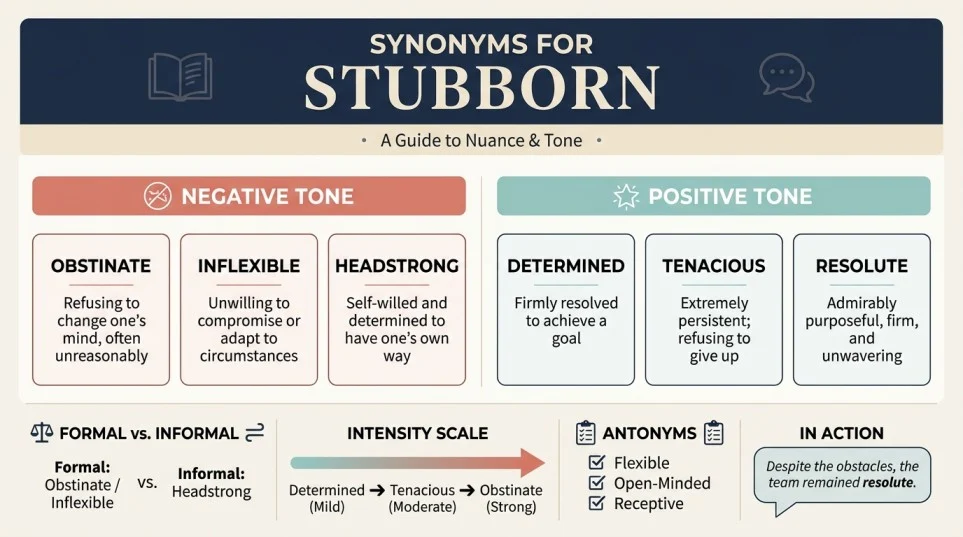
Stubborn means unwilling to change an opinion, decision, or behavior despite advice or opposing evidence. Common synonyms include headstrong, obstinate, persistent, tenacious, determined, inflexible, and resolute. The best choice depends on whether you want to express criticism, determination, or admiration.
Meaning, Tone and Context
The word stubborn describes someone or something that resists change, persuasion, or control. A stubborn person may refuse to reconsider a decision, even when others offer reasonable alternatives.
Simple definition
Stubborn means firmly sticking to an opinion, decision, habit, or course of action, often despite pressure or good reasons to change.
For example, a stubborn student may refuse to follow a teacher’s advice, while a stubborn problem may remain difficult to solve.
Part of speech
Stubborn is an adjective. It describes a person’s attitude, a repeated behavior, or something that resists change.
Examples:
- The stubborn child refused to leave the playground.
- Her stubborn attitude made negotiations difficult.
- The mechanic struggled with a stubborn bolt.
Tone and formality
The word usually has a negative or mildly critical tone when describing a person. However, it can suggest admirable persistence when someone refuses to give up on a worthwhile goal.
| Context | Typical tone | Example |
|---|---|---|
| Personal disagreement | Negative | He is too stubborn to apologize. |
| Workplace feedback | Critical | Her stubborn approach delayed the project. |
| Personal achievement | Positive | His stubborn determination helped him succeed. |
| Everyday conversation | Informal and familiar | My dog is stubborn about taking walks. |
| Creative writing | Depends on context | The stubborn old tree survived every storm. |
Word forms and related words
| Word | Part of speech | Meaning |
|---|---|---|
| Stubborn | Adjective | Resistant to change or persuasion |
| Stubbornness | Noun | The quality of being stubborn |
| Stubbornly | Adverb | In a stubborn manner |
| Obstinate | Adjective | Unreasonably unwilling to change |
| Persistence | Noun | Continued effort despite difficulty |
| Persist | Verb | To continue despite obstacles |
An important distinction is that stubbornness often describes resistance, while persistence emphasizes continued effort toward a goal.
When and How to Use “Stubborn”
Use stubborn when you want to describe resistance to persuasion, a refusal to change, or a problem that will not yield easily. Consider whether the situation calls for criticism, neutral description, or praise.
Here are seven realistic examples.
1. Professional: The manager was stubborn about changing the schedule, even after the team explained the problem.
2. Personal: My brother is stubborn and rarely admits when he is wrong.
3. Academic: The researcher challenged a stubborn assumption that had shaped the field for years.
4. Emotional: She remained stubborn about protecting her family, even when the situation became difficult.
5. Casual conversation: That stubborn jar lid will not open.
6. Email: I appreciate your commitment, but we need to reconsider this stubborn approach before the deadline.
7. Creative writing: The stubborn wind pushed against the door throughout the night.
Notice how the meaning changes with context. Describing a person as stubborn may sound judgmental, but describing a difficult jar lid or a persistent problem is usually neutral.
Another Word for “Stubborn”
The best single replacement for stubborn is often obstinate when you mean someone refuses to change despite reasonable advice. If you want a more positive meaning, determined or tenacious may be better.
Here are the strongest choices for different situations.
| Situation | Best alternative | Why it works |
|---|---|---|
| Professional writing | Inflexible | Highlights an unwillingness to adapt |
| Academic writing | Resistant | Describes opposition to a change or idea |
| Casual conversation | Headstrong | Sounds natural when describing a strong willed person |
| Emotional writing | Unyielding | Emphasizes firm resistance |
| Creative writing | Obstinate | Creates a stronger sense of conflict |
| Resume or workplace profile | Determined | Highlights commitment and initiative |
| Social media captions | Hardheaded | Expresses a blunt, conversational attitude |
| Stronger criticism | Obdurate | Suggests extreme resistance to persuasion |
| Softer description | Strong willed | Emphasizes independence rather than negativity |
For example, instead of writing, “She is stubborn about reaching her goal,” you could write, “She is determined to reach her goal.” The revised sentence focuses on commitment rather than an unwillingness to listen.
When Not to Use “Stubborn”
Although stubborn is useful, it can sound judgmental when you are trying to describe a positive personal quality. In professional or academic writing, a more specific term can communicate the situation more accurately.
| Original sentence | Better alternative | Why it is better |
|---|---|---|
| She is stubborn about finishing her degree. | She is determined to finish her degree. | Emphasizes commitment. |
| He is stubborn about every small decision. | He is inflexible about minor decisions. | Identifies resistance to compromise. |
| The stubborn researcher continued testing the theory. | The persistent researcher continued testing the theory. | Emphasizes sustained effort. |
| We faced a stubborn technical issue. | We faced a persistent technical issue. | Sounds more precise in professional writing. |
| He is stubborn and never listens. | He is obstinate and refuses to consider other views. | Explains the specific behavior. |
Avoid replacing stubborn automatically. First determine whether you mean determination, resistance, independence, persistence, or an unwillingness to cooperate.
Words Commonly Confused With “Stubborn”
Several words describe related qualities, but they do not all express the same attitude.
| Word | Main difference | Best use |
|---|---|---|
| Determined | Focuses on achieving a goal | Positive motivation |
| Persistent | Focuses on continuing despite difficulty | Repeated effort |
| Headstrong | Suggests acting according to one’s own wishes | Independent or impulsive behavior |
| Obstinate | Suggests unreasonable resistance | Strong criticism |
| Tenacious | Emphasizes holding on firmly or refusing to give up | Positive achievement |
| Inflexible | Focuses on an inability or unwillingness to adapt | Rules, plans, attitudes, and policies |
Quick distinction: A determined person keeps working toward a goal. A stubborn person may refuse to change course even when changing would be sensible.
Best Synonym by Context for “Stubborn”
The right synonym depends on what you want to communicate. In formal writing, inflexible and obstinate can express resistance clearly. Positive descriptions, determined, resolute, and tenacious are often more effective.
| Context | Best synonym | Why it works | Example |
|---|---|---|---|
| Formal writing | Obstinate | Expresses unreasonable resistance | The obstinate official rejected every proposal. |
| Academic writing | Resistant | Describes opposition objectively | The community remained resistant to the proposed change. |
| Business communication | Inflexible | Identifies a lack of adaptability | The inflexible policy frustrated employees. |
| Resume | Determined | Highlights commitment | Determined to improve customer satisfaction, I streamlined the process. |
| Casual conversation | Headstrong | Sounds natural and personal | My headstrong cousin always makes his own decisions. |
| Creative writing | Unyielding | Creates a vivid sense of resistance | The unyielding captain refused to surrender. |
| Emotional writing | Uncompromising | Emphasizes firm beliefs | She was uncompromising in defending her family. |
| Strong criticism | Obdurate | Suggests extreme resistance | The obdurate negotiator dismissed every reasonable offer. |
| Mild description | Strong willed | Emphasizes independence | Her strong willed nature helped her speak up. |
| Social media captions | Hardheaded | Communicates blunt determination | A hardheaded dreamer who never gives up. |
| Problem solving | Persistent | Shows that something continues despite effort | The persistent error returned after every update. |
| Personal goals | Resolute | Expresses firm purpose | He remained resolute in his decision to graduate. |
| Teamwork | Uncooperative | Highlights refusal to work with others | The uncooperative member ignored the team’s suggestions. |
| Leadership | Steadfast | Suggests dependable commitment | She remained steadfast during the crisis. |
| Negotiation | Unyielding | Highlights refusal to give ground | Both sides adopted an unyielding position. |
In American English, stubborn, hardheaded, headstrong, and strong willed are all understandable choices. The best one depends on whether the intended meaning is negative, positive, or neutral.
Which Synonym Should You Choose?
Use these five practical questions to select the right word.
1. What is the main behavior? If someone refuses to consider advice, use obstinate. If someone continues working through difficulty, use persistent.
2. How formal is the situation? Choose inflexible for workplace reports, obstinate for formal criticism, and hardheaded for casual conversation.
3. How strong is the emotion? Use strong willed for a gentler description, stubborn for ordinary resistance, and obdurate for extreme resistance.
4. Do you want to praise or criticize? Choose resolute, tenacious, or determined to emphasize positive qualities. Choose intransigent or obstinate when resistance is the problem.
5. What is the sentence about? For a person, consider headstrong or obstinate. A plan, consider inflexible. For an ongoing difficulty, consider persistent.
A useful editing habit is to identify the behavior before choosing a synonym. This prevents you from replacing a familiar word with a more complicated word that changes the original meaning.
Real Life Examples of “Stubborn” in Sentences
These examples show how stronger alternatives can make everyday writing more precise.
| Situation | Example sentence |
|---|---|
| School | The headstrong student insisted on solving the problem independently. |
| Workplace | Our team needs a flexible manager rather than an inflexible decision maker. |
| Essay | An obstinate refusal to consider evidence can weaken an argument. |
| Conversation | You are so hardheaded that you will not even try my suggestion. |
| Social media | Stay determined, stay focused, and keep working toward your dreams. |
| Resume | Demonstrated tenacity while resolving complex customer service challenges. |
| I understand your concerns, but an inflexible approach may prevent us from reaching an agreement. | |
| Storytelling | The unyielding traveler crossed the mountains despite the bitter cold. |
For resumes, focus on the positive quality rather than describing yourself as stubborn. Words such as determined, persistent, and tenacious are generally more suitable because they emphasize useful professional behaviors.
25 Synonyms for “Stubborn”
The following list contains 25 useful alternatives. Some are close synonyms, while others are context dependent expressions that emphasize a particular aspect of stubbornness.
| Synonym | Simple meaning | Best used for | Example sentence |
|---|---|---|---|
| 1. Obstinate | Unwilling to change an opinion | Strong criticism | The obstinate customer rejected every solution. |
| 2. Headstrong | Determined to follow one’s own wishes | Personal behavior | Her headstrong nature often led her into adventures. |
| 3. Inflexible | Unwilling to adapt | Workplace and rules | The inflexible schedule left no room for emergencies. |
| 4. Persistent | Continuing despite difficulties | Effort and problems | Persistent practice improved his writing skills. |
| 5. Tenacious | Holding firmly to a goal | Achievement | The tenacious athlete trained through setbacks. |
| 6. Determined | Firmly committed to a goal | Positive descriptions | She was determined to complete her degree. |
| 7. Resolute | Firm in purpose or decision | Formal and motivational writing | The resolute leader stood by her principles. |
| 8. Unyielding | Refusing to give way | Strong resistance | His unyielding position complicated the negotiations. |
| 9. Uncompromising | Unwilling to weaken one’s standards or position | Principles and negotiations | She remained uncompromising about product quality. |
| 10. Obdurate | Extremely resistant to persuasion | Formal criticism | The obdurate official refused to reconsider. |
| 11. Intransigent | Unwilling to change a position or compromise | Politics and negotiations | The intransigent parties could not reach an agreement. |
| 12. Adamant | Firmly unwilling to change a decision | Strong personal conviction | He was adamant that the report needed revision. |
| 13. Hardheaded | Practical or stubborn, depending on context | Casual conversation | His hardheaded approach made compromise difficult. |
| 14. Strong willed | Having a firm independent will | Personal qualities | The strong willed teenager defended her choices. |
| 15. Opinionated | Having strong opinions | Discussion and personality | The opinionated speaker dominated the debate. |
| 16. Pigheaded | Unreasonably stubborn | Informal criticism | His pigheaded refusal wasted everyone’s time. |
| 17. Bullheaded | Determined in an unreasonable way | Informal criticism | A bullheaded response made the disagreement worse. |
| 18. Dogged | Continuing with persistent determination | Effort and investigation | Her dogged research uncovered the missing evidence. |
| 19. Steadfast | Firm and dependable in loyalty or belief | Positive commitment | He remained steadfast in supporting his colleagues. |
| 20. Unbending | Unwilling to change one’s position | Rules and principles | The unbending director rejected the exception. |
| 21. Uncooperative | Unwilling to work with others | Teamwork | The uncooperative employee ignored repeated requests. |
| 22. Inflexibly minded | Fixed in one’s thinking | Descriptive discussion | An inflexibly minded approach can limit new ideas. |
| 23. Recalcitrant | Resistant to authority or control | Formal descriptions | The recalcitrant pupil refused to follow instructions. |
| 24. Unpersuadable | Not easily convinced | Specific situations | He seemed unpersuadable despite the new evidence. |
| 25. Single minded | Focused intensely on one aim | Goals and ambition | Her single minded pursuit of excellence impressed the team. |
Usage note: These alternatives are not interchangeable in every sentence. Persistent and tenacious often describe admirable effort, while pigheaded, bullheaded, and obdurate usually convey stronger criticism. Opinionated describes strong opinions, not necessarily a refusal to change them.
The phrase inflexibly minded is less idiomatic than inflexible or closed minded in most everyday English. For polished writing, prefer the more natural alternative that fits your exact meaning.
Synonym Groups and Usage Differences
Professional vs. Personal Synonyms
Professional communication benefits from words that describe specific behaviors without making personal judgments.
Use inflexible when someone refuses to adjust a plan, uncooperative when someone will not work with others, and determined when someone stays committed to a useful goal.
In personal conversations, headstrong, hardheaded, and strong willed sound more natural. Their tone depends on the relationship and the situation.
Formal vs. Conversational Synonyms
Formal alternatives include obstinate, obdurate, intransigent, and recalcitrant. They are useful in analytical writing, formal criticism, and discussions of resistance.
Conversational alternatives include hardheaded, pigheaded, and bullheaded. These expressions can sound blunt or insulting, so use them carefully when speaking to someone directly.
Academic Synonyms
Academic writing should explain the nature of resistance rather than rely on a general personality label.
Consider these examples:
- The participants remained resistant to the proposed intervention.
- The argument reflects an inflexible interpretation of the evidence.
- The researcher demonstrated persistence while investigating the problem.
- The committee adopted an intransigent position during negotiations.
Use resistant for opposition, inflexible for a lack of adaptability, and persistent for continued effort. Choose intransigent when a refusal to compromise is central to your argument.
Professional and Business Synonyms
In workplace emails, reviews, and presentations, the best synonym is usually the one that identifies a behavior and its effect.
| Situation | Recommended word | Example |
|---|---|---|
| Employee feedback | Inflexible | The employee was inflexible when priorities changed. |
| Performance review | Determined | She remained determined to meet her targets. |
| Team collaboration | Uncooperative | The uncooperative approach slowed the team. |
| Negotiation | Intransigent | The parties remained intransigent during discussions. |
| Project management | Persistent | His persistent follow up resolved the issue. |
| Resume writing | Tenacious | Demonstrated tenacious problem solving under pressure. |
For constructive feedback, explain what needs to change instead of relying on a label. For example, “Consider alternative solutions when project requirements change” is more actionable than “Stop being stubborn.”
Creative or Literary Synonyms
Creative writing benefits from alternatives that convey character, conflict, and emotion.
- Unyielding: suggests strength and resistance.
- Obstinate: suggests unreasonable refusal.
- Headstrong: suggests independence and impulsiveness.
- Steadfast: suggests loyalty and reliability.
- Dogged: suggests relentless effort.
- Obdurate: suggests extreme resistance to persuasion.
Example: “The steadfast guardian protected the village, while the obstinate ruler refused to hear the villagers’ concerns.”
The contrast between steadfast and obstinate helps distinguish loyalty from unreasonable resistance.
Slang or Modern Synonyms
English has several informal alternatives for stubborn, especially in American conversation.
- Hardheaded: blunt and sometimes critical.
- Pigheaded: strongly insulting in many situations.
- Bullheaded: suggests unreasonable determination.
- Hard to convince: a neutral, conversational expression.
- Set in one’s ways: describes reluctance to change familiar habits.
These expressions are suitable for informal dialogue, personal stories, and casual captions. Avoid slang in academic essays, formal reports, and sensitive workplace feedback.
Strongest vs. Weaker Synonyms
The following scale is approximate. Actual intensity depends on context and delivery.
Mild
Strong willed, determined
Can emphasize independence or positive motivation.
Moderate
Stubborn, headstrong, hardheaded
Common descriptions of resistance or independence.
Strong
Obstinate, intransigent, unyielding
Emphasize firm resistance to advice or compromise.
Very strong
Obdurate, pigheaded
Often convey extreme resistance or sharp disapproval.
This scale is a practical guide, not a universal ranking. For example, unyielding may praise courage in one sentence and criticize an unreasonable position in another.
Emotional vs. Neutral Synonyms
Choose emotional words when the reader needs to feel a character’s frustration, independence, or determination. Choose neutral words when the goal is clear and objective communication.
| Tone | Word choice | Example |
|---|---|---|
| Neutral | Resistant | The department was resistant to the proposal. |
| Positive | Tenacious | Her tenacious efforts helped the team succeed. |
| Positive | Resolute | He remained resolute in his commitment. |
| Critical | Obstinate | The obstinate negotiator dismissed the compromise. |
| Strongly critical | Pigheaded | His pigheaded response angered the group. |
| Formal and critical | Obdurate | The obdurate official rejected further discussion. |
Antonyms of “Stubborn”
An antonym describes the opposite quality, such as openness to advice, flexibility, cooperation, or willingness to change. The most accurate choice depends on which aspect of stubbornness you want to reverse.
| Antonym | Meaning | Example sentence |
|---|---|---|
| 1. Flexible | Able to adapt | Our flexible manager welcomed the revised plan. |
| 2. Adaptable | Able to adjust to change | An adaptable employee learns new systems quickly. |
| 3. Open minded | Willing to consider different ideas | She remained open minded during the debate. |
| 4. Cooperative | Willing to work with others | The cooperative team reached an agreement. |
| 5. Compliant | Willing to follow a request or rule | The compliant student followed the instructions. |
| 6. Agreeable | Willing to agree or please | He was agreeable to changing the schedule. |
| 7. Accommodating | Willing to adjust to others’ needs | The accommodating host changed the seating plan. |
| 8. Receptive | Open to suggestions or ideas | The director was receptive to feedback. |
| 9. Reasonable | Guided by sound judgment | She was reasonable about the proposed changes. |
| 10. Yielding | Willing to give way | The yielding negotiator accepted a fair compromise. |
| 11. Persuadable | Capable of being convinced | He was persuadable once he saw the evidence. |
| 12. Docile | Easy to manage or control | The docile animal followed its handler calmly. |
| 13. Submissive | Inclined to yield to another’s authority | The submissive character rarely challenged the leader. |
| 14. Agreeable minded | Inclined to agree | The agreeable participant supported the group’s decision. |
| 15. Amenable | Willing to consider or accept something | The client was amenable to a different proposal. |
Note: Some antonyms are context specific. Submissive and docile, for example, suggest compliance or yielding behavior, not necessarily a healthy opposite of stubbornness. In most everyday situations, flexible, open minded, receptive, and amenable are the most useful alternatives.
Comparison: Stubborn vs. Similar Words
Stubborn vs. Obstinate
Main difference: Stubborn is a general word for resisting change. Obstinate more strongly suggests unreasonable resistance.
Stronger word: Obstinate usually carries stronger criticism.
Formality: Obstinate often sounds more formal.
- Stubborn: He is stubborn about his daily routine.
- Obstinate: He was obstinate and refused to consider the evidence.
Stubborn vs. Determined
Main difference: Stubborn focuses on refusing to change, while determined focuses on achieving a goal.
Stronger word: Neither is always stronger. Determined expresses purposeful effort, while stubborn can suggest resistance.
Formality: Both work in everyday and professional English.
- Stubborn: She was stubborn about keeping the old process.
- Determined: She was determined to improve the process.
Stubborn vs. Persistent
Main difference: Stubborn emphasizes resistance to change. Persistent emphasizes continuing despite obstacles.
Stronger word: Stubborn may sound more confrontational, while persistent highlights repeated effort.
Formality: Persistent is particularly useful in professional and academic writing.
- Stubborn: He was stubborn about his original answer.
- Persistent: He was persistent in searching for the correct answer.
Stubborn vs. Headstrong
Main difference: Stubborn emphasizes resistance to persuasion. Headstrong emphasizes following one’s own wishes, sometimes impulsively.
Stronger word: Stubborn often emphasizes refusal, while headstrong emphasizes independence.
Formality: Both are common in conversational English.
- Stubborn: The child refused to reconsider his decision.
- Headstrong: The headstrong teenager planned the trip without asking for advice.
Stubborn vs. Tenacious
Main difference: Stubborn often describes resistance, while tenacious describes holding firmly to an objective or continuing through difficulty.
Stronger word: Tenacious sounds more positive when describing achievement.
Formality: Tenacious works well in professional profiles, essays, and formal descriptions.
- Stubborn: He was stubborn about doing things his own way.
- Tenacious: He was tenacious in pursuing a solution.
Stubborn vs. Inflexible
Main difference: Stubborn can describe a person’s attitude or behavior. Inflexible focuses on an unwillingness or inability to adapt.
Stronger word: It depends on the situation. Inflexible can sound more objective, while stubborn can sound more personal.
Formality: Inflexible is especially useful in business and academic writing.
- Stubborn: She was stubborn about changing her opinion.
- Inflexible: She followed an inflexible policy despite changing circumstances.
Common Phrases and Expressions with “Stubborn”
These common expressions help you describe stubborn behavior more naturally in everyday American English.
1. Stubborn as a mule
Meaning: Extremely stubborn, especially when someone refuses to change their mind.
Example sentence: My uncle is stubborn as a mule when it comes to his political opinions.
2. A stubborn streak
Meaning: A tendency to resist advice or insist on doing things one’s own way.
Example sentence: She has a stubborn streak that sometimes makes teamwork challenging.
3. Stubborn as ever
Meaning: Just as unwilling to change as before.
Example sentence: Grandpa is stubborn as ever about driving himself everywhere.
4. Too stubborn to admit defeat
Meaning: Unwilling to accept failure or give up.
Example sentence: He was too stubborn to admit defeat, even after several unsuccessful attempts.
5. A stubborn refusal
Meaning: A firm refusal to accept a request or suggestion.
Example sentence: Her stubborn refusal to reconsider delayed the agreement.
6. Stubbornly refuse
Meaning: Continue refusing despite pressure or persuasion.
Example sentence: The child stubbornly refused to wear the jacket.
7. A stubborn problem
Meaning: A problem that remains difficult to resolve.
Example sentence: The development team spent hours trying to fix a stubborn software bug.
8. Stubbornly optimistic
Meaning: Remaining hopeful despite discouraging circumstances.
Example sentence: She stayed stubbornly optimistic even when the project faced repeated setbacks.
Common Mistakes to Avoid
1. Using stubborn when you mean determined
Incorrect: He is stubborn about finishing his training.
Better: He is determined to finish his training.
Use determined when the emphasis is on reaching a worthwhile goal.
2. Confusing stubborn with persistent
A persistent person continues making an effort. A stubborn person may refuse to reconsider an approach.
Choose persistent when you want to emphasize effort rather than resistance.
3. Using casual words in formal writing
Words such as pigheaded and bullheaded can sound insulting in reports, academic essays, or workplace reviews.
Prefer inflexible, resistant, or obstinate when the context calls for professional language.
4. Choosing an overly dramatic synonym
Calling someone obdurate may exaggerate an ordinary disagreement.
Use stubborn or inflexible when the situation is relatively mild. Reserve stronger terms for situations that genuinely justify them.
5. Repeating stubborn too often
Repeated use makes writing sound limited, especially in essays and stories.
Instead, select alternatives based on the meaning of each sentence. You might use headstrong for personality, inflexible for behavior, and persistent for continued effort.
6. Ignoring emotional tone
Calling a person stubborn may sound critical, while steadfast may suggest loyalty and tenacious may suggest resilience.
Choose a word that reflects your actual judgment rather than simply replacing one adjective with another.
7. Using slang in academic or professional writing
Expressions such as pigheaded may be effective in dialogue but inappropriate in a formal analysis.
Replace informal expressions with precise language that explains the behavior.
FAQs
1. What is the best synonym for stubborn?
The best synonym depends on the context. Use obstinate for unreasonable resistance, determined for commitment to a goal, and tenacious for persistent effort.
2. What is a formal synonym for stubborn?
Obstinate, inflexible, intransigent, and obdurate are formal alternatives. Choose one according to how strongly you want to emphasize resistance or refusal to compromise.
3. What is an informal synonym for stubborn?
Hardheaded, headstrong, pigheaded, and bullheaded are informal alternatives. Some sound insulting, so use them carefully in conversations and personal writing.
4. What is another word for stubborn in professional writing?
Inflexible works when someone resists change, while uncooperative describes difficulty working with others. Use determined or tenacious for positive professional qualities.
5. What is the difference between stubborn and determined?
Stubborn usually emphasizes refusing to change an opinion or approach. Determined emphasizes commitment to achieving a goal despite difficulties or obstacles.
6. What is the opposite of stubborn?
Common opposites include flexible, open minded, receptive, adaptable, and amenable. The best antonym depends on whether you mean willingness to change, cooperate, or consider advice.
Conclusion
Stubborn describes resistance to change, persuasion, or advice, but its meaning can shift with the situation. The best synonyms for stubborn include obstinate for strong criticism, inflexible for professional descriptions, determined for positive ambition, and tenacious for continued effort.
The key is to match the word to your intended meaning, audience, and tone. Before replacing stubborn, ask yourself whether you want to describe resistance, independence, or persistence. That simple habit can make your writing more precise, natural, and effective.
Discover More Post:
- 50+ Synonyms for Investigate | Meanings, Examples, and Best …
- 50+ Synonyms for Opinion | Meanings, Examples, and Best …
- 50+ Synonyms for Greedy | From Selfish to Insatiable, Find the …