Memories help us describe the moments, people, and experiences that stay with us long after they happen. However, using the word memories repeatedly in a personal essay, social media caption, email, or creative story can make your writing feel predictable.
Choosing the right alternative helps you express exactly what you mean. Words such as recollections, remembrances, nostalgic moments, and reminiscences offer different shades of meaning, from factual recall to deep emotional reflection.
This guide to synonyms for memories explains how each alternative works, when to use it, and how to choose the best word for academic writing, professional communication, personal messages, and creative expression.
What Does “Memories” Mean?
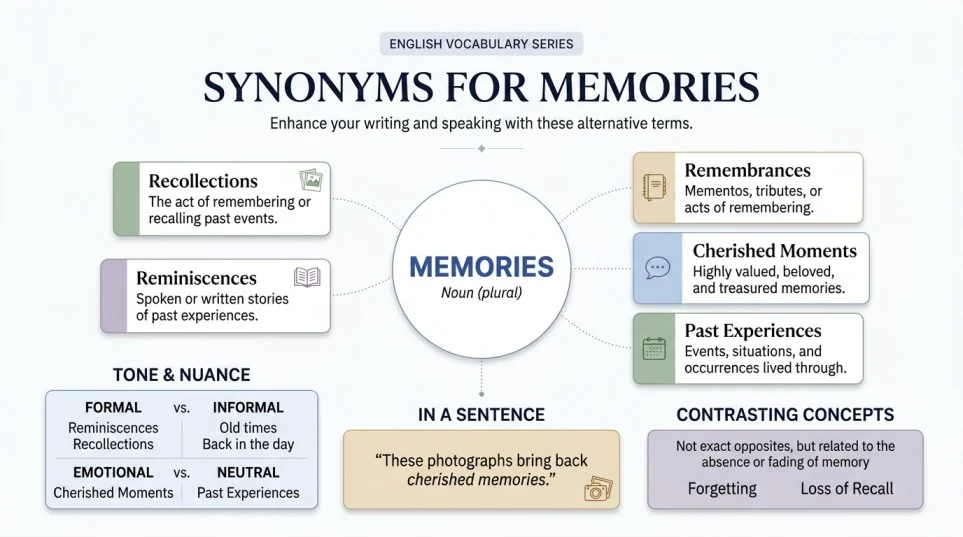
Memories are mental records of past experiences, people, feelings, or events. Common synonyms include recollections, remembrances, reminiscences, and past experiences. Formal writing, use recollections. For emotional writing, choose cherished moments or fond remembrances. For casual conversation, past experiences or old times may sound more natural.
Meaning, Tone and Context
Simple definition
A memory is something remembered from the past, including an experience, an event, a person, a feeling, or information learned earlier. The plural form, memories, refers to multiple remembered things or experiences.
For example, a photograph might bring back memories of childhood, while a former student might share memories of school with old classmates.
Part of speech
Memories is a plural noun. Its singular form is memory.
- Noun: She has wonderful memories of her childhood.
- Related verb: He remembers their first meeting.
- Related adjective: The reunion was memorable.
- Related noun: Her recollection of the event was accurate.
Tone and formality
The word memories is generally neutral, but it often carries a positive or emotional tone when it describes meaningful experiences. The surrounding sentence determines whether the feeling is happy, sad, nostalgic, or painful.
| Feature | Explanation |
|---|---|
| Basic meaning | Experiences or information remembered from the past |
| Part of speech | Plural noun |
| Common tone | Neutral, nostalgic, emotional, or reflective |
| Formality | Suitable for casual and formal writing |
| Common settings | Essays, conversations, captions, speeches, memoirs, and personal messages |
Common uses of memories
People use the word in several situations:
- Personal: Memories of family gatherings and childhood.
- Academic: Memories and learning in cognitive psychology.
- Professional: Memories of a successful project or company milestone.
- Emotional: Memories of someone who is no longer present.
- Creative: Memories that inspire a poem, novel, or personal essay.
The most effective synonym depends on whether you are describing the act of remembering, a specific event, an emotional impression, or a collection of past experiences.
When and How to Use “Memories”
Here are seven realistic examples showing how the word works across different contexts.
1. Personal: My memories of summer vacations with my cousins still make me smile.
2. Academic: The study examines how memories influence learning and decision making.
3. Professional: Our team’s memories of the product launch reflect years of collaboration and hard work.
4. Emotional: She keeps her father’s letters because they preserve precious memories of their time together.
5. Creative writing: The scent of fresh bread awakened memories of her grandmother’s kitchen.
6. Social media: Collecting little memories from every adventure.
7. Email: Thank you for organizing the reunion. It brought back wonderful memories of our school days.
In each example, memories communicates something remembered. A more precise alternative can add information about the experience’s emotional value, accuracy, or significance.
Another Word for “Memories”
The best single replacement for memories in many formal contexts is recollections. However, there is no universal substitute because different words emphasize different aspects of remembering.
| Situation | Best alternative | Why it works |
|---|---|---|
| Professional writing | Recollections | Sounds measured and appropriate for reflective reports |
| Academic writing | Recollections | Emphasizes remembered information or experiences |
| Casual conversation | Old times | Sounds friendly and familiar |
| Emotional writing | Fond remembrances | Highlights affection and sentimental value |
| Creative writing | Reminiscences | Suggests reflection on the past |
| Resume or workplace profile | Experiences | Focuses on what someone has done or learned |
| Social media captions | Throwback moments | Creates a nostalgic, conversational feel |
| Strong emotional meaning | Cherished memories | Emphasizes personal importance |
| Softer, neutral meaning | Past experiences | Avoids adding an unnecessary emotional judgment |
Practical recommendation: Use recollections when precision matters, experiences when discussing what happened, and cherished moments when you want readers to feel the emotional importance of an event.
When Not to Use “Memories”
Although memories is versatile, it can be too broad when a sentence requires a specific meaning.
| Less precise sentence | Better alternative | Why it improves the sentence |
|---|---|---|
| I have memories of the meeting. | I recall the key decisions from the meeting. | Identifies the information remembered |
| We made many memories together. | We shared many unforgettable experiences. | Emphasizes shared activities |
| Her memories were unclear. | Her recollections were unclear. | Fits a discussion of remembered details |
| I miss those memories. | I miss those days. | Sounds more natural in casual conversation |
| The memories were painful. | The recollections were distressing. | Emphasizes the emotional difficulty of remembering |
| This project gave me memories. | This project gave me valuable experience. | Highlights professional development |
Avoid replacing memories with a more complicated word simply to sound sophisticated. The best choice is the one that communicates the intended meaning clearly.
Words Commonly Confused With “Memories”
Several words related to memories describe different aspects of the past. Understanding their differences helps you choose an accurate alternative instead of relying on words that merely sound similar.
| Word | Meaning | When to use it |
|---|---|---|
| Memory | One remembered fact, experience, or mental ability | When discussing a single recollection or the ability to remember |
| Experience | Something that happens to a person | When emphasizing what someone lived through or learned |
| Recollection | An act or instance of remembering something | When accuracy or reflective recall matters |
| Reminiscence | An account or act of reflecting on past experiences | When someone shares stories about earlier times |
| Remembrance | The act of remembering, often with affection or respect | When honoring a person or meaningful event |
| Nostalgia | A sentimental feeling about the past | When describing the emotion associated with earlier times |
For example, experience describes what happened, recollection describes what someone remembers, and nostalgia describes the feeling that remembering may create.
Best Synonym by Context for “Memories”
The best synonym changes according to your audience, purpose, and emotional tone.
| Context | Best synonym | Why it works | Example |
|---|---|---|---|
| Formal writing | Recollections | Precise and professional | Her recollections clarified the timeline. |
| Academic writing | Recollections | Suitable for discussing remembered information | Participants described their recollections of the experiment. |
| Business communication | Experiences | Emphasizes practical involvement | We discussed our experiences during the project. |
| Resume | Experiences | Highlights professional learning and accomplishments | My previous experiences strengthened my leadership skills. |
| Casual conversation | Old times | Sounds friendly and natural | We spent the evening talking about the old times. |
| Creative writing | Reminiscences | Creates a reflective literary tone | His reminiscences filled the quiet afternoon. |
| Emotional writing | Fond remembrances | Expresses affection | She shared fond remembrances of her mother. |
| Strong emotional intensity | Cherished memories | Highlights deep personal importance | Their wedding day remains one of her cherished memories. |
| Soft or moderate tone | Past experiences | Remains relatively neutral | Our past experiences shaped the way we work. |
| Social media captions | Throwback moments | Feels conversational and nostalgic | Throwback moments from our road trip. |
| Memorial writing | Remembrance | Expresses honor or respect | The ceremony was a remembrance of those we lost. |
| Personal essays | Recollections | Supports reflective storytelling | My recollections of that summer remain vivid. |
| Family storytelling | Family stories | Emphasizes shared narratives | Grandpa’s family stories brought everyone together. |
| Travel writing | Travel experiences | Identifies the specific type of event | Her travel experiences changed her perspective. |
| US and UK English | Memories | Widely understood in both varieties | We have wonderful memories of our time together. |
There is no major US versus UK difference in the core meaning of memories. Words such as recollections, remembrances, and experiences are also understood in both varieties of English.
Which Synonym Should You Choose?
Use these practical guidelines to find the best alternative for your sentence.
1. Consider the meaning. If you mean something remembered, choose recollection. If you mean something that happened, choose experience.
2. Match the level of formality. Use recollections in a report or essay. Use old times in an informal conversation with friends.
3. Check the emotional intensity. Choose cherished memories for something deeply meaningful, fond remembrances for affectionate reflection, and past experiences for a neutral description.
4. Think about professional value. In a resume, relevant experience, lessons learned, or professional achievements usually communicates more than memories.
5. Consider the sentence structure. You remember a moment, recall a conversation, share a story, and feel nostalgia. These expressions are related, but they are not interchangeable in every sentence.
6. Read the sentence aloud. If a synonym sounds unnatural or changes your intended meaning, return to the simpler word.
The goal is not to replace every occurrence of memories. It is to make each sentence clearer, more specific, and more engaging.
Real Life Examples of “Memories” in Sentences
These examples show how related words can improve everyday communication.
| Situation | Example sentence |
|---|---|
| School | My recollections of our science fair remind me how much I enjoyed learning through experiments. |
| Workplace | The project gave our team valuable experiences that improved our communication skills. |
| Writing | Her reminiscences of life in a small town inspired the opening chapter. |
| Conversation | We stayed up late talking about the old times. |
| Social media | Little moments, unforgettable adventures, and cherished memories. |
| Resume | My previous professional experiences prepared me to manage complex projects. |
| Thank you for the reunion. It brought back wonderful recollections of our time together. | |
| Storytelling | A familiar song awakened vivid memories of his childhood home. |
| Family | Our family stories keep the traditions of earlier generations alive. |
| Travel | The friendships and experiences from that trip stayed with us long after we returned. |
Notice that the strongest alternatives communicate a more specific idea. In professional writing, experiences can demonstrate growth. In a story, reminiscences can establish a reflective mood.
25 Synonyms for “Memories”
The following table includes close synonyms and context appropriate alternatives. Some entries describe remembered events, while others emphasize the act of remembering or the emotions connected to the past.
| Synonym | Simple meaning | Best used for | Example sentence |
|---|---|---|---|
| 1. Recollections | Things remembered | Formal writing and reflection | Her recollections helped explain what happened. |
| 2. Remembrances | Acts or accounts of remembering | Tributes and personal writing | His remembrances of childhood were touching. |
| 3. Reminiscences | Reflections or stories about the past | Creative and literary writing | Their reminiscences entertained the entire family. |
| 4. Experiences | Events a person has lived through | Work, school, and life stories | Her experiences abroad changed her outlook. |
| 5. Past experiences | Events from an earlier period | Neutral explanations | Past experiences taught him to be patient. |
| 6. Recollections of the past | Remembered events or details | Essays and historical accounts | His recollections of the village were detailed. |
| 7. Memories of old times | Remembered earlier days | Casual conversation | We shared memories of old times over dinner. |
| 8. Cherished moments | Especially treasured experiences | Emotional writing | Their anniversary brought back cherished moments. |
| 9. Fond remembrances | Affectionate memories | Tributes and heartfelt messages | She offered fond remembrances of her teacher. |
| 10. Nostalgic memories | Memories associated with longing for the past | Captions and reflective writing | The old photograph stirred nostalgic memories. |
| 11. Flashbacks | Sudden returns to a past scene or experience | Storytelling and psychology | A familiar sound triggered flashbacks to the journey. |
| 12. Recollections of childhood | Memories from early life | Personal essays | His recollections of childhood were full of wonder. |
| 13. Impressions | General ideas or feelings retained from an experience | Reviews and reflective writing | My first impressions of the city remain positive. |
| 14. Reminders | Things that prompt someone to remember | Everyday communication | These letters are reminders of our friendship. |
| 15. Mental images | Pictures retained in the mind | Descriptive and psychological writing | Mental images of the coastline returned to her. |
| 16. Recalled experiences | Experiences brought back to mind | Reports and reflection | The interview focused on recalled experiences. |
| 17. Recollections of events | Remembered occurrences | Historical or factual discussion | His recollections of events matched the records. |
| 18. Keepsakes | Objects retained for sentimental reasons | Personal and family contexts | The box held keepsakes from her school days. |
| 19. Mementos | Objects that help preserve the memory of something | Travel and celebrations | He kept a ticket as a memento of the concert. |
| 20. Family stories | Narratives about family experiences | Family history and storytelling | Family stories connected the children with their heritage. |
| 21. Anecdotes | Short accounts of interesting incidents | Speeches and informal storytelling | Her anecdotes about college made everyone laugh. |
| 22. Vivid recollections | Especially clear memories | Descriptive and reflective writing | She had vivid recollections of her first performance. |
| 23. Life experiences | Events and lessons accumulated over a lifetime | Personal development | His life experiences shaped his values. |
| 24. Throwback moments | Informal references to earlier experiences | Social media captions | These throwback moments deserve another look. |
| 25. Sentimental memories | Memories carrying strong personal feelings | Personal messages and creative writing | The old recipe brought back sentimental memories. |
Important distinction: These alternatives are not all direct synonyms in every sentence. For instance, a memento is an object associated with a memory, while a flashback is a return to a past scene. Choose the word that matches the idea you want to express.
Synonym Groups and Usage Differences
Professional vs. Personal Synonyms
Professional communication usually benefits from factual, precise language. Personal writing can accommodate warmth, nostalgia, and emotional detail.
| Professional choice | Personal choice |
|---|---|
| Recollections | Cherished memories |
| Previous experiences | Fond remembrances |
| Lessons learned | Precious moments |
| Documented accounts | Family stories |
| Professional experiences | Unforgettable experiences |
For example, write, “My previous experiences strengthened my analytical skills” in a resume. In a personal letter, “Our cherished memories will always bring me comfort” sounds more appropriate.
Formal vs. Conversational Synonyms
Formal language works well when the audience expects accuracy and a measured tone. Conversational language helps people communicate naturally.
| Formal expression | Conversational expression |
|---|---|
| Recollections | Things I remember |
| Reminiscences | Stories about the old days |
| Past experiences | Things I’ve been through |
| Remembrance | Thinking back |
| Recollections of the event | What I remember about it |
Use formal alternatives in research papers, reports, speeches, and carefully written essays. In a text message, “Remember the old days?” will usually sound more natural than “Do you recall our previous experiences?”
Academic Synonyms
Academic writing should prioritize precision rather than decorative vocabulary.
Useful alternatives include:
- Recollections: When discussing what participants remember.
- Recalled experiences: When focusing on reported past events.
- Retained information: When discussing information that remains available for recall.
- Autobiographical memories: When referring to memories of one’s own life.
- Episodic memories: When referring to memories of specific events and experiences.
These terms have different meanings in psychology and research. For example, episodic memories is a specialized term, not a universal replacement for everyday memories.
Professional and Business Synonyms
In the workplace, memories may sound too personal if you are discussing measurable skills, project outcomes, or organizational knowledge.
Consider these alternatives:
- Professional experiences: Work related events and responsibilities.
- Lessons learned: Insights gained through a project or challenge.
- Project history: A record of earlier project activities.
- Documented accounts: Written records of past events.
- Institutional knowledge: Knowledge retained within an organization.
Example: Instead of writing, “My memories of the project helped me improve,” write, “The lessons I learned from the project improved my planning and communication skills.”
Creative or Literary Synonyms
Creative writing often benefits from alternatives that establish atmosphere or suggest emotional depth.
- Reminiscences: Reflective stories about earlier times.
- Reveries: Dreamlike states of thought, sometimes connected with the past.
- Echoes of the past: A figurative expression for lingering influences.
- Vivid recollections: Clear and detailed remembered scenes.
- Cherished moments: Experiences held especially dear.
Example: “Echoes of the past lingered in the quiet house” creates a different atmosphere from “She remembered the house.”
Slang or Modern Synonyms
There is no single slang word that accurately replaces memories in every situation. Informal expressions work best when the audience understands their tone.
- Throwback: A reference to an earlier time or event.
- The good old days: A nostalgic way to describe an earlier period.
- Core memory: An informal expression for a particularly significant or memorable experience.
- Flashback: A return to an earlier scene, often used in storytelling or everyday conversation.
These expressions suit captions, friendly messages, and informal posts. Avoid using them as technical terms in academic papers unless the context specifically calls for informal language.
Strongest vs. Weaker Synonyms
There is no universal intensity scale for synonyms of memories, because some describe the clarity of recall while others describe emotional value. The following scale illustrates emotional emphasis rather than scientific strength.
Mild
Past experiences
Neutral descriptions of earlier events.
Moderate
Fond recollections
Memories with warmth or affection.
Strong
Cherished memories
Experiences with deep personal importance.
Intense
Unforgettable memories
Experiences described as exceptionally difficult to forget.
Remember that unforgettable describes how difficult something is to forget, while cherished describes how much it is valued. They express different qualities.
Emotional vs. Neutral Synonyms
Choose emotionally expressive language when the feeling matters. Choose neutral language when the facts are more important than the emotion.
| Emotional expression | Neutral alternative |
|---|---|
| Precious memories | Past experiences |
| Cherished moments | Significant events |
| Painful recollections | Recollections of difficult events |
| Nostalgic memories | Memories of an earlier period |
| Heartwarming remembrances | Positive recollections |
For a personal tribute, “Her cherished memories of her grandfather brought comfort” is appropriate. For an objective report, “Participants described their recollections of the event” is more measured.
Antonyms of “Memories”
The word memories has no exact set of direct antonyms because remembering is not a single action with one opposite. However, certain words describe contrasting ideas, such as forgetting, absence of recall, or lack of familiarity.
The following 15 terms are contextual opposites or contrasting concepts, not interchangeable dictionary antonyms.
| Antonym or contrasting term | Meaning | Example sentence |
|---|---|---|
| 1. Forgetfulness | A tendency to forget | His forgetfulness made it difficult to recall appointments. |
| 2. Oblivion | A state of being forgotten or unaware | The old tradition gradually faded into oblivion. |
| 3. Amnesia | Loss of memory, usually due to a medical condition or injury | The patient experienced amnesia after the accident. |
| 4. Forgetting | The process of losing access to remembered information | Forgetting the details did not change what happened. |
| 5. Inattention | Lack of attention | Inattention caused her to miss an important detail. |
| 6. Unawareness | Lack of awareness or knowledge | His unawareness of the event surprised his colleagues. |
| 7. Ignorance | Lack of knowledge or information | Ignorance of the rules led to confusion. |
| 8. Unfamiliarity | Lack of previous knowledge or experience | Her unfamiliarity with the town made navigation difficult. |
| 9. Novelty | The quality of being new or unfamiliar | The novelty of the experience made it exciting. |
| 10. Inexperience | Lack of practical experience | His inexperience showed during the first presentation. |
| 11. Disconnection | A lack of connection or association | The story felt disconnected from her personal experiences. |
| 12. Erasure | The removal of a record or trace | The erasure of the written record complicated the investigation. |
| 13. Loss of recall | Inability to retrieve remembered information | Stress sometimes contributed to a temporary loss of recall. |
| 14. Blankness | An absence of clear thought or recollection | Her mind went blank during the interview. |
| 15. Lack of recognition | Failure to identify someone or something familiar | His lack of recognition puzzled his longtime friend. |
Best choice: Use forgetting when contrasting remembering with losing information, amnesia when discussing a specific memory impairment, and unfamiliarity when describing something not previously encountered.
Comparison: Memories vs. Similar Words
These six comparisons clarify the differences between memories and related vocabulary.
Memories vs. Recollections
Main difference: Memories is a broad term for remembered experiences or information. Recollections emphasizes the process or content of remembering.
Strength: Neither is inherently stronger. Recollections can sound more deliberate or reflective.
Formality: Recollections often sounds more formal.
Examples:
- Memories: My memories of the trip make me smile.
- Recollections: Her recollections of the trip included several useful details.
Memories vs. Experiences
Main difference: Memories are what you remember. Experiences are events you have lived through.
Strength: Experiences emphasizes participation, while memories emphasizes what remains in the mind.
Formality: Both are suitable for formal and informal writing.
Examples:
- Memories: I treasure my memories of working abroad.
- Experiences: My experiences working abroad improved my communication skills.
Memories vs. Reminiscences
Main difference: Memories may be individual details or mental records. Reminiscences usually refers to reflective recollections or stories about the past.
Strength: Reminiscences often creates a more reflective, literary feeling.
Formality: Reminiscences is relatively formal or literary.
Examples:
- Memories: The photograph brought back memories of school.
- Reminiscences: His reminiscences about school entertained the audience.
Memories vs. Remembrances
Main difference: Memories is a broad everyday term. Remembrances often emphasizes deliberate remembering, affection, or honoring someone.
Strength: Remembrances can carry a stronger sentimental or commemorative tone.
Formality: Remembrances often appears in tributes and formal reflections.
Examples:
- Memories: We shared happy memories of our teacher.
- Remembrances: Her students offered heartfelt remembrances of their teacher.
Memories vs. Nostalgia
Main difference: Memories are remembered experiences. Nostalgia is a sentimental longing for the past.
Strength: Nostalgia expresses a feeling rather than the remembered event itself.
Formality: Both can appear in formal and casual writing.
Examples:
- Memories: I remember our family vacations.
- Nostalgia: Thinking about those vacations fills me with nostalgia.
Memories vs. Flashbacks
Main difference: Memories are general recollections. Flashbacks involve a return to a past scene or experience, whether in storytelling or certain psychological contexts.
Strength: Flashbacks often suggest an immediate or vivid return to a particular scene.
Formality: Both terms are appropriate in the right context, but flashback has specific narrative and psychological uses.
Examples:
- Memories: She has many memories of her first apartment.
- Flashbacks: The novel uses flashbacks to reveal the character’s childhood.
Common Phrases and Expressions With “Memories”
These expressions are useful in conversations, captions, personal messages, and creative writing.
1. Make memories
Meaning: To create experiences that may be remembered later.
Example sentence: We spent the weekend exploring the mountains and making memories together.
2. Bring back memories
Meaning: To make someone remember a past experience.
Example sentence: That familiar song brings back memories of our college days.
3. Cherish the memories
Meaning: To value remembered experiences deeply.
Example sentence: Even though we live far apart, I cherish the memories we made.
4. Create lasting memories
Meaning: To have experiences that remain important over time.
Example sentence: The family reunion helped us create lasting memories.
5. A trip down memory lane
Meaning: An enjoyable reflection on earlier times.
Example sentence: Looking through our school photographs was a trip down memory lane.
6. Fond memories
Meaning: Warm and affectionate recollections.
Example sentence: She has fond memories of visiting her grandparents every summer.
7. A flood of memories
Meaning: Many recollections arriving at once.
Example sentence: Seeing his childhood home brought a flood of memories.
8. Memories to last a lifetime
Meaning: Experiences expected to remain meaningful for many years.
Example sentence: Watching the sunrise together gave us memories to last a lifetime.
Common Mistakes to Avoid
1. Using a broad word when a precise one is better
Incorrect: My memories helped me qualify for the position.
Better: My professional experiences prepared me for the position.
The revised sentence communicates relevant qualifications rather than simply referring to past events.
2. Confusing memories with nostalgia
Incorrect: Nostalgia is a collection of remembered events.
Better: Nostalgia is a sentimental feeling about the past.
Memories are what you remember, while nostalgia is the emotion you may feel when remembering.
3. Using literary vocabulary in everyday messages
Awkward: I enjoyed our reminiscences at lunch.
More natural: I enjoyed talking about our old times at lunch.
The first sentence is grammatically possible, but the second is more conversational.
4. Choosing an overly dramatic synonym
Awkward: The lunch created unforgettable memories for the ages.
Better: Lunch with my friends was a wonderful experience.
Use intense expressions when the occasion genuinely deserves them.
5. Repeating the same word too often
Repetitive: My memories of school are special. These memories remind me of friends. My memories make me happy.
Improved: My school memories are special. Those recollections remind me of close friends and happy afternoons.
Variation helps, provided the replacement fits the sentence.
6. Choosing the wrong emotional tone
Incorrect for a neutral report: The heartbreaking memories affected every participant.
Better: Participants reported difficult recollections of the event.
The second sentence is more measured and appropriate for objective reporting.
7. Using slang in formal writing
Too casual: Our project gave us some amazing throwback moments.
More professional: Our project created valuable experiences and lasting professional relationships.
Reserve slang and trend based expressions for audiences who will understand their informal tone.
FAQs About Synonyms for Memories
1. What is the best synonym for memories?
The best synonym for memories is recollections in many formal contexts. For emotional writing, cherished memories or fond remembrances may communicate the intended feeling more effectively.
2. What is a formal synonym for memories?
Recollections is a useful formal synonym for memories. It works well in essays, reports, interviews, and reflective writing when discussing information or experiences remembered from the past.
3. What is an informal synonym for memories?
Old times, throwback moments, and things I remember are informal alternatives. Choose the expression that fits your audience and the type of conversation or caption.
4. What is another word for memories in professional writing?
In professional writing, use recollections for remembered details, experiences for work related events, and lessons learned for practical knowledge gained through a project.
5. What is the difference between memories and reminiscences?
Memories can refer to any remembered experiences or information. Reminiscences usually describes reflective recollections or stories about the past, often shared in conversation or writing.
6. What is the opposite of memories?
There is no single exact antonym for memories. Forgetting is a useful contrast when discussing recall, while amnesia refers to a form of memory loss and has a more specific meaning.
Conclusion
Memories describe the experiences, people, events, and information we remember from the past. The best alternatives depend on the purpose of your writing, whether you need the precision of recollections, the warmth of cherished moments, or the practical meaning of experiences.
For emotional writing, choose words that express genuine feeling. Academic and professional communication, prioritize accuracy and clarity. For captions and casual conversations, natural expressions such as old times and throwback moments often work well.
One practical tip is to identify what you want to emphasize before selecting a synonym. Are you describing something remembered, an experience you lived through, or an emotion connected to the past? Answering that question will help you choose a more meaningful word. expressions, and contextual opposites.
Discover More Post:
- 50+ Synonyms for Investigate | Meanings, Examples, and Best …
- 50+ Synonyms for Opinion | Meanings, Examples, and Best …
- 50+ Synonyms for Greedy | From Selfish to Insatiable, Find the …