Have you ever used the word against several times in an essay, email, social media caption, or professional report? Although it is a common English word, repeating it can make your writing feel less precise and less engaging.
Learning synonyms for against helps you communicate opposition, resistance, disagreement, physical contact, and contrast more accurately. The best replacement depends on what you mean, who you are addressing, and how formal your writing needs to be.
This guide explores 25 useful alternatives, explains their differences, and provides practical examples to help you choose the right word naturally.
What Does “Against” Mean?
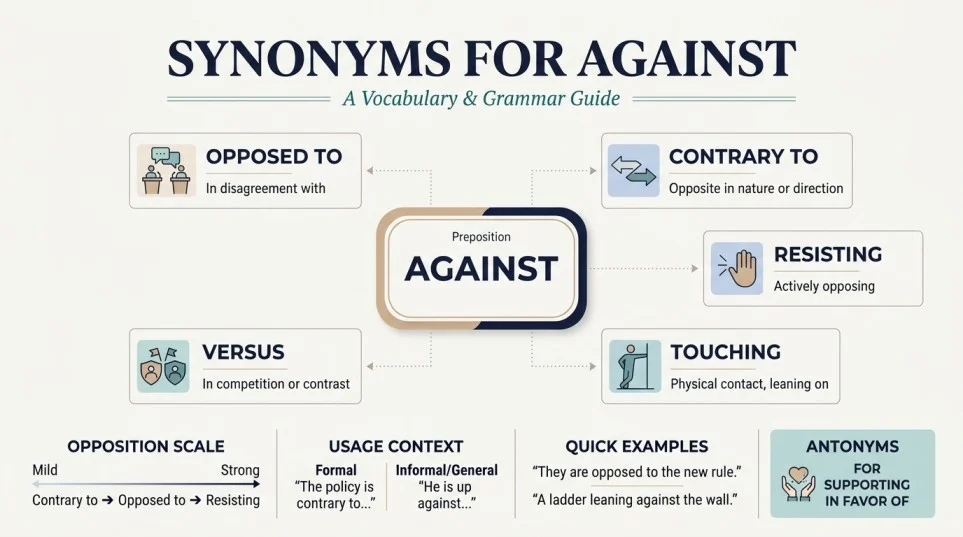
Against means in opposition to, in conflict with, in contact with, or in comparison with something. Useful synonyms include opposed to, contrary to, resisting, opposing, versus, touching, and contrasting with, depending on the sentence and intended meaning.
Meaning, Tone and Context
Simple Definition
The word against describes opposition, resistance, disagreement, physical contact, or a relationship in which two things are compared or work in conflicting directions.
For example, “She voted against the proposal” expresses opposition, while “The ladder rested against the wall” describes physical contact.
Part of Speech
Against is a preposition. It connects a noun or pronoun to another part of a sentence and explains their relationship.
Examples:
- The team competed against its rivals.
- He leaned against the door.
- The evidence worked against the defendant.
Tone and Formality
Against is generally neutral and works in formal, academic, professional, and casual communication. Its emotional tone depends on the surrounding words.
| Context | Tone | Example |
|---|---|---|
| Academic | Neutral and precise | The findings argue against the theory. |
| Professional | Direct | The committee voted against the change. |
| Personal | Potentially emotional | Everyone seemed to be against me. |
| Physical description | Neutral | The bicycle rested against the fence. |
| Legal | Formal | The evidence was used against the accused. |
Common Uses
The word appears in several important contexts:
- Opposition: against a proposal, policy, or decision.
- Competition: playing against another team.
- Protection: insurance against financial loss.
- Physical contact: leaning against a wall.
- Comparison: measuring performance against a standard.
- Disadvantage: circumstances working against someone.
- Prevention: taking precautions against a threat.
Related Word Forms
Against does not have a standard adjective, noun, or verb form. Related words include oppose as a verb, opposition as a noun, opposed as an adjective, and opponent for a person who competes or disagrees.
When and How to Use “Against”
The word is useful whenever you need to express a relationship involving opposition, contact, competition, or comparison.
Here are seven realistic examples.
- Professional: The management team voted against the proposed budget.
- Academic: The latest findings provide evidence against the original hypothesis.
- Personal: I felt as though my friends were against my decision.
- Email: We recommend against making changes before the review is complete.
- Sports: Our school will compete against its strongest rival on Friday.
- Social media: Standing up for what you believe in, even when others are against you.
- Creative writing: Rain tapped against the window as the lights faded.
Notice that the word remains appropriate in all seven sentences, but different synonyms could make certain meanings more specific.
Another Word for “Against”
The best single replacement for against in the sense of opposition is usually opposed to. However, no synonym fits every use because against can describe both abstract relationships and physical positions.
| Situation | Best Alternative | Example |
|---|---|---|
| Professional writing | Opposed to | The director is opposed to the proposal. |
| Academic writing | Contrary to | The results are contrary to earlier findings. |
| Casual conversation | Not in favor of | I am not in favor of that idea. |
| Emotional writing | Hostile toward | He became hostile toward his former friend. |
| Creative writing | In defiance of | She acted in defiance of tradition. |
| Resume or workplace use | Challenged | Challenged outdated procedures to improve efficiency. |
| Social media captions | Standing up to | Standing up to negativity with confidence. |
| Stronger opposition | Resisting | Residents are resisting the proposed development. |
| Softer disagreement | Hesitant about | I am hesitant about approving the plan. |
Important: Some alternatives are phrases rather than single words. Choose them when they express your intended meaning more accurately.
When Not to Use “Against”
Although against is versatile, it can sound vague when the relationship between two things needs clarification.
Consider these situations.
1. When you need to identify disagreement precisely
General: The researcher argued against the idea.
More precise: The researcher challenged the assumptions behind the idea.
The second sentence identifies the action more clearly.
2. When describing physical contact
General: The chair was against the wall.
More natural in many descriptions: The chair was beside the wall.
Use against when the chair touches the wall. Use beside when you simply mean that it is nearby.
3. When discussing data or performance
General: We measured the results against the target.
More explicit: We compared the results with the target.
Both can work, but compared with makes the comparison especially clear.
4. When expressing a mild concern
Overly strong: I am fighting against the schedule.
More natural: I have concerns about the schedule.
Choose language that matches the seriousness of the situation.
5. When discussing rules or evidence
General: The decision was against the rules.
More formal: The decision violated the rules.
The second option communicates a specific breach rather than a broad conflict.
Words Commonly Confused With “Against”
Several related words appear interchangeable but have different meanings.
| Word | Main Difference | Example |
|---|---|---|
| Opposite | Describes a contrasting position or quality | Their opinions are opposite. |
| Contrary to | Means inconsistent with a rule, belief, or fact | The action was contrary to policy. |
| Versus | Identifies competing sides or alternatives | The final is Tigers versus Eagles. |
| Opposed to | Expresses disagreement or resistance | She is opposed to the change. |
| Against | Covers opposition, contact, and other relationships | He leaned against the railing. |
| Compared with | Examines similarities or differences | Sales improved compared with last year. |
The main lesson is simple: a word that expresses disagreement may not work when the original sentence describes physical contact or comparison.
Best Synonym by Context for “Against”
The best synonym depends on the purpose of the sentence, the intended audience, and the relationship you want to describe.
| Context | Best Synonym | Why It Works | Example |
|---|---|---|---|
| Formal writing | Contrary to | Sounds precise and professional | The action was contrary to policy. |
| Academic writing | Inconsistent with | Identifies a conflict between claims or evidence | The results are inconsistent with the hypothesis. |
| Business communication | Opposed to | Expresses a clear position | The board is opposed to the proposal. |
| Resume | Challenged | Highlights constructive action | Challenged inefficient processes. |
| Casual conversation | Not in favor of | Sounds natural and conversational | I am not in favor of the plan. |
| Creative writing | In defiance of | Adds determination or rebellion | She spoke in defiance of convention. |
| Emotional writing | Hostile toward | Conveys antagonism | He became hostile toward his neighbors. |
| Strong opposition | Resisting | Emphasizes active resistance | Residents are resisting eviction. |
| Mild disagreement | Hesitant about | Softens the message | I am hesitant about that decision. |
| Social media captions | Standing up to | Communicates courage and determination | Standing up to negativity. |
| Legal writing | Contrary to | Identifies conflict with a rule or requirement | The conduct was contrary to the statute. |
| Physical contact | Touching | Describes direct contact | The frame was touching the wall. |
| Competition | Versus | Clearly identifies opposing competitors | Lions versus Bears. |
| Comparison | Compared with | Makes the comparison explicit | Performance improved compared with last quarter. |
US and UK Usage
Against is standard in both American and British English. The same is true of most alternatives listed here.
There is no major US versus UK distinction that requires a different synonym. The choice usually depends on tone, meaning, and sentence structure rather than regional vocabulary.
Which Synonym Should You Choose?
Use this practical decision guide before replacing against.
1. Identify the meaning. Are you describing opposition, physical contact, competition, or comparison? Start here because meaning matters more than variety.
2. Consider formality. Use contrary to or inconsistent with in formal analysis. In everyday conversation, not in favor of often sounds more natural.
3. Match the intensity. Hesitant about signals uncertainty, while resisting suggests active opposition. Hostile toward expresses a more negative attitude.
4. Think about professional value. In a resume, words such as challenged and addressed can communicate constructive action when they accurately describe what you did.
5. Check the grammar. Some alternatives require different sentence structures. For example, “opposed to the policy” works, but “versus the policy” does not express the same relationship.
6. Read the sentence aloud. A good synonym should preserve the meaning and sound natural to your intended audience.
Real Life Examples of “Against” in Sentences
These examples show how alternatives can improve clarity across everyday situations.
| Situation | Original Sentence | Improved Alternative |
|---|---|---|
| School | The student argued against the rule. | The student challenged the rule. |
| Workplace | The manager was against the proposal. | The manager opposed the proposal. |
| Academic writing | The data went against the theory. | The data contradicted the theory. |
| Conversation | I am against that idea. | I am not in favor of that idea. |
| Social media | We must stand against bullying. | We must stand up to bullying. |
| Resume | I worked against inefficient processes. | I challenged inefficient processes. |
| We advise against approving the request. | We recommend that you reconsider the request. | |
| Storytelling | She leaned against the door. | She rested against the door. |
The improved sentence is not always shorter. The goal is to express the intended meaning more naturally and precisely.
25 Synonyms for “Against”
The following table includes 25 useful alternatives and related expressions. Some are direct synonyms in opposition related contexts, while others fit only particular meanings of against.
| Synonym | Simple Meaning | Best Used For | Example Sentence |
|---|---|---|---|
| 1. Opposed to | Disagreeing with something | Formal and professional writing | The committee is opposed to the proposal. |
| 2. Contrary to | Conflicting with a rule or belief | Academic and legal writing | His actions were contrary to policy. |
| 3. Opposing | Acting against a position or idea | Debate and politics | Several members are opposing the amendment. |
| 4. Resisting | Refusing to accept or yield | Conflict and social issues | Residents are resisting the proposed closure. |
| 5. Contradicting | Saying or showing the opposite | Research and arguments | The evidence is contradicting his claim. |
| 6. Contesting | Challenging the validity of something | Legal and formal contexts | She is contesting the decision. |
| 7. Challenging | Questioning or confronting something | Workplace and academic contexts | The team is challenging outdated practices. |
| 8. Oppugning | Disputing or attacking a claim | Rare, highly formal writing | The scholar spent years oppugning the accepted theory. |
| 9. Defying | Refusing to obey or accept authority | Rebellion and determination | The protesters continued defying the restrictions. |
| 10. Fighting | Actively struggling against something | Personal and social contexts | They are fighting discrimination. |
| 11. Battling | Struggling against a difficult problem | Emotional and dramatic writing | The town is battling rising costs. |
| 12. Countering | Responding with an opposing action or argument | Business and debate | The company is countering the allegation. |
| 13. Objecting to | Expressing disapproval | Meetings and conversations | Several parents are objecting to the change. |
| 14. Disapproving of | Viewing something negatively | Personal and social contexts | Her family disapproves of the arrangement. |
| 15. In conflict with | Being incompatible or in disagreement | Reports and analysis | The proposal is in conflict with existing rules. |
| 16. Inconsistent with | Not matching or agreeing with something | Academic and scientific writing | The outcome is inconsistent with earlier results. |
| 17. At odds with | In disagreement or conflict | General and professional writing | His statement is at odds with the report. |
| 18. In opposition to | Taking the opposite position | Formal discussion | The group organized in opposition to the measure. |
| 19. Not in favor of | Not supporting something | Casual and professional conversation | I am not in favor of the proposal. |
| 20. Resistant to | Unwilling to accept or change | Behavioral and organizational contexts | Employees were resistant to the new system. |
| 21. Hostile toward | Showing active dislike or aggression | Emotional descriptions | The crowd became hostile toward the speaker. |
| 22. Versus | In competition or contrast with | Sports and comparisons | The schedule lists Hawks versus Wolves. |
| 23. Touching | In physical contact with | Descriptive writing | The ladder was touching the wall. |
| 24. Abutting | Directly adjoining or meeting | Architecture and property descriptions | The garden abuts the stone wall. |
| 25. Compared with | Considered alongside something else | Analysis and performance reviews | Revenue rose compared with the previous quarter. |
Usage note: These alternatives are not interchangeable in every sentence. Opposed to works well for disagreement, touching describes physical contact, and compared with introduces a comparison. Rare words such as oppugning are usually unnecessary in everyday writing.
Synonym Groups and Usage Differences
Professional vs. Personal Synonyms
Professional writing benefits from clear, measured language. Use opposed to, challenging, contrary to, or inconsistent with when discussing proposals, evidence, rules, or workplace decisions.
Personal writing can use more expressive alternatives. Against me, hostile toward, and fighting may communicate emotional conflict, but they can also make a situation sound more serious.
Formal vs. Conversational Synonyms
Formal writing often favors precision and an objective tone.
Examples include:
- Formal: The findings are inconsistent with the initial assumptions.
- Conversational: I am not in favor of that idea.
- Informal: I am not really into that plan.
The last expression is a loose conversational alternative, not a direct synonym in every context.
Academic Synonyms
For essays, research papers, and scholarly discussions, choose words that explain the exact relationship between an argument and the evidence.
Useful choices include contrary to, contradicting, inconsistent with, and challenging.
For example, “The findings contradict the proposed explanation” is clearer than “The findings are against the explanation.”
Professional and Business Synonyms
Business communication should state disagreement without creating unnecessary tension.
Use oppose to express a clear position, recommend against to advise caution, and challenge to question an existing practice.
Example: “We recommend against proceeding until the financial review is complete.”
In resumes, use action verbs such as challenged only when they describe real accomplishments. For example, “Challenged outdated procedures and helped reduce processing time” is useful if the statement is accurate.
Creative or Literary Synonyms
Creative writing may require stronger imagery or emotion.
Defying suggests resistance to authority. Battling implies a difficult struggle. At odds with can describe tension between people, ideas, or circumstances.
Example: “Her hopes stood in defiance of the town’s expectations.”
Slang or Modern Synonyms
Informal expressions such as not into and not feeling can communicate personal disapproval.
Examples:
- “I am not into that idea.”
- “I am not feeling this plan.”
These expressions work in casual conversation, texts, and some social media captions. They are usually unsuitable for research papers, formal reports, and serious professional correspondence.
Strongest vs. Weaker Synonyms
The following scale shows the approximate intensity of selected expressions when they describe disagreement. Actual strength depends on context.
Mild
Hesitant about
Expresses uncertainty rather than firm opposition.
Moderate
Not in favor of
Communicates a clear but measured disagreement.
Strong
Opposing or resisting
Shows active disagreement or refusal.
Intense
Hostile toward
Suggests antagonism or pronounced ill will.
This is a practical guide, not a universal ranking. Defying may suggest determined action, while hostile toward describes an attitude.
Emotional vs. Neutral Synonyms
Neutral expressions help readers understand facts without adding unnecessary emotion. Examples include contrary to, inconsistent with, and compared with.
Emotional alternatives such as battling, hostile toward, and fighting emphasize conflict or struggle. Use them when that additional meaning is important.
Antonyms of “Against”
The most accurate opposite depends on the meaning of against. For opposition, suitable antonyms express agreement or support. For physical contact, words describing separation may work better.
| Antonym | Meaning | Example Sentence |
|---|---|---|
| 1. For | Supporting something | I am for the proposal. |
| 2. In favor of | Supporting or approving | She is in favor of the change. |
| 3. Supporting | Providing approval or assistance | The committee is supporting the initiative. |
| 4. Agreeing with | Sharing an opinion | I am agreeing with the main recommendation. |
| 5. Endorsing | Publicly approving | The organization is endorsing the plan. |
| 6. Advocating | Actively promoting an idea | They are advocating reform. |
| 7. Favorable toward | Showing approval | The reviewers were favorable toward the proposal. |
| 8. Backing | Giving support | The manager is backing the new approach. |
| 9. Defending | Protecting or arguing in support of | She is defending the decision. |
| 10. Promoting | Encouraging acceptance or development | The campaign is promoting safer roads. |
| 11. Approving of | Accepting something positively | His parents approve of the arrangement. |
| 12. Aligned with | In agreement with a position or goal | The strategy is aligned with our objectives. |
| 13. Consistent with | In agreement with facts or principles | The results are consistent with earlier research. |
| 14. Beside | At the side of something | The chair stood beside the table. |
| 15. Away from | At a distance from something | Move the ladder away from the wall. |
The first 13 alternatives generally concern support or agreement. Beside and away from relate to physical position, so they are useful opposites only in appropriate spatial contexts.
Comparison: Against vs. Similar Words
Against vs. Opposed To
The main difference is grammatical and stylistic. Against is a preposition with several meanings, while opposed to specifically expresses disagreement or resistance.
- Stronger: Neither phrase is always stronger. Opposed to can sound more explicit about a position.
- More formal: Both work in professional writing.
- Examples:
- Against: The board voted against the proposal.
- Opposed to: The board is opposed to the proposal.
Against vs. Contrary To
Contrary to emphasizes conflict with a rule, expectation, statement, or belief.
- Stronger: It is more specific about inconsistency, not necessarily stronger emotionally.
- More formal: Contrary to is often more formal.
- Examples:
- Against: His actions were against company policy.
- Contrary to: His actions were contrary to company policy.
Against vs. Versus
Versus identifies two competing sides or alternatives. It is common in sports, debates, and comparisons.
- Stronger: Neither word is inherently stronger.
- More formal: Against is generally more natural in full sentences; versus is useful in labels and comparisons.
- Examples:
- Against: Our team played against its rival.
- Versus: The match was Tigers versus Eagles.
Against vs. Opposite
Against often expresses conflict or contact. Opposite describes a contrasting position, direction, or quality.
- Stronger: Neither word is inherently stronger.
- More formal: Both are standard, but their grammatical roles differ.
- Examples:
- Against: The bicycle rested against the fence.
- Opposite: The bicycle was parked opposite the entrance.
Against vs. Resisting
Resisting describes an active attempt to withstand, prevent, or refuse something. Can simply describe a position or relationship.
- Stronger: Resisting often implies active effort.
- More formal: Both can be appropriate in formal writing.
- Examples:
- Against: The community voted against the plan.
- Resisting: The community is resisting the proposed closure.
Against vs. Compared With can introduce a benchmark, while compared with explicitly signals that two things are being evaluated together.
- Stronger: Neither is inherently stronger.
- More formal: Both are acceptable in business and academic writing.
- Examples:
- Against: Sales were measured against the target.
- Compared with: Sales increased compared with the previous quarter.
Common Phrases and Expressions with “Against”
1. Vote Against
Meaning: To choose not to support a proposal in a formal vote.
Example sentence: Three members voted against the proposed changes.
2. Stand Against
Meaning: To publicly oppose something considered wrong or harmful.
Example sentence: The organization stands against discrimination.
3. Fight Against
Meaning: To make an active effort to stop or overcome something.
Example sentence: Communities continue to fight against food insecurity.
4. Protect Against
Meaning: To take action to reduce the risk of harm.
Example sentence: Strong passwords help protect against unauthorized access.
5. Guard Against
Meaning: To remain alert to a possible problem or danger.
Example sentence: Review the figures carefully to guard against errors.
6. Go Against
Meaning: To act contrary to a rule, expectation, or personal belief.
Example sentence: She refused to go against her principles.
7. Lean Against
Meaning: To rest at an angle with physical support from something.
Example sentence: He leaned against the counter while waiting.
8. Work Against
Meaning: To create a disadvantage or make a goal harder to achieve.
Example sentence: Poor planning can work against an otherwise strong proposal.
Common Mistakes to Avoid
1. Replacing Every Use With “Opposed To”
Against can describe contact, protection, and comparison, not just disagreement. “The ladder leaned opposed to the wall” is incorrect. Use “The ladder leaned against the wall.”
2. Confusing “Against” With “Opposite”
Opposite describes a contrasting position or quality. Against can describe contact or opposition. Choose the word that matches the relationship.
3. Using Casual Language in Formal Writing
Expressions such as not into may sound too informal in an academic paper. Prefer opposed to or not in favor of when appropriate.
4. Making Mild Disagreement Sound Aggressive
Saying “I am fighting against your suggestion” may sound confrontational. “I have concerns about your suggestion” is more constructive.
5. Repeating “Against” Too Often
Repeated use can make writing monotonous. Vary the language only when the alternatives preserve the original meaning.
6. Choosing the Wrong Emotional Tone
Hostile toward communicates more than simple disagreement. Use it only when the sentence genuinely describes antagonism.
7. Using Rare Words to Sound Sophisticated
Words such as oppugning are uncommon in everyday English. A familiar word like challenging often makes the message clearer.
FAQs
1. What Is the Best Synonym for Against?
The best synonym is usually opposed to when describing disagreement. Use contrary to for conflicts with rules, versus for competition, and touching for physical contact.
2. What Is a Formal Synonym for Against?
Contrary to is a useful formal alternative when something conflicts with a rule, belief, or expectation. Inconsistent with works particularly well in academic analysis.
3. What Is an Informal Synonym for Against?
Not in favor of is a natural conversational alternative. Expressions such as not into can work in casual speech but may sound unsuitable in formal writing.
4. What Is Another Word for Against in Professional Writing?
Use opposed to for disagreement, challenging for questioning an existing practice, and recommend against when advising someone not to proceed with a decision.
5. What Is the Difference Between Against and Opposed To?
Against can describe opposition, physical contact, and comparison. Opposed to specifically communicates disagreement or resistance, making it more precise for expressing a position.
6. What Is the Opposite of Against?
For disagreement, common opposites include for, in favor of, and supporting. For physical contact, away from may be appropriate, depending on the sentence.
Conclusion
The word against can express opposition, disagreement, competition, physical contact, and comparison. The best synonyms include opposed to, contrary to, resisting, challenging, versus, and touching, each serving a different purpose.
For professional writing, prioritize clarity and precision. Work, explain the relationship between claims and evidence. For personal or creative writing, choose alternatives that reflect the intended emotional tone.
The most useful vocabulary tip is to identify what against means in your specific sentence before replacing it. A precise word improves clarity without changing your message.
Source verification note: Before publishing, verify definitions and usage against trusted dictionaries such as Cambridge Dictionary, Oxford Learner’s Dictionaries, Merriam Webster, Collins Dictionary, or Britannica where relevant. This article provides original editorial explanations and does not claim dictionary quotations.0 of 13 checks marked complete.
Discover More Post:
- 50+ Synonyms for Investigate | Meanings, Examples, and Best …
- 50+ Synonyms for Opinion | Meanings, Examples, and Best …
- 50+ Synonyms for Greedy | From Selfish to Insatiable, Find the …