The word sadly can express disappointment, grief, regret, or an unfortunate situation. However, repeating it in essays, emails, social media captions, and everyday conversations can make your writing feel less expressive.
Choosing the right alternative helps you communicate the exact emotion or situation you mean. This guide explores synonyms for sadly, explains their differences, and provides practical examples to help you choose the most natural word for each context. Quick Answer: What Does “Sadly” Mean?
Sadly means in an unhappy, sorrowful, disappointing, or unfortunate way. Common synonyms include unfortunately, regretfully, sorrowfully, unhappily, and mournfully. Use unfortunately for disappointing circumstances, sorrowfully for deep sadness, and regretfully when expressing personal regret or communicating disappointing news.
Meaning, Tone and Context
What Does Sadly Mean?
Sadly is an adverb that describes an action, statement, or situation associated with sadness, disappointment, regret, or misfortune.
For example, “She smiled sadly” describes a smile accompanied by sorrow. In contrast, “Sadly, the event was canceled” expresses disappointment about an unfortunate outcome.
The exact meaning depends on the sentence. Sometimes sadly describes an emotion, while in other situations it introduces disappointing information.
Tone and Formality
| Feature | Explanation |
|---|---|
| Part of speech | Adverb |
| Main meaning | In a sad, sorrowful, or unfortunate way |
| Tone | Emotional, sympathetic, or disappointed |
| Formality | Suitable for casual, creative, academic, and professional writing |
| Common uses | Personal messages, stories, essays, announcements, and conversations |
| Related word | Sad, the adjective form |
| Related noun | Sadness |
| Related verb | Sadden |
| Opposite | Happily, cheerfully, or fortunately, depending on context |
When Is Sadly the Right Choice?
Use sadly when you want to communicate sadness without explaining every detail of the emotion. It works especially well when the emotional context is already clear.
For instance, “He sadly accepted the decision” suggests disappointment or sorrow. If you write “Sadly, the application was rejected,” the word communicates that the result is unwelcome.
When precision matters, choose a more specific alternative. Unfortunately emphasizes a bad outcome, while mournfully highlights grief.
When and How to Use “Sadly”
Here are seven realistic examples showing how sadly works in different situations.
- Professional: Sadly, we cannot approve the request at this time.
The word communicates disappointing news, although unfortunately may sound more neutral in a business email. - Personal: She sadly waved goodbye as her best friend left town.
The word describes a visible emotional response to separation. - Academic: Sadly, several historical documents were lost before researchers could examine them.
The word expresses regret about an unfortunate loss. - Emotional: He spoke sadly about the friend he had lost.
It describes sorrow conveyed through speech. - Creative writing: The old house stood sadly beneath the gray evening sky.
The word gives the description a melancholy atmosphere. - Social media: Sadly, summer vacation is finally over.
It conveys mild disappointment in a conversational way. - Email: Sadly, I will not be able to attend the meeting tomorrow.
It expresses regret, although “Unfortunately, I will not be able to attend” is often more professional.
Another Word for “Sadly”
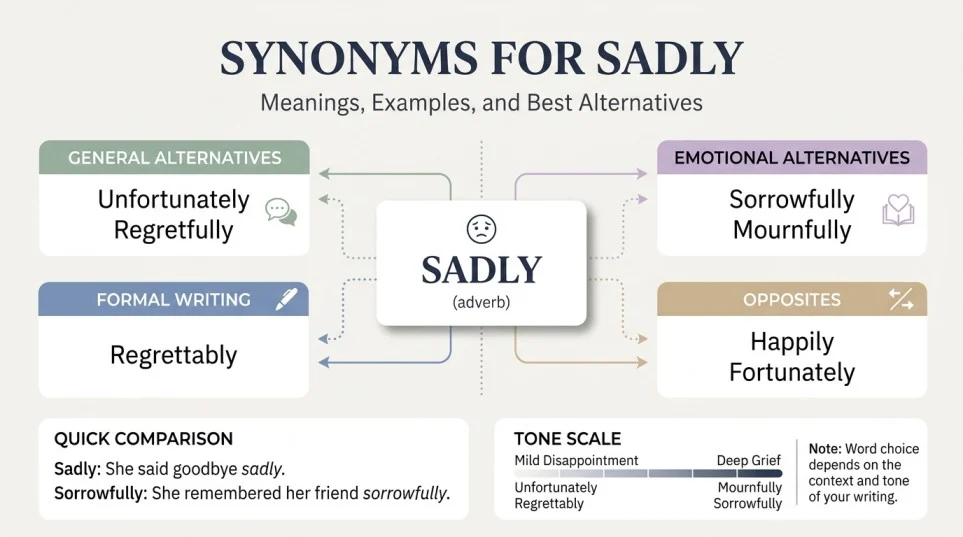
The best single replacement for sadly is usually unfortunately when discussing a disappointing event. However, if the sentence describes a person’s feelings, sorrowfully, unhappily, or mournfully may be more accurate.
Choose your alternative according to what you want the reader to understand.
| Context | Best Alternative | Example |
|---|---|---|
| Professional writing | Unfortunately | Unfortunately, the deadline has passed. |
| Academic writing | Regrettably | Regrettably, the available evidence is incomplete. |
| Casual conversation | Bummer, unfortunately | Unfortunately, we missed the concert. |
| Emotional writing | Sorrowfully | She sorrowfully remembered her childhood home. |
| Creative writing | Melancholically | The music played melancholically in the empty room. |
| Resume or workplace communication | Unfortunately | Unfortunately, the project was postponed. |
| Social media captions | Unfortunately | Unfortunately, the weekend ended too soon. |
| Stronger emotional meaning | Mournfully | He mournfully spoke about his loss. |
| Softer emotional meaning | Regretfully | I regretfully declined the invitation. |
Practical recommendation: Use unfortunately for bad circumstances, regretfully for decisions or apologies, and sorrowfully for genuine emotional pain. These distinctions make your writing clearer and more natural.
When Not to Use “Sadly”
Although sadly is versatile, it is not always the most precise choice.
1. When reporting facts professionally
Instead of: “Sadly, the company reported lower revenue.”
Better: “The company reported lower revenue.”
If the fact itself needs no emotional commentary, removing sadly makes the statement more objective.
2. When communicating disappointing news
Instead of: “Sadly, your application was unsuccessful.”
Better: “Unfortunately, your application was unsuccessful.”
Unfortunately focuses on the negative outcome without suggesting that the writer personally feels sad.
3. When expressing personal regret
Instead of: “Sadly, I must decline your invitation.”
Better: “Regretfully, I must decline your invitation.”
Regretfully makes the connection to a decision or personal regret more explicit.
4. When describing intense grief
Instead of: “She sadly mourned her brother.”
Better: “She mourned her brother with profound sorrow.”
The second sentence conveys a more specific and serious emotional experience.
5. When describing a person’s visible behavior
Instead of: “He looked sadly at the photograph.”
Better: “He gazed mournfully at the photograph.”
Mournfully may communicate deeper grief, while sadly remains suitable for ordinary disappointment.
Words Commonly Confused With “Sadly”
Several related words express negative emotions, but their meanings are not identical.
| Word | Main Difference | Best Used When |
|---|---|---|
| Unfortunately | Emphasizes an unwelcome event or outcome | Explaining bad news or circumstances |
| Regretfully | Emphasizes personal regret or reluctance | Declining an invitation or announcing a decision |
| Sorrowfully | Expresses visible or felt sorrow | Describing grief or emotional pain |
| Mournfully | Suggests deep grief or mourning | Writing about loss and bereavement |
| Unhappily | Describes unhappiness or dissatisfaction | Explaining a person’s feelings or an unsatisfactory situation |
| Tragically | Emphasizes a devastating event or outcome | Discussing death, disaster, or severe misfortune |
For example, “Unfortunately, the train was delayed” describes an inconvenience. “Mournfully, she remembered her father” emphasizes grief rather than an external problem.
Best Synonym by Context for “Sadly”
The most effective synonym depends on your audience, purpose, and intended emotional intensity.
| Context | Best Synonym | Why It Works | Example |
|---|---|---|---|
| Formal writing | Regrettably | Sounds measured and professional | Regrettably, the proposal was rejected. |
| Academic writing | Unfortunately | Clearly describes an unfavorable result | Unfortunately, the experiment produced inconclusive results. |
| Professional or business use | Unfortunately | Communicates bad news neutrally | Unfortunately, delivery will take another week. |
| Resume or workplace report | Unsuccessfully, where appropriate | Describes an outcome without adding unnecessary emotion | The team unsuccessfully attempted to meet the original deadline. |
| Casual conversation | Unfortunately | Sounds natural and familiar | Unfortunately, I missed the game. |
| Creative writing | Melancholically | Adds a reflective, literary mood | The violin played melancholically at dusk. |
| Emotional writing | Sorrowfully | Highlights genuine sadness | She sorrowfully accepted the news. |
| Strong emotional intensity | Mournfully | Suggests deep grief | He mournfully visited the memorial. |
| Mild disappointment | Regretfully | Softens the expression of disappointment | I regretfully canceled our plans. |
| Social media captions | Sadly | Short and immediately understandable | Sadly, the trip is over. |
| News reporting | Tragically, when justified | Signals a genuinely devastating event | Tragically, several families lost their homes. |
| Personal apologies | Regretfully | Expresses reluctance or regret | I regretfully have to change our plans. |
| Customer service | Unfortunately | Keeps the message courteous and direct | Unfortunately, that item is out of stock. |
| Storytelling | Sorrowfully | Adds an emotional dimension | He sorrowfully closed the letter. |
| Neutral factual reporting | No adverb | Avoids unnecessary emotional judgment | The event was canceled because of severe weather. |
US and UK Usage
Sadly, unfortunately, regretfully, sorrowfully, and mournfully are understood in both American and British English. There is no major regional difference that requires a different synonym.
For US professional writing, unfortunately is a dependable choice for disappointing information. Regretfully is useful when the sentence emphasizes the writer’s regret, although both words can overlap in practice.
Which Synonym Should You Choose?
Use these five questions to find the best alternative.
- What do you mean? If you describe an unfortunate event, choose unfortunately. If you describe emotional pain, consider sorrowfully.
- How formal is the situation? Regrettably and unfortunately suit many professional messages. Bummer belongs mainly in casual conversation.
- How intense is the emotion? Sadly often communicates ordinary sadness. Mournfully suggests deeper grief, while tragically describes a severe event rather than merely a sad feeling.
- Are you expressing your own feelings? Use regretfully when a decision disappoints you or you must decline something.
- Does the sentence need an emotional word? Sometimes the clearest choice is to remove the adverb and report the facts directly.
The best synonym is not necessarily the most sophisticated word. It is the one that communicates your meaning accurately to your intended reader.
Real Life Examples of “Sadly” in Sentences
These examples demonstrate how to replace sadly with a more specific expression when the situation calls for it.
School: Unfortunately, the school library was closed when we arrived.
Workplace: Regrettably, the team could not complete the project within the original timeframe.
Writing: The character sorrowfully read the final letter from her mother.
Conversation: Unfortunately, we have to leave before the concert ends.
Social media: Sadly, our favorite café is closing this month.
Resume or professional report: The team did not achieve its initial sales target, despite several improvement efforts.
Email: Unfortunately, I will need to reschedule our appointment. Thank you for understanding.
Storytelling: He mournfully placed the old photograph beside the flowers.
Each example uses a word that suits its context. A professional report often benefits from neutral language, while a personal story may need a more expressive description.
25 Synonyms for “Sadly”
The following 25 alternatives cover different shades of sadness, disappointment, regret, and misfortune. Some are direct replacements, while others work only in specific contexts.
| Synonym | Simple Meaning | Best Used For | Example Sentence |
|---|---|---|---|
| 1. Unfortunately | In an undesirable way | Bad news and disappointing outcomes | Unfortunately, the store was closed. |
| 2. Regretfully | With regret or reluctance | Decisions and formal communication | I regretfully declined the offer. |
| 3. Regrettably | In a way that causes regret | Formal and academic writing | Regrettably, the records were incomplete. |
| 4. Sorrowfully | With sadness or sorrow | Emotional writing | She sorrowfully said goodbye. |
| 5. Mournfully | With deep grief | Loss and mourning | He mournfully remembered his friend. |
| 6. Unhappily | In an unhappy or dissatisfied way | Personal feelings and circumstances | She unhappily accepted the arrangement. |
| 7. Melancholically | With a thoughtful, lingering sadness | Literary descriptions | The piano played melancholically. |
| 8. Gloomily | In a gloomy or pessimistic manner | Mood and atmosphere | He gloomily predicted another delay. |
| 9. Woefully | In a way that conveys distress or serious inadequacy | Serious problems and literary writing | The report was woefully incomplete. |
| 10. Tearfully | With tears or visible emotion | Emotional conversations | She tearfully thanked her supporters. |
| 11. Plaintively | In a way that expresses sorrow or a plea | Dialogue and storytelling | The child called plaintively for help. |
| 12. Lamentably | In a regrettable or unfortunate way | Formal commentary | Lamentably, the historic building was destroyed. |
| 13. Tragically | In a way involving severe misfortune | Death, disasters, and devastating events | Tragically, the rescue attempt failed. |
| 14. Disappointedly | With disappointment | Reactions to unmet expectations | He looked disappointedly at the empty stage. |
| 15. Dejectedly | With low spirits or discouragement | Defeat and discouragement | She dejectedly left the competition. |
| 16. Despondently | With a loss of hope | Serious discouragement | He despondently reviewed the results. |
| 17. Dolefully | In a sorrowful or mournful manner | Expressive and literary writing | The singer dolefully performed the ballad. |
| 18. Dolorously | With deep sorrow or distress | Formal or literary descriptions | She dolorously recounted the loss. |
| 19. Morosely | In a gloomy, sullen manner | Pessimistic moods | He morosely stared out the window. |
| 20. Glumly | In a visibly unhappy or disappointed way | Everyday conversation | They glumly watched the rain. |
| 21. Heavily | With emotional weight or a burdened feeling | Expressions such as sighing heavily | She sighed heavily after hearing the news. |
| 22. Solemnly | In a serious, grave manner | Serious occasions and reflections | He solemnly acknowledged the loss. |
| 23. Piteously | In a way that evokes pity | Dramatic descriptions and appeals | The injured animal cried piteously. |
| 24. Wistfully | With gentle longing or regret | Memories and unrealized hopes | She wistfully recalled her college days. |
| 25. Bummer, in the expression “what a bummer” | Something disappointing or unfortunate | Informal American English | What a bummer that the game was canceled. |
Accuracy note: These words are not interchangeable in every sentence. For example, tragically emphasizes severe misfortune, wistfully suggests longing, and solemnly conveys seriousness rather than sadness alone. Choose the word that matches the intended meaning.
Synonym Groups and Usage Differences
Professional vs. Personal Synonyms
Professional writing usually benefits from clear, restrained language. Unfortunately, regrettably, and regretfully can communicate disappointing information without making a message overly emotional.
Personal writing allows more expressive alternatives. Sorrowfully, mournfully, and tearfully can communicate grief, affection, and emotional vulnerability.
Compare these examples:
Professional: Unfortunately, the shipment will arrive later than expected.
Personal: She sorrowfully watched her childhood home disappear from view.
Formal alternatives are useful in reports, essays, presentations, and professional correspondence.
| Formal or Literary | Conversational Alternative |
|---|---|
| Regrettably | Unfortunately |
| Lamentably | Sadly |
| Sorrowfully | Sadly |
| Mournfully | Sadly |
| Melancholically | In a sad mood |
| Dejectedly | Feeling down |
| Glumly | Unhappily |
Formal vocabulary is not automatically better. In an ordinary text message, “Unfortunately, I cannot make it” often sounds more natural than “Lamentably, I cannot attend.”
Academic Synonyms
Academic writing should prioritize accuracy and an objective tone. Unfortunately is suitable when a result creates a genuine limitation. Regrettably may work in reflective commentary, but it can introduce unnecessary personal judgment.
Consider these examples:
Less precise: Sadly, the survey did not provide enough information.
More objective: The survey did not provide enough information to support the conclusion.
The second version is often preferable in research because it reports the limitation directly.
Professional and Business Synonyms
In emails, customer service messages, workplace reports, and presentations, choose words that communicate the problem without sounding dramatic.
Use unfortunately for disappointing outcomes, regretfully for decisions involving personal or organizational regret, and unsuccessfully when describing an attempt that did not achieve its goal.
For example, “Unfortunately, we cannot offer a refund under the current policy” is direct and courteous.
Avoid using words such as dolorously or piteously in ordinary business messages. Their literary tone can distract from the practical information.
Creative or Literary Synonyms
Creative writing benefits from words that reveal a character’s emotional state or establish an atmosphere.
Melancholically suggests lingering sadness or reflection. Wistfully communicates longing for something absent or unattainable. Mournfully conveys a stronger sense of grief.
For example, “She wistfully studied the photograph” suggests that she longs for the time or person represented in it. The sentence communicates more than simple sadness.
Slang or Modern Synonyms
American English speakers frequently use expressions such as “what a bummer,” “that sucks,” and “feeling down” to communicate disappointment or sadness.
These expressions are suitable for informal conversations, personal messages, and casual social media captions.
They are generally unsuitable for academic papers, formal announcements, and professional reports. In those contexts, unfortunately or a direct factual statement is usually more appropriate.
Strongest vs. Weaker Synonyms
The following scale is approximate because emotional intensity depends on the sentence and situation.
| Approximate Intensity | Word | Emotional Effect |
|---|---|---|
| Mild | Glumly | Everyday disappointment |
| Mild | Unhappily | General dissatisfaction |
| Moderate | Sadly | General sadness or regret |
| Moderate | Regretfully | Personal regret or reluctance |
| Moderate | Sorrowfully | Clear emotional sadness |
| Strong | Dejectedly | Discouragement after a setback |
| Strong | Despondently | Deep discouragement or lost hope |
| Strong | Mournfully | Grief associated with loss |
| Contextually strongest | Tragically | A devastating event or outcome |
Tragically does not simply mean extremely sadly. It describes a severe or disastrous situation, so it should not be used to exaggerate ordinary disappointments.
Emotional vs. Neutral Synonyms
Emotionally expressive alternatives include sorrowfully, mournfully, tearfully, dolefully, and wistfully. They help readers understand a person’s feelings.
More neutral choices include unfortunately and, in suitable contexts, unsuccessfully. They describe an undesirable result or a failed attempt without necessarily communicating personal grief.
For clear reporting, sometimes the best choice is no synonym at all.
Antonyms of “Sadly”
The opposite of sadly depends on whether the word describes an emotion or an unfortunate situation. The following 15 alternatives cover happiness, optimism, good fortune, and positive emotional expression.
| Antonym | Meaning | Example Sentence |
|---|---|---|
| 1. Happily | With happiness or satisfaction | She happily accepted the invitation. |
| 2. Cheerfully | In a bright and positive manner | He cheerfully greeted his neighbors. |
| 3. Joyfully | With great happiness | They joyfully celebrated their graduation. |
| 4. Gladly | Willingly and with pleasure | I would gladly help you move. |
| 5. Merrily | In a lively, cheerful manner | The children merrily sang together. |
| 6. Gleefully | With excited delight | She gleefully opened her birthday present. |
| 7. Blissfully | With complete happiness or contentment | They blissfully enjoyed their quiet afternoon. |
| 8. Hopefully | With hope or positive expectation | We hopefully awaited the final results. |
| 9. Optimistically | With confidence about a favorable outcome | The team optimistically approached the challenge. |
| 10. Positively | In an affirmative or constructive manner | She responded positively to the feedback. |
| 11. Thankfully | With gratitude or relief | Thankfully, everyone arrived safely. |
| 12. Fortunately | As a result of good luck or favorable circumstances | Fortunately, we found another route. |
| 13. Luckily | Through good fortune | Luckily, the rain stopped before the ceremony. |
| 14. Delightfully | In a pleasing or enjoyable manner | The evening passed delightfully. |
| 15. Contentedly | With satisfaction and peace of mind | He contentedly read beside the window. |
Remember that emotional opposites and situational opposites are different. Happily contrasts with sadly when describing feelings, while fortunately contrasts with sadly when the word introduces an unfortunate event.
Comparison: Sadly vs. Similar Words
Sadly vs. Unfortunately
Main difference: Sadly often communicates an emotion, while unfortunately usually introduces an unwelcome event.
Strength: Neither is inherently stronger. Sadly can sound more emotional, whereas unfortunately is often more neutral.
Formality: Both work in professional writing.
Examples:
Sadly, she left her hometown.
Unfortunately, the flight was canceled.
Sadly vs. Regretfully
Main difference: Sadly emphasizes sadness, while regretfully emphasizes regret or reluctance.
Strength: Sadly can communicate grief. Regretfully can sound restrained and deliberate.
Formality: Regretfully is particularly useful in formal communication.
Examples:
He sadly remembered his childhood friend.
I regretfully declined the invitation.
Sadly vs. Sorrowfully
Main difference: Sorrowfully places greater emphasis on felt sorrow, while sadly has a broader range of meanings.
Strength: Sorrowfully often sounds more emotionally expressive.
Formality: Both are grammatically appropriate, but sorrowfully is less common in everyday professional writing.
Examples:
She sadly looked at the empty chair.
She sorrowfully remembered her late grandmother.
Sadly vs. Mournfully
Main difference: Mournfully suggests deep grief, often associated with death or significant loss. Sadly can describe milder disappointment.
Strength: Mournfully generally carries a stronger association with grief.
Formality: Both can appear in creative writing, but mournfully is more specialized.
Examples:
He sadly watched the old building close.
He mournfully attended his friend’s memorial.
Sadly vs. Tragically
Main difference: Sadly describes an emotional state or an unfortunate situation. Tragically emphasizes a devastating event.
Strength: Tragically signals a serious or disastrous outcome.
Formality: Both can be used in formal writing when accurate.
Examples:
Sadly, the concert was postponed.
Tragically, the fire claimed several lives.
Sadly vs. Unhappily
Main difference: Unhappily can describe a person’s dissatisfaction or an unhappy condition. Sadly also describes an emotional manner or introduces unfortunate news.
Strength: Neither word is always stronger. The context determines the emotional effect.
Formality: Both are suitable for general writing, though unfortunately is often more natural when announcing bad news.
Examples:
She sadly said goodbye to her friends.
She lived unhappily in a place where she felt isolated.
Common Phrases and Expressions with “Sadly”
1. Sadly enough
Meaning: Used to emphasize an unfortunate or disappointing fact.
Example: Sadly enough, the opportunity disappeared before we could apply.
2. Sadly missed
Meaning: Remembered with affection and sadness after someone has died or left.
Example: Her kindness will be sadly missed by everyone who knew her.
3. Sadly mistaken
Meaning: Completely or seriously wrong about something.
Example: Anyone who assumes success comes without effort is sadly mistaken.
4. Sadly, no
Meaning: A polite way to express disappointment when the answer is negative.
Example: Sadly, no, there are no tickets left for tonight.
5. Sadly to say
Meaning: An expression introducing an unpleasant or disappointing fact.
Example: Sadly to say, the historic records have been lost.
6. Sadly enough, it was true
Meaning: An expression emphasizing that an unpleasant fact was genuine.
Example: Sadly enough, the warning had been accurate.
7. Sadly overlooked
Meaning: Not given the attention or recognition something deserves, with a sense of regret.
Example: Her contribution to the project was sadly overlooked.
8. Sadly lacking
Meaning: Missing something important to an undesirable degree.
Example: The presentation was sadly lacking in supporting evidence.
Common Mistakes to Avoid
1. Using sadly for every disappointing situation. Unfortunately is often more precise when discussing a canceled event, rejected application, or delayed shipment.
2. Confusing sadly with regretfully. Sadly describes sorrow or an unfortunate circumstance, while regretfully often describes a decision made with reluctance.
3. Using literary words in everyday business emails. Words such as dolorously and plaintively can sound unnatural in ordinary workplace communication.
4. Making a minor inconvenience sound tragic. Reserve tragically for serious misfortune rather than a missed appointment or a canceled lunch.
5. Repeating sadly too often. Vary your sentence structure, select a more precise word, or remove unnecessary emotional commentary.
6. Choosing a synonym with the wrong emotional tone. Wistfully suggests longing, while mournfully suggests grief. They do not communicate exactly the same feeling.
7. Using slang in academic or professional writing. Expressions such as “that sucks” are conversational. Use unfortunately or a neutral statement in formal contexts.
FAQs
1. What is the best synonym for sadly?
Unfortunately is often the best general alternative when describing an unfortunate situation. Sorrowfully is more appropriate for emotional sadness, while regretfully suits decisions involving regret.
2. What is a formal synonym for sadly?
Regrettably is a useful formal synonym when discussing an undesirable outcome. Unfortunately also works well in business emails, academic writing, reports, and professional announcements.
3. What is an informal synonym for sadly?
“Feeling down” is a natural informal expression for experiencing sadness. “What a bummer” works when reacting casually to a disappointing event.
4. What is another word for sadly in professional writing?
Unfortunately is a dependable choice for professional communication because it conveys disappointing information clearly. Regretfully is useful when a decision or refusal involves personal regret.
5. What is the difference between sadly and unfortunately?
Sadly can describe a person’s emotional state or introduce an unfortunate situation. Unfortunately focuses more directly on an unwelcome outcome, such as a delay or cancellation.
6. What is the opposite of sadly?
Happily is the most direct opposite when sadly describes an emotion. Fortunately is a better contrast when sadly introduces an unfortunate circumstance or disappointing event.
Conclusion
Sadly expresses sorrow, disappointment, or an unfortunate situation, but the best alternative depends on the meaning you want to communicate. Unfortunately works well for bad news, regretfully suits reluctant decisions, and sorrowfully or mournfully adds emotional depth.
When choosing synonyms for sadly, consider your audience, the seriousness of the situation, and the tone of your sentence. A precise word can make an email more professional, an essay clearer, or a story more emotionally engaging.
Vocabulary tip: Before replacing sadly, ask yourself whether you are describing a feeling, expressing regret, or reporting an unfortunate event. Answering that question will help you select a more accurate synonym.
Discover More Post:
- 50+ Synonyms for Investigate | Meanings, Examples, and Best …
- 50+ Synonyms for Opinion | Meanings, Examples, and Best …
- 50+ Synonyms for Greedy | From Selfish to Insatiable, Find the …