Have you ever used the word issue several times in an email, essay, report, or everyday conversation? Although it is useful in many situations, repeating it can make your writing sound vague or less engaging.
Learning synonyms for issue helps you communicate more precisely. Depending on your meaning, you might choose problem, concern, matter, topic, obstacle, or question. The best choice depends on whether you are describing a difficulty, discussing a subject, raising a concern, or referring to something that has been published.
This guide explains the meaning, tone, and practical use of each alternative so you can make confident vocabulary choices in academic, professional, and everyday English.
What Does “Issue” Mean?
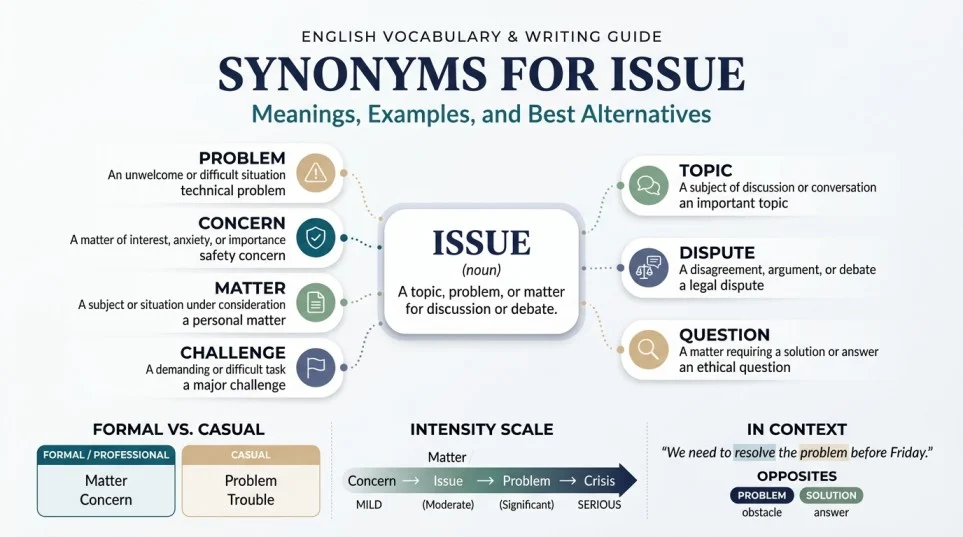
An issue is a subject, matter, concern, or problem that needs attention or discussion. Common synonyms include problem for difficulties, topic for discussion, concern for worries, and matter for general situations.
Meaning, Tone and Context
The word issue has several meanings. Its best synonym depends on how it functions in a sentence.
1. Simple definition
As a noun, issue can mean:
- A problem that needs attention.
- A subject that people discuss or debate.
- A concern that affects someone.
- A particular edition of a magazine or newspaper.
- The act of officially providing or distributing something, as in the issue of a permit.
As a verb, issue means to officially release, publish, announce, or distribute something.
2. Part of speech
Issue is both a noun and a verb.
| Form | Meaning | Example |
|---|---|---|
| Noun | A problem or subject | We discussed the issue. |
| Verb | To release or officially provide | The agency will issue a permit. |
| Plural noun | Multiple problems or subjects | Several issues remain unresolved. |
3. Tone and formality
The word issue is generally neutral and suitable for formal and informal communication. In professional settings, it can sound diplomatic because it often describes a difficulty without directly assigning blame.
However, it can be too broad when a more specific word would explain the situation better.
For example, The report has an issue is less informative than The report contains an inaccurate figure.
4. Common use cases
You will frequently encounter issue in:
- Business emails and workplace discussions.
- Academic essays and research papers.
- News articles and public debates.
- Personal conversations about concerns.
- Technical support and troubleshooting.
- Publishing, official documents, and administrative processes.
5. Related word forms
- Issue: A problem, subject, or official release.
- Issues: More than one problem or subject.
- Issued: Released, distributed, or officially provided.
- Issuing: The act of releasing or providing something.
- Issuer: An organization or person that issues something.
The noun and verb forms have different meanings, so choose a synonym that matches the intended use.
When and How to Use “Issue”
Use issue when you need a neutral way to identify a problem, introduce a subject, or describe something that requires attention. The following examples show how its meaning changes by context.
1. Professional: We need to resolve the issue before the client meeting. Here, issue refers to a workplace problem.
2. Academic: The essay examines the issue of access to higher education. Here, it means a subject for analysis.
3. Personal: She wanted to discuss an issue that had been bothering her. The word refers to a personal concern.
4. Email: Please let me know if you encounter any issues with the application. Here, it refers to possible technical difficulties.
5. Social media: Online privacy is an important issue for young users. It identifies a matter of public interest.
6. Publishing: The latest issue of the magazine features interviews with local artists. In this sentence, it means an edition.
7. Official communication: The department will issue new guidelines next month. Here, issue is a verb meaning to release or publish.
The key lesson is that a synonym must match the intended meaning, not simply replace the same sequence of letters.
Another Word for Issue
The best single replacement for issue is usually problem when describing something that is wrong. However, matter, concern, topic, and question may be more accurate when the word refers to a subject or something that needs discussion.
Here are the best alternatives by context.
| Context | Another word for issue | Example |
|---|---|---|
| Professional writing | Matter | We need to address this matter promptly. |
| Academic writing | Question | The research explores a complex question. |
| Casual conversation | Problem | I have a problem with my laptop. |
| Emotional writing | Concern | Her main concern was her family’s safety. |
| Creative writing | Conflict | The central conflict shapes the story. |
| Resume or workplace | Challenge | I resolved a challenging customer complaint. |
| Social media | Topic | Climate change is a popular topic online. |
| Stronger meaning | Crisis | The company faced a financial crisis. |
| Softer meaning | Concern | I have a small concern about the proposal. |
| Public debate | Controversy | The decision sparked public controversy. |
Choosing the right alternative
For professional writing, matter is useful when you want a neutral, diplomatic tone. Use concern when something deserves attention, and problem when something is actually wrong.
For academic work, question, subject, and matter can introduce areas of investigation. Emotional or creative writing, conflict, difficulty, and trouble can communicate more specific experiences.
For resumes, describe the actual action or achievement whenever possible. Example, Resolved recurring billing errors is stronger than Handled billing issues.
When Not to Use “Issue”
Although issue is versatile, it is not always the clearest choice. Avoid it when a more precise word would explain what happened.
| Vague sentence | Better sentence | Why it is better |
|---|---|---|
| There is an issue with the payment. | The payment was declined. | Identifies the exact problem. |
| We discussed several issues. | We discussed staffing and budget concerns. | Names the subjects. |
| She has an issue with the decision. | She disagrees with the decision. | Explains her position. |
| The team issued a problem. | The team identified a problem. | Uses the correct verb. |
| The issue made him sad. | The rejection disappointed him. | Communicates the emotional effect. |
| I read the latest issue online. | I read the latest edition online. | Clarifies the publishing meaning. |
Avoid using issue as a substitute for every uncomfortable situation. Words such as error, delay, disagreement, complaint, and obstacle often tell readers more.
Words Commonly Confused With “Issue”
Several words overlap with issue, but they do not always have the same meaning.
| Word | Main difference | When to use it |
|---|---|---|
| Problem | A difficulty that needs a solution | Something is not working correctly. |
| Concern | Something that causes worry or deserves attention | A person has reservations. |
| Topic | A subject being discussed | A conversation or essay has a focus. |
| Matter | A general situation or subject | A neutral or formal discussion is needed. |
| Question | Something being asked or examined | An answer, decision, or investigation is needed. |
| Challenge | A difficult task or situation | Effort or skill is required. |
Remember: A problem is usually something that needs fixing, a concern is something that matters or causes worry, and a topic is simply something people discuss.
Best Synonym by Context for Issue
The best synonym for issue changes according to the purpose of your sentence. Use this table as a practical reference.
| Context | Best synonym | Why it works | Example |
|---|---|---|---|
| Formal writing | Matter | Sounds measured and professional | The matter requires further review. |
| Academic writing | Question | Supports analytical discussion | This question deserves further study. |
| Business communication | Concern | Raises a difficulty diplomatically | I would like to discuss a concern. |
| Resume | Challenge | Highlights a situation requiring skill | Overcame operational challenges. |
| Casual conversation | Problem | Direct and familiar | I have a problem with my phone. |
| Creative writing | Conflict | Adds narrative tension | Their conflict changed everything. |
| Emotional expression | Worry | Expresses personal anxiety | Her greatest worry was losing her home. |
| Strong intensity | Crisis | Describes a serious situation | The organization faced a crisis. |
| Mild or moderate tone | Matter | Avoids unnecessary drama | We should review this matter. |
| Social media | Topic | Fits public discussion | Mental health is an important topic. |
| Technical support | Error | Identifies a technical fault | The system displayed an error. |
| Public debate | Controversy | Highlights disagreement | The proposal created controversy. |
| Publishing | Edition | Refers to a publication release | The summer edition is available. |
| Government | Dispute | Emphasizes disagreement | The two parties entered a dispute. |
| Official distribution | Release | Describes making something available | The agency announced the release of its report. |
The table includes related alternatives for different meanings of issue. Not every word is interchangeable with every other word.
Which Synonym Should You Choose?
Before replacing issue, consider five factors.
1. Meaning: Decide whether you mean a problem, subject, concern, publication, or official release. This is the most important step.
2. Formality: Choose matter for diplomatic professional writing, problem for direct communication, and topic for ordinary discussion.
3. Emotional intensity: Use concern for something troubling, difficulty for a manageable obstacle, and crisis for a genuinely serious situation.
4. Professional value: In workplace writing and resumes, state the exact problem, action, or result. Corrected reporting errors is more informative than addressed issues.
5. Sentence context: Check how the replacement changes the meaning. A magazine issue can be an edition, but it cannot normally be replaced by problem.
A useful rule is to choose the most specific accurate word rather than the most complicated one.
Real Life Examples of Issue in Sentences
These examples show how to use more precise alternatives in everyday situations.
| Situation | Original sentence | Improved sentence |
|---|---|---|
| School | The essay discusses an important issue. | The essay examines unequal access to education. |
| Workplace | We need to fix this issue. | We need to correct the reporting error. |
| General writing | This issue needs attention. | This concern deserves immediate attention. |
| Conversation | I have an issue with the plan. | I disagree with one part of the plan. |
| Social media | This is a major issue online. | Online privacy has become a major topic. |
| Resume | I handled customer issues. | I resolved customer complaints efficiently. |
| There is an issue with the order. | The order contains the wrong item. | |
| Storytelling | The issue divided the family. | The disagreement divided the family. |
These revisions are more effective because they tell readers exactly what happened instead of making them infer the meaning.
25 Synonyms for Issue
The following table contains 25 useful alternatives. Some are direct replacements in particular contexts, while others work only for specific meanings of issue.
| Synonym | Simple meaning | Best used for | Example sentence |
|---|---|---|---|
| 1. Problem | Something that needs fixing | General difficulties | We solved the problem quickly. |
| 2. Concern | Something that deserves attention or causes worry | Professional and personal communication | My main concern is the delivery date. |
| 3. Matter | A situation or subject | Formal writing | The matter remains under review. |
| 4. Topic | A subject for discussion | Essays and conversations | The topic attracted considerable interest. |
| 5. Question | Something to answer or investigate | Academic analysis | This question requires more research. |
| 6. Difficulty | Something hard to manage | Personal and practical challenges | She experienced difficulty accessing the account. |
| 7. Challenge | A demanding situation or task | Workplace and personal growth | The team overcame a significant challenge. |
| 8. Obstacle | Something that prevents progress | Planning and problem solving | Limited funding was the main obstacle. |
| 9. Complication | An added difficulty | Medical, technical, and practical contexts | A scheduling complication delayed the project. |
| 10. Trouble | A problem or an uncomfortable situation | Informal conversation | We had trouble connecting to the network. |
| 11. Dilemma | A difficult choice between options | Ethical and personal decisions | He faced a dilemma about accepting the offer. |
| 12. Dispute | A disagreement between people or groups | Legal and business contexts | The companies settled their dispute. |
| 13. Controversy | A subject that causes strong public disagreement | News and public debate | The policy sparked controversy. |
| 14. Conflict | A clash between people, ideas, or interests | Relationships and storytelling | Their conflict affected the entire team. |
| 15. Grievance | A complaint about unfair treatment | Workplace and formal complaints | She filed a grievance with management. |
| 16. Complaint | An expression of dissatisfaction | Customer service | The company investigated the complaint. |
| 17. Error | A mistake or incorrect result | Technical and academic writing | The software detected an error. |
| 18. Fault | A defect or cause of a problem | Equipment and troubleshooting | The technician identified a fault in the wiring. |
| 19. Setback | An event that slows progress | Projects and personal goals | The unexpected delay was a setback. |
| 20. Crisis | A serious situation requiring urgent action | High intensity situations | The company responded to a financial crisis. |
| 21. Predicament | A difficult or awkward situation | Personal and creative writing | He found himself in a difficult predicament. |
| 22. Subject | Something being discussed or studied | Academic and general writing | The subject deserves careful consideration. |
| 23. Theme | A central idea or recurring subject | Literature and creative work | Justice is a central theme in the novel. |
| 24. Edition | A particular version of a publication | Magazines and newspapers | The latest edition includes a special report. |
| 25. Release | The act of making something available | Official announcements and publishing | The release of the new guidelines is scheduled for Friday. |
Usage note: Edition and release match the publishing or distribution meanings of issue. Problem, error, and crisis describe different kinds of difficulties, so choose them according to the facts.
Synonym Groups and Usage Differences
Grouping synonyms by purpose makes it easier to choose the right word without changing the meaning of your sentence.
Professional vs. Personal Synonyms
Professional writing often benefits from neutral words such as matter, concern, challenge, and dispute. These terms help explain a situation without making the language unnecessarily emotional.
Personal communication may call for worry, trouble, difficulty, or problem. These words can communicate the speaker’s feelings more directly.
Examples:
- Professional: We need to address a concern about the revised schedule.
- Personal: I am worried about the revised schedule.
Both sentences describe something that needs attention, but the second expresses a more personal feeling.
Formal vs. Conversational Synonyms
Formal language is useful in reports, essays, presentations, and official emails. Conversational language works better in everyday discussions and text messages.
| Formal or neutral | Conversational | Example |
|---|---|---|
| Matter | Problem | We need to discuss the problem. |
| Concern | Worry | I have a worry about the timing. |
| Difficulty | Trouble | We had trouble opening the file. |
| Dispute | Argument | They had an argument over the payment. |
| Complication | Hitch | We encountered a hitch in our plans. |
The conversational choices are not always exact equivalents. For instance, argument often implies a verbal disagreement, while dispute can refer to a broader or more formal disagreement.
Academic Synonyms
Academic writing benefits from words that identify the precise subject of an investigation.
- Question: Best when the research investigates something that needs an answer.
- Problem: Useful for a clearly defined problem or research problem.
- Concern: Appropriate when discussing a risk, limitation, or ethical consideration.
- Subject: Useful for a broad area of study.
- Controversy: Appropriate when researchers or members of the public strongly disagree.
Example:
Less precise: The paper discusses an important issue in education.
More precise: The paper investigates unequal access to educational resources.
The second sentence identifies the actual subject instead of relying on a general label.
Professional and Business Synonyms
In business communication, a well chosen synonym can make a message more useful and diplomatic.
| Situation | Recommended word | Example |
|---|---|---|
| A customer is dissatisfied | Complaint | We reviewed the customer’s complaint. |
| A process is not working | Problem | The team corrected the processing problem. |
| A colleague raises a worry | Concern | Thank you for raising this concern. |
| Two parties disagree | Dispute | Both parties agreed to resolve the dispute. |
| Progress is blocked | Obstacle | We removed the obstacle to implementation. |
| Something is incorrect | Error | We corrected the billing error. |
For resumes and performance reviews, focus on actions and results rather than writing that you simply handled issues.
For example, Resolved 35 customer complaints in one month is more specific than Managed customer issues, provided the achievement is accurate.
Creative or Literary Synonyms
Creative writing often needs words that reveal the nature of a situation or create a stronger emotional effect.
- Conflict: A clash between characters, values, or goals.
- Dilemma: A difficult choice with competing consequences.
- Predicament: An awkward or difficult position.
- Crisis: A serious turning point requiring urgent action.
- Trouble: A familiar word that can create a conversational or dramatic tone.
Example:
Plain: The character faced an issue with her family.
More descriptive: The character faced a dilemma that threatened to divide her family.
The second version identifies the nature of the difficulty and creates a clearer picture for the reader.
Slang or Modern Synonyms
Some informal expressions can replace issue in casual conversations, but they are not appropriate in every setting.
| Expression | Meaning | Best context |
|---|---|---|
| Hassle | An annoying inconvenience | Casual conversation |
| Hang up | A personal difficulty or persistent reservation | Informal discussion |
| Drama | Conflict or an emotionally charged situation | Casual social conversations |
| Hitch | A small unexpected problem | Everyday speech |
Examples:
- That paperwork was such a hassle.
- I have a hang up about public speaking.
- There was a small hitch in our travel plans.
Avoid using drama when you mean a serious technical fault, legal dispute, or safety concern. It can make the situation sound emotional rather than factual.
Strongest vs. Weaker Synonyms
Not all synonyms communicate the same level of seriousness. This scale provides a rough guide, although the real intensity depends on context.
Mild
Matter, concern
A subject or something that deserves attention.
Moderate
Problem, difficulty, obstacle
A recognizable challenge that may require action.
Serious
Crisis, emergency
A serious situation that may require immediate action.
Do not choose a stronger word simply to make writing sound impressive. A minor inconvenience is not necessarily a crisis.
Emotional vs. Neutral Synonyms
Neutral synonyms describe a situation without adding much emotion. Emotional synonyms communicate worry, frustration, conflict, or personal difficulty.
| Neutral word | More emotional alternative | Difference |
|---|---|---|
| Matter | Worry | Adds personal anxiety. |
| Problem | Frustration | Emphasizes annoyance. |
| Disagreement | Conflict | May suggest a deeper clash. |
| Difficulty | Predicament | Suggests an awkward or difficult position. |
| Concern | Fear | Expresses a stronger emotional response. |
For factual reports, prefer neutral wording unless the emotional meaning is relevant. In personal stories, emotional alternatives can help readers understand how a situation affects someone.
Antonyms of Issue
The word issue has several meanings, so it has no single opposite that works in every sentence. The following table lists context dependent opposites and contrasting expressions rather than claiming that all 15 are universal dictionary antonyms.
| Antonym or contrasting expression | Meaning | Example sentence |
|---|---|---|
| 1. Solution | An answer to a problem | We finally found a solution. |
| 2. Resolution | A decision or settlement that resolves a matter | The resolution ended the dispute. |
| 3. Answer | A response to a question | Her answer cleared up the confusion. |
| 4. Agreement | A shared decision or understanding | The two teams reached an agreement. |
| 5. Harmony | A state of peaceful cooperation | Harmony returned to the group. |
| 6. Peace | A state without conflict | The families lived in peace. |
| 7. Stability | A state of steadiness | The new system restored stability. |
| 8. Smooth operation | Functioning without difficulty | The update ensured smooth operation. |
| 9. Accuracy | Correctness and freedom from error | Accuracy improved after the review. |
| 10. Success | A favorable result | The project was a success. |
| 11. Advantage | A beneficial condition | The change gave the team an advantage. |
| 12. Benefit | A helpful result | The new policy offered a clear benefit. |
| 13. Certainty | The state of being definite or known | The evidence provided certainty. |
| 14. Clarity | The quality of being easy to understand | Her explanation brought clarity. |
| 15. Publication withheld | The opposite action to releasing something publicly | Publication was withheld until the review was complete. |
These words contrast with particular meanings of issue. For example, solution contrasts with a problem, agreement contrasts with a dispute, and publication withheld contrasts with issuing a publication.
Comparison: Issue vs. Similar Words
The following comparisons explain which word is more precise in common situations.
Issue vs. Problem
Main difference: Issue is broader and can refer to a problem or a subject. Problem specifically suggests a difficulty.
Which is stronger? Problem often sounds more direct when something needs fixing.
Which is more formal? Both work in formal writing, but issue can sound more diplomatic.
Examples:
- Issue: We need to discuss the issue at tomorrow’s meeting.
- Problem: The problem is that the figures do not match.
Issue vs. Concern
Main difference: A concern is something that causes worry or deserves attention. An issue may simply be a topic or problem.
Which is stronger? Neither is always stronger. Concern highlights the importance or worry attached to something.
Which is more formal? Both are appropriate for professional writing.
Examples:
- Issue: The committee reviewed the issue.
- Concern: The committee expressed concern about the project’s cost.
Issue vs. Topic
Main difference: A topic is a subject of discussion. An issue often refers to a matter that needs consideration or involves a problem.
Which is stronger? Issue can suggest greater importance or difficulty.
Which is more formal? Both work in academic and professional writing.
Examples:
- Issue: Water shortages are a serious public issue.
- Topic: Water conservation was the topic of the lecture.
Issue vs. Matter
Main difference: A matter is a general subject or situation. An issue may imply a problem or a point of debate.
Which is stronger? Issue can sound more problem focused.
Which is more formal? Both are suitable for formal communication.
Examples:
- Issue: We identified an issue with the proposal.
- Matter: We will discuss the matter privately.
Issue vs. Challenge
Main difference: A challenge is something demanding that requires effort, skill, or perseverance. An issue may be any subject or problem.
Which is stronger? A challenge emphasizes difficulty and the effort needed to overcome it.
Which is more formal? Both are professional, but challenge is useful when discussing growth or achievement.
Examples:
- Issue: The project has an issue with its timeline.
- Challenge: Meeting the deadline was a significant challenge.
Issue vs. Dispute
Main difference: A dispute is a disagreement between people, organizations, or groups. An issue is a much broader term.
Which is stronger? Dispute is more specific about disagreement.
Which is more formal? Both are formal enough for business communication, but dispute is especially useful in legal or contractual contexts.
Examples:
- Issue: The company reviewed the issue.
- Dispute: The company settled its dispute with the supplier.
Common Phrases and Expressions With Issue
These expressions are useful in everyday English, professional emails, reports, and formal discussions.
1. Address an issue
Meaning: To take action on a problem or matter.
Example sentence: The manager promised to address the issue before the end of the week.
2. Raise an issue
Meaning: To bring a concern or subject to someone’s attention.
Example sentence: One employee raised an issue about the new attendance policy.
3. Resolve an issue
Meaning: To find a solution to a problem.
Example sentence: Our technical team resolved the issue within an hour.
4. A pressing issue
Meaning: A matter that needs urgent attention.
Example sentence: Affordable housing remains a pressing issue in many cities.
5. A sensitive issue
Meaning: A subject that requires careful handling because it may upset or offend people.
Example sentence: The counselor discussed the sensitive issue with compassion.
6. Get to the root of the issue
Meaning: To discover the underlying cause of a problem.
Example sentence: We need to get to the root of the issue before changing the system.
7. Take issue with something
Meaning: To disagree with or object to something.
Example sentence: Several readers took issue with the article’s conclusion.
8. The heart of the issue
Meaning: The central or most important part of a matter.
Example sentence: The heart of the issue is whether the policy treats everyone fairly.
Common Mistakes to Avoid
Using synonyms correctly requires attention to meaning, tone, and grammar. These are six common mistakes to watch for.
1. Using issue when a precise word is available. Instead of saying, “There is an issue with the printer,” write, “The printer is out of paper,” if that is the actual problem.
2. Confusing a topic with a problem. A topic is something people discuss, while a problem is something that may need to be fixed. Not every topic is a problem.
3. Choosing casual wording for formal communication. Words such as hassle and drama may sound unprofessional in a research paper, official report, or business proposal.
4. Using a dramatic synonym for a minor difficulty. A delayed appointment is usually an inconvenience, not a crisis. Match the word to the seriousness of the situation.
5. Repeating issue too often. Replace repetition with accurate alternatives such as concern, matter, error, or dispute when the context supports them.
6. Choosing the wrong grammatical form. You can issue a statement, resolve a problem, or raise a concern. You would not normally say that someone “resolved a statement” when they mean it was officially released.
FAQs
1. What is the best synonym for issue?
The best synonym depends on context. Use problem for a difficulty, concern for something requiring attention, and topic for a subject of discussion.
2. What is a formal synonym for issue?
Matter is a useful formal alternative when discussing a situation. Concern, dispute, and question are appropriate when their specific meanings match the context.
3. What is an informal synonym for issue?
Problem, trouble, and hassle are common informal alternatives. Use hassle for an annoying inconvenience, and trouble for a general difficulty.
4. What is another word for issue in professional writing?
Professional alternatives include matter, concern, challenge, error, and obstacle. Choose the word that accurately describes the situation rather than using a vague substitute.
5. What is the difference between an issue and a problem?
An issue can be a subject, concern, publication edition, or problem. A problem specifically refers to something difficult, incorrect, or requiring a solution.
6. What is the opposite of issue?
There is no single opposite for every meaning of issue. Solution contrasts with a problem, agreement with a dispute, and answer with a question.
Conclusion
Learning synonyms for issue can make your writing clearer, more natural, and more effective. Words such as problem, concern, matter, topic, and challenge offer useful alternatives, but each communicates a slightly different meaning.
For professional communication, choose precise and neutral language. For academic writing, identify the specific subject or research question. In personal and creative writing, select words that reflect the situation’s emotional weight.
The most useful vocabulary tip is simple: describe exactly what you mean before choosing a synonym. A precise word helps readers understand your message without unnecessary explanation., or Britannica. Check that each synonym fits its example and that context dependent contrasts are not presented as universal antonyms.
Discover More Post:
- 50+ Synonyms for Investigate | Meanings, Examples, and Best …
- 50+ Synonyms for Opinion | Meanings, Examples, and Best …
- 50+ Synonyms for Greedy | From Selfish to Insatiable, Find the …