The word realize appears frequently in essays, emails, conversations, and professional writing. However, repeating it can make your sentences sound less precise, especially when you want to express understanding, discovery, awareness, or achievement.
Learning the best synonyms for realize helps you communicate more clearly. Whether you are writing an academic paper, updating a resume, sharing an emotional experience, or creating a social media caption, the right alternative can make your message more natural and effective.
This guide explains the meaning of realize, its most useful alternatives, and how to choose the right word for each situation.
What Does “Realize” Mean?
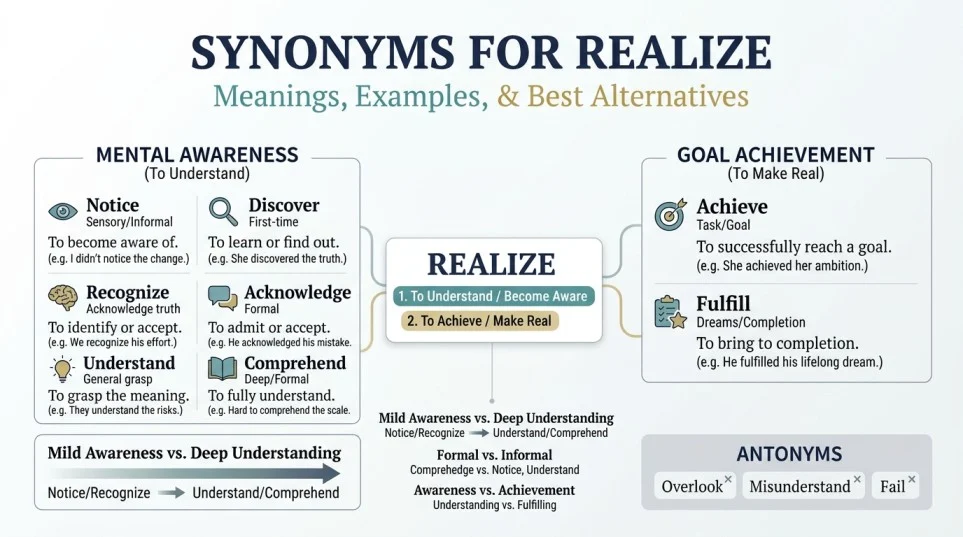
To realize means to become aware of something, understand a fact, discover something previously unnoticed, or achieve a goal. Common synonyms include recognize, understand, notice, discover, acknowledge, comprehend, and achieve, depending on the intended meaning and context.
Meaning, Tone and Context
What Does Realize Mean?
The word realize has two important meanings in American English.
1. To become aware of or understand something: You suddenly recognize a fact, mistake, situation, or truth.
Example: I realized that I had sent the wrong attachment.
2. To achieve or make something happen: You turn a plan, ambition, or possibility into reality.
Example: She worked hard to realize her dream of becoming a writer.
These meanings are related, but they are not interchangeable. A synonym that works for understanding may not work for achieving a goal.
Part of Speech
Realize is a verb. Its common forms include:
| Word Form | Example |
|---|---|
| Realize | I realize the importance of preparation. |
| Realizes | He realizes his mistake. |
| Realized | They realized the truth yesterday. |
| Realizing | She is realizing her potential. |
| Realization | His realization changed everything. |
| Realizable | The plan is realizable with enough resources. |
Tone and Formality
Realize is generally neutral and works in casual conversation, academic writing, professional communication, and personal storytelling.
Its tone depends on the sentence. Realizing a mistake may suggest regret, realizing a truth may indicate personal growth, and realizing an ambition may communicate success.
Common Uses of Realize
People commonly use realize when discussing:
- Awareness of a mistake or problem.
- Understanding a difficult concept.
- Discovering an unexpected fact.
- Accepting an uncomfortable truth.
- Recognizing someone’s value or contribution.
- Achieving a goal, ambition, or potential.
When and How to Use “Realize”
Choose realize when you want to express a change in awareness or describe the achievement of a goal. The following examples show how it works in different situations.
1. Professional: I realized that our original deadline was unrealistic.
2. Academic: Students often realize the importance of research after reviewing the evidence.
3. Personal: I finally realized how much my friends had supported me.
4. Emotional: She realized that holding onto the past was preventing her from moving forward.
5. Email: I just realized that I forgot to attach the revised document.
6. Social media: Sometimes, you realize how far you have come only when you look back.
7. Career: He worked for years to realize his ambition of leading a successful team.
In the first six examples, realize relates primarily to awareness or understanding. In the final example, it describes achieving an ambition.
That distinction is important when selecting a replacement.
Another Word for “Realize”
The best single replacement for realize is usually recognize when referring to awareness, or understand when referring to comprehension. For achieving a goal, achieve or fulfill may be more accurate.
Here are the best alternatives by context.
| Context | Recommended Word | Example |
|---|---|---|
| Professional writing | Recognize | We recognize the need for improvement. |
| Academic writing | Understand | Researchers understand the limitations of the study. |
| Casual conversation | Get it | I get it now. |
| Emotional writing | Acknowledge | She acknowledged her feelings. |
| Creative writing | Discover | He discovered something unexpected about himself. |
| Resume or workplace | Achieve | Achieved the annual performance target. |
| Social media captions | Notice | I never noticed how beautiful this place was. |
| Stronger emphasis | Comprehend | She fully comprehended the consequences. |
| Softer expression | Suspect | I began to suspect that something was wrong. |
Practical tip: Always check the meaning of your original sentence before replacing realize. Awareness, understanding, acceptance, and achievement require different vocabulary choices.
When Not to Use “Realize”
Although realize is versatile, it can sound vague when a more specific verb communicates your meaning more clearly.
1. When You Mean Finding Something New
Instead of saying, I realized a new solution, use I discovered a new solution.
Discover emphasizes finding something that was previously unknown or unnoticed.
2. When You Mean Understanding a Difficult Idea
Instead of I realized the mathematical principle, write I understood the mathematical principle or I comprehended the mathematical principle.
Understand is natural and accessible, while comprehend can sound more formal or emphasize deeper intellectual understanding.
3. When You Mean Accepting a Fact
Instead of He realized his mistake, consider He acknowledged his mistake if you want to emphasize openly admitting it.
Realize describes awareness. Acknowledge suggests recognition or acceptance, sometimes with an element of responsibility.
4. When You Mean Achieving a Goal
Instead of She realized her ambition, you could write She achieved her ambition or She fulfilled her ambition.
Achieve emphasizes success. Fulfill often suggests satisfying a personal ambition, promise, expectation, or purpose.
5. When You Want More Emotional Impact
Instead of I realized how much I missed home, try I finally understood how deeply I missed home.
The revised sentence adds emotional depth, although the best choice depends on the intended voice.
Words Commonly Confused With “Realize”
Several words overlap with realize but communicate different ideas.
| Word | Main Difference | Example |
|---|---|---|
| Recognize | Identify or acknowledge something familiar or significant | I recognized the warning signs. |
| Understand | Grasp the meaning of an idea | I understand your explanation. |
| Notice | Become aware of something through observation | I noticed a change in her tone. |
| Discover | Find something previously unknown | We discovered a more efficient method. |
| Acknowledge | Admit, accept, or recognize something | He acknowledged his mistake. |
| Achieve | Successfully accomplish a goal | She achieved her target. |
These distinctions matter because substituting one word for another can change the meaning of a sentence.
For example, I noticed the problem suggests awareness, while I understood the problem suggests comprehension. I acknowledged the problem indicates recognition or acceptance, and I solved the problem communicates a different action altogether.
Best Synonym by Context for “Realize”
The most effective synonym depends on what you want to communicate, not simply which word sounds more sophisticated.
| Context | Best Synonym | Why It Works | Example |
|---|---|---|---|
| Formal writing | Recognize | Clear and professional | The committee recognized the need for reform. |
| Academic writing | Understand | Direct and precise | Students understand the central argument. |
| Professional communication | Acknowledge | Emphasizes acceptance or recognition | We acknowledge the risks involved. |
| Resume | Achieve | Highlights measurable success | Achieved a 15 percent increase in customer retention. |
| Casual conversation | Get it | Natural and conversational | I get it now. |
| Creative writing | Discover | Suggests a new finding or insight | She discovered a truth she had long avoided. |
| Emotional writing | Appreciate | Highlights awareness of value or importance | I appreciate how much you have helped me. |
| Strong emphasis | Comprehend | Emphasizes grasping complex information | He comprehended the full consequences. |
| Softer expression | Suspect | Expresses tentative belief rather than certainty | I began to suspect that something had changed. |
| Social media captions | Notice | Works well for observations | I finally noticed the beauty in ordinary moments. |
| Problem solving | Identify | Pinpoints a specific issue or cause | The team identified the main obstacle. |
| Personal growth | Recognize | Highlights self awareness | She recognized her own strengths. |
| Goal achievement | Fulfill | Emphasizes satisfying an ambition or purpose | He fulfilled his lifelong ambition. |
| Mistake correction | Detect | Emphasizes finding an error | The editor detected an inconsistency. |
| New information | Learn | Emphasizes gaining knowledge | We learned why the system had failed. |
For American English, realize is the standard spelling. British English commonly uses realise. Both forms carry the same basic meanings, so the spelling should match the style guide you follow.
Which Synonym Should You Choose?
Use this simple decision guide to find the most accurate alternative.
If you became aware of something
Choose notice, recognize, or detect.
Example: We detected an error in the report.
If you understood an idea
Choose understand, comprehend, or grasp.
Example: She grasped the central concept quickly.
If you accepted a fact or mistake
Choose acknowledge, admit, or accept.
Example: He admitted that his decision was wrong.
If you made a goal happen
Choose achieve, fulfill, or accomplish.
Example: She accomplished everything on her list.
Consider These Five Factors
- Meaning: Decide whether you mean awareness, understanding, acceptance, discovery, or achievement.
- Formality: Prefer understand, recognize, or acknowledge in professional writing. Reserve get it for casual conversation.
- Emotional intensity: Use admit when responsibility matters, or appreciate when emphasizing gratitude or value.
- Professional value: On a resume, describe what you accomplished or improved instead of merely stating what you realized.
- Sentence context: Read the complete sentence after replacing the word. A synonym should preserve the original meaning and grammar.
Real Life Examples of “Realize” in Sentences
The following examples demonstrate how to replace realize with more precise vocabulary across everyday situations.
| Situation | Original Sentence | Improved Alternative |
|---|---|---|
| School | I realized the answer was incorrect. | I recognized that the answer was incorrect. |
| Workplace | We realized the process was inefficient. | We identified inefficiencies in the process. |
| Writing | She realized that the ending needed work. | She recognized that the ending needed revision. |
| Conversation | I realized what you meant. | I understand what you mean now. |
| Social media | I realized how much I have grown. | I can see how much I have grown. |
| Resume | I realized my career goals. | I achieved my career goals. |
| I realized I had missed your message. | I noticed that I had missed your message. | |
| Storytelling | He realized the stranger was telling the truth. | He discovered that the stranger was telling the truth. |
Notice that the best replacement sometimes requires changing the sentence structure, not simply swapping one verb for another.
For resumes and business writing, specific achievements and actions are usually more informative than general statements about awareness.
- 25 Synonyms for “Realize”
The following 25 words and expressions cover the main meanings of realize. Some are close synonyms, while others work only in particular contexts.
| Synonym | Simple Meaning | Best Used For | Example Sentence |
|---|---|---|---|
| 1. Recognize | Identify or become aware of something | General awareness | I recognized the importance of early planning. |
| 2. Understand | Know the meaning of something | Everyday and academic use | She understood the instructions immediately. |
| 3. Notice | Become aware through observation | Everyday situations | He noticed a small error in the calculation. |
| 4. Discover | Find something previously unknown | New information | We discovered a better way to organize the files. |
| 5. Acknowledge | Recognize or accept something | Formal and professional writing | The manager acknowledged the team’s concerns. |
| 6. Comprehend | Understand something fully | Complex ideas | The students comprehended the difficult passage. |
| 7. Grasp | Understand an idea clearly | Conversational and academic use | Maya grasped the concept after one example. |
| 8. Perceive | Become aware of or interpret something | Formal and descriptive writing | He perceived a change in the audience’s mood. |
| 9. Identify | Establish what something is | Research and problem solving | The analyst identified the source of the error. |
| 10. Detect | Discover the presence of something | Technical and investigative contexts | The software detected an unusual pattern. |
| 11. Discern | Recognize a subtle difference or detail | Formal and literary writing | She discerned a hint of disappointment in his voice. |
| 12. Learn | Gain knowledge or become aware | Education and everyday use | We learned that the meeting had been postponed. |
| 13. Appreciate | Recognize the value or importance of something | Personal and emotional contexts | I appreciate how much effort you invested. |
| 14. Admit | Acknowledge something, often reluctantly | Mistakes and responsibility | He admitted that he had misunderstood the request. |
| 15. Accept | Recognize something as true or valid | Difficult truths and decisions | She accepted that the project needed more time. |
| 16. Conclude | Reach a judgment based on information | Academic and analytical writing | The researchers concluded that further testing was necessary. |
| 17. Infer | Reach a conclusion from evidence | Research and reasoning | We inferred the cause from the available data. |
| 18. Deduce | Reach a conclusion through logical reasoning | Analytical contexts | The detective deduced the answer from the clues. |
| 19. Uncover | Bring hidden information to light | Investigative and creative writing | The audit uncovered a serious accounting error. |
| 20. Become aware | Begin to know or notice something | Neutral explanations | She became aware of the risks involved. |
| 21. Get it | Understand something | Informal conversation | I get it now, thanks for explaining. |
| 22. Catch on | Begin to understand | Casual conversation | He caught on after watching the demonstration. |
| 23. Wake up to | Become aware of an important reality | Informal, emphatic writing | They woke up to the need for change. |
| 24. Achieve | Successfully accomplish something | Goals and results | The company achieved its annual target. |
| 25. Fulfill | Bring an ambition, promise, or purpose to completion | Personal goals and formal writing | She fulfilled her dream of opening a bookstore. |
Important distinction: Words such as achieve and fulfill are suitable alternatives only when realize means making a goal or ambition a reality. Words such as infer and deduce are appropriate when the context involves reaching a conclusion through reasoning.
Synonym Groups and Usage Differences
Professional vs. Personal Synonyms
Professional writing benefits from clear, evidence based language. Words such as identify, recognize, acknowledge, and determine can communicate awareness or conclusions without sounding overly emotional.
Personal writing allows more expressive choices. Appreciate, discover, accept, and come to understand can convey reflection, gratitude, or emotional growth.
Compare these examples:
Professional: The team identified the cause of the delay.
Personal: I finally understood why the experience mattered so much to me.
Both sentences communicate a change in knowledge, but their tone and purpose differ.
Formal vs. Conversational Synonyms
| Formal or Neutral | Conversational | Example |
|---|---|---|
| Comprehend | Get it | I get it now. |
| Acknowledge | Admit | She admitted her mistake. |
| Determine | Figure out | We figured out the problem. |
| Recognize | Notice | I noticed the difference. |
| Discover | Find out | I found out what happened. |
Formal words are useful in reports, research papers, presentations, and official emails. Conversational expressions sound more natural in texts, friendly discussions, and informal messages.
Academic Synonyms
Academic writing values precision, evidence, and logical reasoning. The following alternatives work well when their meanings fit the sentence.
- Understand: Explain comprehension of a concept or theory.
- Recognize: Identify a pattern, limitation, or relationship.
- Infer: Draw a conclusion from evidence.
- Deduce: Reach a conclusion through logical reasoning.
- Conclude: State the judgment reached after analysis.
- Identify: Specify a factor, problem, or research variable.
- Acknowledge: Recognize a limitation, concern, or opposing argument.
For example, instead of writing, The researcher realized a relationship between the variables, write, The researcher identified a relationship between the variables.
If the relationship is an interpretation rather than a directly observed finding, inferred may be more accurate.
Professional and Business Synonyms
In workplace communication, choose a verb that explains what happened or what action followed.
| Situation | Recommended Word | Example |
|---|---|---|
| Finding a problem | Identify | We identified three areas for improvement. |
| Accepting responsibility | Acknowledge | I acknowledge the oversight. |
| Understanding a requirement | Understand | I understand the revised requirements. |
| Reaching a conclusion | Determine | We determined the cause of the delay. |
| Delivering a result | Achieve | The team achieved its quarterly target. |
| Recognizing value | Appreciate | We appreciate your continued support. |
For a resume, avoid vague claims such as I realized my professional potential. Use measurable achievements, relevant skills, and concrete contributions whenever possible.
Creative or Literary Synonyms
Creative writing often needs words that reveal a character’s gradual understanding or emotional transformation.
- Discover: Suggests an unexpected revelation.
- Perceive: Emphasizes how someone interprets a situation.
- Discern: Highlights subtle details or hidden meanings.
- Uncover: Suggests revealing something concealed.
- Come to understand: Shows gradual personal growth.
- Awaken to: Expresses a new or profound awareness.
Example: As the room fell silent, she discerned the disappointment behind his polite smile.
This sentence offers more descriptive depth than simply saying that she realized he was disappointed.
Slang or Modern Synonyms
Several conversational expressions can replace realize in casual situations.
- Get it: Understand something.
- Catch on: Begin to understand.
- Figure out: Find an answer or understand how something works.
- Wake up to: Become aware of an important reality.
- Find out: Learn information that was previously unknown.
Examples:
- I finally figured out how the app works.
- He caught on to the joke.
- She woke up to the consequences of her decision.
These expressions work in casual dialogue, social media posts, and friendly messages. For academic papers, formal reports, and professional applications, choose a more precise alternative when appropriate.
Strongest vs. Weaker Synonyms
There is no universal intensity ranking because each word describes a different kind of awareness. However, the following guide shows how emphasis changes.
| Level | Word or Expression | Effect |
|---|---|---|
| Mild observation | Notice | Simple awareness |
| General awareness | Recognize | Identification or acknowledgment |
| Clear understanding | Understand | Direct comprehension |
| Deep understanding | Comprehend | Emphasis on complete understanding |
| Careful judgment | Discern | Recognition of subtle meaning |
| Evidence based conclusion | Deduce | Strong focus on logical reasoning |
| Open acceptance | Admit | Emphasis on accepting a fact or mistake |
| Significant revelation | Uncover | Emphasis on revealing hidden information |
Use the word that matches the actual event. Deduce is not simply a stronger version of notice, and admit does not necessarily mean understanding something more deeply.
Emotional vs. Neutral Synonyms
Neutral synonyms communicate facts without adding much emotion. Emotional alternatives can suggest regret, gratitude, acceptance, or personal growth.
| Neutral Word | More Emotional Alternative | Difference |
|---|---|---|
| Notice | Appreciate | Adds recognition of value |
| Understand | Come to terms with | Suggests emotional acceptance |
| Recognize | Admit | Can suggest reluctance or responsibility |
| Discover | Uncover | May imply revealing something hidden |
| Accept | Reconcile yourself to | Suggests coming to terms with a difficult reality |
| Learn | Realize deeply | Adds emphasis, though a more specific phrase may be clearer |
For example, I recognized the change is neutral, while I finally came to terms with the change suggests an emotional process of acceptance.
Antonyms of “Realize”
The opposite of realize depends on which meaning you intend. When realize means becoming aware, antonyms describe a lack of awareness or understanding. When it means achieving a goal, the opposite involves failure to achieve it.
The following table includes 15 useful opposites and contrasting expressions.
| Antonym | Meaning | Example Sentence |
|---|---|---|
| 1. Overlook | Fail to notice something | I overlooked a small error in the report. |
| 2. Miss | Fail to notice or recognize | She missed the warning signs. |
| 3. Ignore | Deliberately pay no attention | He ignored the evidence. |
| 4. Forget | Fail to remember | I forgot that the deadline was today. |
| 5. Misunderstand | Understand incorrectly | They misunderstood the instructions. |
| 6. Misinterpret | Interpret something incorrectly | She misinterpreted his comment. |
| 7. Misconstrue | Interpret incorrectly, often in a misleading way | He misconstrued her intention. |
| 8. Remain unaware | Continue without knowledge of something | They remained unaware of the change. |
| 9. Disregard | Treat something as unimportant | The team disregarded the warning. |
| 10. Neglect | Fail to give something proper attention | He neglected an important detail. |
| 11. Deny | Refuse to accept a claim or reality | She denied that a mistake had occurred. |
| 12. Dismiss | Reject something without serious consideration | He dismissed the evidence too quickly. |
| 13. Confuse | Fail to distinguish clearly between things | I confused the two dates. |
| 14. Fail | Not succeed in accomplishing something | They failed to achieve their target. |
| 15. Abandon | Give up a goal or undertaking | She abandoned her original plan. |
These are contextual opposites rather than interchangeable antonyms in every sentence. For example, overlook contrasts with becoming aware, while fail contrasts with achieving a goal.
Comparison: Realize vs. Similar Words
Realize vs. Recognize
Main difference: Realize often describes becoming aware of a fact, while recognize can mean identifying something familiar or acknowledging its significance.
Stronger: Neither is universally stronger. Realize may emphasize a new understanding, while recognize can emphasize identification.
More formal: Both are suitable for formal writing.
Examples:
- Realize: I realized that the deadline had changed.
- Recognize: I recognized the person who entered the room.
Realize vs. Understand
Main difference: Realize often suggests becoming aware of something, while understand emphasizes grasping its meaning.
Stronger: Understand emphasizes comprehension. Realize can emphasize the moment of awareness.
More formal: Both are neutral and suitable for professional or academic contexts.
Examples:
- Realize: She realized that the figures were incorrect.
- Understand: She understood why the figures were incorrect.
Realize vs. Notice
Main difference: Notice usually describes becoming aware through observation. Realize can involve reflection, reasoning, or a new understanding.
Stronger: Realize often suggests a deeper conclusion, although context determines the effect.
More formal: Both are appropriate in formal writing.
Examples:
- Realize: He realized that his approach was ineffective.
- Notice: He noticed a spelling error in the document.
Realize vs. Discover
Main difference: Realize usually describes awareness or understanding, while discover emphasizes finding information, facts, or something previously unknown.
Stronger: Discover may sound more significant when the sentence concerns a new finding.
More formal: Both work in academic and professional writing.
Examples:
- Realize: The team realized that the data was incomplete.
- Discover: The team discovered an additional source of data.
Realize vs. Acknowledge
Main difference: Realize means becoming aware, while acknowledge means recognizing, admitting, or accepting something.
Stronger: Acknowledge may communicate greater willingness to accept responsibility.
More formal: Acknowledge often sounds more formal in reports and professional communication.
Examples:
- Realize: He realized that his decision had caused problems.
- Acknowledge: He acknowledged that his decision had caused problems.
Realize vs. Achieve
Main difference: Realize can mean becoming aware or making an ambition a reality. Achieve specifically emphasizes successfully reaching a goal or result.
Stronger: Achieve communicates accomplishment more directly.
More formal: Both work in formal writing, but achieve is often more effective when reporting measurable results.
Examples:
- Realize: She realized her ambition of becoming a scientist.
- Achieve: She achieved her goal of publishing her first research paper.
Common Phrases and Expressions with “Realize”
1. Realize a Dream
Meaning: Make a long held ambition become reality.
Example sentence: After years of saving, they realized their dream of owning a home.
2. Realize the Importance of Something
Meaning: Become aware of how valuable or significant something is.
Example sentence: I realized the importance of clear communication during the project.
3. Come to Realize
Meaning: Gradually become aware of or understand something.
Example sentence: She came to realize that progress takes patience.
4. Suddenly Realize
Meaning: Become aware of something unexpectedly.
Example sentence: I suddenly realized that I had left my keys at work.
5. Fully Realize
Meaning: Understand something completely or recognize its full extent.
Example sentence: They did not fully realize the costs involved until construction began.
6. Realize Your Potential
Meaning: Develop or use your abilities to their fullest extent.
Example sentence: Consistent practice helped him realize his potential as a musician.
7. Realize a Profit
Meaning: Convert an investment or asset into an actual financial gain, usually through a sale or transaction.
Example sentence: The business realized a profit after selling its remaining inventory.
8. Make Someone Realize
Meaning: Cause someone to become aware of or understand something.
Example sentence: Her thoughtful question made me realize how much the decision mattered.
These expressions are common, but some have specialized meanings. For example, realize a profit is a financial expression and should not be replaced with understand a profit.
Common Mistakes to Avoid
1. Using realize when a more precise verb is available. Instead of I realized the cause, write I identified the cause when you specifically mean finding it.
2. Confusing awareness with comprehension. I noticed the explanation means you became aware of it. I understood the explanation means you grasped its meaning.
3. Using casual expressions in formal writing. Phrases such as I got it work in conversation, but I understood is usually more suitable for an academic paper.
4. Choosing an overly dramatic word. Replacing realize with uncover can suggest hidden information. Do not use it for a routine observation unless something was genuinely concealed.
5. Repeating realize too often. Alternate between recognize, understand, notice, and identify when their meanings accurately match your sentences.
6. Choosing the wrong emotional tone. Admit can suggest accepting responsibility, while appreciate can express gratitude. Select the word that reflects your actual intention.
7. Using an achievement synonym for an awareness meaning. Achieve and fulfill are not suitable replacements when you simply mean becoming aware of a fact.
FAQs
1. What is the best synonym for realize?
The best synonym is usually recognize for awareness, understand for comprehension, discover for new findings, and achieve or fulfill when describing the successful completion of a goal.
2. What is a formal synonym for realize?
Recognize, acknowledge, comprehend, and determine are useful formal alternatives. Choose the word that accurately expresses awareness, acceptance, understanding, or a conclusion.
3. What is an informal synonym for realize?
Get it, catch on, figure out, and find out are common conversational alternatives. Their suitability depends on whether you mean understanding, discovering, or solving something.
4. What is another word for realize in professional writing?
Identify, recognize, acknowledge, and determine work well in professional writing. Use achieve when reporting a completed goal, particularly when measurable results support the statement.
5. What is the difference between realize and recognize?
Realize commonly means becoming aware of a fact or understanding something. Recognize often means identifying something familiar or acknowledging its importance.
6. What is the opposite of realize?
Opposites depend on the intended meaning. Overlook and remain unaware contrast with becoming aware, while fail contrasts with realizing an ambition through achievement.
Conclusion
Learning synonyms for realize helps you express awareness, understanding, discovery, acceptance, and achievement with greater precision. Words such as recognize, understand, notice, acknowledge, and discover are useful alternatives, while achieve and fulfill work when discussing goals.
The best word is not necessarily the most formal or complicated one. It is the word that communicates your intended meaning naturally and accurately.
Vocabulary tip: Before replacing realize, ask yourself whether you mean to notice something, understand it, accept it, discover it, or accomplish it. Answering that question will help you choose a more effective synonym in almost any situation.
Discover More Post:
- 50+ Synonyms for Correct | Meanings, Examples, and Best …
- 50+ Synonyms for Investigate | Meanings, Examples, and Best …
- 50+ Synonyms for Nose | From Everyday Expressions to Vivid …