The word “quick” appears everywhere. You might use it in an email, resume, essay, text, caption, workplace message, or everyday conversation, only to notice that the same word keeps appearing again and again.
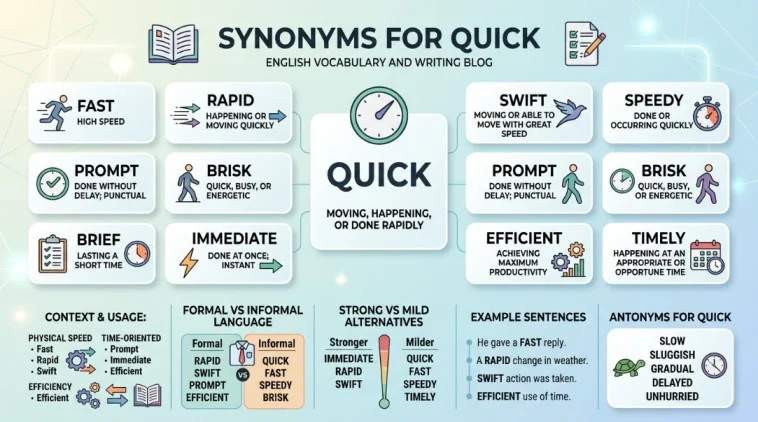
Knowing the right alternatives can make your writing sharper and more natural. The best synonyms for quick include words such as fast, rapid, swift, prompt, speedy, brisk, and immediate, but each carries a slightly different meaning, tone, or level of formality.
This guide explains how to choose the right word based on context, intensity, audience, and purpose. Whether you are improving vocabulary or polishing professional writing, the goal is not simply to replace quick, but to choose a more precise word.
What Does “Quick” Mean?
Quick means happening, moving, responding, or being completed in a short amount of time. Depending on context, useful synonyms include fast for general use, rapid for formal writing, swift for polished descriptions, prompt for professional communication, and speedy for casual language.
Meaning, Tone and Context
1. Simple Definition
Quick generally describes something that happens, moves, responds, or finishes in a short time.
For example:
“Please give me a quick response.”
Here, quick means a response that comes soon.
2. Part of Speech
Quick is primarily an adjective.
Example:
“She gave me a quick answer.”
It can also appear in the phrase “the quick,” although this usage is uncommon in everyday American English and usually appears in fixed expressions or older language.
The adverb form is quickly.
Example:
“He quickly finished the assignment.”
3. Tone
Quick is usually neutral. It can sound positive when speed is useful, such as in “quick service,” but it can also suggest impatience in some situations, such as “I need a quick answer.”
4. Formality Level
Quick is common in both casual and professional English. It works well in conversations, emails, workplace communication, essays, and everyday writing.
For highly formal writing, words such as rapid, prompt, swift, or immediate may provide greater precision depending on the sentence.
5. Common Use Cases
Quick is commonly used for:
- Movement
- Responses
- Decisions
- Actions
- Changes
- Services
- Learning
- Reactions
- Tasks
- Communication
6. Related Word Forms
Quick is related to several useful forms:
Quick: adjective
Quickly: adverb
Quickness: noun
Quickened: verb form meaning made faster or became faster
Slow: common opposite
When and How to Use “Quick”
Quick is useful when you want to communicate speed without adding a highly specific emotional or formal meaning.
Professional
“We need a quick response before the meeting begins.”
This is natural in workplace communication.
Personal
“I took a quick shower before leaving.”
Here, quick means taking a short amount of time.
Academic
“The experiment produced a quick change in temperature.”
In academic writing, a more precise term such as rapid may sometimes sound stronger.
Emotional
“She gave him a quick glance and looked away.”
Quick describes a brief action without necessarily creating strong emotion.
Creative
“A quick breeze swept through the open window.”
The word gives the sentence a sense of movement.
Social Media
“Just a quick coffee before work.”
This sounds natural and conversational.
“Just a quick reminder that the report is due Friday.”
This is a common professional expression.
Another Word for “Quick”
The best single replacement depends on what you mean by quick.
- Professional writing: prompt
- Academic writing: rapid
- Casual conversation: fast
- Emotional writing: swift
- Creative writing: brisk
- Resume or workplace use: efficient or prompt
- Social media captions: speedy or fast
- Stronger meaning: rapid
- Softer meaning: brisk or timely
If you mean something takes little time rather than moves quickly, brief may be a better choice.
For example:
“Let’s have a quick meeting.”
can become:
“Let’s have a brief meeting.”
The second sentence focuses more on duration than speed.
When Not to Use “Quick”
Quick is not always the most precise choice.
- If you are describing extremely high speed, rapid or lightning fast may communicate greater intensity.
- If you are describing a short event, brief is often better.
- If you are describing a professional response, prompt may sound more polished.
- If you are describing an efficient process, efficient is more meaningful than quick because it emphasizes good results with little wasted time.
Compare:
“The company provided a quick solution.”
“The company provided an efficient solution.”
The first focuses on speed. The second suggests that the solution worked well while avoiding unnecessary effort or resources.
Words Commonly Confused With “Quick”
| Word | Difference |
|---|---|
| Fast | Usually focuses on speed or movement |
| Rapid | Suggests a high rate of change or movement |
| Swift | Often describes fast movement or action with a polished tone |
| Prompt | Focuses on responding or acting without unnecessary delay |
| Brief | Focuses on short duration rather than speed |
| Immediate | Means happening at once or without delay |
The distinction matters because synonyms are rarely interchangeable in every sentence.
For example, “a brief meeting” means a meeting that does not last long. “A rapid meeting” is not natural English.
Best Synonym by Context for “Quick”
| Context | Best Synonym | Why It Works | Example |
|---|---|---|---|
| Formal writing | Rapid | Precise and polished | The region experienced rapid growth. |
| Academic writing | Rapid | Common for measurable change | The treatment caused rapid improvement. |
| Professional use | Prompt | Emphasizes timely action | Thank you for your prompt response. |
| Resume | Efficient | Highlights productive performance | Developed efficient solutions for clients. |
| Casual conversation | Fast | Natural and familiar | That car is really fast. |
| Creative writing | Swift | Creates vivid movement | A swift movement caught her attention. |
| Emotional tone | Sudden | Highlights unexpected change | A sudden silence filled the room. |
| Strong intensity | Rapid | Suggests a high rate | The patient experienced rapid changes. |
| Soft or moderate tone | Brisk | Suggests energetic movement | We took a brisk walk. |
| Social media | Fast | Short and familiar | Time goes fast when you are having fun. |
| Short duration | Brief | Focuses on length | I had a brief conversation with her. |
| No delay | Immediate | Emphasizes instant action | The system requires immediate attention. |
Which Synonym Should You Choose?
Start by asking what aspect of quickness you want to communicate.
- If the focus is physical speed, choose fast or speedy.
- If the focus is a high rate of change, rapid is usually stronger and more precise.
- If the focus is professional responsiveness, prompt works especially well.
- If the focus is a short amount of time, brief may be more accurate.
If the action needs an elegant or descriptive tone, swift can add polish.
- For resumes and workplace writing, choose a word that communicates value rather than speed alone. Efficient, responsive, timely, and prompt can often provide more useful information.
Real Life Examples of “Quick” in Sentences
School
“She gave a quick answer during the class discussion.”
Workplace
“Our team needs a quick solution to the scheduling problem.”
Writing
“The writer used a quick transition between the two ideas.”
Conversation
“Can you give me a quick update?”
Social Media
“Enjoying a quick break before the next meeting.”
Resume
“Known for quick problem solving and dependable communication.”
For a stronger professional version, consider:
“Known for efficient problem solving and responsive communication.”
“Just a quick note to confirm our meeting.”
Storytelling
“He cast a quick glance toward the door before leaving.”
25 Synonyms for “Quick”
| Synonym | Simple Meaning | Best Used For | Example Sentence |
|---|---|---|---|
| Fast | Moving or happening at high speed | Everyday speech | The train is fast. |
| Rapid | Happening at a high rate | Academic and formal writing | The company experienced rapid growth. |
| Swift | Moving or acting quickly | Creative and polished writing | She made a swift decision. |
| Speedy | Happening or completed quickly | Casual and friendly language | We received speedy service. |
| Prompt | Done without unnecessary delay | Professional communication | Thank you for your prompt reply. |
| Brisk | Quick and energetic | Walking, movement, activity | We went for a brisk walk. |
| Hasty | Done too quickly, often without enough thought | Negative or cautionary contexts | His hasty decision created problems. |
| Immediate | Happening at once | Urgent situations | The issue requires immediate attention. |
| Instant | Happening almost at once | Everyday and marketing language | The app provides instant access. |
| Sudden | Happening unexpectedly and quickly | Events and emotions | A sudden storm changed our plans. |
| Expeditious | Completed quickly and efficiently | Formal and professional writing | The agency promised expeditious processing. |
| Fleet | Moving quickly and lightly | Literary or descriptive writing | The deer made a fleet escape. |
| Nimble | Moving quickly and easily | Physical movement and thinking | Her nimble fingers repaired the device. |
| Briskly | In a quick and energetic manner | Descriptive writing | He walked briskly toward the station. |
| Hurried | Done with little available time | Time pressured situations | She gave a hurried explanation. |
| Accelerated | Made faster or increased in rate | Technical and formal contexts | The project entered an accelerated phase. |
| Immediate | Without waiting | Urgent communication | We need immediate action. |
| Lively | Energetic and active | Conversation and activity | The discussion became lively and engaging. |
| Agile | Able to move or respond quickly | Business, technology, and movement | The agile team adapted to the change. |
| Responsive | Reacting quickly and appropriately | Workplace communication | Our support team is highly responsive. |
| Efficient | Achieving results without wasted time or effort | Professional and resume writing | She developed an efficient workflow. |
| Timely | Happening at an appropriate or useful time | Business and formal writing | The timely update helped the team. |
| Fleeting | Lasting for a very short time | Emotional and creative writing | He noticed a fleeting smile. |
| Brief | Lasting only a short time | Meetings and communication | We had a brief discussion. |
| Hasty | Done with excessive speed and insufficient thought | Negative situations | A hasty conclusion can lead to mistakes. |
Note that some words in this table are context based alternatives rather than perfect replacements in every sentence. A good synonym should preserve the intended meaning, not merely resemble the original word.
Synonym Groups and Usage Differences
Professional vs. Personal Synonyms
In professional communication, prompt, timely, responsive, efficient, and expeditious can be more useful than quick.
For example:
“Thank you for your quick response.”
is perfectly acceptable.
“Thank you for your prompt response.”
sounds slightly more polished and is especially common in business emails.
In personal communication, fast, speedy, and quick are usually more natural.
Formal vs. Conversational Synonyms
Fast and quick are common conversational choices.
Rapid, expeditious, accelerated, and prompt can sound more formal depending on context.
For example:
“The situation changed fast.”
sounds conversational.
“The situation underwent rapid change.”
sounds more formal and analytical.
Academic Synonyms
Academic writing benefits from precision.
Rapid, accelerated, immediate, brief, and sudden can be useful when their exact meanings match the evidence.
For example:
“The population experienced rapid growth.”
is more precise than:
“The population grew quick.”
The second sentence is also grammatically incorrect because quickly would be required in that construction.
Professional and Business Synonyms
Prompt is particularly useful when discussing responses, communication, action, or service.
Efficient works well when describing systems, processes, workflows, and performance.
Responsive is useful when describing people, teams, customer service, or organizations.
Timely emphasizes that something happened at a useful or appropriate moment.
Creative or Literary Synonyms
Swift, fleet, fleeting, brisk, and nimble can add descriptive depth.
For example:
“She gave him a quick smile.”
is simple.
“She gave him a fleeting smile.”
suggests that the smile lasted only a moment.
Slang or Modern Synonyms
There are casual expressions that communicate speed, but they are highly dependent on audience and situation.
Words such as speedy and fast are safe in everyday American English.
Avoid overly informal expressions in resumes, academic essays, formal reports, and business proposals unless the style specifically calls for them.
Strongest vs. Weaker Synonyms
A useful intensity scale is:
Mild: timely, brisk
Moderate: quick, fast, speedy
Strong: swift, rapid
Very strong or urgent: immediate, instant
Negative fast action: hasty, hurried
The strongest word is not automatically the best word. Precision matters more than intensity.
Emotional vs. Neutral Synonyms
Quick is generally neutral.
Swift can sound more dramatic or polished.
Sudden emphasizes surprise.
Hasty can imply poor judgment.
Fleeting can create a temporary or emotional feeling.
Prompt and timely usually remain professional and neutral.
Antonyms of “Quick”
| Antonym | Meaning | Example Sentence |
|---|---|---|
| Slow | Moving or happening at a low speed | The internet connection is slow. |
| Sluggish | Moving or responding with little energy | The computer became sluggish. |
| Gradual | Developing slowly over time | The change was gradual. |
| Leisurely | Happening in a relaxed, unhurried way | They enjoyed a leisurely breakfast. |
| Delayed | Happening later than expected | The flight was delayed. |
| Late | Not happening at the expected time | He arrived late. |
| Unhurried | Happening without pressure or haste | She took an unhurried walk. |
| Lengthy | Continuing for a long time | The meeting was lengthy. |
| Prolonged | Continuing longer than expected | The illness caused prolonged discomfort. |
| Lingering | Remaining for longer than expected | A lingering smell filled the room. |
| Sluggishly | In a slow or inactive manner | The machine moved sluggishly. |
| Tardy | Later than expected | The employee was tardy. |
| Deliberate | Done carefully rather than quickly | She took a deliberate approach. |
| Time consuming | Requiring considerable time | The manual process was time consuming. |
| Procrastinating | Delaying an action unnecessarily | He kept procrastinating on the assignment. |
Comparison: “Quick” vs. Similar Words
Quick vs. Fast
Quick and fast both describe speed, but fast is especially common for movement or a high speed.
Fast is often stronger when describing physical speed.
Neither is necessarily more formal.
Example:
“She is quick at solving puzzles.”
“The car is fast.”
Quick vs. Rapid
Rapid emphasizes a high rate of movement, growth, or change.
Rapid is more formal than quick in many contexts.
Example:
“The response was quick.”
“The company experienced rapid growth.”
Quick vs. Swift
Swift suggests quick movement or action and often sounds more polished or literary.
Swift can feel more descriptive than quick.
Example:
“He made a quick decision.”
“He made a swift decision.”
Quick vs. Prompt
Prompt focuses on responding or acting without delay.
Prompt is more professional in many workplace situations.
Example:
“She gave me a quick reply.”
“She gave me a prompt reply.”
Quick vs. Brief
Quick can describe speed or short duration.
Brief specifically emphasizes short duration.
Example:
“Let’s have a quick meeting.”
“Let’s have a brief meeting.”
The second sentence focuses more clearly on the meeting being short.
Quick vs. Immediate
Quick means soon or fast.
Immediate means occurring at once or requiring action without delay.
Immediate is stronger when urgency matters.
Example:
“We need a quick response.”
“We need an immediate response.”
Common Phrases and Expressions with “Quick”
1. Quick answer
Meaning:
An answer given in a short amount of time.
Example sentence:
“Let me give you a quick answer before the meeting starts.”
2. Quick response
Meaning:
A response provided soon after a request or message.
Example sentence:
“Thank you for your quick response.”
3. Quick look
Meaning:
A brief glance or examination.
Example sentence:
“I took a quick look at the document.”
4. Quick break
Meaning:
A short period of rest.
Example sentence:
“Let’s take a quick break before continuing.”
5. Quick fix
Meaning:
A simple solution that solves an immediate problem, often temporarily.
Example sentence:
“This update is only a quick fix until we can redesign the system.”
6. Quick reminder
Meaning:
A brief message intended to remind someone about something.
Example sentence:
“Just a quick reminder that the application closes Friday.”
7. Quick decision
Meaning:
A decision made in a short amount of time.
Example sentence:
“The manager had to make a quick decision.”
8. Quick start
Meaning:
A fast beginning or a method that allows something to begin quickly.
Example sentence:
“The tutorial gives new users a quick start.”
Common Mistakes to Avoid
1. Using “Quick” When a More Precise Word Is Better
Quick is broad. If you mean a short meeting, use brief. If you mean a fast response, use prompt.
2. Confusing “Quick” With “Quickly”
Quick is usually an adjective.
“She is a quick learner.”
Quickly is an adverb.
“She learned the material quickly.”
3. Using a Casual Synonym in Formal Writing
Fast and speedy are perfectly normal words, but rapid, prompt, efficient, or timely may be more appropriate in certain formal contexts.
4. Using an Overly Dramatic Synonym
Do not use instant or rapid when ordinary quick communicates the situation accurately.
5. Repeating “Quick” Too Often
Repeated use can make writing feel limited.
Instead of:
“Quick response, quick service, and quick delivery.”
consider:
“Prompt responses, efficient service, and speedy delivery.”
6. Choosing the Wrong Emotional Tone
Hasty can imply poor judgment. Sudden can suggest surprise. Fleeting can suggest something temporary.
Replacing quick with any of these words can change the meaning.
7. Using Slang in Academic or Professional Writing
Highly casual expressions may weaken an essay, resume, proposal, or formal email.
Choose vocabulary that matches the audience and purpose.
FAQs
What is the best synonym for “quick”?
The best synonym depends on context. Fast works generally, rapid suits formal writing, prompt fits professional communication, and brief works when you mean short duration.
What is a formal synonym for “quick”?
Rapid, prompt, expeditious, accelerated, and immediate can work as formal alternatives, depending on whether you mean speed, responsiveness, or urgency.
What is an informal synonym for “quick”?
Fast and speedy are natural informal alternatives. They work well in conversations, texts, captions, and everyday American English.
What is another word for “quick” in professional writing?
Prompt, timely, responsive, and efficient are strong professional choices. Each emphasizes a slightly different quality, such as speed, timing, reaction, or productivity.
What is the difference between “quick” and “fast”?
Quick can describe a short action, response, or duration, while fast commonly emphasizes speed or movement. Their meanings overlap in many everyday sentences.
What is the opposite of “quick”?
Common opposites include slow, sluggish, gradual, delayed, leisurely, unhurried, and lengthy. The best antonym depends on whether you mean speed or duration.
Conclusion
Quick is a versatile English word that describes speed, short duration, or fast action. Its meaning is simple, but choosing the best alternative requires attention to context and tone.
Use fast for everyday language, rapid for high rates of change, prompt for professional responses, brief for short duration, swift for polished descriptions, and efficient when workplace performance matters.
The most useful vocabulary habit is to avoid replacing a word simply because you want variety. First identify the exact meaning you want, then select the synonym that communicates it most accurately.
Discover More Post:
- 25+ Synonyms for Share | Meanings, Examples and Best …
- 25+ Synonyms for Navigate | Meanings, Examples, and Best …
- 25+ Synonyms for Achieve | Meanings, Examples, and Best …