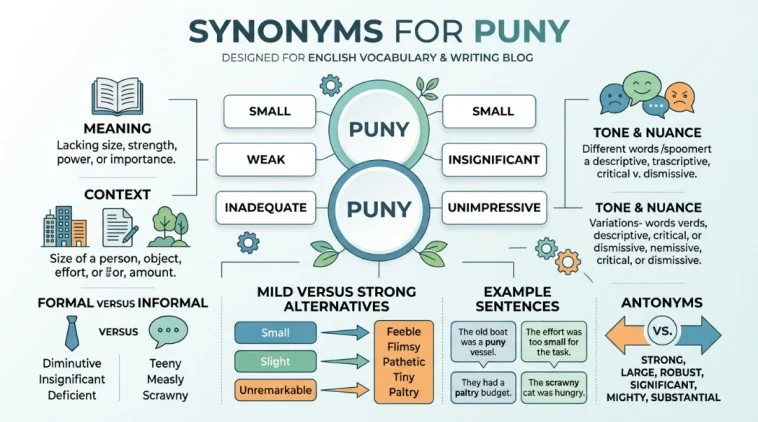
Using synonyms for puny can make your writing far more precise. A word like puny may describe something physically small, weak, unimpressive, or lacking in strength, but the best replacement depends on exactly what you mean.
For example, a writer may need diminutive for size, feeble for weakness, paltry for an inadequate amount, or insignificant for lack of importance. Choosing the right alternative helps your emails, essays, captions, stories, and professional writing sound more natural and intentional.
What Does “Puny” Mean?
Puny describes something that is unusually small, weak, or lacking in strength and importance. Depending on context, useful synonyms include diminutive, undersized, feeble, frail, paltry, insignificant, and wimpy.
Meaning, Tone and Context
Simple Definition
Puny generally means small and weak, especially when something appears noticeably lacking in size, strength, power, or effectiveness.
The word can describe people, animals, objects, amounts, efforts, or results. Its exact meaning depends heavily on the sentence.
Part of Speech
Puny is an adjective.
Example:
“The puppy looked puny beside the larger dogs.”
Tone
Puny is usually negative or dismissive. It can suggest that something is not merely small but disappointingly small or weak.
In playful or humorous writing, however, puny can sound teasing rather than seriously insulting.
Formality Level
Puny is common in everyday English and creative writing. It is understandable in professional communication, but more precise alternatives are often better for formal documents.
Common Use Cases
Puny can describe:
- Physical size
- Physical strength
- Weak performance
- Small amounts
- Limited power
- Unimpressive efforts
- Something viewed as insignificant
Related Forms
The main related forms are:
Puny: adjective
Punyish: uncommon and informal
Puny person or thing: noun phrase using the adjective
The opposite depends on the intended meaning. For size, words such as large or massive work well. For strength, strong, powerful, or robust may be better.
When and How to Use “Puny”
Use puny when you want to emphasize that something seems noticeably small or weak, often compared with something larger or stronger.
1. Personal Context
“The puny kitten tried to climb the oversized chair.”
2. Creative Context
“His puny lantern barely illuminated the dark trail.”
3. Casual Context
“That puny cup of coffee did nothing to wake me up.”
4. Emotional Context
“She felt puny and powerless after the argument.”
5. Social Media Context
“Tiny dog, puny paws, enormous personality.”
6. Storytelling Context
“The hero laughed at the creature’s puny attempt to move the stone.”
7. Descriptive Context
“The plant produced a puny harvest despite months of care.”
Another Word for “Puny”
There is no single best replacement for every use of puny. The ideal choice depends on whether you mean small, weak, inadequate, insignificant, or unimpressive.
| Situation | Best Alternative |
|---|---|
| Professional writing | Insignificant |
| Academic writing | Insignificant |
| Casual conversation | Tiny |
| Emotional writing | Feeble |
| Creative writing | Diminutive |
| Resume or workplace use | Limited |
| Social media captions | Tiny |
| Stronger meaning | Feeble |
| Softer meaning | Small |
For physical size, diminutive or undersized can be more precise. For weakness, feeble or frail usually communicates the idea better.
When Not to Use “Puny”
Avoid puny when you need neutral, respectful, or highly precise language.
For example:
Less precise:
“The company received a puny budget.”
More professional:
“The company received a limited budget.”
Calling a person puny can also sound insulting because the word often carries a judgment about someone’s body or strength.
In academic writing, puny may sound too conversational. Small, limited, minimal, or insignificant can provide a more objective tone.
Words Commonly Confused With “Puny”
Puny vs. Tiny
Tiny primarily emphasizes very small physical size.
Puny often adds an idea of weakness or inadequacy.
Tiny: “She found a tiny shell.”
Puny: “The puny engine struggled to move the vehicle.”
Puny vs. Feeble
Feeble focuses mainly on weakness or lack of force.
Puny can describe both smallness and weakness.
Feeble: “His voice sounded feeble.”
Puny: “The puny motor could not lift the load.”
Puny vs. Petite
Petite usually describes a person who is attractively or delicately small, especially in a neutral or positive way.
Puny usually has a negative or dismissive tone.
Petite: “She has a petite frame.”
Puny: “The puny animal looked weak.”
Puny vs. Paltry
Paltry usually describes an amount that is disappointingly small or inadequate.
Puny can describe physical size or strength as well.
Paltry: “The workers received a paltry bonus.”
Puny: “The machine produced a puny amount of power.”
Puny vs. Insignificant
Insignificant emphasizes lack of importance, influence, or meaningful effect.
Puny more often suggests physical smallness or weakness.
Insignificant: “The error had an insignificant effect on the results.”
Puny: “The device generated a puny signal.”
Puny vs. Wimpy
Wimpy is informal and focuses on a lack of strength, courage, or toughness.
Puny more strongly suggests small size combined with weakness.
Wimpy: “That excuse sounds wimpy.”
Puny: “The puny puppy could not reach the food bowl.”
Best Synonym by Context for “Puny”
| Context | Best Synonym | Why It Works | Example |
|---|---|---|---|
| Formal writing | Insignificant | Sounds objective and precise | The change had an insignificant effect. |
| Academic writing | Minimal | Describes a very small degree objectively | The study found minimal improvement. |
| Professional or business use | Limited | Avoids insulting language | The project has limited resources. |
| Resume | Modest | Gives a neutral description of scale | Managed a modest team during the launch. |
| Casual conversation | Tiny | Natural and familiar | That tiny car fits anywhere. |
| Creative writing | Diminutive | Adds descriptive detail | A diminutive figure appeared in the doorway. |
| Emotional tone | Feeble | Highlights weakness | He gave a feeble response. |
| Strong intensity | Frail | Emphasizes physical weakness | The frail animal needed immediate care. |
| Soft or moderate tone | Small | Neutral and flexible | The plant grew to a small size. |
| Social media captions | Tiny | Short, natural, and accessible | Tiny paws, huge attitude. |
| US usage | Tiny | Very common in everyday American English | We found a tiny café nearby. |
| UK usage | Diminutive | Useful in descriptive writing | The diminutive character stood quietly. |
Which Synonym Should You Choose?
Start by identifying what puny means in your sentence.
- If you mean physical size, choose tiny, small, diminutive, or undersized.
- If you mean physical weakness, choose feeble, frail, weak, or wimpy.
- If you mean an inadequate amount, choose meager, scanty, or paltry.
- If you mean lack of importance, choose insignificant or negligible.
For professional and academic communication, avoid unnecessarily judgmental wording. A neutral alternative often communicates the same idea more effectively.
Real Life Examples of “Puny” in Sentences
School
“The student described the plant as puny because it had barely grown.”
Workplace
“The team rejected the puny budget because it could not cover the required expenses.”
Writing
“The author uses the puny character to contrast weakness with courage.”
Conversation
“That puny umbrella will not protect you from this storm.”
Social Media
“Puny paws, giant personality.”
Resume
Instead of writing, “Managed a puny team,” use:
“Managed a small team of five employees.”
Instead of:
“The proposed budget is puny.”
Use:
“The proposed budget appears insufficient for the project’s requirements.”
Storytelling
“The puny warrior stood before the enormous gate without showing fear.”
25 Synonyms for “Puny”
| Synonym | Simple Meaning | Best Used For | Example Sentence |
|---|---|---|---|
| Tiny | Very small | Physical size | A tiny bird landed on the fence. |
| Small | Not large | General size | They moved into a small apartment. |
| Little | Small in size or amount | Everyday speech | He carried a little backpack. |
| Diminutive | Unusually small | Formal or literary description | The diminutive statue stood near the entrance. |
| Undersized | Smaller than expected | Objects, people, animals | The undersized equipment could not handle the task. |
| Petite | Small and delicately built | People and fashion | The store offers petite clothing. |
| Minute | Extremely small | Precise or formal descriptions | A minute crack appeared in the surface. |
| Miniature | A very small representation or version | Objects and models | She collected miniature houses. |
| Meager | Too small or inadequate in amount | Resources, food, income | The family survived on a meager income. |
| Scanty | Barely enough | Supplies, quantities, information | The report provided scanty evidence. |
| Paltry | Disappointingly small or inadequate | Amounts, rewards, results | The workers received a paltry payment. |
| Insignificant | Lacking importance | Results, effects, issues | The difference was insignificant. |
| Negligible | So small it can almost be ignored | Measurements, effects, costs | The additional cost was negligible. |
| Feeble | Lacking strength or force | People, voices, efforts | He made a feeble attempt to lift the box. |
| Frail | Physically delicate or weak | People, animals, bodies | The frail bird needed protection. |
| Weak | Lacking physical or effective strength | People, arguments, systems | The weak signal disappeared quickly. |
| Wimpy | Weak or lacking toughness | Casual speech | The wimpy motor could not climb the hill. |
| Insubstantial | Lacking strength, size, or substance | Formal descriptions | The structure looked insubstantial. |
| Unimpressive | Not producing a strong effect | Performance, results, displays | The initial results were unimpressive. |
| Limited | Restricted in amount or ability | Professional contexts | The team has limited resources. |
| Modest | Relatively small without sounding harsh | Amounts, achievements, scale | The company achieved modest growth. |
| Weedy | Thin, weak, or poorly developed | Informal physical description | The young plant looked weedy. |
| Lilliputian | Extremely small, often humorously | Literary or playful writing | The Lilliputian figures filled the miniature scene. |
| Microscopic | Extremely small, sometimes figurative | Scientific or exaggerated description | The microscopic opening was difficult to see. |
| Slight | Small or delicate in size or degree | Physical features and amounts | A slight figure entered the room. |
Synonym Groups and Usage Differences
Professional vs. Personal Synonyms
Professional writing usually benefits from neutral words such as limited, modest, minimal, or insignificant.
Personal and conversational writing gives you more freedom to use tiny, little, wimpy, or puny, depending on the intended tone.
Formal vs. Conversational Synonyms
Formal writing favors words such as insignificant, negligible, minimal, diminutive, and insubstantial.
Conversational English naturally uses tiny, small, little, and wimpy.
The best choice is the one that matches the relationship between the writer and reader.
Academic Synonyms
Academic writing should prioritize precision over dramatic wording.
Good choices include minimal, insignificant, negligible, limited, and small.
For example:
Less academic:
“The experiment produced a puny improvement.”
More academic:
“The experiment produced minimal improvement.”
Professional and Business Synonyms
In workplace communication, puny can sound dismissive.
Use limited, modest, minimal, or insufficient when discussing budgets, resources, teams, results, or capacity.
Instead of saying:
“The department has a puny budget.”
Write:
“The department has a limited budget.”
Creative or Literary Synonyms
Creative writing allows more expressive vocabulary.
Diminutive, Lilliputian, frail, weedy, and microscopic can create stronger imagery when used appropriately.
These words should support the scene rather than simply replace puny mechanically.
Slang or Modern Synonyms
Wimpy is the clearest informal alternative.
It can describe someone or something that seems weak, timid, or lacking toughness.
It works well in casual conversation but should generally be avoided in academic essays, formal reports, resumes, and professional correspondence.
Strongest vs. Weaker Synonyms
A useful approximate intensity scale is:
Mild: small → little → modest
Moderate: tiny → diminutive → undersized
Weakness focused: weak → frail → feeble
Inadequacy focused: limited → meager → paltry
Strongly dismissive: puny → wimpy → paltry
Intensity depends on context, so this is a practical writing guide rather than a strict dictionary ranking.
Emotional vs. Neutral Synonyms
Neutral choices include small, limited, minimal, and modest.
More emotional choices include puny, feeble, frail, wimpy, and paltry.
If your goal is objective communication, select the neutral option. If your goal is characterization, humor, criticism, or vivid storytelling, a stronger word may be appropriate.
Antonyms of “Puny”
| Antonym | Meaning | Example Sentence |
|---|---|---|
| Large | Big in size | They moved into a large house. |
| Big | Greater than average in size | A big dog waited outside. |
| Huge | Extremely large | The stadium has a huge entrance. |
| Gigantic | Exceptionally large | A gigantic tree dominated the landscape. |
| Massive | Very large and heavy | The machine has a massive frame. |
| Enormous | Extremely great in size | An enormous crowd gathered outside. |
| Substantial | Large or considerable in amount | The company made a substantial investment. |
| Strong | Having considerable physical or functional power | The bridge is strong enough for heavy traffic. |
| Powerful | Having great force or influence | The engine is remarkably powerful. |
| Robust | Strong and able to withstand difficulty | The system uses a robust design. |
| Sturdy | Solid and physically strong | The table has a sturdy construction. |
| Mighty | Very strong or powerful | The mighty river moved through the valley. |
| Formidable | Strong enough to inspire respect or concern | They faced a formidable opponent. |
| Impressive | Producing admiration through size, quality, or ability | The team delivered an impressive performance. |
| Significant | Important or considerable in effect or amount | The project produced significant results. |
Comparison: “Puny” vs. Similar Words
Puny vs. Tiny
Main difference: Tiny focuses on very small size, while puny often combines smallness with weakness.
Stronger: Puny usually carries more negative judgment.
More formal: Tiny is neutral, while neither word is especially formal.
Examples:
“The tiny seed was difficult to see.”
“The puny plant struggled to survive.”
Puny vs. Small
Main difference: Small is neutral, while puny can suggest disappointing size or weakness.
Stronger: Puny.
More formal: Small can work in almost any context.
Examples:
“She lives in a small apartment.”
“The puny generator could not power the building.”
Puny vs. Feeble
Main difference: Feeble emphasizes weakness, while puny can emphasize both size and weakness.
Stronger: Feeble for weakness.
More formal: Feeble is generally more suitable in formal descriptive writing.
Examples:
“He gave a feeble response.”
“The puny machine produced little power.”
Puny vs. Paltry
Main difference: Paltry usually describes an inadequate amount, reward, or result.
Stronger: Paltry when criticizing an inadequate quantity.
More formal: Paltry is more suitable than puny in some written contexts.
Examples:
“The offer included a paltry bonus.”
“The puny device produced a weak signal.”
Puny vs. Insignificant
Main difference: Insignificant means unimportant or having little effect, while puny often refers to physical size or strength.
Stronger: Puny is more vivid, while insignificant is more objective.
More formal: Insignificant.
Examples:
“The error was insignificant.”
“The puny engine struggled uphill.”
Puny vs. Wimpy
Main difference: Both can suggest weakness, but wimpy is more informal and can suggest a lack of toughness or courage.
Stronger: Neither is universally stronger, but wimpy can sound more insulting about character.
More formal: Puny.
Examples:
“The puny motor lacked sufficient power.”
“That wimpy excuse did not convince anyone.”
Common Phrases and Expressions with “Puny”
1. Puny Little Thing
Meaning: A dismissive way to describe something very small or weak.
Example sentence:
“The puny little thing could barely carry the load.”
2. Puny Attempt
Meaning: An attempt that appears weak, inadequate, or ineffective.
Example sentence:
“His puny attempt to open the jar failed immediately.”
3. Puny Effort
Meaning: An effort that seems insufficient or unimpressive.
Example sentence:
“The team made a puny effort to solve the problem.”
4. Puny Amount
Meaning: An amount that seems disappointingly small.
Example sentence:
“They offered only a puny amount for the damaged equipment.”
5. Puny Figure
Meaning: A person or figure that appears unusually small or weak.
Example sentence:
“A puny figure stood beneath the enormous statue.”
6. Puny Little Man
Meaning: A strongly dismissive description of a small or weak man.
Example sentence:
“The villain mocked him as a puny little man.”
7. Puny Strength
Meaning: Very limited physical or functional strength.
Example sentence:
“The motor’s puny strength was obvious on the steep road.”
Common Mistakes to Avoid
1. Using Puny When You Only Mean Small
Puny can imply weakness or inadequacy.
Use small or tiny when you simply want to describe size without criticism.
2. Confusing Puny With Insignificant
Puny can describe something physically small or weak. Insignificant usually concerns importance or effect.
3. Using Puny in Formal Business Communication
Calling a budget or resource puny can sound dismissive.
Choose limited, modest, or insufficient instead.
4. Using an Overly Dramatic Synonym
Gigantic, microscopic, or Lilliputian may sound exaggerated when a simple word such as small would be clearer.
5. Repeating Puny Too Often
If the same word appears repeatedly, vary it according to meaning rather than replacing it randomly.
6. Choosing the Wrong Emotional Tone
Wimpy and paltry can sound judgmental.
Use modest, limited, or small when you need a neutral tone.
7. Using Slang in Academic Writing
Avoid wimpy in essays and research based writing.
Use precise terms such as weak, minimal, limited, or insignificant.
FAQs
What is the best synonym for puny?
The best synonym depends on context. Use tiny for size, feeble for weakness, paltry for inadequate amounts, and insignificant for lack of importance.
What is a formal synonym for puny?
Formal alternatives include diminutive, insignificant, negligible, minimal, limited, and insubstantial, depending on the intended meaning.
What is an informal synonym for puny?
Wimpy is a common informal alternative when you mean weak or lacking toughness. Tiny is another natural everyday choice for small size.
What is another word for puny in professional writing?
Use limited, minimal, modest, or insignificant in professional writing. These alternatives communicate the intended idea without sounding unnecessarily insulting.
What is the difference between puny and tiny?
Tiny mainly describes very small size. Puny can describe small size while also suggesting weakness, inadequacy, or a lack of power.
What is the opposite of puny?
The opposite depends on context. Size, use large or huge. For strength, use strong or powerful. For importance, use significant.
Conclusion
Synonyms for puny range from neutral words such as small and tiny to stronger choices such as feeble, frail, paltry, and wimpy. The right alternative depends on you are describing size, weakness, inadequacy, or lack of importance.
For professional and academic writing, favor precise and neutral choices such as limited, minimal, insignificant, or negligible. For creative or casual writing, words such as diminutive, tiny, and wimpy can create a stronger voice.
A useful vocabulary habit is to identify the exact idea behind the original word before choosing a synonym. That small step makes your writing clearer, more natural, and more effective.
Discover More Post:
- 25+ Synonyms for Share | Meanings, Examples and Best …
- 25+ Synonyms for Navigate | Meanings, Examples, and Best …
- 25+ Synonyms for Achieve | Meanings, Examples, and Best …