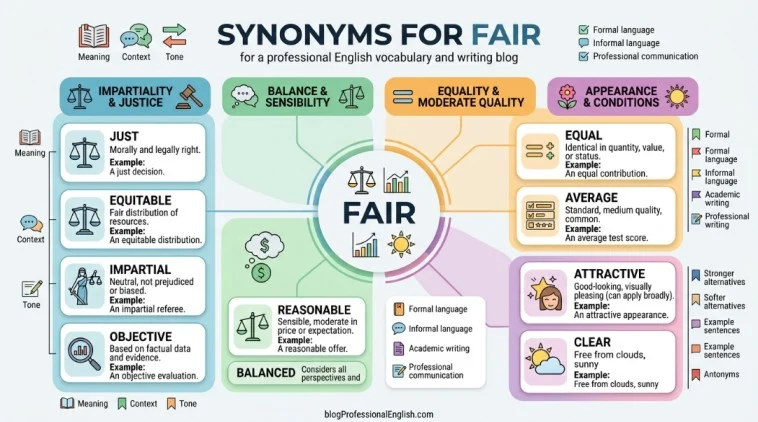
The word fair appears everywhere, from school essays and workplace emails to social media captions, resumes, reviews, and everyday conversations. The problem is that fair can mean several different things, so repeating it can make otherwise strong writing sound vague.
Choosing the right alternative depends on what you mean. You might need equitable for a policy, reasonable for a price, impartial for a decision, attractive for someone’s appearance, or average for describing performance.
This guide explains the most useful synonyms for fair, including their meanings, tones, contexts, examples, and subtle differences. It also shows which word works best in professional, academic, casual, emotional, and creative writing.
What Does “Fair” Mean?
Fair usually means just, reasonable, impartial, or acceptable. Depending on context, useful synonyms include equitable for formal writing, reasonable for everyday use, impartial for decisions, average for performance, and attractive when describing appearance.
Meaning, Tone and Context
Simple Definition
Fair commonly describes something that is just, reasonable, unbiased, or acceptable.
For example, if everyone receives the same opportunity, the process may be called fair. If a price is neither too high nor too low, it may also be described as fair.
The word has several meanings, so context matters. In another sentence, fair can describe someone as attractive, weather as clear, or performance as average.
Part of Speech
Fair is primarily an adjective.
Examples include:
- The teacher made a fair decision.
- That seems like a fair price.
- She has fair hair.
- We had fair weather during the trip.
Fair can also function as an adverb in expressions such as “play fair.”
As a noun, fair can refer to an event where people gather for entertainment, shopping, food, or exhibitions.
Example:
- We visited the county fair on Saturday.
Tone
Fair usually has a neutral to positive tone when it means just, reasonable, or unbiased.
It can become less positive when it means average or mediocre.
For example:
- “The manager made a fair decision” sounds positive.
- “His performance was fair” may suggest that his performance was only average.
Formality Level
Fair works comfortably in casual, professional, and academic English.
However, a more precise synonym can improve formal writing. Equitable, impartial, objective, and reasonable may communicate a specific meaning more clearly.
Common Use Cases
Fair is frequently used when discussing:
- Rules and policies
- Prices and costs
- Decisions
- Treatment of people
- Opportunities
- Arguments
- Performance
- Appearance
- Weather
- Opinions
- Agreements
- Workplace situations
Important Word Forms
Common related forms include:
- Fair
- Fairly
- Fairness
- Unfair
- Unfairly
- Unfairness
The noun fairness refers to the quality of being just, reasonable, or impartial.
Example:
- Fairness is important when evaluating employees.
The opposite adjective is unfair.
When and How to Use “Fair”
Use fair when you want to communicate justice, reasonableness, balance, or acceptability without sounding overly dramatic.
It is especially useful when the exact meaning is clear from the surrounding sentence.
1. Professional Context
“The hiring committee followed a fair selection process.”
Here, fair means impartial and equitable.
2. Personal Context
“I think it is fair to give everyone a chance.”
Here, fair means reasonable and just.
3. Academic Context
“The study attempts to provide a fair comparison between the two methods.”
Here, fair means balanced and unbiased.
4. Workplace Context
“The employee received a fair evaluation based on her results.”
Here, fair means reasonable and impartial.
5. Email Context
“Thank you for offering a fair solution to the issue.”
Here, fair communicates reasonableness and balance.
6. Social Media Context
“Everyone deserves a fair chance to succeed.”
Here, fair expresses equal opportunity.
7. Casual Context
“That seems like a fair price for the service.”
Here, fair means reasonable or acceptable.
Another Word for “Fair”
The best single replacement for fair depends on the meaning you want.
- For professional writing, equitable or impartial can be stronger choices.
- For academic writing, objective, balanced, or impartial often provide greater precision.
- For casual conversation, reasonable and okay can sound natural.
- For emotional writing, just and deserved may communicate stronger feelings.
- For creative writing, balanced, just, kind, or reasonable can work depending on the scene.
- For resumes and workplace writing, objective, equitable, and consistent may sound more specific.
- For social media captions, equal, reasonable, or just can be concise and natural.
- For a stronger meaning, choose equitable, just, or impartial.
- For a softer meaning, choose reasonable, acceptable, or decent.
When Not to Use “Fair”
Fair can become too vague when your sentence requires a precise description.
Instead of writing:
“The company has a fair policy.”
You could write:
“The company has an equitable policy that gives all employees the same opportunity.”
Fair can also sound too weak when you want to emphasize strong justice.
Instead of:
“The decision was fair.”
You might write:
“The decision was completely impartial.”
The word can also be misleading when fair means average.
For example:
“Her performance was fair.”
This may suggest that her performance was merely acceptable. If you mean average, average or moderate may be clearer.
When describing appearance, fair can also sound old fashioned or ambiguous. Attractive, lovely, or good looking may communicate the intended meaning more naturally.
Words Commonly Confused With “Fair”
Fair vs. Just
Fair usually describes reasonable or balanced treatment.
Just emphasizes moral correctness or what someone deserves.
Example:
- The teacher made a fair decision.
- The punishment was just.
Fair vs. Equal
Fair means reasonable or just.
Equal means the same in amount, value, status, or opportunity.
Something can be equal without being fair.
Example:
- Everyone received equal amounts of work.
- The manager created a fair workload based on each person’s responsibilities.
Fair vs. Impartial
Fair is broad and can describe many situations.
Impartial specifically means not favoring one person or side.
Example:
- The outcome was fair.
- The judge remained impartial.
Fair vs. Reasonable
Fair often involves justice or equal treatment.
Reasonable focuses more on logic, acceptability, or moderation.
Example:
- The teacher gave us a fair opportunity.
- The customer requested a reasonable refund.
Fair vs. Objective
Fair can mean unbiased.
Objective means based on facts rather than personal feelings or opinions.
Example:
- The evaluation was fair.
- The reviewer used objective criteria.
Fair vs. Average
When fair describes quality or performance, it can mean average or acceptable.
Average is more direct when you specifically mean a typical level.
Example:
- The restaurant received a fair review.
- The restaurant’s food was average.
Best Synonym by Context for “Fair”
| Context | Best Synonym | Why It Works | Example |
|---|---|---|---|
| Formal writing | Equitable | Emphasizes fair treatment and distribution | The policy promotes equitable access. |
| Academic writing | Objective | Highlights fact based evaluation | The researchers used objective criteria. |
| Professional use | Impartial | Shows freedom from favoritism | The manager made an impartial decision. |
| Resume | Objective | Communicates neutrality and professional judgment | Provided objective feedback during evaluations. |
| Business use | Reasonable | Works well for prices, requests, and agreements | The client proposed a reasonable solution. |
| Casual conversation | Reasonable | Sounds natural and approachable | That seems like a reasonable price. |
| Creative writing | Just | Adds moral or emotional force | She believed the punishment was just. |
| Emotional tone | Deserved | Connects fairness with what someone merits | He finally received the recognition he deserved. |
| Strong meaning | Equitable | Clearly emphasizes fairness in treatment | The organization seeks equitable opportunities. |
| Soft meaning | Acceptable | Makes the statement less forceful | The proposed arrangement is acceptable. |
| Social media captions | Equal | Short and clear when discussing opportunity | Everyone deserves an equal chance. |
| Weather | Clear | Fits fair weather when conditions are pleasant | We enjoyed clear skies all afternoon. |
| Appearance | Attractive | Modern and natural for physical appeal | The design has an attractive appearance. |
| Performance | Average | Clearly communicates ordinary quality | Her results were average this semester. |
| Pricing | Reasonable | Commonly describes a satisfactory cost | The service comes at a reasonable price. |
Which Synonym Should You Choose?
Start by identifying what fair means in your sentence.
- If you mean equal or just treatment, consider equitable, just, or evenhanded.
- If you mean without favoritism, choose impartial, unbiased, or objective.
- If you mean acceptable or sensible, use reasonable, acceptable, or moderate.
- If you mean average quality, choose average, middling, or passable.
- If you mean physical appeal, choose attractive, beautiful, or lovely.
- If you mean pleasant weather, consider clear, bright, or pleasant.
The best synonym is not necessarily the most sophisticated word. The best synonym is the one that preserves the original meaning while fitting the sentence naturally.
Real Life Examples of “Fair” in Sentences
School
“The teacher gave every student a fair opportunity to participate.”
A more formal version could use equal or equitable, depending on the intended meaning.
Workplace
“Employees expect fair treatment from their managers.”
Here, equitable or impartial may work in a formal policy discussion.
Writing
“The article presents a fair assessment of the issue.”
For academic writing, balanced or objective may be more precise.
Conversation
“That is a fair point.”
This common expression means the person’s argument is reasonable or valid.
Social Media
“Everyone deserves a fair chance.”
The phrase communicates equal opportunity in a simple, accessible way.
Resume
“Provided fair and objective evaluations of project performance.”
In a resume, objective may communicate professional neutrality more precisely.
“I believe this is a fair solution for both sides.”
A more formal alternative could be:
“I believe this is a reasonable solution for both parties.”
Storytelling
“The old judge was known for making fair decisions.”
If the story emphasizes moral justice, just could create a stronger literary effect.
25 Synonyms for “Fair”
| Synonym | Simple Meaning | Best Used For | Example Sentence |
|---|---|---|---|
| Just | Morally right or deserved | Justice and moral situations | The court reached a just decision. |
| Equitable | Fair and balanced for everyone | Formal and professional writing | The company wants an equitable compensation system. |
| Impartial | Not favoring either side | Decisions and judgments | The referee remained impartial throughout the game. |
| Unbiased | Free from personal preference | Reviews and evaluations | We need an unbiased assessment of the proposal. |
| Evenhanded | Treating people or sides equally | Formal discussion and policy | The editor gave an evenhanded review of both arguments. |
| Objective | Based on facts rather than feelings | Academic and professional writing | The manager used objective standards to evaluate performance. |
| Reasonable | Sensible and acceptable | Prices, requests, decisions | The customer made a reasonable request. |
| Balanced | Giving appropriate attention to different sides | Arguments and reports | The article offers a balanced discussion of the topic. |
| Equal | The same in opportunity, value, or treatment | Rights and opportunities | Every applicant deserves an equal opportunity. |
| Honest | Truthful and sincere | Opinions and assessments | She gave me an honest evaluation of my work. |
| Legitimate | Valid or properly justified | Claims and decisions | The customer had a legitimate complaint. |
| Proper | Correct or appropriate | Conduct and procedures | The committee followed the proper process. |
| Acceptable | Good enough or satisfactory | Standards and agreements | The proposed terms are acceptable to both parties. |
| Moderate | Neither excessive nor extreme | Prices, opinions, and conditions | The store offers products at moderate prices. |
| Decent | Good enough or respectable | Casual descriptions | He found a decent apartment near campus. |
| Respectable | Worthy of approval or regard | Quality and achievement | She earned a respectable score on the exam. |
| Average | Typical rather than exceptional | Performance and quality | The student’s performance was average. |
| Middling | Around an average level | Quality and performance | The movie received middling reviews. |
| Passable | Adequate but not impressive | Skills and quality | His Spanish was passable after one semester. |
| Attractive | Pleasing in appearance | People, designs, and products | The website has an attractive layout. |
| Beautiful | Highly pleasing in appearance | People, places, and creative descriptions | The garden looked beautiful at sunrise. |
| Lovely | Pleasant, attractive, or charming | Personal and creative writing | They spent a lovely afternoon together. |
| Good looking | Pleasant in physical appearance | Informal descriptions of people | The actor is widely considered good looking. |
| Clear | Free from clouds or bad weather | Weather | We had clear skies throughout the weekend. |
| Pleasant | Comfortable or enjoyable | Weather and general conditions | The city experienced pleasant weather in May. |
Synonym Groups and Usage Differences
Professional vs. Personal Synonyms
Professional writing benefits from precise words such as equitable, impartial, objective, and reasonable.
Personal communication can use simpler alternatives such as just, honest, reasonable, and equal.
For example, a workplace policy might say:
“The organization is committed to equitable treatment.”
A personal conversation might say:
“That does not seem fair to me.”
Both communicate a similar idea, but the tone and level of precision are different.
Formal vs. Conversational Synonyms
Formal writing often benefits from equitable, impartial, objective, and evenhanded.
Conversational English usually sounds more natural with fair, reasonable, just, or okay.
In a text message, you might write:
“That seems fair.”
In a formal report, you could write:
“The proposed process appears equitable.”
Academic Synonyms
Academic writing requires precision because a broad word can leave the reader uncertain about the intended meaning.
- Use objective when discussing evidence or evaluation.
- Use impartial when discussing freedom from favoritism.
- Use balanced when discussing multiple viewpoints.
- Use equitable when discussing fair distribution, access, or treatment.
- Use reasonable when evaluating a conclusion, assumption, or interpretation.
Professional and Business Synonyms
In emails, presentations, workplace policies, and business documents, the best synonym depends on the subject.
- For pricing, reasonable is highly natural.
- For employee treatment, equitable is more precise.
- For evaluations, objective is useful.
- For decision making, impartial communicates neutrality.
- For agreements, acceptable can provide a softer tone.
Example:
“The proposed price is reasonable.”
This sounds more natural than using equitable, because the issue involves cost rather than distribution of rights.
Creative or Literary Synonyms
Creative writing gives you more freedom to choose emotionally expressive alternatives.
Just can create a strong sense of moral correctness.
Lovely can add warmth.
Beautiful emphasizes visual appeal.
Honest can add emotional authenticity.
Example:
“She wanted a just ending for everyone involved.”
This carries more emotional weight than simply saying:
“She wanted a fair ending.”
Slang or Modern Synonyms
There are few true slang synonyms for fair that preserve its full meaning.
Words such as okay, legit, or solid can sometimes replace fair in casual speech, but they do not always have the same meaning.
For example:
“That price is fair.”
can become:
“That price is reasonable.”
In very casual speech, someone might say:
“That price is legit.”
However, legit means credible, genuine, or acceptable in context, so it should not replace fair in formal writing.
Strongest vs. Weaker Synonyms
A useful intensity scale depends on the exact sense.
Mild: acceptable, decent
Moderate: reasonable, fair, balanced
Stronger: just, impartial, equitable
Very precise: objective, evenhanded, unbiased
These words are not perfectly interchangeable, so choose according to the intended meaning rather than intensity alone.
Emotional vs. Neutral Synonyms
Fair, reasonable, and objective usually sound relatively neutral.
Just can carry a stronger moral tone.
Deserved focuses on what someone merits.
Honest can add personal sincerity.
For example:
“The employee received a fair review.”
is relatively neutral.
“The employee received the recognition she deserved.”
has a stronger emotional quality.
Antonyms of “Fair”
Because fair has several meanings, its antonyms also depend on context.
| Antonym | Meaning | Example Sentence |
|---|---|---|
| Unfair | Not just or reasonable | The decision seemed unfair to the employees. |
| Unjust | Morally wrong or undeserved | The punishment was unjust. |
| Biased | Favoring one side | The review appeared biased. |
| Partial | Favoring a particular person or side | The judge was accused of being partial. |
| Prejudiced | Formed from unfair judgment or preference | The policy was criticized as prejudiced. |
| Unequal | Not the same in treatment or opportunity | The two groups received unequal opportunities. |
| Discriminatory | Treating people unfairly because of a characteristic | The organization removed a discriminatory rule. |
| Unreasonable | Not sensible or acceptable | The customer considered the demand unreasonable. |
| Excessive | More than is appropriate | The company charged an excessive fee. |
| Extreme | Far from moderate | The proposal required an extreme response. |
| Dishonest | Not truthful | The seller gave a dishonest description. |
| Subjective | Based heavily on personal opinion | The evaluation was too subjective. |
| Mediocre | Only average in quality | The restaurant’s food was mediocre. |
| Unattractive | Not pleasing in appearance | The old design looked unattractive. |
| Cloudy | Covered with clouds | The morning was cloudy rather than fair. |
Comparison: “Fair” vs. Similar Words
Fair vs. Just
Main difference: Fair focuses on reasonable or balanced treatment, while just emphasizes moral correctness or what someone deserves.
Which one is stronger: Just often sounds morally stronger.
Which one is more formal: Both work in formal writing, but just can sound more philosophical or moral.
Example sentences:
- The manager made a fair decision.
- The punishment was just.
Fair vs. Equal
Main difference: Fair means reasonable or just, while equal means the same.
Which one is stronger: Neither is inherently stronger.
Which one is more formal: Both are widely accepted in formal writing.
Example sentences:
- The process was fair to every applicant.
- Every applicant received equal consideration.
Fair vs. Impartial
Main difference: Fair is broad, while impartial specifically means free from favoritism.
Which one is stronger: Impartial is more precise for judgments.
Which one is more formal: Impartial is generally more formal.
Example sentences:
- The decision was fair.
- The judge remained impartial.
Fair vs. Reasonable
Main difference: Fair often involves justice, while reasonable emphasizes logic and acceptability.
Which one is stronger: Fair can carry a stronger justice related meaning.
Which one is more formal: Both are suitable for professional writing.
Example sentences:
- The employee received fair treatment.
- The customer requested a reasonable refund.
Fair vs. Objective
Main difference: Fair describes just treatment, while objective describes a fact based approach without personal bias.
Which one is stronger: Objective is more precise for evaluations.
Which one is more formal: Objective is especially common in academic and professional writing.
Example sentences:
- The review was fair.
- The review used objective criteria.
Fair vs. Average
Main difference: Fair can mean reasonable, just, attractive, clear, or average depending on context. Average specifically means typical or ordinary.
Which one is stronger: Fair can sound more positive than average when discussing quality.
Which one is more formal: Both are standard, but average is clearer when discussing performance.
Example sentences:
- His performance was fair.
- His performance was average.
Common Phrases and Expressions with “Fair”
1. Fair and square
Meaning:
This means honestly, directly, and without cheating or unfair advantage.
Example sentence:
“She won the competition fair and square.”
2. Fair enough
Meaning:
This means that something seems reasonable or acceptable.
Example sentence:
“Fair enough, I understand why you changed the schedule.”
3. A fair chance
Meaning:
A reasonable opportunity to succeed.
Example sentence:
“Every student deserves a fair chance to participate.”
4. A fair price
Meaning:
A price that seems reasonable for the value provided.
Example sentence:
“The contractor offered us a fair price for the renovation.”
5. Fair play
Meaning:
Honest and respectful behavior according to accepted rules.
Example sentence:
“The coach emphasized fair play throughout the tournament.”
6. To play fair
Meaning:
To follow rules and avoid cheating or unfair behavior.
Example sentence:
“Everyone agreed to play fair during the competition.”
7. Fair point
Meaning:
A reasonable or valid argument.
Example sentence:
“That is a fair point, and we should consider it.”
8. Fair treatment
Meaning:
Reasonable and just treatment of a person or group.
Example sentence:
“Employees expect fair treatment in the workplace.”
Common Mistakes to Avoid
1. Using Fair When a More Precise Word Is Better
Fair is useful, but sometimes it does not tell the reader exactly what you mean.
Instead of “a fair evaluation,” consider objective evaluation when you specifically mean fact based judgment.
2. Confusing Fair With Equal
Equal means the same. Fair means just or reasonable.
Giving everyone the exact same amount is equal, but it may not always be fair.
3. Using a Casual Synonym in Formal Writing
Words such as okay, legit, or solid may sound too casual in an academic paper or business report.
Choose reasonable, acceptable, objective, or equitable instead.
4. Using an Overly Dramatic Synonym
Replacing every instance of fair with just can make ordinary statements sound unnecessarily serious.
“The restaurant has a fair price” does not need a dramatic alternative.
Reasonable price is more natural.
5. Repeating Fair Too Often
Repeated use can make your writing feel limited.
Instead of using fair several times, vary your vocabulary with reasonable, equitable, impartial, balanced, or objective when the meaning supports the change.
6. Choosing the Wrong Emotional Tone
Just can sound morally powerful, while reasonable sounds calmer.
Choose according to the emotional effect you want.
7. Using Slang in Academic or Professional Writing
Casual alternatives can weaken formal communication.
Keep informal expressions for conversations, texts, and relaxed social content unless the context specifically calls for conversational language.
FAQs
What is the best synonym for fair?
The best synonym depends on meaning. Reasonable works for prices and decisions, equitable for treatment, and impartial for judgments.
What is a formal synonym for fair?
Equitable is a strong formal synonym when discussing fair treatment or distribution. Impartial and objective also work in appropriate contexts.
What is an informal synonym for fair?
Reasonable is a natural informal alternative in many situations. Expressions such as fair enough are also common in everyday American English.
What is another word for fair in professional writing?
Professional alternatives include equitable, impartial, objective, balanced, and reasonable, depending on the exact meaning of the sentence.
What is the difference between fair and just?
Fair generally means reasonable or balanced, while just emphasizes moral correctness, justice, or what someone deserves.
What is the opposite of fair?
The most direct opposite is unfair. Depending on context, alternatives include unjust, biased, partial, unequal, and unreasonable.
Conclusion
The word fair is versatile because it can describe justice, reasonableness, equal treatment, average quality, appearance, or pleasant weather. That flexibility makes it useful, but it can also make your writing less precise when the intended meaning is specific.
- For professional and formal contexts, equitable, impartial, and objective are valuable choices. For everyday communication, reasonable, just, and equal often sound natural. For performance, average may be clearer, while attractive or beautiful can work when fair refers to appearance.
The most effective vocabulary strategy is simple: do not replace a word merely to sound sophisticated. Identify the exact meaning first, then choose the synonym that matches your context, tone, and audience.
Discover More Post:
- 25+ Synonyms for Share | Meanings, Examples and Best …
- 25+ Synonyms for Navigate | Meanings, Examples, and Best …
- 25+ Synonyms for Achieve | Meanings, Examples, and Best …