If you use the word “interaction” repeatedly in essays, emails, workplace writing, captions, or everyday conversation, your writing can start to feel predictable. The right alternative can make your meaning clearer and your sentence more natural.
The best synonym depends on what you mean. A conversation, a professional exchange, a social connection, and active participation are all forms of interaction, but they do not communicate exactly the same idea.
This guide explains the meaning, tone, context, and practical use of common alternatives. You will also find examples for school, work, social media, professional communication, creative writing, and everyday conversation.
What Does “Interaction” Mean?
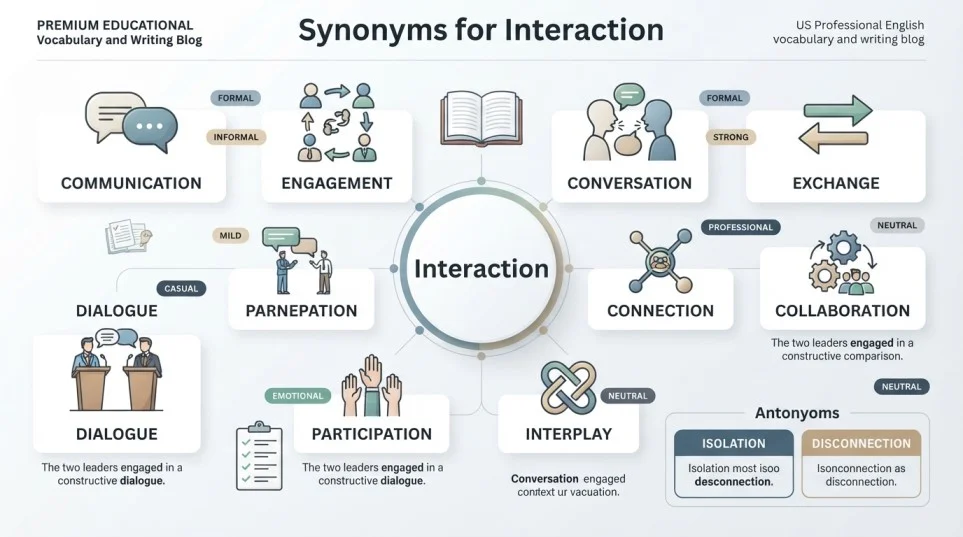
Interaction means communication, contact, or activity between two or more people, groups, systems, or things. Depending on context, useful synonyms include communication, engagement, exchange, dialogue, participation, contact, conversation, collaboration, connection, and interplay.
Meaning, Tone and Context
Simple Definition
Interaction refers to the way people, groups, objects, or systems communicate, respond, or affect one another.
For example, a conversation between coworkers is an interaction. A customer speaking with a representative is also an interaction.
The word can describe a single event or an ongoing pattern of communication.
Part of Speech
“Interaction” is a noun.
Related forms include “interact,” which is the verb, and “interactive,” which is an adjective.
For example:
“Students interact with one another during group activities.”
“The course uses interactive exercises.”
Tone
Interaction is usually neutral. It does not automatically express a positive or negative feeling.
The surrounding words create the tone. “Positive interaction” sounds favorable, while “limited interaction” suggests reduced communication or contact.
Formality Level
Interaction is neutral to moderately formal. It works well in academic writing, business communication, reports, workplace documents, and everyday speech.
In casual conversation, words such as “conversation,” “contact,” or “talk” may sound more natural depending on the sentence.
Common Use Cases
Interaction commonly describes:
- Communication between people
- Customer and business contact
- Classroom participation
- Workplace communication
- Social relationships
- Online engagement
- Collaboration between groups
- Communication between computer systems
- Exchanges between organizations
- The way different factors affect one another
Important Word Forms
| Word Form | Meaning | Example |
|---|---|---|
| Interaction | Communication or mutual activity | The interaction was productive. |
| Interact | To communicate or respond to another person or thing | Employees interact with customers daily. |
| Interactive | Designed to involve active participation | The workshop includes interactive activities. |
When and How to Use “Interaction”
“Interaction” works best when you want to describe communication or mutual activity without specifying exactly what happened.
1. Professional
“The manager encouraged more interaction between the marketing and sales teams.”
Here, interaction describes communication and cooperation between two workplace groups.
2. Personal
“Our regular interaction helped us become better friends.”
The word describes ongoing social contact.
3. Academic
“Classroom interaction can encourage students to share different perspectives.”
This use is appropriate in essays, educational reports, and research based discussions.
4. Emotional
“Her positive interaction with the children created a welcoming atmosphere.”
The word remains neutral, while “positive” provides the emotional direction.
5. Creative
“The brief interaction between the two strangers changed the course of the story.”
Here, interaction creates a sense of a meaningful encounter.
6. Social Media
“Meaningful interaction with your audience can strengthen a brand community.”
In digital contexts, interaction can include comments, replies, reactions, messages, and other forms of engagement.
7. Email
“We appreciate your interaction with our support team and welcome your feedback.”
The word sounds professional and appropriate for customer communication.
Another Word for “Interaction”
There is no single replacement that works perfectly in every sentence. The best alternative depends on the specific meaning.
Professional Writing
Use “engagement,” “communication,” “exchange,” or “collaboration” when describing workplace activity.
Academic Writing
Use “dialogue,” “discourse,” “exchange,” “participation,” or “interplay” when the context requires greater precision.
Casual Conversation
Use “conversation,” “contact,” “talk,” or “communication.”
Emotional Writing
Use “connection,” “rapport,” “encounter,” or “engagement” when the human feeling behind the interaction matters.
Creative Writing
Use “encounter,” “exchange,” “interplay,” “connection,” or “conversation.”
Resume or Workplace Use
Use “collaboration,” “engagement,” “communication,” “networking,” or “client contact” when describing a specific professional skill.
Social Media Captions
Use “engagement,” “connection,” “conversation,” or “community interaction.”
Stronger Meaning
For active and meaningful interaction, “engagement,” “collaboration,” “dialogue,” or “interplay” may provide more detail.
Softer Meaning
For simple or limited contact, “contact,” “communication,” “association,” or “encounter” may work better.
When Not to Use “Interaction”
“Interaction” can sometimes be too broad. If you know exactly what happened, a more precise word can improve the sentence.
Instead of:
“We had an interaction about the project.”
Try:
“We had a discussion about the project.”
“Discussion” tells the reader that people talked about a specific topic.
Instead of:
“The employee had positive interaction with customers.”
Try:
“The employee built strong rapport with customers.”
The second sentence communicates a stronger relationship rather than simple contact.
Avoid using “interaction” when you actually mean participation.
Instead of:
“Her interaction in the workshop was valuable.”
Try:
“Her participation in the workshop was valuable.”
The second sentence clearly shows that she took part in the activity.
Words Commonly Confused With “Interaction”
Interaction vs. Communication
Communication focuses on sending or receiving information. Interaction is broader and can include communication plus responses, behavior, or mutual influence.
Interaction vs. Engagement
Engagement usually suggests active involvement or attention. Interaction can be simple contact without strong involvement.
Interaction vs. Conversation
A conversation is a specific form of verbal communication. Interaction can include conversations, gestures, digital responses, teamwork, and system activity.
Interaction vs. Participation
Participation means taking part in an activity. Interaction emphasizes communication or mutual response.
Interaction vs. Collaboration
Collaboration means working together toward a shared goal. Interaction does not necessarily involve cooperation or a common objective.
Interaction vs. Connection
Connection emphasizes a relationship or link. Interaction describes the activity or contact occurring between people, groups, or systems.
Best Synonym by Context for “Interaction”
| Context | Best Synonym | Why It Works | Example |
|---|---|---|---|
| Formal writing | Communication | Clear and professional | Effective communication improves teamwork. |
| Academic writing | Discourse | Fits structured intellectual discussion | Academic discourse encourages critical thinking. |
| Professional use | Engagement | Suggests active involvement | Customer engagement increased this quarter. |
| Business | Exchange | Highlights two way communication | The meeting encouraged an exchange of ideas. |
| Resume | Collaboration | Shows teamwork toward a goal | Led collaboration between five departments. |
| Casual conversation | Conversation | Sounds natural and specific | We had a great conversation yesterday. |
| Creative writing | Encounter | Adds a sense of a meaningful meeting | Their unexpected encounter changed everything. |
| Emotional tone | Connection | Emphasizes a human relationship | The experience created a lasting connection. |
| Strong intensity | Engagement | Suggests active involvement | The campaign generated strong audience engagement. |
| Mild or moderate tone | Contact | Describes simple communication | I have had limited contact with the client. |
| Social media | Engagement | Commonly describes audience responses | The post received strong audience engagement. |
| Teamwork | Collaboration | Shows people working together | Collaboration improved the final result. |
| Discussion | Dialogue | Emphasizes two way exchange | The event opened a dialogue about education. |
| Multiple factors | Interplay | Shows mutual influence | The study examines the interplay of culture and technology. |
| US and UK usage | Interaction | Common and broadly understood | The study examines student interaction in class. |
Which Synonym Should You Choose?
Choose the word that describes the exact type of interaction rather than simply replacing the original word.
- Use communication when information is being exchanged.
- Use conversation when people are talking informally or directly.
- Use engagement when someone is actively involved or responding.
- Use collaboration when people work together toward a shared result.
- Use dialogue when the exchange involves ideas, viewpoints, or serious discussion.
- Use connection when the relationship between people is important.
- Use participation when the main idea is taking part in an activity.
- Use encounter when describing a meeting or brief experience with someone.
- Use interplay when two or more forces, ideas, or factors influence each other.
Real Life Examples of “Interaction” in Sentences
School
“Classroom interaction gives students opportunities to ask questions and exchange ideas.”
Workplace
“Regular interaction between departments can reduce communication problems.”
Writing
“The author uses dialogue to create natural interaction between the characters.”
Conversation
“I enjoyed my interaction with everyone at the event.”
Social Media
“Meaningful interaction with followers can help build an active online community.”
Resume
“Managed daily customer interaction while maintaining a professional service experience.”
“Thank you for your interaction with our customer service team.”
Storytelling
“Their brief interaction at the station became the beginning of an unexpected friendship.”
25 Synonyms for “Interaction”
| Synonym | Simple Meaning | Best Used For | Example Sentence |
|---|---|---|---|
| Communication | Exchange of information | General and professional use | Clear communication helps teams avoid confusion. |
| Contact | Direct connection with someone | Business and personal situations | Please maintain regular contact with the client. |
| Engagement | Active involvement or attention | Business, education, and social media | The new activity improved student engagement. |
| Exchange | Two way sharing of ideas or information | Formal and professional writing | The conference encouraged an exchange of ideas. |
| Dialogue | Conversation involving ideas or viewpoints | Academic, social, and formal contexts | The program created a dialogue between community leaders. |
| Conversation | Informal or direct verbal communication | Personal and casual situations | We had a friendly conversation after class. |
| Involvement | Active participation or connection | Personal, workplace, and community contexts | Her involvement in the project was valuable. |
| Participation | Taking part in an activity | Education, events, and organizations | Student participation increased during the workshop. |
| Connection | A relationship or link between people or things | Emotional and social contexts | The experience created a strong connection between the two groups. |
| Correspondence | Written communication between people | Formal letters and professional communication | Their correspondence continued for several months. |
| Collaboration | Working together toward a shared goal | Workplace and academic settings | Collaboration between the teams improved the project. |
| Discourse | Structured communication about ideas or subjects | Academic and formal writing | The paper contributes to current academic discourse. |
| Interchange | Mutual exchange between people or groups | Formal writing | Cultural interchange can broaden perspectives. |
| Consultation | Discussion for advice or professional input | Business and professional settings | The decision followed consultation with industry experts. |
| Cooperation | Working together willingly | Organizations and relationships | Cooperation between departments solved the problem. |
| Networking | Building professional relationships | Careers and business | Networking helped her meet several industry professionals. |
| Socializing | Spending time communicating socially | Casual and personal contexts | Socializing with coworkers helped build stronger relationships. |
| Association | A relationship or connection | Formal and general contexts | The organization has a long association with local schools. |
| Meeting | An occasion where people come together | Workplace and organizational settings | The meeting produced several useful ideas. |
| Discussion | Detailed talk about a subject | Academic, workplace, and everyday contexts | The discussion focused on possible solutions. |
| Negotiation | Discussion intended to reach an agreement | Business and conflict resolution | The negotiation resulted in a revised contract. |
| Rapport | A comfortable and trusting relationship | Professional and personal relationships | The counselor quickly developed rapport with the students. |
| Encounter | A meeting or experience with someone | Personal and creative writing | The unexpected encounter inspired a new story. |
| Interplay | Mutual influence between things or people | Academic and analytical writing | The research explores the interplay between language and culture. |
| Outreach | Organized effort to communicate with or help others | Community, nonprofit, and business settings | The organization expanded its community outreach program. |
Synonym Groups and Usage Differences
Professional vs. Personal Synonyms
Professional writing often benefits from words such as communication, engagement, collaboration, consultation, and exchange.
Personal writing can sound more natural with conversation, connection, contact, socializing, or encounter.
For example, “customer engagement” fits a business report, while “friendly conversation” fits a personal story.
Formal vs. Conversational Synonyms
Formal writing can use discourse, interchange, consultation, communication, and dialogue.
Conversational writing usually sounds more natural with conversation, contact, talk, connection, or meeting.
The goal is not to choose the most sophisticated word. Choose the word that sounds natural for the audience.
Academic Synonyms
Academic writing often requires precision. Words such as discourse, dialogue, exchange, participation, and interplay can explain the exact type of interaction being discussed.
For example, “The study examines the interplay between language and identity” is more specific than “The study examines the interaction between language and identity.”
Professional and Business Synonyms
In business communication, engagement, communication, collaboration, consultation, networking, and exchange are especially useful.
For resumes, focus on the actual activity. “Managed client communication” is more informative than simply saying “managed client interaction.”
Creative or Literary Synonyms
Creative writing often benefits from encounter, connection, exchange, dialogue, conversation, and interplay.
These words can help readers understand whether a moment was brief, emotional, intellectual, dramatic, or relational.
Slang or Modern Synonyms
There is no single slang replacement for interaction that works in every situation.
Words such as “talk,” “chat,” or “hangout” may work in casual communication, but they should usually be avoided in academic papers, formal reports, and professional documents when a more precise word is available.
Strongest vs. Weaker Synonyms
There is no universal intensity ranking because each word describes a different aspect of interaction. A useful contextual scale is:
Mild contact → communication → conversation → exchange → engagement → collaboration
This is not a strict strength ranking. For example, collaboration can be highly active, while a conversation can be brief or deeply meaningful.
Emotional vs. Neutral Synonyms
Neutral words include communication, contact, exchange, discussion, and interaction.
More relational words include connection and rapport.
Words such as encounter can add narrative or emotional significance, especially in creative writing.
Antonyms of “Interaction”
The opposite of interaction depends on the intended meaning. The following words can function as contextual opposites rather than exact dictionary opposites.
| Antonym | Meaning | Example Sentence |
|---|---|---|
| Isolation | Separation from others | Prolonged isolation can reduce opportunities for communication. |
| Separation | State of being apart | The separation limited contact between the groups. |
| Detachment | Lack of involvement or connection | His emotional detachment made communication difficult. |
| Disengagement | Withdrawal from active involvement | Student disengagement affected classroom participation. |
| Withdrawal | Moving away from communication or participation | Her withdrawal reduced contact with the team. |
| Avoidance | Deliberately staying away from contact | Avoidance of discussion delayed the decision. |
| Seclusion | Being kept or staying apart from others | The period of seclusion limited social contact. |
| Solitude | Being alone | He enjoyed solitude after a busy week. |
| Silence | Absence of spoken communication | The room fell into silence after the announcement. |
| Noncommunication | Lack of communication | Noncommunication created confusion between the departments. |
| Disconnection | Lack of connection or contact | The technical problem caused a temporary disconnection. |
| Estrangement | Loss of a close relationship | Years of estrangement made reconciliation difficult. |
| Alienation | Feeling separated from a group or community | Social alienation can make people feel disconnected. |
| Inaction | Failure to act or respond | Inaction prevented the teams from addressing the issue. |
| Indifference | Lack of interest or concern | His indifference discouraged further discussion. |
Comparison: “Interaction” vs. Similar Words
Interaction vs. Communication
The main difference is scope. Communication specifically involves exchanging information, while interaction can include communication, behavior, responses, and mutual influence.
Neither word is automatically stronger. Communication is often more precise when information exchange is the focus.
“Communication between the teams improved.”
“Interaction between the teams increased.”
Interaction vs. Engagement
Engagement usually suggests active attention or involvement. Interaction can describe simple contact without suggesting strong involvement.
Engagement is often more active in professional and digital contexts.
“The campaign increased customer engagement.”
“The campaign encouraged customer interaction.”
Interaction vs. Conversation
Conversation is specifically a spoken or written exchange between people. Interaction has a broader meaning.
Conversation is more natural for everyday speech.
“We had a conversation about the trip.”
“Our interaction with the host was brief.”
Interaction vs. Participation
Participation means taking part in an activity. Interaction emphasizes communication or mutual response.
Participation is more precise when attendance or involvement in an activity is the main idea.
“Student participation increased.”
“Student interaction increased.”
Interaction vs. Collaboration
Collaboration means working together toward a shared objective. Interaction does not necessarily involve teamwork.
Collaboration is therefore more specific when people jointly produce something.
“The teams collaborated on the report.”
“The teams interacted during the meeting.”
Interaction vs. Connection
Connection emphasizes a link or relationship, often with emotional meaning.
Interaction focuses more on the activity occurring between people or things.
“The conversation created a strong connection.”
“The conversation was a meaningful interaction.”
Common Phrases and Expressions with “Interaction”
1. Social Interaction
Meaning: Communication or activity between people in a social setting.
Example sentence: “Regular social interaction can help people develop stronger relationships.”
2. Human Interaction
Meaning: Communication or mutual activity involving people.
Example sentence: “Technology has changed the way people experience human interaction.”
3. Customer Interaction
Meaning: Communication between a customer and a business or representative.
Example sentence: “Every customer interaction should be handled professionally.”
4. Positive Interaction
Meaning: Communication or activity that produces a favorable experience.
Example sentence: “The teacher encouraged positive interaction among students.”
5. Meaningful Interaction
Meaning: Communication that has value, significance, or emotional impact.
Example sentence: “The event gave participants an opportunity for meaningful interaction.”
6. Face to Face Interaction
Meaning: Direct communication between people who are physically together.
Example sentence: “Face to face interaction can make difficult conversations easier.”
7. Online Interaction
Meaning: Communication or activity that occurs through digital platforms.
Example sentence: “Online interaction has become an important part of modern education.”
8. Social Media Interaction
Meaning: Responses and communication between users and audiences on social platforms.
Example sentence: “The brand tracks social media interaction to understand audience interests.”
Common Mistakes to Avoid
1. Using “Interaction” When a More Precise Word Is Better
“Interaction” is broad. If you mean discussion, collaboration, participation, or negotiation, use that specific word.
2. Confusing Interaction With Communication
Communication focuses on information exchange. Interaction can include broader mutual activity.
3. Using a Casual Synonym in Formal Writing
Words such as “chat” or “hangout” may sound inappropriate in a research paper or formal business report.
4. Using an Overly Dramatic Synonym
Do not call a simple meeting an “encounter” if the word creates unnecessary drama or literary emphasis.
5. Repeating the Same Word Too Often
If “interaction” appears several times in nearby sentences, replace some instances with accurate alternatives such as communication, engagement, exchange, or conversation.
6. Choosing the Wrong Emotional Tone
“Connection” can suggest a relationship, while “contact” can sound more neutral. Choose according to the feeling you want to communicate.
7. Using Slang in Academic or Professional Writing
Casual words can make formal writing sound less polished. Use precise, audience appropriate vocabulary instead.
FAQs
What is the best synonym for “interaction”?
The best synonym depends on context. Communication works broadly, while engagement, conversation, exchange, collaboration, or connection may be better for specific situations.
What is a formal synonym for “interaction”?
Formal alternatives include communication, discourse, interchange, consultation, exchange, and dialogue. The right choice depends on whether you mean discussion, contact, or mutual activity.
What is an informal synonym for “interaction”?
Conversation, chat, contact, talk, and socializing can work in informal contexts. “Conversation” is usually the safest natural alternative for everyday communication.
What is another word for “interaction” in professional writing?
Professional alternatives include communication, engagement, collaboration, exchange, consultation, networking, and client contact, depending on the activity being described.
What is the difference between “interaction” and “communication”?
Communication focuses on exchanging information, while interaction is broader and can include communication, responses, behavior, participation, and mutual influence.
What is the opposite of “interaction”?
Contextual opposites include isolation, separation, withdrawal, disengagement, silence, disconnection, avoidance, and noncommunication. The appropriate opposite depends on the intended meaning.
Conclusion
Interaction describes communication, contact, response, or mutual activity between people, groups, systems, or other entities. It is a useful neutral word, but it can sometimes be too broad when a more precise term is available.
Professional writing, consider communication, engagement, collaboration, or exchange. For casual situations, conversation or contact may sound more natural. emotional writing, connection or rapport can add relational meaning. Academic writing may benefit from dialogue, discourse, or interplay.
The most useful vocabulary habit is simple: do not replace a word just to sound different. Replace it when the alternative communicates your exact meaning more clearly.
For published content, definitions and subtle distinctions should be verified with trusted dictionaries such as Cambridge, Oxford, Merriam Webster, Collins, or Britannica.
Discover More Post:
- 25+ Synonyms for Proficient | Meanings, Examples, and Best …
- 25+ Synonyms for Depression | Meanings, Examples, and …
- 25+ Synonyms for Marginalized | Meanings, Examples, and Best …